
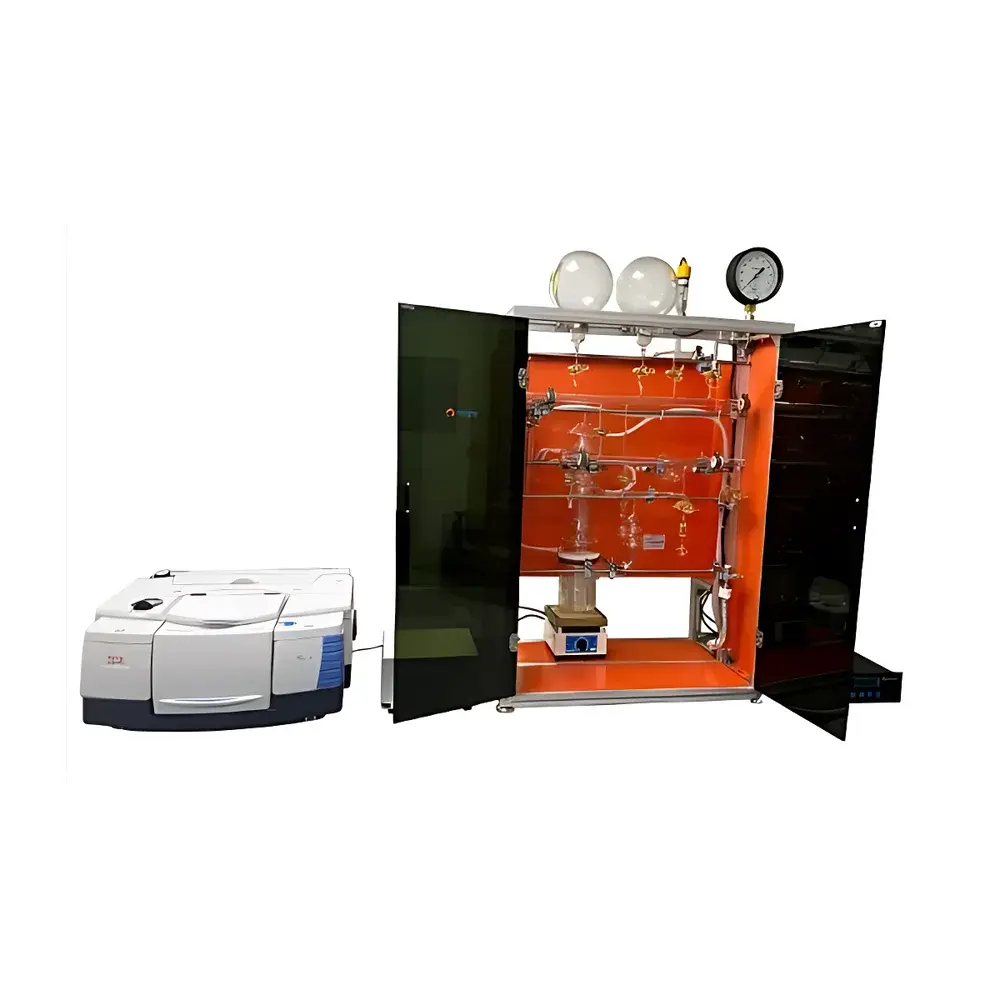
Cilabs In-Situ FTIR Characterization System with High-Vacuum Chamber and Transmission Quartz Cell
| Brand | Cilabs |
|---|---|
| Origin | Beijing, China |
| Manufacturer Type | OEM Manufacturer |
| Product Origin | Domestic (China) |
| Model | In-Situ FTIR Characterization System with High-Vacuum Chamber and Transmission Quartz Cell |
| Pricing | Upon Request |
Overview
The Cilabs In-Situ FTIR Characterization System with High-Vacuum Chamber and Transmission Quartz Cell is an engineered platform for real-time, surface-sensitive infrared spectroscopic analysis of heterogeneous catalysts under controlled thermal, gaseous, and vacuum environments. It integrates a high-vacuum glass manifold—comprising a two-stage pumping system (mechanical pump + four-stage glass diffusion pump)—with a temperature-programmable, transmission-mode quartz IR cell compatible with commercial Fourier-transform infrared (FTIR) spectrometers (e.g., Bruker VERTEX, Thermo Nicolet iS50). The system operates on the principle of in-situ and operando FTIR spectroscopy: by maintaining sample integrity across sequential pretreatment (calcination, reduction/oxidation), adsorption/desorption of probe molecules (e.g., CO, NH₃, pyridine, NO), and dynamic reaction monitoring, it enables direct correlation between surface species evolution and catalytic function. Core measurement capabilities include quantification of Brønsted vs. Lewis acid site distribution, metal dispersion via CO chemisorption band analysis, surface hydroxyl speciation, and transient intermediate identification during catalytic turnover—all under vacuum conditions down to 10⁻³ Pa.
Key Features
- High-vacuum capability: Achieves base pressure ≤10⁻³ Pa using a low-noise mechanical pump coupled with a borosilicate glass four-stage diffusion pump and liquid nitrogen cold trap.
- Optimized gas handling: All valves are borosilicate glass UHV-compatible stopcocks, ensuring zero hydrocarbon outgassing and full optical visibility for alignment and leak diagnostics.
- Modular IR cell: Quartz body with integrated heating (up to 450 °C, programmable ramping), thermocouple feedback, gas inlets/outlets, and dual CaF₂ windows (transmission mode, 4000–1000 cm⁻¹ spectral range).
- Probe molecule compatibility: Supports acidic (NH₃, pyridine) and basic (CO, NO) adsorbates; inert high-borosilicate construction prevents cross-contamination during multi-step adsorption sequences.
- Flexible integration: IR cell can be inserted or withdrawn from the FTIR beam path without breaking vacuum; optional extension tubing enables remote positioning for synchrotron or benchtop configurations.
- Customizable optics: Standard CaF₂ windows; optional substitution with KBr, CsI, BaF₂, or polyethylene for extended spectral coverage (down to 250 cm⁻¹) based on application requirements.
- Maintenance-ready design: Bellows and O-rings follow ISO-KF standards; all glass components are replaceable without specialized tools or system bake-out.
Sample Compatibility & Compliance
The system accommodates powdered catalysts (e.g., Pt/Al₂O₃, H-ZSM-5, CeO₂-based oxides), supported metals, zeolites, and metal–organic frameworks (MOFs) in self-supporting wafer form (typically 10–15 mg, 13 mm diameter). Sample loading occurs under ambient conditions; subsequent evacuation and thermal treatment occur within the sealed quartz cell. All wetted materials—including valves, tubing, and storage bulbs—are borosilicate glass or Kovar-sealed, eliminating metallic contamination and ensuring chemical inertness toward halogenated, sulfur-containing, or amine-based probe molecules. The system conforms to ASTM D7269-22 (standard practice for FTIR characterization of solid catalysts) and supports GLP-compliant data acquisition when paired with validated FTIR software. Vacuum integrity meets ISO 2859-1 sampling criteria for leak rate verification (<1×10⁻⁹ mbar·L/s helium).
Software & Data Management
No proprietary control software is embedded; instead, the system interfaces directly with industry-standard FTIR acquisition platforms (OPUS, OMNIC, GRAMS/AI) via external hardware triggers (TTL signals) for synchronized temperature ramping, gas dosing, and spectral collection. All vacuum parameters (low-range Pirani gauge, high-range Bayard–Alpert ionization gauge) output analog voltage signals (0–10 V) compatible with data loggers or LabVIEW-based automation. Audit trails—including timestamped valve actuation, temperature setpoints, and pressure readings—are exportable as CSV files. For regulatory environments (e.g., pharmaceutical catalyst development), the system supports 21 CFR Part 11 compliance when integrated with validated electronic lab notebook (ELN) systems that enforce user authentication, electronic signatures, and immutable data archiving.
Applications
- Catalyst surface acidity profiling: Differentiation and quantification of Brønsted (e.g., OH⁺ groups at ~1540 cm⁻¹ with pyridine) and Lewis acid sites (e.g., Al³⁺ coordination at ~1450 cm⁻¹) in zeolites and mixed oxides.
- Adsorption geometry and electronic effects: Monitoring CO vibrational shifts (2000–2100 cm⁻¹) to assess d-π back-donation changes induced by bimetallic interactions (e.g., Pd–Ag/SiO₂) or support effects (e.g., TiO₂ vs. SiO₂).
- Surface hydroxyl dynamics: Tracking bridging vs. terminal OH stretching modes (3700–3500 cm⁻¹) during dehydration or rehydration cycles on γ-Al₂O₃ or MgO.
- Reaction intermediate detection: Capturing transient carbonyl, formate, or methoxy species during low-temperature CO₂ hydrogenation or methanol steam reforming.
- Oxide surface oxygen speciation: Using isotopic ¹⁸O exchange coupled with time-resolved FTIR to resolve lattice oxygen mobility in perovskite or spinel catalysts.
FAQ
Can this system be used with synchrotron IR beamlines?
Yes—the quartz cell and CaF₂ windows transmit >85% across the mid-IR range, and the modular design allows coupling to beamline endstations via differential pumping stages. Custom flange adapters (CF-63 or DN40) are available upon request.
What is the maximum heating rate and thermal stability tolerance?
The quartz cell supports linear ramp rates up to 20 °C/min and maintains ±1 °C stability at 450 °C for ≥12 h under dynamic gas flow (10–50 mL/min). Thermal gradients across the sample bed are <5 °C (verified by embedded thermocouple mapping).
Is residual water vapor interference mitigated during high-vacuum measurements?
Yes—the liquid nitrogen cold trap (−196 °C) condenses H₂O, CO₂, and hydrocarbons; combined with the diffusion pump’s high compression ratio for light gases, residual H₂O partial pressure remains below 10⁻⁶ mbar during spectroscopic acquisition.
How is gas purity ensured before introduction to the sample chamber?
Gases pass through a dedicated purification train: stainless-steel filters (0.1 µm), heated copper oxide scrubbers (for O₂ removal), and molecular sieve traps (for H₂O/hydrocarbons); purity is verified via residual gas analysis (RGA) prior to each experiment.
Does the system support automated sequential dosing of multiple probe molecules?
Not natively—but third-party solenoid valve manifolds (e.g., VICI Valco) with TTL-triggered sequencing can be integrated into the gas inlet line, enabling unattended multi-step adsorption protocols under software-defined pressure and dwell time control.



