
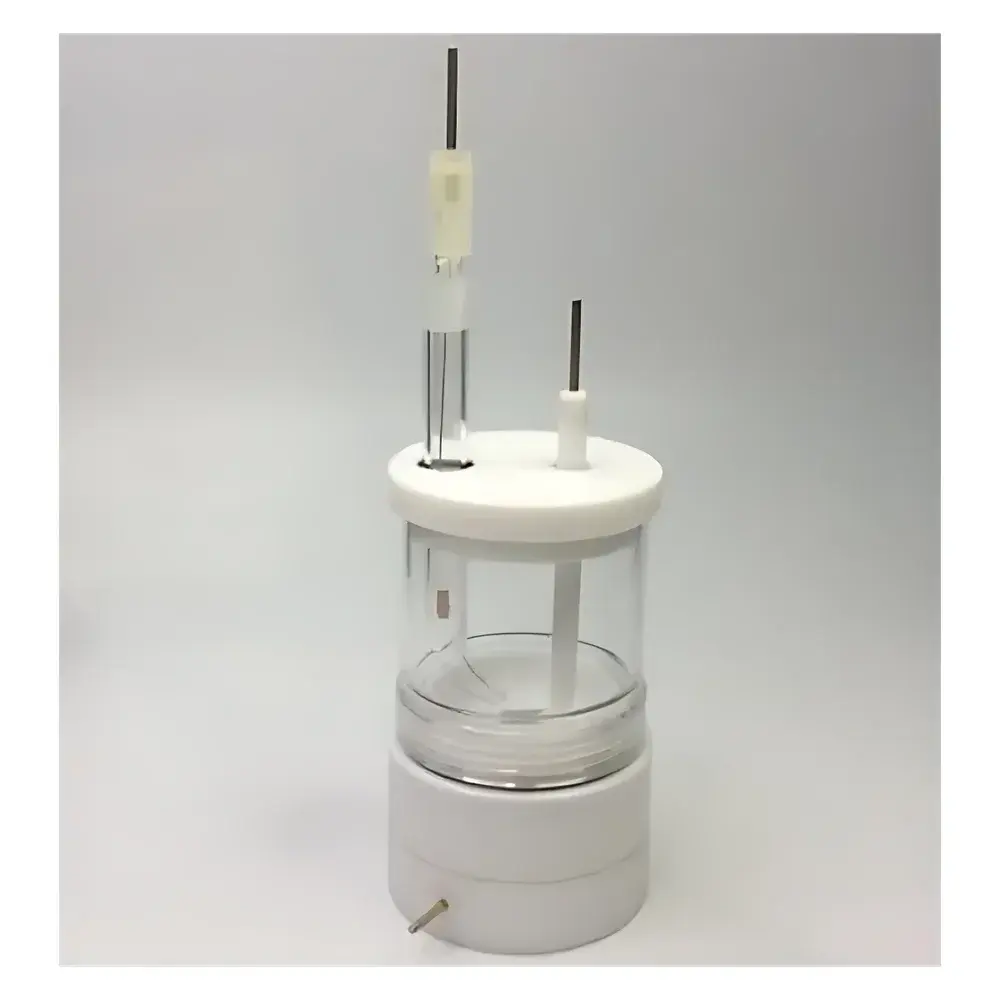
Multifunctional Electrochemical Cell
| Brand | CEA (Zhongjiao Jinyuan) |
|---|---|
| Origin | Beijing, China |
| Manufacturer Type | OEM Producer |
| Model | Multifunctional Electrochemical Cell |
| Volume | Customizable |
| Electrode Configuration | Removable planar working electrode |
| Cell Cap Material | PTFE |
| Cap Ports | Dual standard ports (for reference and counter electrodes) |
Overview
The CEA Multifunctional Electrochemical Cell is an engineered platform designed for controlled, reproducible electrochemical investigations in research and development laboratories. Based on classical three-electrode configuration principles—comprising a working electrode, reference electrode, and counter electrode—the cell supports a wide range of electrochemical techniques including cyclic voltammetry (CV), chronoamperometry (CA), electrochemical impedance spectroscopy (EIS), and potentiostatic/galvanostatic corrosion testing. Its modular architecture enables seamless integration with commercial potentiostats and scanning electron microscopes (SEM), making it especially suitable for ex situ or in situ electrochemical–microstructural correlation studies. The cell operates under ambient atmospheric conditions by default but can be adapted for inert-atmosphere or sealed-gas environments via optional gas-tight fittings.
Key Features
- Removable planar working electrode assembly—facilitates rapid electrode exchange, surface cleaning, and post-experiment characterization (e.g., SEM, XRD, or XPS analysis without disassembly of the full cell).
- Chemically inert PTFE cell cap with precision-machined dual 6 mm diameter ports—standardized for compatibility with common Luggin capillaries, Ag/AgCl reference electrodes, and Pt wire or graphite counter electrodes.
- Optional gas management configuration: integrated gas inlet and outlet tubing ports allow for purging with N₂, Ar, or reactive gases (e.g., O₂, H₂, CO₂) to maintain defined electrochemical environments during long-term polarization or photoelectrochemical experiments.
- Customizable internal volume—from 5 mL to 100 mL—tailored to sample mass, electrolyte volume requirements, and experimental time constants (e.g., low-volume cells minimize ohmic drop; larger volumes support extended stability tests).
- Robust mechanical design with PTFE body and chemically resistant sealing—ensures long-term compatibility with aqueous, non-aqueous, and highly corrosive electrolytes (e.g., concentrated H₂SO₄, LiPF₆ in carbonate solvents, molten salts).
Sample Compatibility & Compliance
The cell accommodates working electrodes fabricated from metals (Pt, Au, Ni, stainless steel), carbon-based materials (glassy carbon, carbon paper, FTO/ITO-coated glass), conductive polymers, and magnetic substrates (e.g., NiFe alloys, CoPt thin films). Its open geometry and removable electrode holder simplify mounting of fragile or irregularly shaped samples—including freestanding nanowire arrays or photocatalyst-coated membranes. While not certified to a specific international standard, the cell’s construction and dimensional consistency align with common laboratory practices referenced in ASTM G59 (Standard Test Method for Conducting Potentiodynamic Polarization Resistance Measurements), ASTM G102 (Calculation of Corrosion Rates), and ISO 17463 (Electrochemical noise measurement for localized corrosion assessment). It supports GLP-compliant documentation when used with validated potentiostat systems featuring audit-trail-enabled software.
Software & Data Management
The cell itself is hardware-only and does not include embedded firmware or proprietary software. It is fully compatible with industry-standard electrochemical workstations—including those from BioLogic, Metrohm Autolab, Gamry Instruments, and Pine Research—enabling direct acquisition, real-time visualization, and post-processing using their native platforms (EC-Lab®, NOVA, Framework, AfterMath). All acquired data (current vs. time/potential, impedance spectra, derivative plots) are exportable in ASCII, CSV, or binary formats for integration into MATLAB, Python (with libraries such as PyEIS or ECpy), or statistical analysis suites. When paired with compliant potentiostats, full traceability—including operator ID, timestamped method parameters, and instrument calibration logs—can be maintained per FDA 21 CFR Part 11 requirements.
Applications
- Pre-SEM electrochemical conditioning: controlled oxide layer formation, selective etching, or cathodic reduction prior to high-resolution imaging.
- Corrosion science: potentiodynamic polarization, electrochemical noise monitoring, and zero-resistance ammeter (ZRA) coupling for galvanic corrosion studies.
- Photoelectrochemistry: integration with solar simulators and quartz windows for incident photon-to-current efficiency (IPCE) and transient photocurrent measurements.
- Magnetic electrode studies: investigation of magnetoelectrochemical effects under applied fields using ferromagnetic working electrodes.
- Electrocatalyst screening: rapid evaluation of HER, OER, ORR, and CO₂RR activity across diverse catalyst formulations and electrolyte pH ranges.
FAQ
Can this cell be used under inert atmosphere?
Yes—by installing optional gas-tight PTFE caps with Swagelok-compatible fittings, the cell can be purged and sealed for experiments requiring O₂- or moisture-free environments.
Is the working electrode holder compatible with rotating disk electrode (RDE) configurations?
No—the standard design supports static planar electrodes only; however, custom RDE-compatible variants can be engineered upon request.
What is the maximum operating temperature?
The PTFE construction limits continuous use to ≤130 °C; for elevated-temperature studies, alternative fluoropolymer or quartz-bodied versions are available.
Do you provide electrode polishing kits or reference electrode refills?
CEA supplies complementary accessories—including reversible hydrogen electrode (RHE) assemblies, saturated calomel electrodes (SCE), and alumina polishing slurries—upon separate order.
Is technical documentation available in English?
Yes—full dimensional drawings, material safety data (MSDS), and application notes are provided in English upon request and are compatible with institutional procurement workflows.



