
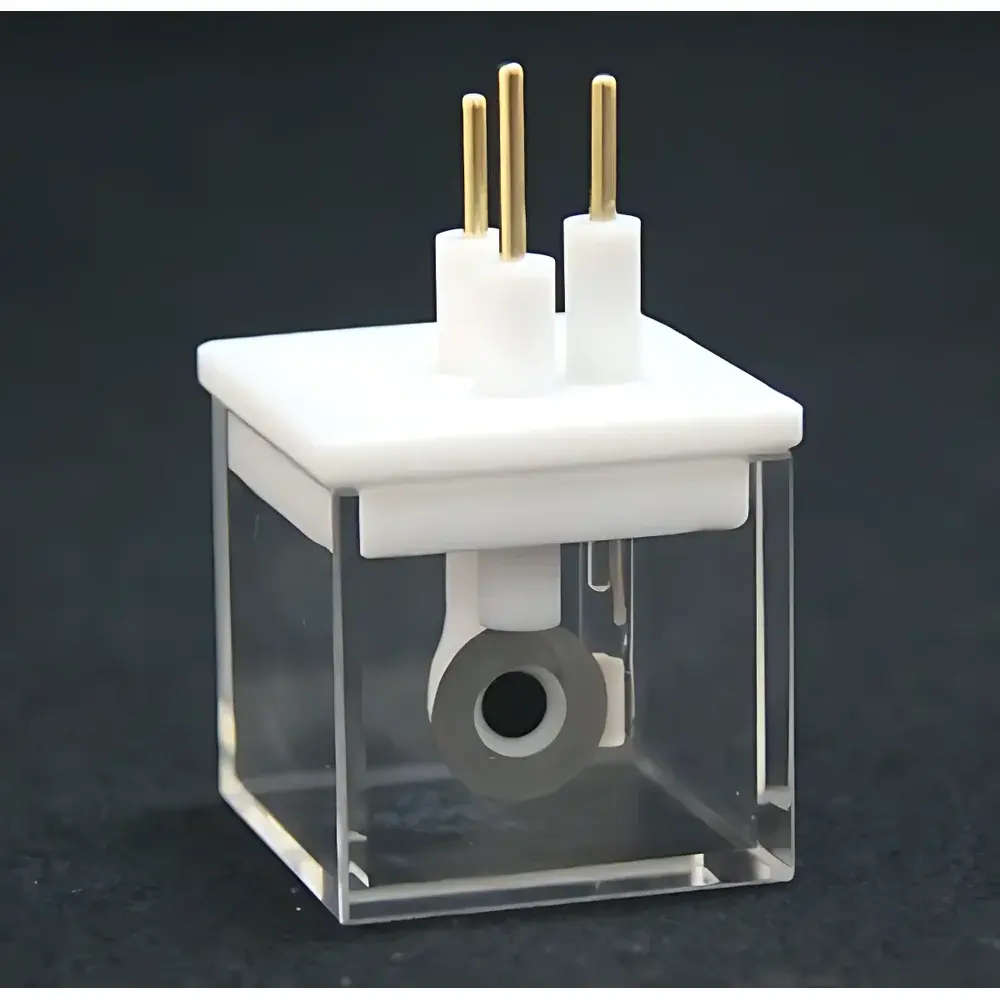
Zhongjiaojinyuan PECK20 Quartz Square Photoelectrochemical Cell
| Brand | Zhongjiaojinyuan |
|---|---|
| Origin | Beijing, China |
| Manufacturer Type | OEM/ODM Manufacturer |
| Country of Origin | China |
| Model | PECK20 |
| Component Category | Optical Component |
| Volume | 45 mL |
| Dimensions (L×W×H) | 30 mm × 30 mm × 50 mm |
| Body Material | Fused Quartz |
| Optical Aperture | Four-side transparent |
| Cap Material | PTFE |
| Standard Electrode Set | Pt wire counter electrode, Ag/AgCl reference electrode, Pt electrode clamp for working electrode |
| Electrode Compatibility | Modular — user-configurable electrode assembly |
Overview
The Zhongjiaojinyuan PECK20 Quartz Square Photoelectrochemical Cell is an engineered optical-electrochemical interface designed for controlled illumination and precise electrochemical measurement under standardized laboratory conditions. Built on the principles of photoelectrochemistry—where incident photons generate charge carriers at semiconductor/electrolyte interfaces—the PECK20 enables quantitative investigation of photocurrent response, incident photon-to-current efficiency (IPCE), flat-band potential determination, and interfacial charge transfer kinetics. Its square geometry and four-side optical access support collimated or focused beam illumination from multiple angles—including normal incidence, oblique irradiation, and side-illumination configurations—making it compatible with UV-Vis-NIR light sources, monochromators, and laser systems. The cell’s fused quartz construction ensures high transmission (>90%) across 180–2500 nm, critical for broadband spectral studies and avoiding UV absorption artifacts common in borosilicate or polymer-based cells.
Key Features
- Fused quartz body fabricated via high-purity melting process, minimizing trace metal contamination and autofluorescence—essential for low-noise photocurrent detection and long-term stability in aqueous and non-aqueous electrolytes.
- Four-face optical transparency enables flexible optical path design: top-down, side-on, or dual-beam illumination setups for anisotropic photoelectrode characterization.
- Chemically inert PTFE cap provides vacuum-tight sealing while resisting oxidation, halogenated solvents, and strong acids/bases—supporting operation in aggressive electrolytes (e.g., 1 M H2SO4, 0.1 M NaOH, LiPF6-based organic electrolytes).
- Modular three-electrode configuration: includes a Pt wire counter electrode, a reversible Ag/AgCl (3 M KCl) reference electrode with fritted junction, and a precision-machined Pt electrode clamp accommodating rod-, foil-, or film-type working electrodes (diameter range: 1–5 mm; thickness up to 1 mm).
- Compact footprint (30 × 30 × 50 mm) and 45 mL internal volume optimize reagent economy and minimize solution resistance—critical for low-impedance electrochemical impedance spectroscopy (EIS) measurements below 100 mΩ cm².
Sample Compatibility & Compliance
The PECK20 cell supports heterogeneous photoelectrodes including metal oxides (TiO2, WO3, BiVO4), chalcogenides (CdS, CuInGaSe2), perovskites (MAPbI3), and carbon-based catalysts deposited on conductive substrates (FTO, ITO, Ni foam). Its design conforms to ASTM E1021-22 (Standard Practice for Determining Quantum Yields of Photolytic Processes) and ISO 13773:2020 (Photocatalytic materials — Test method for photocatalytic activity). All wetted components meet USP Class VI biocompatibility requirements, and the cell is suitable for use in GLP-compliant laboratories when paired with audit-trail-capable potentiostats (e.g., BioLogic SP-300, Metrohm Autolab PGSTAT302N).
Software & Data Management
While the PECK20 itself is a passive optical-electrochemical interface, it integrates seamlessly with industry-standard electrochemical workstations and data acquisition platforms. When used with instruments supporting EC-Lab®, NOVA, or GPES software, users can synchronize light pulses (via TTL triggers) with chronoamperometry, linear sweep voltammetry, or Mott-Schottky analysis. All electrode connections utilize standard BNC and banana-jack interfaces, enabling direct integration into automated test benches. Raw current-time and potential-time datasets are exportable in ASCII (.txt), CSV, or binary formats compatible with MATLAB, Python (SciPy/Pandas), and OriginLab for kinetic modeling and statistical error propagation analysis.
Applications
- Photoelectrochemical water splitting efficiency evaluation under AM 1.5G illumination.
- Time-resolved photocurrent decay analysis for carrier lifetime estimation in nanostructured semiconductors.
- In situ UV-Vis absorption spectroelectrochemistry during photoanodic oxidation processes.
- Stability testing of photoelectrodes under continuous illumination and bias (e.g., 100-h operational durability per IEA Task 16 protocols).
- Multi-wavelength IPCE mapping for bandgap validation and defect-state identification.
FAQ
Is the PECK20 cell compatible with corrosive electrolytes such as hydrofluoric acid (HF)?
Yes—the fused quartz body and PTFE cap resist HF concentrations up to 5% v/v at room temperature. However, Ag/AgCl reference electrodes are not HF-compatible; users should substitute with reversible hydrogen electrode (RHE) assemblies or custom quasi-reference electrodes.
Can the cell be adapted for gas-phase photoelectrocatalysis?
With minor modifications—such as installing gas-tight O-rings and a septum inlet—the PECK20 supports headspace-controlled experiments (e.g., CO2 reduction in biphasic media). A dedicated gas-diffusion variant (PECK20-GD) is available upon request.
What is the maximum operating temperature and pressure?
The standard PECK20 is rated for ambient pressure and temperatures between −10 °C and +80 °C. For elevated-temperature applications (>80 °C), optional quartz-to-metal compression seals and high-temp PTFE variants are offered.
Are custom electrode geometries supported?
Yes—Zhongjiaojinyuan provides OEM electrode machining services, including microfabricated WE arrays, mesh counter electrodes, and integrated reference microjunctions, subject to minimum order quantities.
Does the cell include calibration documentation?
Each unit ships with a Certificate of Conformance (CoC) listing dimensional tolerances (±0.05 mm), quartz UV transmittance curve (200–800 nm), and leak-test verification at 0.5 bar positive pressure. NIST-traceable calibration of electrodes is available as an add-on service.




