
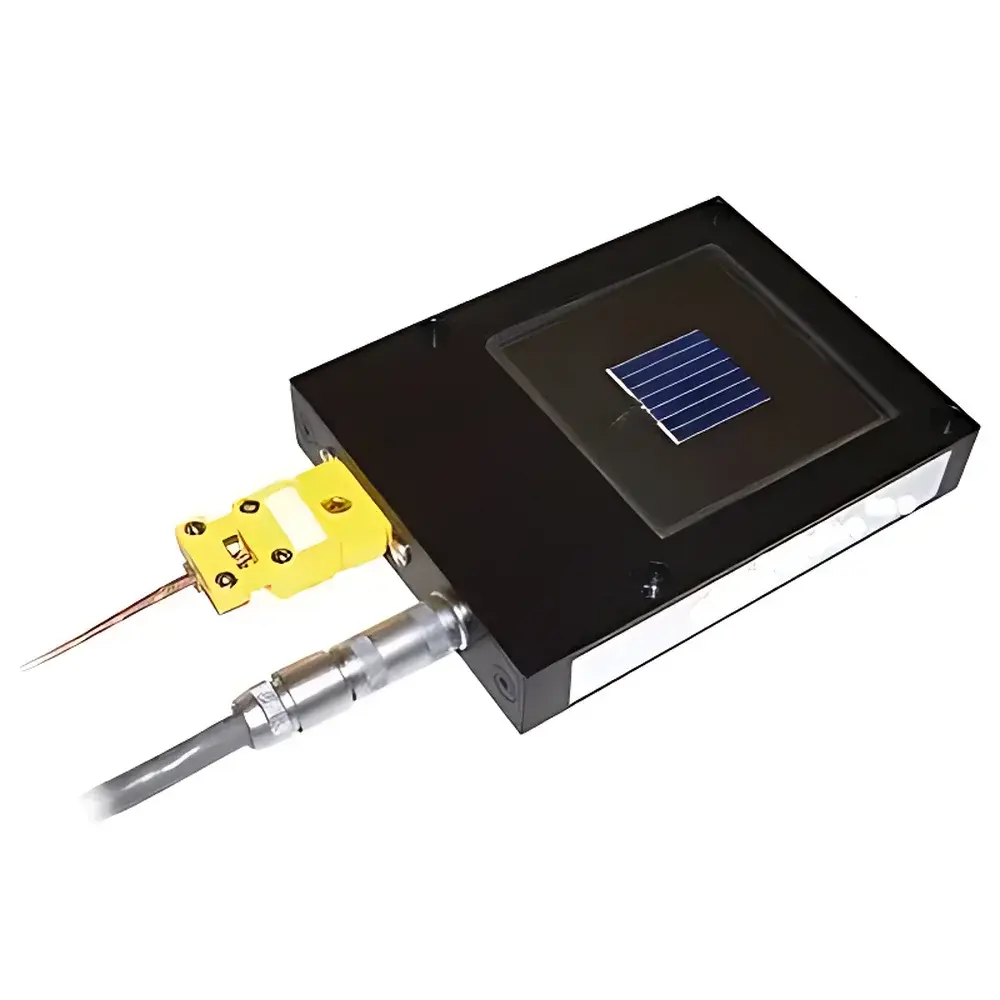
CNI Solar Reference Cell and Readout Meter (NREL-Calibrated, IEC 60904-2 Compliant)
| Brand | CNI (China Education Goldsource) |
|---|---|
| Origin | USA |
| Manufacturer Type | Original Equipment Manufacturer (OEM) |
| Import Status | Imported |
| Model | REF-SC-2×2-M |
| Calibration | NREL-traceable certificate included |
| Irradiance Range | 0–3.500 sun (1 sun = 1000 W/m², AM1.5G, 25 °C) |
| Irradiance Accuracy | ±0.1% at 1.0000 sun (23 °C), ±0.2% + 2 counts elsewhere |
| Temperature Range | 0–199.9 °C |
| Temp Accuracy | ±0.5 °C typical (24–26 °C), ±1.2 °C max (10–40 °C) |
| Analog Outputs | 1 V/sun (irradiance), 10 mV/°C (temperature) |
| Dimensions | 151 × 95 × 178 mm |
| Weight | 1.8 kg |
| Operating Environment | 10–40 °C, 0–90% RH non-condensing |
Overview
The CNI Solar Reference Cell and Readout Meter is a precision-calibrated photovoltaic reference standard engineered for traceable irradiance measurement and temperature monitoring in laboratory-grade solar simulation and I-V characterization environments. Built around a monocrystalline silicon photodiode with active area of 2 cm × 2 cm, the device operates on the fundamental principle of photovoltaic responsivity under standardized spectral irradiance conditions (IEC 60904-2, ASTM E927). Its calibration is directly traceable to the National Renewable Energy Laboratory (NREL), ensuring metrological integrity across photovoltaic R&D, production QA, and inter-laboratory comparison studies. The system delivers real-time, high-stability readings of incident solar irradiance in “sun” units—where 1 sun equals 1000 W/m² under AM1.5G spectrum at 25 °C cell temperature—enabling strict adherence to STC (Standard Test Conditions) and NOCT (Nominal Operating Cell Temperature) protocols. Unlike generic photodiodes, this reference cell integrates an embedded thermocouple conforming to IEC 60904-2 mechanical and thermal mounting requirements, allowing simultaneous, co-located irradiance and junction temperature measurement critical for accurate power conversion efficiency calculations.
Key Features
- NREL-certified calibration certificate included, with uncertainty budget and measurement date stamped per ISO/IEC 17025 practices
- Monocrystalline Si reference cell with defined spectral response matching IEC 60904-3 Class A requirements
- Dual-range autoranging readout meter with 0.0001 sun resolution (low range) and 0.001 sun resolution (high range)
- Simultaneous analog outputs via BNC connectors: 1 V/sun (irradiance) and 10 mV/°C (temperature), compatible with data acquisition systems and I-V curve tracers
- Thermocouple integrated per IEC 60904-2 Annex B—mounted in direct thermal contact with the cell backplane to minimize thermal lag
- Stable <1 second settling time and 3 Hz sampling rate, supporting dynamic irradiance profiling during flash-pulse or continuous-source testing
- Rugged aluminum housing with EMI-shielded electronics, rated for continuous operation in controlled lab environments (10–40 °C, non-condensing humidity)
Sample Compatibility & Compliance
This reference system is designed for use with silicon-based photovoltaic devices—including PERC, TOPCon, HJT, and thin-film cells—as well as multi-junction test structures requiring spectral mismatch correction. It is fully compliant with IEC 60904-2 (requirements for reference solar cells), IEC 60904-4 (procedures for calibration), and ASTM E1021 (standard test method for calibrating reference cells). The NREL-traceable calibration satisfies GLP and ISO 17025 documentation requirements for accredited PV testing laboratories. When used in conjunction with Class AAA solar simulators, it enables full compliance with IEC 61215 and IEC 61646 qualification testing sequences. No optical filters or external attenuators are required; the cell’s inherent linearity over 0–3.5 sun ensures fidelity across both low-intensity indoor testing and high-flux concentrator applications.
Software & Data Management
While the meter operates as a standalone hardware instrument, its analog outputs are fully compatible with third-party DAQ platforms (e.g., National Instruments, Keysight, Keithley) and custom Python/LabVIEW control scripts. All calibration metadata—including spectral responsivity curves, temperature coefficients, and uncertainty components—is provided in machine-readable PDF format on the NREL certificate. For laboratories operating under FDA 21 CFR Part 11 or ISO 13485 frameworks, the analog output architecture supports integration into validated electronic lab notebooks (ELNs) with audit-trail-capable acquisition software. Firmware updates are not applicable; calibration stability is maintained through passive component selection and hermetic sealing—no field recalibration is permitted per IEC 60904-4.
Applications
- Primary calibration of solar simulators prior to PV module or cell I-V testing
- Real-time irradiance normalization during light-soaking, MPPT tracking, or degradation studies (e.g., ISOS-L-1, ISOS-D-1)
- Temperature-compensated efficiency calculation in tandem cell characterization
- Reference standard in intercomparisons between national metrology institutes (NMIs) and commercial PV test labs
- Validation of spectral mismatch corrections in multi-junction cell testing
- Traceable irradiance monitoring in accelerated aging chambers and climate-controlled environmental test cells
FAQ
Is this reference cell suitable for measuring concentrated sunlight (CPV)?
Yes—its linear response up to 3.5 sun and thermal design support use in low-concentration (up to ~5X) CPV validation, provided cell temperature is actively monitored and stabilized.
Can the calibration certificate be renewed or re-issued?
NREL does not perform routine recalibration of fielded reference cells. Recertification requires return to an ISO/IEC 17025-accredited calibration lab with NREL-traceable transfer standards; CNI provides guidance but does not offer in-house recalibration services.
What is the expected lifetime under continuous exposure?
When operated within specified temperature/humidity limits and protected from UV-induced encapsulant yellowing (e.g., using quartz cover glass), the cell maintains calibration stability better than ±0.5% per year, consistent with IEC 60904-4 long-term drift recommendations.
Does the readout meter support RS-232 or USB communication?
No—this is an analog-output-only instrument. Digital interfacing must be achieved externally via DAQ hardware connected to the BNC terminals.
How is traceability to NREL documented?
Each unit ships with a NREL-issued certificate listing the calibration date, measurement uncertainty (k=2), reference standard ID, and direct chain of traceability to NREL’s primary reference cell bank, in accordance with ISO/IEC 17025 Clause 6.6.



