
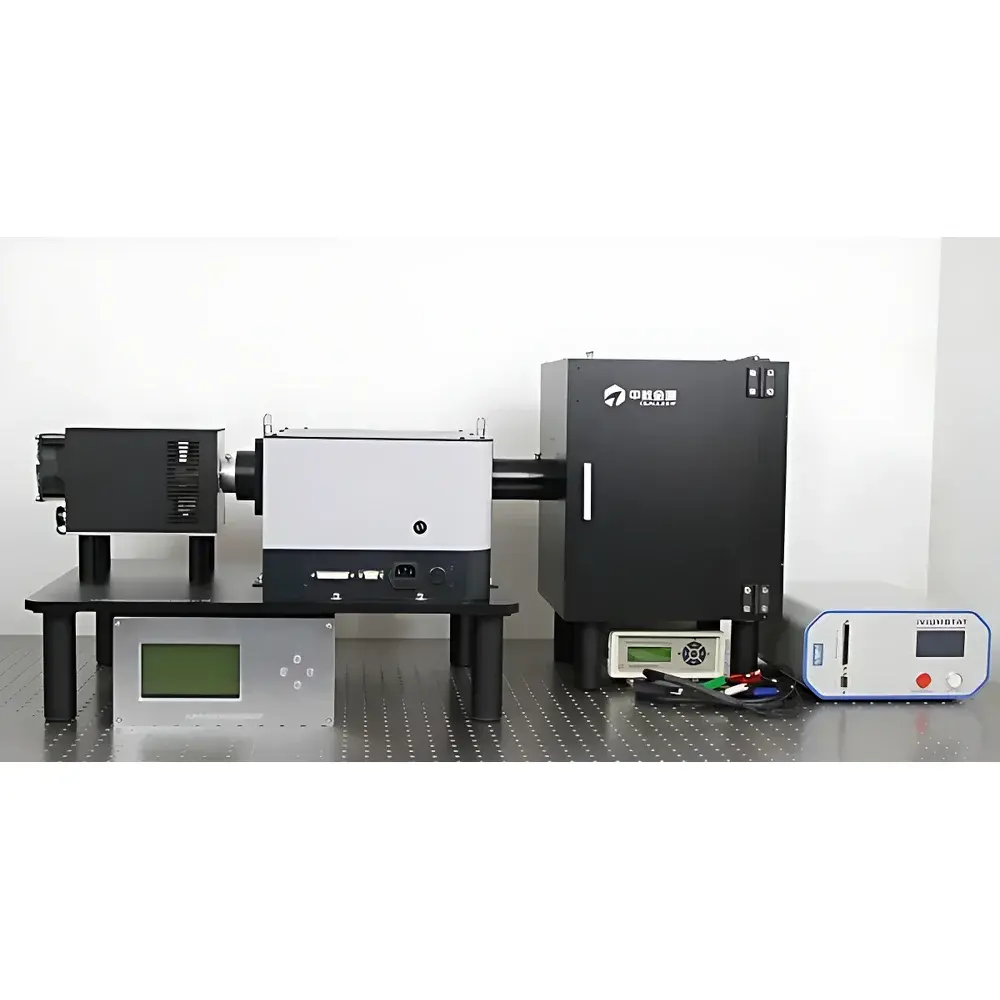
CEL-SLF Adjustable Monochromatic Light Source System
| Brand | CEL (Zhongjiao Jinyuan) |
|---|---|
| Origin | Beijing, China |
| Manufacturer Type | Direct Manufacturer |
| Product Category | Domestic |
| Model | CEL-SLF |
| Light Source Type | Xenon Lamp |
| Illumination Mode | External Irradiation |
| Output Power Density | ≥10.00 mW/cm² (up to >50 mW/cm²) |
| Spectral Bandwidth Tunability | 0.1–30 nm |
| Wavelength Stability | < ±0.5% (RMS over 8 h) |
| Optical Architecture | Asymmetric Horizontal Czerny-Turner with Aberration-Corrected Design |
| Grating Options | Dual- or Triple-Grating Configurable (e.g., CEL-IS151 / CEL-IS302) |
| Interface | USB 2.0 & RS232 |
| Shutter Timing Resolution | 0.1 ms |
| Nitrogen Purge Port | Yes |
| Mechanical Drive | Precision Worm Gear Mechanism |
| Slit Design | Symmetrical, Self-Protected Blade Edges |
| Optical Chamber Isolation | Fully Separated from Mechanical Drive Compartment |
| Housing | Integrated Cast-Alloy Monoblock Chassis |
Overview
The CEL-SLF Adjustable Monochromatic Light Source System is a research-grade optical instrumentation platform engineered for high-fidelity spectral selectivity and radiometric stability in photophysical, photoelectrochemical, and materials characterization laboratories. At its core, the system integrates a 300 W short-arc xenon lamp—emitting a continuous spectrum from 200 nm to 2500 nm—with a high-resolution scanning monochromator based on an asymmetric horizontal Czerny-Turner optical layout. This architecture incorporates coma-corrected optics and secondary dispersion suppression to minimize stray light and maximize spectral purity. The system operates on the principle of wavelength-selective diffraction: incident broadband radiation is collimated, dispersed by a rotating grating, and re-imaged through an exit slit, delivering tunable quasi-monochromatic output. Its design prioritizes metrological integrity—achieving long-term irradiance stability better than ±0.5% RMS—and mechanical rigidity via a one-piece cast-alloy monoblock housing, ensuring minimal thermal drift and vibration-induced misalignment during extended spectral scans.
Key Features
- High-stability 300 W xenon lamp with solar-spectrum-mimicking irradiance profile (200–2500 nm), enabling broadband compatibility with UV–Vis–NIR applications.
- Optimized optical path delivering peak irradiance up to >50 mW/cm² at the sample plane under focused configuration.
- Continuously adjustable spectral bandwidth from 0.1 nm to 30 nm, calibrated against NIST-traceable reference standards.
- Asymmetric Czerny-Turner monochromator with dual- or triple-grating capability (e.g., CEL-IS151 or CEL-IS302), supporting interchangeable gratings for resolution/sensitivity trade-off optimization.
- Integrated motorized filter wheel (IFW6, 6-position) with automatic indexing synchronized to wavelength scan; accommodates Ø18 mm × 2 mm filters for higher-order spectrum rejection (e.g., long-pass filtering below 185 nm or above 1600 nm).
- Precision worm-gear drive mechanism ensures wavelength reproducibility ≤ ±0.05 nm and angular repeatability < 0.002°, with acoustically damped operation suitable for low-noise measurement environments.
- Dedicated nitrogen purge port enables stable operation in deep-UV (185–220 nm) and near-IR (1400–1600 nm) regions where atmospheric absorption compromises spectral fidelity.
- Physically isolated optical and mechanical compartments prevent lubricant outgassing contamination and stray light ingress—critical for GLP-compliant photometric workflows.
- USB 2.0 and RS232 interfaces support full remote control of grating selection, slit width adjustment, filter positioning, and shutter actuation via vendor-provided SDK or third-party LabVIEW/Python APIs.
Sample Compatibility & Compliance
The CEL-SLF system is compatible with standard optical components including fiber-coupled detectors (SMA905), linear and area-array CCD/CMOS spectrometers, lock-in amplifiers, and electrochemical workstations (e.g., Ivium CompactStat.h10800, CHI660E). It supports integration into shielded dark chambers (e.g., DK25, 30 × 30 × 30 cm), custom photoelectrochemical cells (CEL-CPE50, QPE series), and multi-electrode configurations for IPCE, action spectrum, and transient photocurrent analysis. All optical interfaces conform to ISO 10110 surface quality standards; quartz and MgF₂ optics meet ASTM E430 spectral transmission specifications. The system’s firmware supports audit trail logging and user-access-level permissions—facilitating alignment with FDA 21 CFR Part 11 requirements when deployed in regulated R&D environments.
Software & Data Management
Control software provides intuitive graphical interface for wavelength sweep programming, dwell-time assignment, multi-step irradiation sequencing, and real-time power monitoring via optional CEL-NP2000 radiometer integration. Raw spectral data export is supported in CSV, ASCII, and HDF5 formats. Time-stamped metadata—including lamp hours, grating ID, filter position, slit width, ambient temperature, and nitrogen flow status—is embedded in each acquisition file. Batch processing scripts enable automated calibration curve generation (e.g., responsivity mapping across 300–1100 nm) and inter-session normalization. Software architecture complies with IEEE 1584 interoperability guidelines and includes TLS 1.2-secured remote access for centralized lab management.
Applications
The CEL-SLF system serves as a foundational tool in photovoltaic quantum efficiency testing (IPCE, EQE), photocatalytic reaction kinetics (e.g., H₂ evolution, CO₂ reduction), time-resolved transient absorption spectroscopy, optoelectronic device characterization (OLEDs, perovskites, OPVs), and fundamental studies in ultrafast photophysics. Its ability to deliver calibrated, narrowband irradiance enables precise action spectrum determination compliant with ISO 17025-accredited protocols. In electrochemistry, it facilitates wavelength-dependent photocurrent onset analysis and band-edge estimation in semiconductor electrodes. For materials science, it supports reflectance/transmittance mapping across functional thin films and nanostructured absorbers—particularly where spectral selectivity is required to isolate carrier generation mechanisms.
FAQ
What is the spectral range covered by the CEL-SLF system when paired with the standard xenon lamp and quartz optics?
The system delivers usable output from 185 nm to 1600 nm, limited primarily by grating efficiency and detector sensitivity—not by the lamp itself.
Can the CEL-SLF be used for absolute irradiance measurements?
Yes, when calibrated using a NIST-traceable reference detector (e.g., CEL-NP2000) and appropriate correction factors for grating efficiency and slit function, the system supports traceable radiometric quantification.
Is the system compatible with vacuum ultraviolet (VUV) measurements below 185 nm?
Not natively; VUV operation requires magnesium fluoride optics, differential pumping, and deuterium lamp integration—beyond standard CEL-SLF configuration.
How does the system handle higher-order diffraction artifacts?
Through synchronized motorized filter wheel operation and selectable long-pass/short-pass interference filters, eliminating unwanted harmonic contributions without manual intervention.
Does the software support automated compliance reporting for ISO/IEC 17025 or GLP audits?
Yes—the software logs all hardware state changes, user actions, and environmental parameters with immutable timestamps, generating audit-ready reports per ISO/IEC 17025 Clause 7.7 and ALAC/GLP Annex 4 requirements.



