
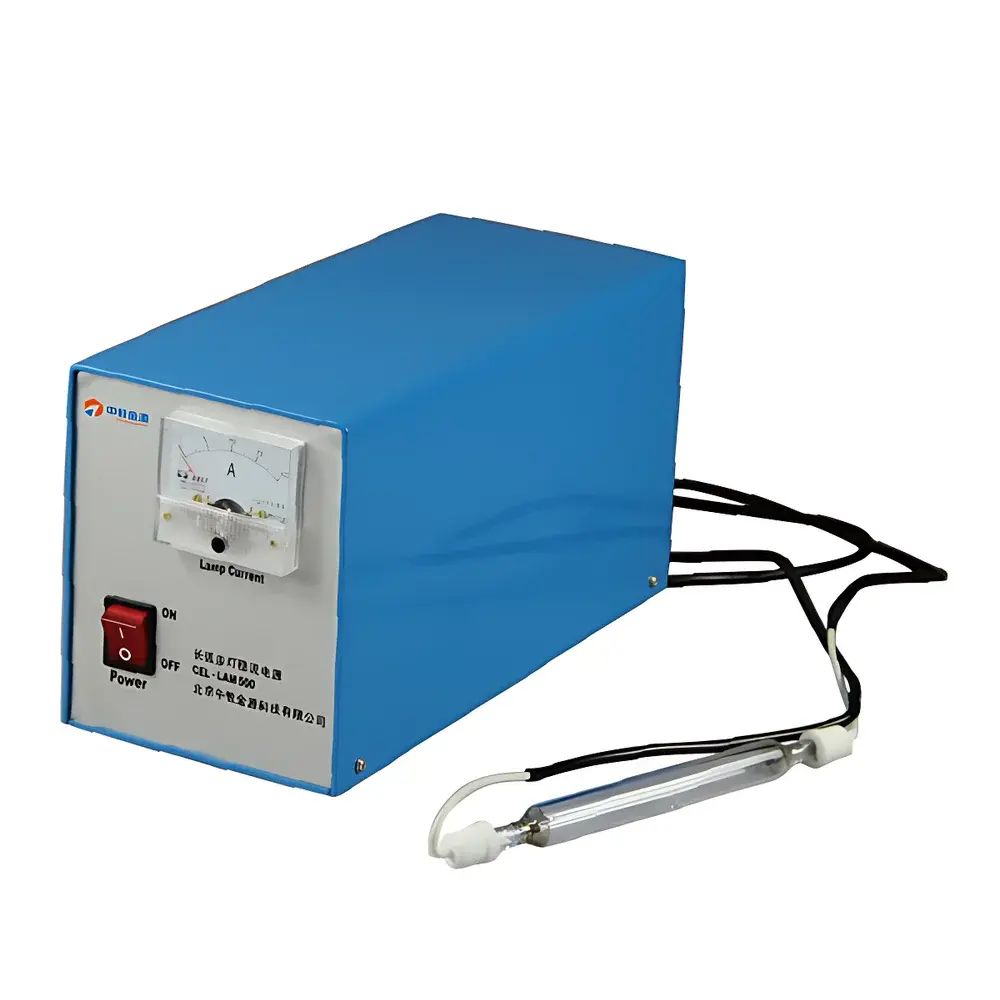
CEL-WLAM500 UV-External Irradiation Photochemical Reaction System by CEA (China Education Goldsource)
| Brand | CEA |
|---|---|
| Origin | Beijing, China |
| Manufacturer Type | Direct Manufacturer |
| Origin Category | Domestic |
| Model | CEL-WLAM500 |
| Light Source Type | Medium-Pressure Long-Arc Mercury Lamp |
| Irradiation Mode | External Illumination |
| Input Power | 500 W |
| Lamp Length | 220 mm |
| Operating Voltage | 220 V AC |
| Compatible Reactor Volume Range | 1–5000 mL |
| Reflector Type | Full-Spectrum Reflective Lamp Housing |
| Optional Enclosure Dimensions | 400 × 400 × 500 mm or 400 × 400 × 700 mm |
| Filter Integration | Top-Mounted Optical Filter Holder for Wavelength Selection (UV/VIS) |
Overview
The CEL-WLAM500 UV-External Irradiation Photochemical Reaction System is an engineered platform designed for controlled, reproducible photochemical experimentation under defined ultraviolet (UV) and near-UV/visible spectral conditions. It operates on the principle of external irradiation—where a stabilized medium-pressure long-arc mercury lamp delivers collimated, high-intensity polychromatic output onto reaction vessels from an external axis. This configuration avoids internal lamp contamination, thermal interference with reaction media, and optical path distortion caused by immersion-type light sources. The system’s core architecture integrates a precision-matched electronic ballast, full-spectrum reflective aluminum housing, and modular filter-mounting interface at the reactor top—enabling selective spectral delivery (e.g., UVC 254 nm, UVB 302 nm, UVA 365 nm, or broadband UV+VIS) without modifying the lamp or power supply. Designed for laboratory-scale synthesis, photocatalytic screening, and mechanistic photolysis studies, the CEL-WLAM500 supports rigorous experimental design in compliance with standard photochemical protocols (ISO 10128, ASTM E2051).
Key Features
- Stable 500 W medium-pressure long-arc mercury lamp with 220 mm arc length, delivering high photon flux density (>100 mW/cm² at 365 nm, measured at 10 cm working distance)
- Optimized full-spectrum reflective lamp housing to maximize directional irradiance and minimize stray light
- Top-access optical filter holder accommodating standard 25–50 mm diameter interference or bandpass filters (e.g., WG320, UG11, LP420)
- Modular enclosure options (400 × 400 × 500 mm / 400 × 400 × 700 mm) with integrated ventilation ducts, electrical safety interlocks, and black-anodized interior for light containment
- Compatible with diverse reactor geometries—including quartz jacketed tubes, Pyrex beakers, custom flow cells, and multi-vial holders—across volumes from 1 mL to 5 L
- Ballast with soft-start ignition, current regulation, and over-temperature cutoff to ensure lamp longevity and operational repeatability
Sample Compatibility & Compliance
The CEL-WLAM500 accommodates liquid-phase, slurry-phase, and gas–liquid interfacial reactions in optically transparent vessels (quartz ≥190 nm transmission, borosilicate ≥300 nm). Its external illumination geometry eliminates lamp degradation from solvent exposure and enables real-time sampling without system shutdown. The system conforms to IEC 61000-6-3 (EMC emissions), IEC 61000-6-2 (immunity), and meets mechanical safety requirements per ISO 12100. When operated with traceable NIST-calibrated radiometers and documented filter transmission data, experimental irradiance values satisfy reporting criteria for peer-reviewed photochemistry (e.g., J. Phys. Chem. A, ACS Catalysis). For GLP-regulated environments, audit trails can be established via external data loggers interfacing with the lamp’s analog monitoring port.
Software & Data Management
While the CEL-WLAM500 operates as a hardware-controlled standalone unit, it features a 0–5 V analog output for irradiance monitoring and a TTL-compatible trigger port for synchronization with external instrumentation (e.g., spectrophotometers, GC autosamplers, or time-resolved fluorescence detectors). Users may integrate the system into LabVIEW, Python (PyVISA), or MATLAB environments using optional RS-485 or USB-to-serial adapters. All operating parameters—including lamp runtime, cumulative exposure dose (J/cm²), and thermal stability logs—can be recorded externally for 21 CFR Part 11–compliant data archiving when paired with validated acquisition software.
Applications
- Photocatalytic degradation kinetics (e.g., TiO₂-mediated oxidation of organic pollutants)
- Photoinduced C–C bond formation and [2+2] cycloadditions under UVC/UVA excitation
- Photopolymerization initiation and crosslinking studies
- Photostability testing of pharmaceuticals per ICH Q1B guidelines
- Solar-simulated accelerated aging of coatings and polymers (when combined with appropriate VIS-pass filters)
- Quantum yield determination using actinometry (ferrioxalate, potassium iodide)
FAQ
Can the CEL-WLAM500 be used with ozone-generating wavelengths (e.g., 185 nm)?
No—the standard quartz envelope blocks sub-200 nm emission; ozone-producing operation requires optional synthetic fused silica lamps and dedicated exhaust handling.
Is radiometric calibration included with the system?
Calibration is not supplied by default; users are advised to perform initial spectral irradiance mapping using a NIST-traceable spectroradiometer prior to quantitative experiments.
What cooling methods are recommended for extended operation?
For continuous runs >30 min, forced-air convection via the enclosure’s rear vent ports is required; water-cooled lamp housings are available as OEM accessories.
Does the system support dimming or intensity modulation?
Output intensity is fixed per lamp specification; variable irradiance is achieved via neutral density filters or adjustable source-to-sample distance—not via electronic dimming.
How is lamp lifetime monitored?
Lamp end-of-life is indicated by >20% decline in 365 nm irradiance (measured with calibrated sensor) or visible electrode erosion—typical rated life is 1,000 hours at rated power.




