
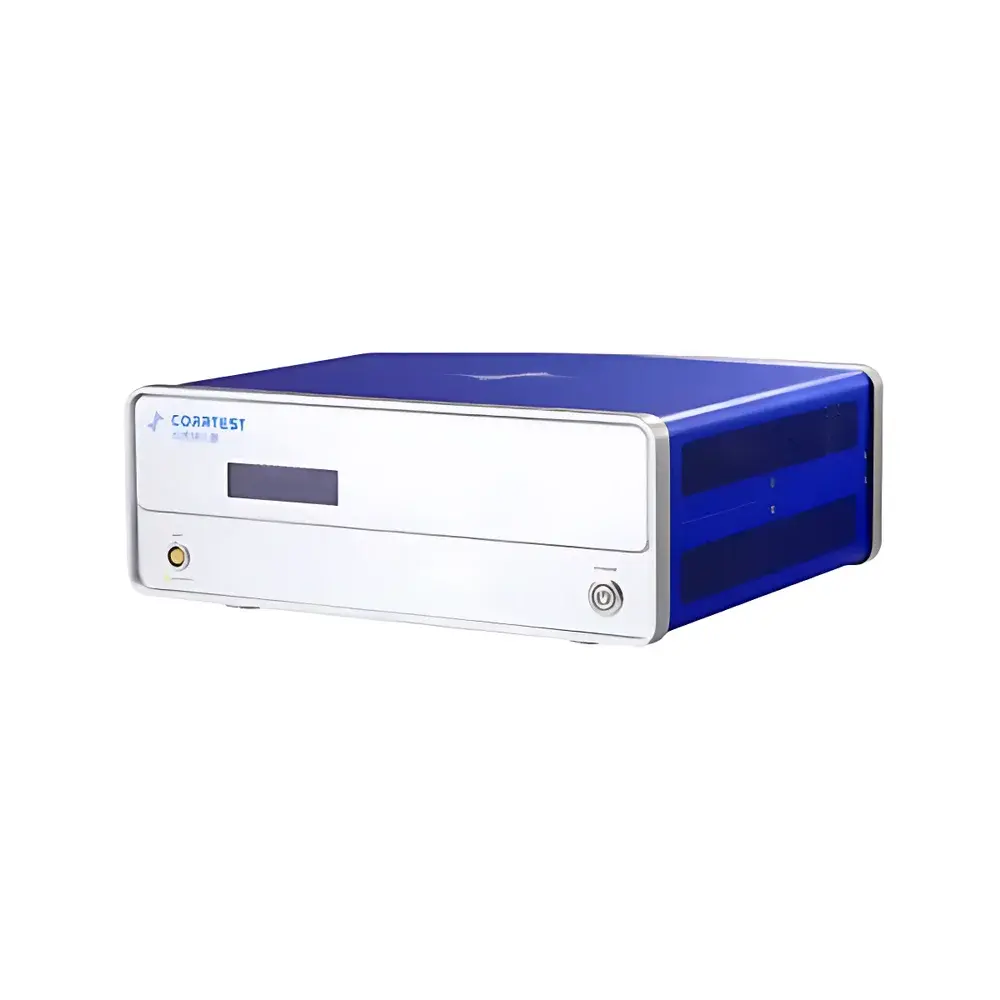
Zhongjiaojinyuan CS310M Electrochemical Workstation
| Brand | Zhongjiaojinyuan |
|---|---|
| Origin | Beijing, China |
| Manufacturer Type | Direct Manufacturer |
| Product Origin | Domestic (China) |
| Model | CS310M Electrochemical Workstation |
| Light Source Type | Other Light Sources |
| Irradiation Mode | External Illumination |
| Potentiostatic Range | ±10 V |
| Galvanostatic Range | ±2.0 A |
| Potential Control Accuracy | 0.1% of full scale ±1 mV |
| Current Control Accuracy | 0.1% of full scale |
| Potential Resolution | 10 mV (>100 Hz), 3 mV (<10 Hz) |
| Current Sensitivity | 1 pA |
| Potential Rise Time | <1 ms (<10 mA), <10 ms (<2 A) |
| Reference Electrode Input Impedance | 10¹² Ω |
| Current Range | 2 nA–2 A (10 decades) |
| Cell Voltage Compliance | ±21 V |
| Max Output Current | 2.0 A |
| CV/LSV Scan Rate | 0.001 mV/s–10 V/s |
| CA/CC Pulse Width | 0.0001–65,000 s |
| EIS Frequency Range | 10 mHz–1 MHz |
| AD Acquisition | 16-bit @ 1 MHz, 20-bit @ 1 kHz |
| DA Resolution | 16-bit, Settling Time: 1 ms |
Overview
The Zhongjiaojinyuan CS310M Electrochemical Workstation is a high-precision, dual-channel potentiostat/galvanostat engineered for rigorous electrochemical research and industrial R&D applications. Built upon a robust analog front-end architecture with low-noise current amplification and high-stability voltage control, the CS310M implements classical potentiostatic and galvanostatic techniques—including cyclic voltammetry (CV), linear sweep voltammetry (LSV), chronoamperometry (CA), chronopotentiometry (CP), and electrochemical impedance spectroscopy (EIS)—with metrological traceability to fundamental SI units. Its core design adheres to the principles of controlled-potential electrolysis and feedback-controlled current delivery, enabling accurate quantification of interfacial charge transfer kinetics, double-layer capacitance, diffusion-limited currents, and corrosion-related electrochemical parameters. The system supports both three-electrode and two-electrode configurations and integrates seamlessly with external illumination modules—such as xenon or mercury arc lamps—for photoelectrochemical studies under controlled irradiation (external illumination mode). It serves as a foundational platform for laboratories engaged in energy storage, corrosion science, sensor development, and functional materials characterization.
Key Features
- High-fidelity analog signal conditioning with 16-bit ADC at up to 1 MHz sampling rate and optional 20-bit resolution at lower bandwidths for enhanced dynamic range in low-current measurements
- Dual independent control loops supporting simultaneous potentiostatic and galvanostatic operation with real-time feedback compensation for solution resistance (IR drop)
- Programmable low-pass filtering with eight adjustable bandwidth settings to suppress noise without distorting transient response
- Wide current range spanning 10 decades (2 nA to 2 A) with automatic range switching and sub-picoampere sensitivity for ultra-low-current detection
- Fast potential step response (<1 ms for small-signal steps) and precise digital waveform generation (DDS-based sine, triangle, square waveforms with <1% THD)
- Comprehensive EIS capabilities including frequency-domain sweeps (10 mHz–1 MHz), time-domain monitoring, and potential-step EIS (e.g., Mott–Schottky analysis)
- Integrated hardware safety features: overvoltage protection, current limiting, thermal shutdown, and open-circuit detection
Sample Compatibility & Compliance
The CS310M accommodates standard electrochemical cells—including conventional three-electrode setups (working, counter, reference), rotating disk electrodes (RDE), and zero-resistance ammeter (ZRA) configurations for galvanic couple analysis. It supports aqueous, non-aqueous, and molten salt electrolytes across pH 0–14 and temperature ranges compatible with standard laboratory accessories (e.g., thermostated cells). All hardware and firmware comply with IEC 61010-1 safety standards for electrical equipment used in measurement, control, and laboratory use. While not certified to FDA 21 CFR Part 11 out-of-the-box, the CorrTest software architecture supports audit-trail logging, user access control, and electronic signature protocols when deployed within validated GLP/GMP environments—subject to site-specific configuration and validation documentation per ISO/IEC 17025 requirements.
Software & Data Management
CorrTest v4.x is the native Windows-based control and analysis suite bundled with the CS310M. It provides modular experiment sequencing, real-time visualization, and post-acquisition processing tools compliant with ASTM G59 (potentiodynamic polarization), ASTM G102 (electrochemical impedance calculations), and ISO 16773 (corrosion testing of coated metals). Raw data are stored in binary format with embedded metadata (timestamp, instrument ID, parameter set, calibration history) and exportable to CSV, TXT, or MATLAB-compatible MAT files. The software includes built-in routines for Tafel extrapolation, Kramers–Kronig validation of EIS spectra, differential pulse voltammetry deconvolution, and battery cycling analysis (GITT/PITT). All experimental methods are scriptable via COM interface, enabling integration into automated test benches or custom Python/MATLAB workflows.
Applications
- Electrodeposition and electrosynthesis mechanism studies, including nucleation/growth modeling and mass transport analysis
- Development and validation of electrochemical biosensors and gas sensors under static and flow conditions
- Performance evaluation of lithium-ion battery cathodes/anodes, solid-state electrolytes, and redox-flow systems under galvanostatic/potentiostatic stress
- Corrosion assessment of structural alloys in simulated concrete pore solution, seawater, or acidic soil leachates using EPR, EN, and ZRA methodologies
- Photoelectrochemical characterization of semiconductor thin films (e.g., TiO₂, BiVO₄, perovskites) under controlled xenon or mercury lamp irradiation
- Quantitative analysis of inhibitor efficiency, coating delamination kinetics, and cathodic protection current distribution in field-representative geometries
FAQ
Is the CS310M compatible with rotating disk electrode (RDE) systems?
Yes—the workstation includes dedicated RDE speed control output and synchronized data acquisition for hydrodynamic voltammetry.
Does it support electrochemical noise (EN) measurements per ASTM G199?
Yes—CorrTest includes EN acquisition mode with dual-channel high-resolution current/voltage logging and statistical power spectral density analysis.
Can the instrument perform Mott–Schottky analysis?
Yes—via EIS potential-step mode with automated capacitance vs. potential plotting and dopant density calculation.
What is the maximum sampling rate for transient techniques like chronoamperometry?
The system supports up to 1 MS/s (16-bit) for short-duration transients; effective resolution adjusts dynamically based on selected filter bandwidth and averaging.
Is remote operation possible via LAN or Ethernet?
No—communication is exclusively via USB 2.0; however, USB extension cables or active USB-over-Ethernet adapters may be used in controlled lab networks.





