
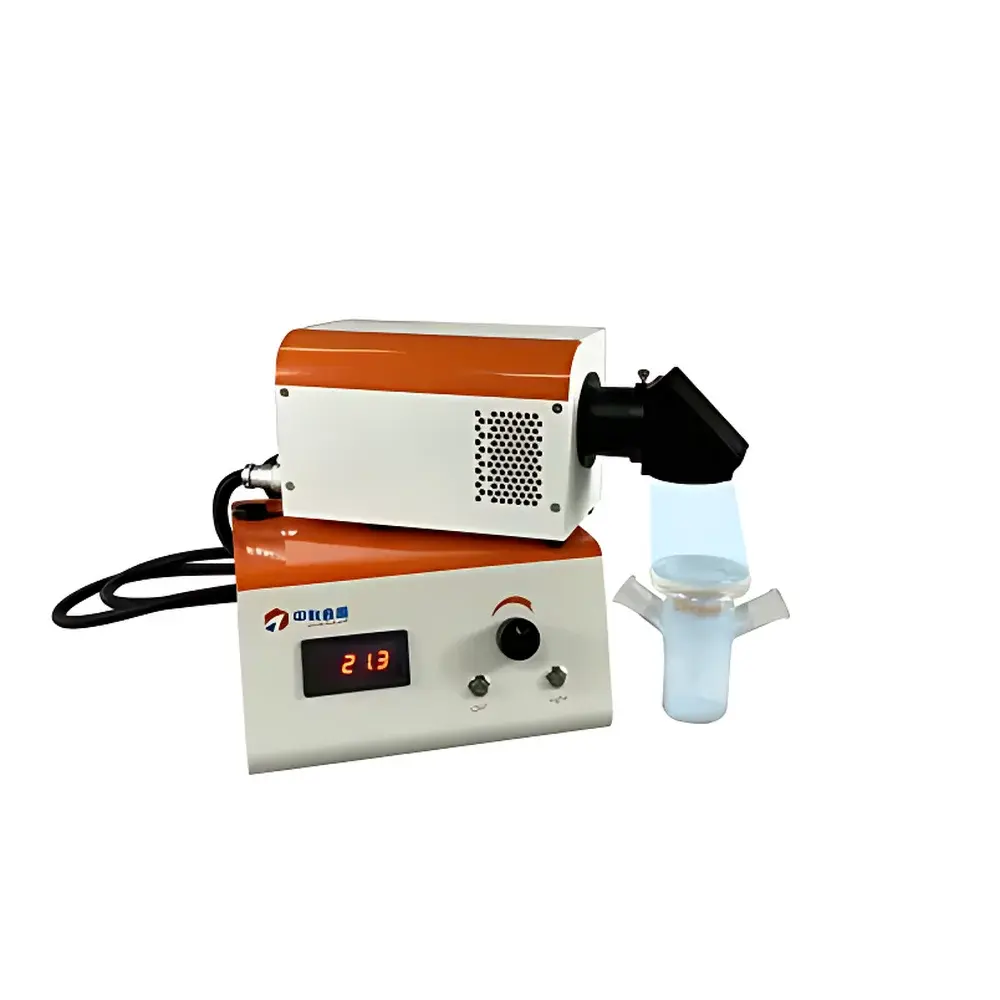
CEL-PF300-T6 Xenon Arc Light Source for Photocatalytic Research
| Brand | CEAULIGHT (Zhongjiaojinyuan) |
|---|---|
| Origin | Beijing, China |
| Manufacturer Type | OEM/ODM Producer |
| Product Category | Light Source Module |
| Model | CEL-PF300-T6 |
| Output Spectral Range | 300–2500 nm (ozone-free) |
| UV Output (<390 nm) | 2.6 W |
| Visible Output (390–770 nm) | 18.6 W, 5600 K, 5000 lm |
| IR Output (>770 nm) | 28.8 W |
| Input Power | 300 W (Ignition Voltage: 30 kV |
| Operating Voltage | 14 V DC) |
| Operating Current | 21 A (adjustable 10–22 A) |
| Total Radiant Flux | 50 W |
| Lamp Life | >1000 h (up to 6000 h under controlled lab conditions) |
| Beam Diameter | ≥60 mm (with optional continuous-adjustment collimator) |
| Illuminance Stability | ±5% (with multi-point thermal feedback control) |
| Cooling | Intelligent fan system with 60 s post-shutdown delay |
| Lamp Replacement | PE300 modular xenon lamp — tool-free, no wiring disassembly required |
| Optical Interface | Standard M62/M52 threaded mount for filter stacking |
| Optional Accessories | CEL-LMP400 motorized lift stage, CEL-LB70 light-tight enclosure (400 × 400 × 700 mm), CEL-NP2000-2 calibrated optical power meter, quartz-coated bandpass & longpass filters (e.g., UVIRCut400, AM1.5G, QD365–QD940 series) |
Overview
The CEL-PF300-T6 is a high-stability, air-cooled xenon arc light source engineered specifically for quantitative photocatalytic and photochemical research. It operates on the principle of broadband continuum emission from a high-pressure DC-driven xenon plasma arc, delivering spectrally stable irradiance across the ultraviolet, visible, and near-infrared regions (300–2500 nm). Unlike pulsed or LED-based systems, the CEL-PF300-T6 provides true solar-simulated spectral continuity—critical for kinetic studies requiring reproducible photon flux distribution in heterogeneous photocatalysis, such as water splitting, CO2 photoreduction, and pollutant degradation. Its output is calibrated against the ASTM G173-03 AM1.5G reference spectrum and traceable to NIST-traceable radiometric standards via the optional CEL-NP2000-2 power meter. The system is designed for integration into closed-loop photoreactors, glovebox-compatible optical benches, and multi-instrument test platforms where spectral fidelity, temporal stability, and operational safety are non-negotiable.
Key Features
- Modular thermal architecture with multi-zone temperature sensing and adaptive fan speed control ensures ±5% irradiance stability over extended operation cycles.
- Integrated high-voltage ignition module (30 kV pulse) and regulated DC power supply (14 V, 21 A nominal) deliver consistent arc ignition and low-noise current regulation—minimizing flicker-induced experimental variance.
- Tool-free PE300 lamp replacement mechanism eliminates electrical reconnection steps, reducing downtime and operator exposure risk during routine maintenance.
- Coaxial optical alignment system guarantees mechanical concentricity among lamp envelope, heat shield, collimating optics, and mounting flange—enabling repeatable beam positioning across instrument configurations.
- Dual-stage thermal isolation between high-voltage electronics and optical chamber prevents electromagnetic interference and thermal drift in sensitive detection subsystems.
- Standard M62/M52 threaded front port supports up to four stacked optical filters (e.g., AM1.5G + UVIRCut400 + QD365) without vignetting or alignment loss.
- 60-second intelligent post-shutdown cooling cycle extends lamp service life by mitigating thermal shock during rapid cooldown phases.
Sample Compatibility & Compliance
The CEL-PF300-T6 is compatible with standard photochemical reactor geometries—including top-irradiated slurry reactors, side-illuminated flow cells, and gas-phase fixed-bed configurations. Its 60 mm minimum beam diameter accommodates common 25–100 mL reaction vessels and enables uniform illumination of catalyst-coated substrates (e.g., TiO2/FTO electrodes, g-C3N4 films). All optical components comply with ISO 9001 manufacturing controls. Electrical design conforms to IEC 61000-6-3 (EMI emission limits) and IEC 61000-6-2 (immunity requirements). While not certified for medical or industrial process use, the system meets GLP-aligned documentation practices for academic and industrial R&D labs conducting catalytic kinetics per ISO 10678, ISO 22197-1 (NO removal), and ASTM E2051 (photocatalytic activity assessment).
Software & Data Management
The CEL-PF300-T6 operates as a standalone hardware module with no embedded firmware or proprietary software dependency. Power output is manually adjustable via front-panel potentiometer (0–100% intensity), with real-time monitoring of lamp voltage, current, and heatsink temperature available via analog outputs (0–5 V). For automated workflows, analog signals can be integrated into third-party DAQ systems (e.g., National Instruments LabVIEW, MATLAB Data Acquisition Toolbox) for synchronized irradiance logging, reactor temperature correlation, and time-resolved quantum yield calculation. When paired with the CEL-NP2000-2 optical power meter, users obtain NIST-traceable irradiance values (W/m²) at user-defined wavelengths—enabling compliance with reporting requirements for journals such as ACS Catalysis, Applied Catalysis B: Environmental, and Journal of Materials Chemistry A.
Applications
- Quantitative photocatalytic hydrogen evolution (HER) and oxygen evolution (OER) under simulated solar irradiation.
- CO2 photoreduction to CH4, CO, or HCOOH using plasmonic or MOF-based catalysts.
- UV–vis–NIR accelerated aging studies for polymer degradation, dye sensitization, and semiconductor passivation.
- Photoinduced charge carrier dynamics analysis via time-resolved transient absorption (TA) or photoluminescence (PL) spectroscopy.
- Photothermal and photoelectrochemical (PEC) coupling experiments requiring simultaneous broadband illumination and electrochemical biasing.
- Environmental remediation validation per ISO 22197-2 (acetaldehyde decomposition) and ISO 10678 (methylene blue degradation).
FAQ
What spectral calibration standards does the CEL-PF300-T6 reference?
The system’s spectral output is characterized using an AULTT-P4000 spectroradiometer and aligned to the ASTM G173-03 AM1.5G reference spectrum. Absolute irradiance values are validated using the optional CEL-NP2000-2 calibrated power meter.
Can the CEL-PF300-T6 operate continuously for >8 hours?
Yes—under ambient temperatures ≤25 °C and relative humidity <60%, continuous operation exceeds 8 h with stable output. In high-dust or high-humidity environments, lamp life degrades significantly; use within a CEL-LB70 enclosure is recommended.
Is the PE300 lamp compatible with older CEL-PF300 models?
Yes—the PE300 lamp is mechanically and electrically backward-compatible with all CEL-PF300-series lamp housings (T1 through T6), though thermal management and stability improvements are exclusive to the T6 platform.
Does the system support external TTL triggering or analog modulation?
No—the CEL-PF300-T6 is a DC-stabilized constant-current source with no built-in modulation capability. For pulsed irradiation, users must integrate an external mechanical chopper or electro-optic modulator upstream of the output beam.
What safety certifications apply to the CEL-LB70 enclosure?
The CEL-LB70 is a Class 1 light-tight enclosure compliant with IEC 60825-1:2014 (laser product safety) for containment of stray UV radiation; it is not rated for explosion-proof or IP65 environments.




