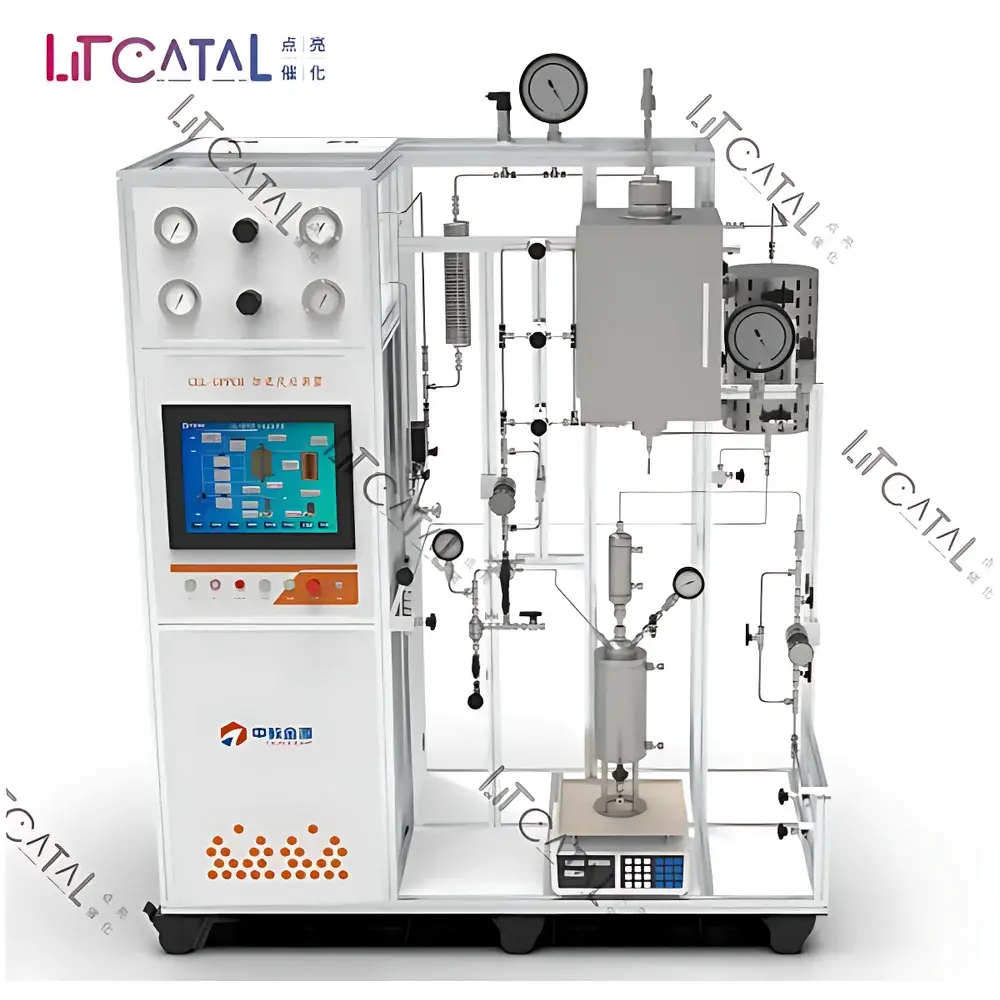
CEL-GPPCH Custom Hydrogenation Reaction System by Beijing Zhongjiao Jinyuan
| Brand | Zhongjiao Jinyuan |
|---|---|
| Origin | Beijing, China |
| Manufacturer Type | Direct Manufacturer |
| Region of Origin | Domestic (PRC) |
| Model | CEL-GPPCH Custom Hydrogenation Reaction System |
| Pricing | Upon Request |
| Dimensions | 1410 mm × 730 mm × 1664 mm |
| Construction Material | ASTM A240 316L Stainless Steel |
| Reactor Temperature Range | 0–300 °C (precision oil-bath heating) |
| Vaporizer Temperature Range | 0–600 °C |
| Tubing Trace Heating Range | 0–200 °C |
| Maximum Operating Pressure | <10 MPa |
| Liquid Flow Rate | 0.1–5 mL/min |
| Catalyst Bed Volume | <100 mL |
| Gas Flow Range (expandable channels) | 0–500 sccm per line |
| Analytical Balance Capacity | 0–15 kg (resolution: 0.1 g) |
| Safety Systems | Proportional pressure relief valve, rupture disc, independent overtemperature alarm at all thermal zones, interlocked shutdown logic |
Overview
The CEL-GPPCH Custom Hydrogenation Reaction System is a fully integrated, software-controlled fixed-bed catalytic reactor platform engineered for rigorous evaluation of heterogeneous hydrogenation catalysts under precisely regulated thermochemical conditions. It operates on classical catalytic reaction engineering principles—employing plug-flow reactor (PFR) geometry with axial dispersion minimization—and supports gas-phase, liquid-phase, and concurrent gas–liquid feed configurations over solid catalyst beds. Designed for laboratory-scale kinetic studies, catalyst screening, and process parameter optimization, the system enables controlled operation across a broad operational envelope: temperatures from ambient to 300 °C in the reactor zone (via high-stability silicone oil bath), vaporization up to 600 °C, and trace-heated transfer lines to prevent condensation. Pressure control is maintained below 10 MPa using certified ASME-coded components, with dual-stage safety integration including proportional unloading valves and certified rupture discs. All thermal zones incorporate independent Pt100 RTD sensors with configurable overtemperature setpoints and hardware-triggered emergency shutdown sequences compliant with IEC 61508 SIL-1 functional safety requirements.
Key Features
- Modular fixed-bed reactor architecture constructed entirely from ASTM A240 316L stainless steel—resistant to H₂ embrittlement, chloride corrosion, and thermal cycling fatigue
- Multi-zone temperature control: reactor (oil-bath), vaporizer (tubular furnace), and transfer lines (trace heating)—each with PID tuning, ramp/soak programming, and real-time deviation monitoring
- Mass flow-controlled gas delivery (0–500 sccm per channel, expandable to ≥4 independent streams) with digital MFCs traceable to NIST standards
- Precision liquid dosing via syringe pump or HPLC-grade metering pump (0.1–5 mL/min, ±0.5% full scale)
- In-line gravimetric monitoring using IP65-rated analytical balance (0–15 kg, 0.1 g resolution) for continuous condensate mass tracking
- Integrated sampling manifold with septum-sealed ports and heated transfer lines for direct coupling to GC, GC-MS, or online FTIR systems
- Industrial-grade HMI interface: 15.6″ ruggedized touch-panel PC running Windows IoT LTSB with deterministic real-time data acquisition (100 Hz logging capability)
- Full system interlock logic: pressure–temperature–flow cross-checking, automatic venting upon fault detection, and audit-trail-enabled event logging
Sample Compatibility & Compliance
The CEL-GPPCH accommodates catalyst forms including pellets, extrudates, powders, and monoliths (bed volume ≤100 mL). It supports reactions involving H₂, CO, NH₃, light hydrocarbons (C₁–C₄), alcohols, nitriles, unsaturated aromatics, and heteroatom-containing feedstocks—provided compatibility with 316L and operating conditions is verified. The system conforms to key international design and operational frameworks: ASME B31.3 Process Piping Code for high-pressure gas service; PED 2014/68/EU (Category IV pressure equipment); and ISO 13849-1 for safety-related control systems. All electrical components meet UL 61010-1 and CE/EMC directives. For regulated environments, optional 21 CFR Part 11-compliant software modules provide electronic signatures, role-based access control, and immutable audit trails suitable for GLP/GMP validation.
Software & Data Management
Control and data acquisition are managed via Zhongjiao Jinyuan’s proprietary LabReact™ v4.2 software suite—developed in compliance with ISA-88 and ISA-95 modular automation standards. The application provides synchronized multi-parameter trending (T, P, Fgas, Fliq, mcond), automated method sequencing (including TPR/TPD-compatible temperature ramps), and configurable alarm escalation. Raw time-series data are stored in HDF5 format with embedded metadata (operator ID, batch tag, calibration timestamps). Export options include CSV, MATLAB .mat, and ASTM E1923-compliant XML for third-party kinetic modeling tools (e.g., gPROMS, COMSOL Reaction Engineering Module). Report generation follows customizable templates aligned with ASTM D3226, ISO 10724, and internal R&D documentation protocols.
Applications
- Kinetic modeling of hydrogenation/dehydrogenation pathways (e.g., nitrobenzene → aniline, furfural → tetrahydrofurfuryl alcohol)
- Catalyst deactivation studies under realistic sulfur-, nitrogen-, or coke-forming conditions
- Screening of bimetallic or supported noble metal catalysts (Pd/C, Pt/Al₂O₃, Ni–Mo/γ-Al₂O₃) for selective hydrogenolysis
- Process intensification assessment—including trickle-bed vs. fixed-bed performance comparison under identical residence time distributions
- Reaction calorimetry integration via heat balance calculation using inlet/outlet enthalpy differentials and condensate mass accumulation
- Support for tandem reaction systems when coupled with optional TPR/TPD, in situ Raman, or transient pulse response modules
FAQ
What catalyst bed configurations are supported?
Standard configuration supports single fixed-bed geometry with thermocouple tree insertion (up to 5 axial points). Dual-bed and guard-bed arrangements are available as custom options.
Can the system be validated for GMP environments?
Yes—when equipped with Part 11-compliant software, IQ/OQ documentation packages, and third-party calibration certificates (NIST-traceable MFCs, RTDs, pressure transducers), the system meets baseline qualification requirements for catalyst development labs under FDA oversight.
Is remote monitoring supported?
The embedded industrial PC includes dual Ethernet ports and optional LTE/WiFi module support; secure remote desktop access and OPC UA server integration are available under extended service agreements.
What maintenance intervals are recommended?
Preventive maintenance is scheduled every 500 operational hours or annually—whichever occurs first—with emphasis on MFC recalibration, valve seat inspection, and oil-bath fluid analysis.
Are explosion-proof variants available?
ATEX Zone 1 and IECEx-certified versions (with flameproof enclosures and intrinsically safe signal conditioning) can be supplied upon request, subject to detailed hazardous area classification documentation.