
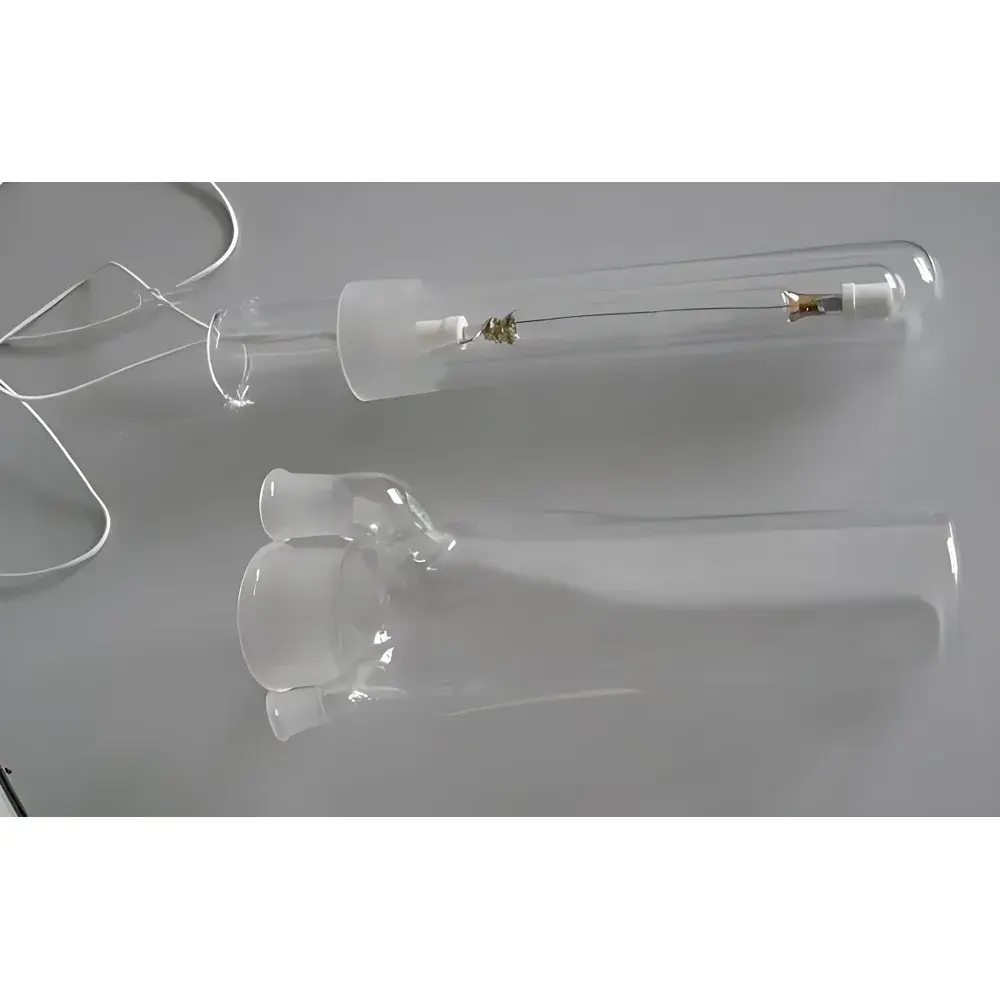
Inner-Illumination Photochemical Reactor CNR-25/50 by CNI (Zhongjiao Jinyuan)
| Brand | CNI (Zhongjiao Jinyuan) |
|---|---|
| Origin | Beijing, China |
| Manufacturer Type | Direct Manufacturer |
| Origin Category | Domestic (China-made) |
| Model | CNR-25/50 |
| Pricing | Upon Request |
Overview
The CNI CNR-25/50 Inner-Illumination Photochemical Reactor is a laboratory-scale, modular photochemical reaction system engineered for controlled irradiation-driven chemical transformations—particularly photocatalytic degradation, solar fuel synthesis, and mechanistic photochemistry studies. Unlike external illumination configurations, this reactor employs an inner-illumination design: the light source (typically a medium- or high-pressure mercury, xenon, or LED lamp) is inserted coaxially through a quartz cold finger into the reaction mixture, ensuring uniform photon flux distribution, minimized light path attenuation, and enhanced quantum yield reproducibility. The system operates on the principle of direct photon absorption by dissolved or suspended photocatalysts (e.g., TiO₂, g-C₃N₄, MOFs) under precisely regulated thermal and hydrodynamic conditions. Its architecture integrates optical, thermal, and fluidic control domains to support quantitative structure–activity relationship (QSAR) studies and kinetic modeling compliant with IUPAC photochemical data reporting guidelines.
Key Features
- Coaxial inner-illumination geometry with integrated quartz cold finger (CEQW-22, 60/40 standard taper, 220 mm effective length) enabling efficient IR heat extraction via circulating coolant (e.g., 10–25 °C water/glycol)
- High-borosilicate PYREX® glass reaction vessels (CNR-25/50 series) available in two nominal volumes: 250 mL (CNR-25) and 500 mL (CNR-50), both compatible with magnetic stirring and rated for sustained operation up to 80 °C under ambient pressure
- Optimized optical transmission: Quartz cold finger exhibits >90% transmittance across 200–400 nm (UVC–UVA), critical for bandgap excitation of wide-bandgap semiconductors
- Dedicated light-shielded reaction enclosure constructed from powder-coated steel with interlocked access door, meeting ISO 13857 safety clearance requirements for UV containment
- Standardized ground-glass joints (60/40) ensure leak-tight, vacuum-compatible assembly with auxiliary modules (gas inlet/outlet valves, condensers, sampling ports)
- Modular scalability: Designed to interface with CNI’s lamp power supplies (e.g., PL-SXE300 series), temperature controllers, and gas dosing manifolds for multi-parameter reaction optimization
Sample Compatibility & Compliance
The CNR-25/50 accommodates heterogeneous slurries (e.g., 0.1–2.0 g/L catalyst loading), homogeneous solutions, and gas-saturated liquid phases. Vessels resist corrosion from common solvents (water, methanol, acetonitrile, dichloromethane) and mild acidic/basic media (pH 2–10). All wetted parts comply with USP Class VI biocompatibility standards. The system supports GLP-aligned experimental execution: batch records may include timestamped lamp-on duration, coolant inlet/outlet temperatures, stir rate (via external tachometer input), and ambient light-intensity logging (optional radiometer integration). While not certified to IEC 61000-6-3 for EMC, its shielded enclosure mitigates electromagnetic interference during concurrent instrumentation use.
Software & Data Management
The reactor itself is hardware-only and does not embed firmware or onboard software. However, it is fully interoperable with third-party data acquisition platforms (e.g., LabVIEW, MATLAB Data Acquisition Toolbox, or Python-based PySerial/DAQmx drivers) when paired with optional sensors (PT100 temperature probes, optical power meters, dissolved oxygen electrodes). Experimental metadata—including lamp spectral output (via calibrated spectroradiometer), cumulative photon dose (Einstein·L⁻¹), and real-time temperature gradients—can be logged and exported in CSV or HDF5 format for kinetic analysis per ASTM E2093-21 (Standard Guide for Photoreactor Calibration). Audit trails are maintained externally via institutional LIMS or ELN systems adhering to 21 CFR Part 11 requirements when configured with electronic signatures.
Applications
- Photocatalytic mineralization of organic pollutants (e.g., rhodamine B, phenol, pharmaceuticals) under simulated solar or UVA irradiation
- Quantum efficiency determination of novel photocatalysts using actinometry (e.g., potassium ferrioxalate or Aberchrome 540)
- Photoinduced hydrogen evolution reactions (HER) and CO₂ reduction in aqueous or non-aqueous electrolytes
- Photopolymerization kinetics under controlled wavelength-selective excitation
- Photo-Fenton and persulfate activation studies requiring precise thermal management during radical generation
- Method development for ISO 10678:2010 (Determination of photocatalytic activity of nanomaterials)
FAQ
What lamp types are compatible with the CNR-25/50 cold finger?
Standard compatibility includes 300 W and 500 W medium-pressure Hg and Xe arc lamps with 22 mm outer diameter and 60/40 taper mounts. LED arrays with collimated 365 nm or 405 nm emission are also supported with custom adapter sleeves.
Can the reactor operate under inert atmosphere or vacuum?
Yes—equipped with dual 60/40 ports and optional Swagelok® SS fittings, it supports N₂/Ar purging and vacuum levels down to 10⁻² mbar when paired with a diaphragm pump and Viton® O-rings.
Is the PYREX® reaction vessel resistant to hydrofluoric acid?
No—HF etches borosilicate glass; alternative quartz vessels must be specified separately for HF-containing systems.
Does CNI provide photometric calibration services for this reactor?
CNI offers optional factory calibration reports traceable to NIM (National Institute of Metrology, China) for irradiance (W·m⁻²) at 254 nm, 365 nm, and 405 nm using a NIST-traceable thermopile sensor.
What stirring speed range is recommended for optimal mass transfer?
Empirical optimization indicates 300–600 rpm for 250 mL batches and 200–450 rpm for 500 mL batches to balance suspension homogeneity and vortex minimization without compromising lamp stability.



