

CEL-EQE External Quantum Efficiency Measurement System
| Brand | CEAULIGHT (Zhongjiaojinyuan) |
|---|---|
| Origin | Beijing, China |
| Manufacturer Type | Direct Manufacturer |
| Product Category | Domestic |
| Model | CEL-EQE |
| Price Range | USD 14,000 – 70,000 |
| Measurement Mode | DC |
Overview
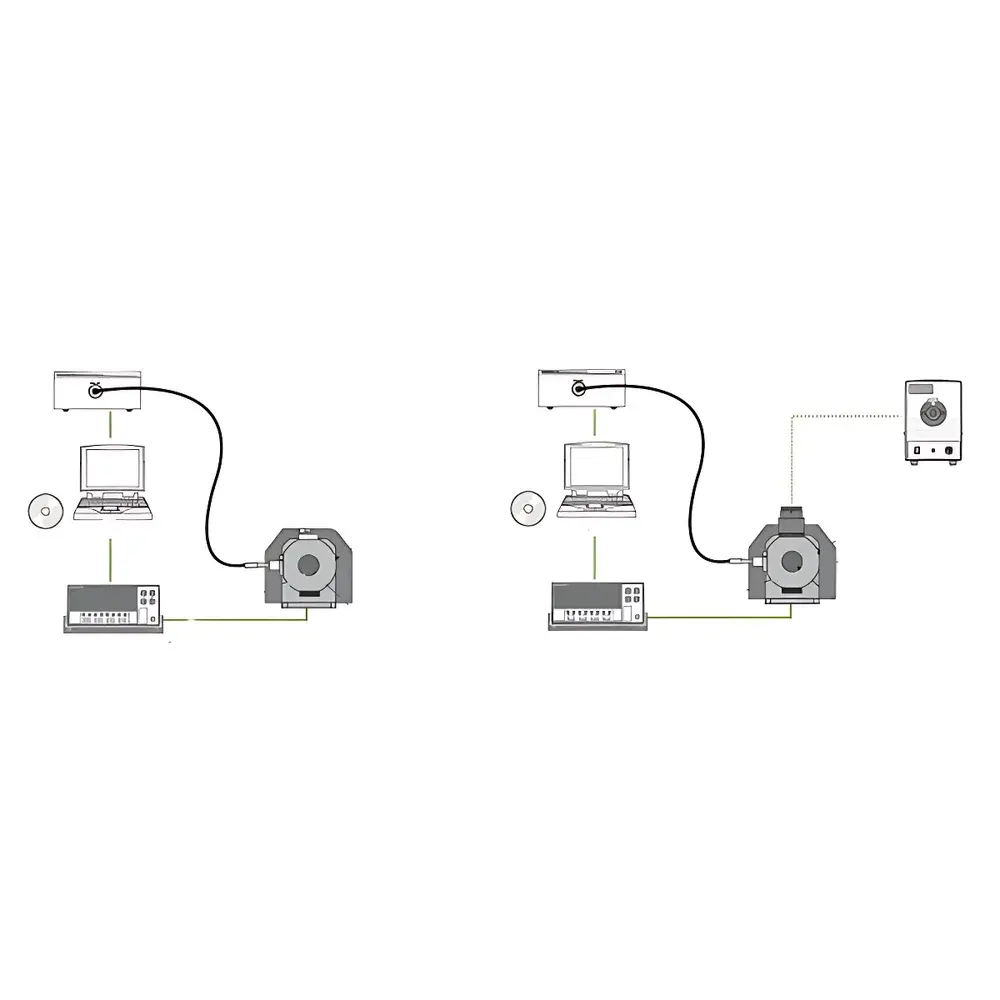
The CEL-EQE External Quantum Efficiency (EQE) Measurement System is an engineered instrumentation platform designed for precise, reproducible quantification of photon-to-electron conversion efficiency in electroluminescent (EL) devices under direct current excitation. Based on the fundamental principle of integrating sphere photometry coupled with calibrated spectral radiometry, the system measures the ratio of emitted photons (integrated over 4π steradians) to injected electrons—yielding the device-level external quantum efficiency (ηEQE = photons emitted per electron injected). This metric is critical for evaluating OLEDs, QLEDs, perovskite LEDs, inorganic micro-LEDs, and other thin-film electroluminescent architectures where optical outcoupling losses—including substrate waveguiding, internal reflection, and angular emission asymmetry—must be rigorously accounted for. The system operates under controlled DC bias conditions, enabling stable I–V–L (current–voltage–luminance) characterization synchronized with full-spectrum acquisition from 200 nm to 1100 nm.
Key Features
- Optically calibrated integrating sphere (3.3–8 inch internal diameter) with Spectralon® coating (>99% diffuse reflectance from 250–2500 nm), ensuring angularly invariant collection of all emitted radiation regardless of sample emission profile.
- Synchronized DC source control via IEEE-488/GPIB interface to Keithley 2400 Series SourceMeter units, supporting programmable voltage sweeps, constant-current driving, and pulsed operation modes.
- Real-time spectral acquisition during electrical stimulation: Each I–V step triggers immediate capture of full EL spectrum using a back-illuminated, thermoelectrically cooled CCD detector (2048-channel AULTT-P4000 spectrometer).
- High-dynamic-range photometric capability: luminous flux measurement range from 0.00013 lm to 0.12 lm (for 2×2 mm² emission area, white light), traceable to NIST-traceable calibration standards.
- Modular architecture supports seamless integration with optional accessories including nitrogen-purged sample chambers, temperature-controlled stages (−40°C to +150°C), and automated XY sample positioning.
- Dual-mode software interface enables both guided wizard-based measurements and script-driven batch acquisition for high-throughput R&D environments.
Sample Compatibility & Compliance
The CEL-EQE system accommodates planar electroluminescent devices including small-molecule and polymer OLEDs, quantum dot light-emitting diodes (QLEDs), perovskite LEDs (PeLEDs), and inorganic thin-film LEDs fabricated on glass, silicon, or flexible substrates. Device formats include pixelated arrays, single-emission-layer structures, and multilayer stacks with transparent or reflective cathodes. All optical and electronic subsystems comply with IEC 62301 (standby power measurement), ISO/IEC 17025:2017 (general requirements for competence of testing and calibration laboratories), and support GLP/GMP-aligned data integrity workflows—including audit trail logging, user access controls, and electronic signature capability per FDA 21 CFR Part 11 when configured with validated software modules.
Software & Data Management
The proprietary EQEControl Suite provides comprehensive instrument orchestration, real-time visualization, and post-processing analytics. It supports simultaneous plotting of current density (J), voltage (V), luminance (L), EQE(λ), CIE 1931 chromaticity coordinates, CCT, and CRI across multiple datasets. Spectral data are stored in HDF5 format with embedded metadata (wavelength calibration, integration time, source settings, environmental conditions). Export options include CSV, ASCII, and MATLAB-compatible .mat files. Batch analysis tools enable comparative EQE mapping across device batches, degradation studies (time-resolved EQE tracking), and statistical reporting compliant with ASTM E2911–22 (Standard Practice for Reporting Photovoltaic and Light-Emitting Diode Characterization Data).
Applications
- Development and optimization of emissive layers in OLED/QLED displays and solid-state lighting modules.
- Quantitative benchmarking of charge injection balance, exciton confinement, and outcoupling enhancement strategies (e.g., microlens arrays, scattering layers).
- Fundamental studies of triplet–singlet harvesting mechanisms in thermally activated delayed fluorescence (TADF) emitters.
- Stability assessment of EL efficiency under constant-current stress (LT50/LT90 lifetime modeling).
- Correlation of EQE with electroluminescence spectra to identify parasitic non-radiative recombination pathways.
- Validation of simulation models (e.g., ray-tracing optical simulations, drift-diffusion device physics models) against experimental EQE spectra.
FAQ
What is the difference between external quantum efficiency (EQE) and internal quantum efficiency (IQE)?
EQE quantifies the ratio of emitted photons to injected electrons and includes all optical loss mechanisms; IQE requires additional optical modeling or complementary techniques (e.g., absorption spectroscopy, waveguide mode analysis) to deconvolve outcoupling losses.
Can the CEL-EQE system measure transient EQE under pulsed bias?
Yes—when paired with compatible fast-switching source meters and gated CCD acquisition, the system supports microsecond-scale time-resolved EQE profiling.
Is spectral calibration traceable to national standards?
All spectrometers are factory-calibrated using NIST-traceable tungsten-halogen and mercury-argon line sources; users may perform on-site recalibration using optional calibration kits.
Does the system support cryogenic operation?
The base configuration operates at ambient temperature; low-temperature adaptation is available via integration with closed-cycle cryostats (down to 10 K) and vacuum-compatible integrating spheres.
How is photometric accuracy ensured across the UV–NIR range?
Spectral responsivity correction is applied using pre-measured detector quantum efficiency curves, validated against calibrated reference detectors (Hamamatsu S1337 series) across 200–1100 nm.






