
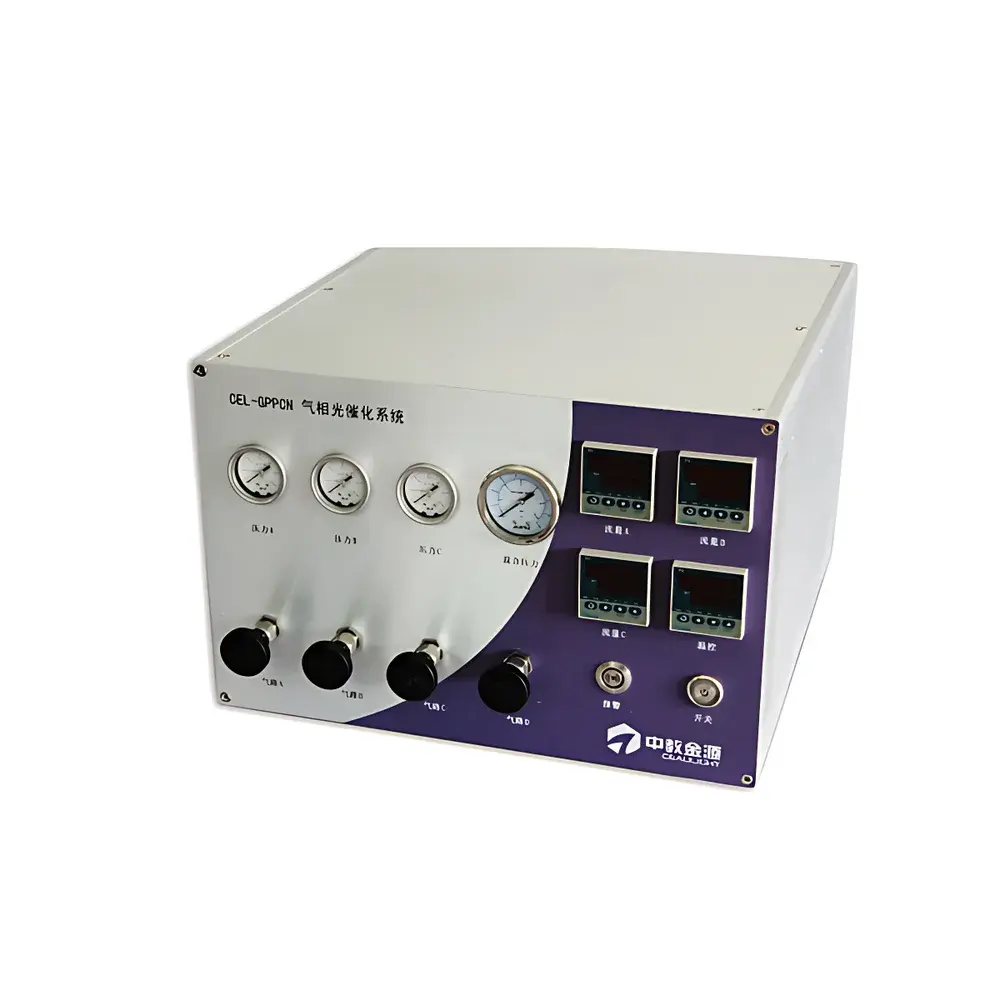
CEL-GPPCN Gas-Phase Photocatalytic Reaction System
| Brand | CEA (China Education Goldsource) |
|---|---|
| Origin | Beijing, China |
| Manufacturer Type | Direct Manufacturer |
| Country of Origin | China |
| Model | CEL-GPPCN |
| Pricing | Upon Request |
| System Pressure Rating | 2.0 MPa |
| Gas Channels | 4 (3 controlled mass flow + 1 purge line) |
| Mass Flow Controllers | Two 100 mL/min + One 200 mL/min, Accuracy: ±0.1% FS |
| Pressure Monitoring | 3 inlet pressure gauges + 1 mixing chamber gauge |
| Mixing Chamber Volume | 100 mL |
| Temperature Control Range | Ambient to 200 °C (mixing chamber & tubing) |
| Outlet Tubing | Stainless steel self-limiting temperature heating line |
| Valves & Fittings | Imported Anlok stainless steel 316L needle valves and compression fittings |
| Dimensions (W×D×H) | 400 mm × 400 mm × 270 mm |
| Optional Reactors | CEL-GPRT100 (gas–solid fixed-bed), CEL-APR100H (temperature-controlled gas–liquid), CEL-HPRT100+ (high-pressure multiphase), CEL-GPCR100 (standardized stainless steel gas-phase photocatalytic reactor), LB706 photochemical enclosure |
| Light Source Compatibility | Full-spectrum xenon lamps, mercury arc lamps, and tunable LED arrays |
Overview
The CEL-GPPCN Gas-Phase Photocatalytic Reaction System is an engineered platform for controlled, quantitative investigation of heterogeneous photocatalytic processes under gaseous or mixed-phase conditions. Designed around Couette-type laminar flow dynamics and precision mass transport principles, the system enables reproducible delivery, mixing, and residence-time-controlled exposure of reactive gas streams over illuminated catalyst surfaces. Its architecture integrates thermally stabilized gas handling with modular reactor integration—supporting fundamental studies in surface reaction kinetics, quantum yield determination, and transient species analysis via online coupling to GC, MS, or FTIR. The system operates within a rigorously defined pressure envelope (up to 2.0 MPa) and thermal envelope (ambient to 200 °C), ensuring compatibility with both low-temperature VOC oxidation and high-temperature thermo-photocatalytic transformations such as CO₂ hydrogenation or NH₃ synthesis.
Key Features
- Four-channel gas distribution manifold: three independently controlled mass flow controllers (two 100 mL/min + one 200 mL/min, ±0.1% full-scale accuracy) plus dedicated purge line with integrated particulate filter and check valve
- Thermally regulated 100 mL mixing chamber and associated stainless steel 316L tubing, actively heated and maintained from ambient to 200 °C with PID feedback control
- Self-limiting temperature stainless steel outlet line prevents thermal runaway and ensures safe discharge of exothermic effluent streams
- High-integrity fluidic path constructed entirely from electropolished 316L stainless steel with Anlok-certified compression fittings and ultra-low-leakage needle valves
- Real-time pressure monitoring at all three inlet ports and within the mixing chamber via calibrated mechanical gauges
- Modular reactor interface supporting rapid exchange among five standardized configurations: fixed-bed gas–solid (CEL-GPRT100), jacketed gas–liquid (CEL-APR100H), high-pressure multiphase (CEL-HPRT100+), ISO-compliant stainless steel gas-phase reactor (CEL-GPCR100), and light-tight photochemical enclosure (LB706)
Sample Compatibility & Compliance
The CEL-GPPCN accommodates a broad range of catalytic materials—including TiO₂, g-C₃N₄, MOFs, perovskites, and plasmonic nanostructures—in powder, pellet, monolith, or coated-substrate formats. It supports continuous-flow operation under stoichiometric, sub-stoichiometric, or excess-gas conditions, enabling kinetic modeling under differential or integral reactor regimes. All wetted components conform to ASTM A276 and ASME BPE standards for surface finish and material traceability. The system’s pressure-rated design complies with PED 2014/68/EU Category II requirements, and its electrical safety meets IEC 61010-1:2010 for laboratory equipment. When operated with validated protocols and audit-trail-enabled data acquisition (via optional software), it supports GLP-compliant reporting for environmental catalysis studies aligned with ISO 22197-1 (NO removal), ISO 22197-2 (acetaldehyde degradation), and ASTM D7259 (VOC abatement efficiency).
Software & Data Management
While hardware operation is fully manual or semi-automated via external PLC interfaces, the CEL-GPPCN is compatible with third-party SCADA platforms (e.g., LabVIEW, Ignition, or Siemens Desigo CC) for time-synchronized logging of flow rates, temperatures, pressures, and external detector signals (e.g., GC-FID, QMS total ion current). Optional firmware upgrades enable Modbus RTU/TCP communication for centralized process supervision. All configuration parameters—including setpoints, calibration coefficients, and reactor geometry definitions—are stored in human-readable XML files, facilitating version control and protocol replication across laboratories. Raw sensor outputs are timestamped to microsecond resolution, satisfying minimum data integrity requirements for kinetic modeling and uncertainty propagation analysis per GUM (JCGM 100:2018).
Applications
- Gas-phase photocatalytic degradation of volatile organic compounds (VOCs), including formaldehyde, acetaldehyde, benzene, and toluene under simulated indoor or industrial emission conditions
- CO₂ photoreduction to CO, CH₄, or CH₃OH using supported Cu/TiO₂ or Co-based molecular catalysts under visible-light irradiation
- Photocatalytic nitrogen fixation (N₂ → NH₃) under ambient pressure and mild thermal assistance (≤150 °C)
- Light-assisted sulfurization reactions for chalcogenide thin-film synthesis (e.g., MoS₂, WS₂)
- Coupled photo-thermal catalysis for selective C–H activation and alkane dehydrogenation
- Stability testing of photocatalysts under accelerated aging protocols involving cyclic illumination, thermal ramping, and humidity modulation
FAQ
What reactor configurations are validated for use with the CEL-GPPCN system?
The system is factory-tested with five reactor types: CEL-GPRT100 (fixed-bed gas–solid), CEL-APR100H (jacketed gas–liquid), CEL-HPRT100+ (high-pressure multiphase, up to 10 MPa), CEL-GPCR100 (ISO-standardized stainless steel gas-phase reactor), and LB706 (light-tight photochemical enclosure with UV–Vis–NIR port options).
Can the system be integrated with online gas chromatography or mass spectrometry?
Yes—the outlet line features a standardized 1/8″ Swagelok fitting compatible with heated transfer lines and gas sampling loops. Integration requires external carrier gas regulation and detector synchronization, supported via TTL or analog voltage triggers.
Is the temperature control system programmable for ramp-and-hold profiles?
The standard controller supports single-setpoint operation; however, optional PID modules with RS485 Modbus support enable multi-step thermal programming when interfaced with external supervisory software.
Does the system meet regulatory requirements for use in GMP environments?
As supplied, the CEL-GPPCN is not 21 CFR Part 11 compliant. However, when paired with validated third-party data acquisition software featuring electronic signatures, audit trails, and role-based access control, it may be qualified for GMP-aligned research workflows under internal SOPs.
What maintenance intervals are recommended for mass flow controllers and pressure gauges?
Annual recalibration of MFCs against NIST-traceable standards is advised. Mechanical pressure gauges require verification every six months; digital transducers (if retrofitted) follow manufacturer-specified calibration cycles, typically every 12 months.



