
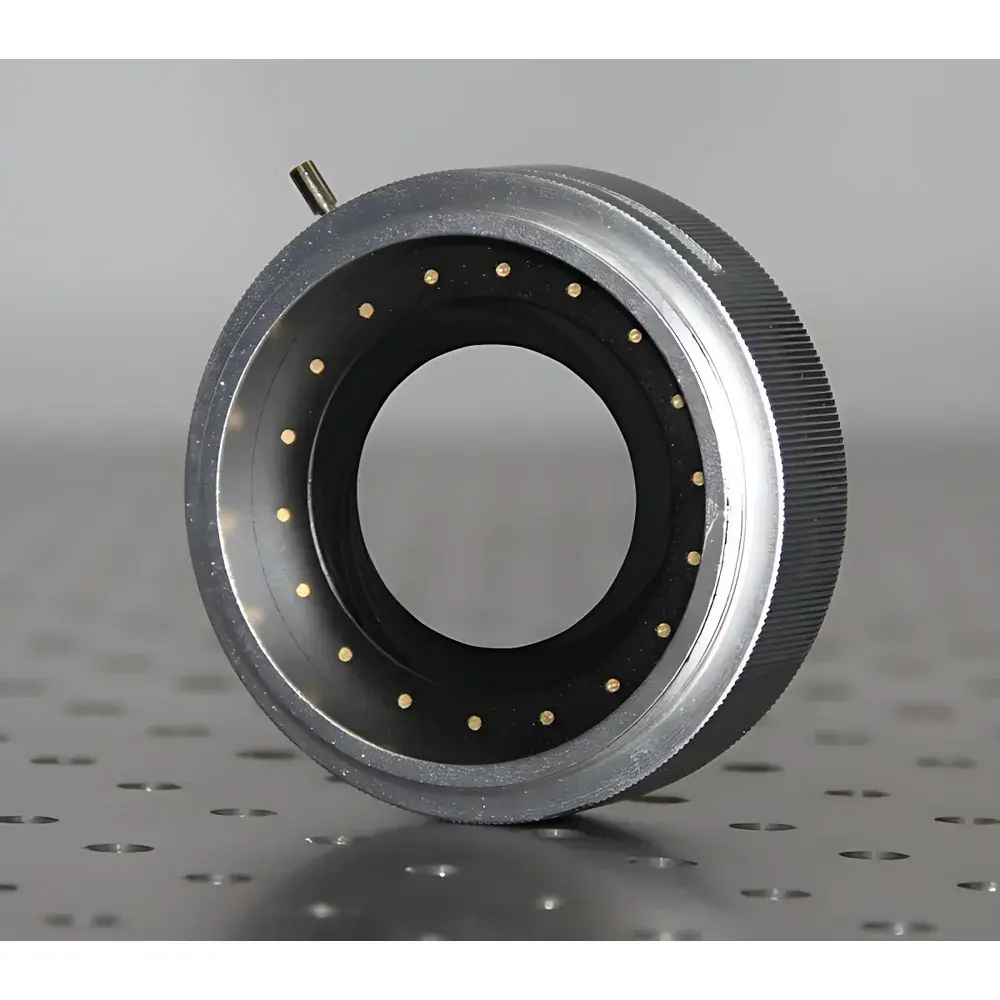
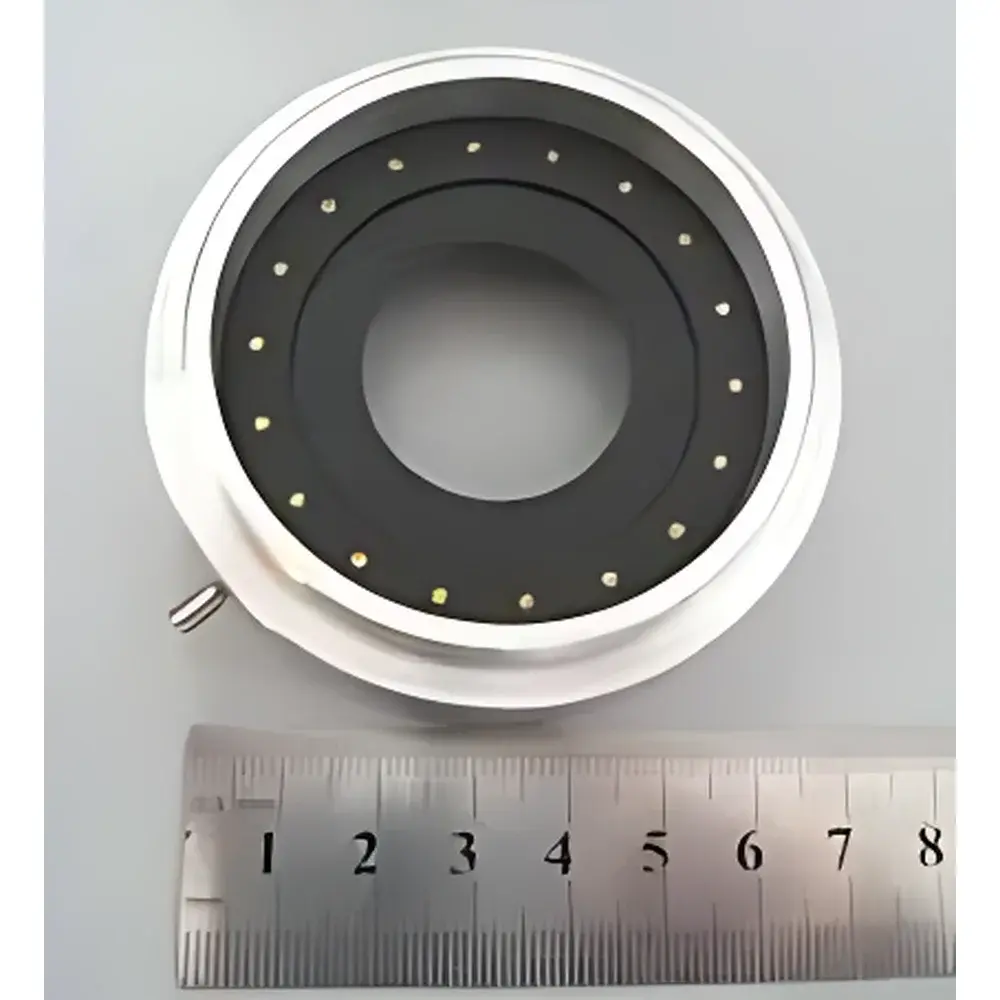
Adjustable Iris Diaphragm
| Brand | CNI |
|---|---|
| Origin | Beijing, China |
| Manufacturer Type | OEM Manufacturer |
| Origin Category | Domestic |
| Model | Adjustable Iris Diaphragm |
| Pricing | Upon Request |
| Aperture Range | 3–60 mm (Continuously Variable) |
Overview
The CNI Adjustable Iris Diaphragm is a precision mechanical optical component engineered for accurate control of beam diameter and irradiance distribution in laboratory, research, and industrial optical setups. Based on the principle of concentric multi-blade iris actuation, it enables smooth, repeatable adjustment of the effective aperture from 3 mm to 60 mm—without discrete steps or mechanical backlash. This device does not perform measurement or spectral analysis; rather, it serves as a passive, alignment-critical element in laser delivery systems, collimation benches, imaging optics, photodetector calibration stations, and optical path conditioning for spectrometers or interferometers. Its robust all-metal construction ensures long-term dimensional stability under ambient thermal fluctuations and repeated manual operation.
Key Features
- Continuously variable aperture range from 3 mm to 60 mm, calibrated for radial symmetry and minimal vignetting
- High-precision brass and stainless-steel blade assembly with low-hysteresis spring return mechanism
- Black-anodized aluminum housing to minimize internal stray light and support integration into dark-box environments
- Standard M25.5×0.75 external thread mount compatible with common lens tubes, kinematic mounts, and optical breadboards
- No electrical interface required—fully manual operation with tactile knurled adjustment ring for fine control
- Designed for use in ambient laboratory conditions (15–30 °C, <60% RH); no active cooling or vacuum compatibility
Sample Compatibility & Compliance
The CNI Adjustable Iris Diaphragm is compatible with free-space optical configurations operating across UV-VIS-NIR spectra (190–1100 nm), provided incident beam divergence and power density remain within safe limits for uncooled metallic apertures (≤5 W/cm² for CW lasers). It does not introduce spectral filtering or polarization dependence. While not certified to ISO 9001 or ISO/IEC 17025 as a standalone metrological instrument, its mechanical repeatability (±0.15 mm at full scale) supports traceable beam profiling when used in conjunction with NIST-traceable beam profilers or scanning slit systems. It complies with general laboratory safety standards for non-powered optical hardware per IEC 60825-1 (laser product safety) when integrated into Class 1–3R optical enclosures.
Software & Data Management
This is a purely mechanical, analog optical component with no embedded electronics, firmware, or digital interface. Consequently, it does not require drivers, SDKs, or software integration. Aperture setting is recorded manually in experimental logs or linked via metadata tags in image acquisition software (e.g., Thorlabs ThorCam, MATLAB Image Acquisition Toolbox, or LabVIEW-based beam characterization suites) when paired with synchronized camera capture. For GLP/GMP-aligned labs, operators may document aperture position using standardized logbook entries or LIMS-integrated checklists referencing defined SOPs (e.g., “Aperture set to 22.0 mm prior to CCD flat-field calibration”).
Applications
- Laser beam conditioning prior to spatial filters or fiber coupling optics
- Defining field stops in Köhler illumination pathways for microscopy and machine vision systems
- Controlling numerical aperture (NA) in collimated test setups for lens MTF evaluation
- Attenuating beam intensity via geometric area reduction—used as a coarse neutral-density alternative in high-power UV systems where absorptive filters degrade
- Establishing reference apertures for radiometric calibration of integrating spheres and photodiode-based power meters
- Aligning optical axis symmetry in interferometric cavity design and cavity dumping experiments
FAQ
Is this iris diaphragm motorized or remotely controllable?
No—it is strictly manual. No electrical connections, stepper motors, or RS-232/USB interfaces are included.
Can it be used in vacuum environments?
Not without modification. Standard version uses lubricated metal-on-metal contacts unsuitable for UHV; custom dry-film coated variants are available upon engineering consultation.
What is the maximum incident power density it can withstand?
For continuous-wave (CW) sources, ≤5 W/cm² at visible wavelengths; pulsed lasers require peak fluence evaluation—contact technical support with pulse duration, repetition rate, and spot size.
Does the aperture scale include metric markings?
Yes—engraved millimeter graduations (0.5 mm increments) are visible adjacent to the adjustment ring, with interpolation possible between marks.
Is there a locking mechanism to prevent drift during vibration?
No integral lock is provided; however, optional friction-lock collars (sold separately) can be threaded onto the M25.5 mount to secure position under moderate lab vibration.



