
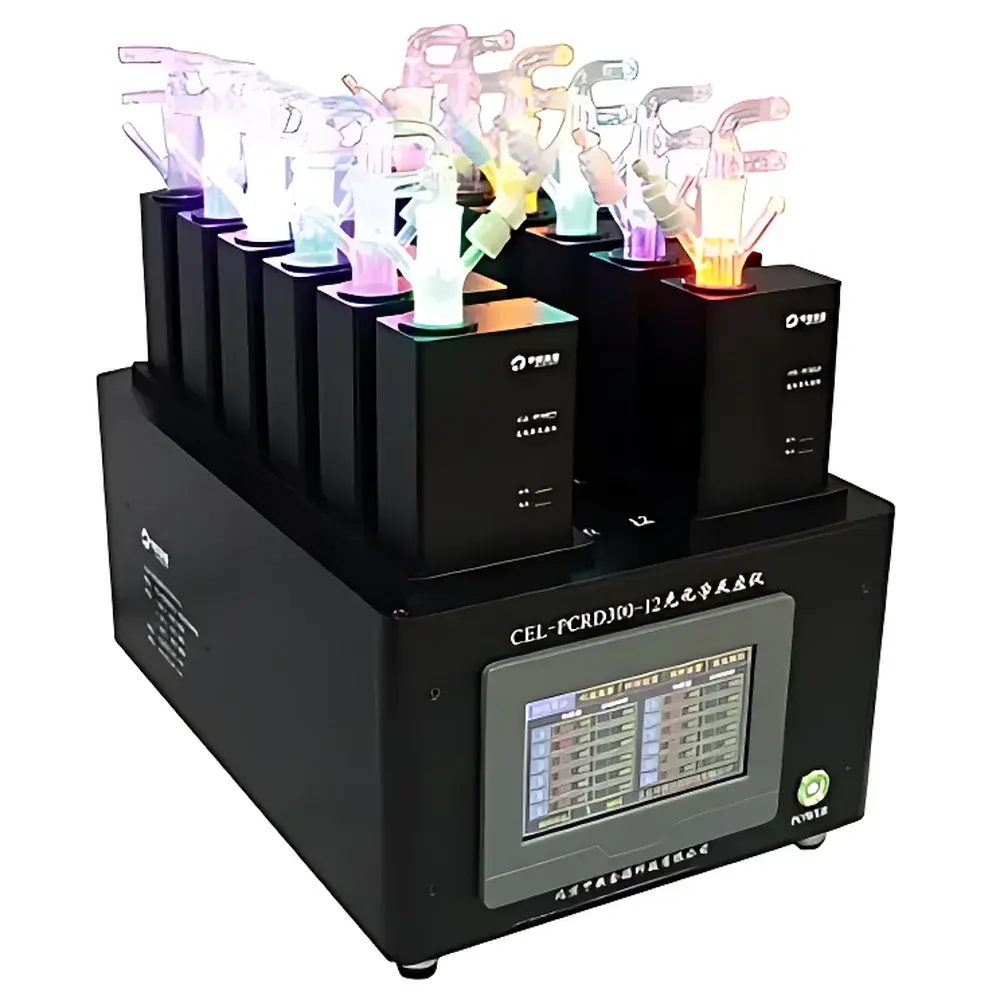
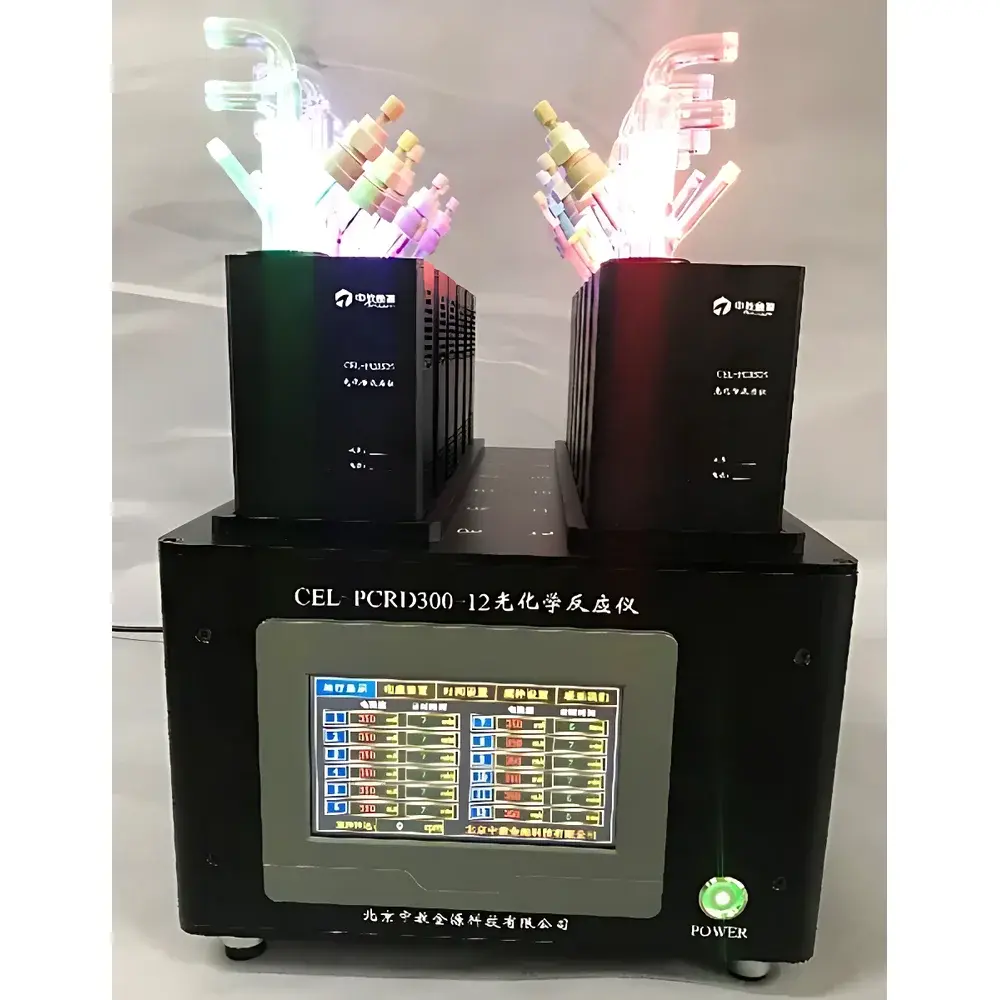
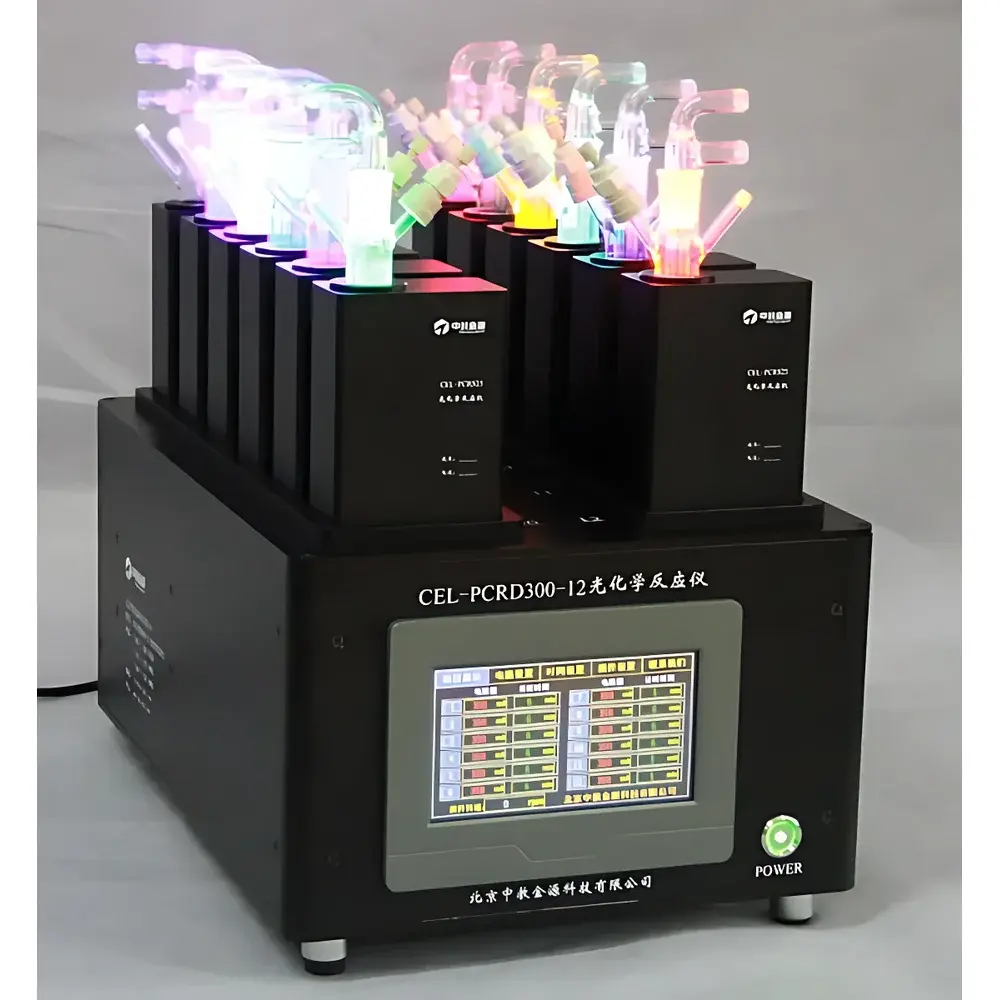
CEL-PCRD300-12 LED Photoreactor System
| Brand | CEL (China Education Goldsource) |
|---|---|
| Origin | Beijing, China |
| Manufacturer Type | Direct Manufacturer |
| Product Category | Domestic |
| Model | CEL-PCRD300-12 |
| Light Source Type | High-Power Tunable LED Array |
| Irradiation Mode | Side-Illumination Configuration |
| Number of Reaction Stations | 12 Independent Channels |
| LED Power per Channel | 25 W (DC 38 V, ±0.01%) |
| Total Input Power | 300 W (AC 220 V, ±0.01%) |
| Touchscreen Interface | 7-inch HD LCD (240 × 128 dpi) |
| Illuminated Area per Station | 100 mm × 20 mm (for 50 mL quartz tube) |
| Irradiance Uniformity | < 2% (measured across active irradiated surface) |
| Standard Wavelengths | 365, 395, 405, 420, 455, 470, 500, 520, 590, 620, 660 nm, and White LED |
| Optional Wavelengths | 740, 810, 850, 940 nm |
| Cooling Method | Passive/Convection (No Water Cooling Required) |
| Modular Lamp Housing | CEL-PCRS25 — Hot-Swappable LED Modules |
| Gas Control System | CEL-GDT-12 12-Channel Gas Distribution Unit with Independent Mass Flow Regulation |
| Sample Vessels | 12 × Quartz Reaction Tubes (50 mL standard |
| Temperature Management | Compatible with external cooling jackets or cryo-cold wells (optional) |
| Software Compatibility | Standalone touchscreen control |
Overview
The CEL-PCRD300-12 LED Photoreactor System is an engineered platform for high-throughput, wavelength-resolved photochemical experimentation under controlled environmental conditions. Designed around the principles of quantum yield determination, photocatalytic kinetics, and reaction stoichiometry analysis, it employs a side-illumination architecture based on individually addressable, high-radiance LED modules—eliminating reliance on broadband arc lamps (e.g., Xe or Hg) and associated optical filtering, thermal management, and spectral instability issues. Each of the 12 reaction stations operates independently, enabling parallel irradiation experiments at discrete wavelengths, intensities, and gaseous or liquid-phase atmospheres. The system supports both static and flow-through configurations and is optimized for studies requiring precise photon flux delivery—including heterogeneous photocatalysis, solar fuel generation (H₂ evolution, CO₂ reduction), nitrogen fixation, environmental pollutant degradation, and photobiological reaction screening.
Key Features
- 12-channel parallel architecture with fully independent control of irradiance, wavelength selection, magnetic stirring speed, gas composition, and vacuum level per station.
- Side-illumination geometry delivering >10× larger effective irradiated area compared to conventional bottom-illuminated reactors—enhancing photon absorption efficiency in turbid or scattering media.
- Modular CEL-PCRS25 LED lamp housings support hot-swappable wavelength modules, allowing rapid reconfiguration without system shutdown or recalibration.
- No water cooling or mechanical filters required—LEDs operate at DC 38 V with passive thermal dissipation, ensuring long-term radiometric stability and reduced maintenance overhead.
- Integrated 7-inch HD touchscreen controller (240 × 128 dpi resolution) provides real-time monitoring and parameter logging for all 12 channels, with non-volatile memory for method storage and recall.
- Standardized quartz reaction tubes (50 mL, UV-grade fused silica) ensure high transmittance from 250 nm to >1100 nm; optional 100 mL configuration available with matching irradiation geometry.
Sample Compatibility & Compliance
The CEL-PCRD300-12 accommodates diverse sample formats—including suspended catalyst slurries, immobilized photocatalyst films, gas-phase mixtures (e.g., CO₂/H₂O vapor), and homogeneous solutions—within standardized quartz vessels rated for vacuum (<10⁻² mbar) and inert or reactive atmospheres. All wetted components (PEEK fittings, fluoropolymer tubing, stainless-steel gas manifolds) comply with ISO 8573-1 Class 2 purity standards for compressed air/gas handling. While not certified to IEC 61000-6-3 or UL 61010-1 as a complete system, individual subassemblies—including the CEL-GDT-12 gas distribution unit—meet CE marking requirements for electromagnetic compatibility and low-voltage directive compliance. The reactor design facilitates GLP-aligned experimental documentation when paired with external audit-trail-capable data acquisition systems.
Software & Data Management
Operation is managed via embedded firmware running on the 7-inch capacitive touchscreen interface. Each channel records timestamped operational parameters—including LED drive current, measured junction temperature, stirrer RPM, gas flow rates (via integrated MFC feedback), and vacuum pressure—into internal flash memory (≥10,000 data points per channel). Export is supported via USB 2.0 to CSV format for post-processing in MATLAB, Python (Pandas), or OriginLab. Although the system does not natively implement FDA 21 CFR Part 11 electronic signature or audit trail functionality, its deterministic control logic and parameter logging structure enable integration into validated laboratory information management systems (LIMS) through RS-232 or Modbus RTU protocols (available via optional expansion module).
Applications
- Quantitative evaluation of photocatalyst activity across multiple wavelengths for bandgap mapping and action spectrum derivation.
- High-throughput screening of co-catalysts, sacrificial agents, and support materials under industrially relevant illumination conditions.
- Kinetic modeling of interfacial charge transfer processes via in situ product quantification (e.g., GC-TCD/FID, HPLC-UV/Vis, online MS).
- Photocorrosion resistance testing under controlled O₂, N₂, or Ar atmospheres with simultaneous electrochemical biasing (requires optional potentiostat interface).
- Environmental simulation studies—e.g., NOₓ abatement, VOC mineralization, and antibiotic photolysis—under simulated solar spectra assembled from discrete LED bands.
- Photoenzymatic and photobiocatalytic reaction optimization where narrowband excitation minimizes unintended photodamage to biomacromolecules.
FAQ
Does the CEL-PCRD300-12 support real-time spectral irradiance measurement?
No built-in spectroradiometer is included; however, each CEL-PCRS25 module is factory-calibrated for radiant flux (W/sr) at its nominal wavelength. NIST-traceable calibration reports are supplied per module batch.
Can the system be operated under anaerobic conditions?
Yes—the CEL-GDT-12 gas distribution unit supports sequential purging, continuous inert gas sparging, and dynamic atmosphere switching across all 12 channels with mass flow accuracy ±1% FS.
Is temperature control integrated into the base unit?
No; thermal regulation requires external integration—e.g., circulating chillers connected to optional cold-well adapters or Peltier-cooled stage mounts compatible with the 100 mm × 20 mm irradiation footprint.
What is the maximum permissible operating temperature of the quartz reaction tubes?
Standard tubes are rated to 800 °C for short-term exposure; sustained operation above 200 °C is not recommended without vacuum-sealed PTFE-free sealing solutions.
Are firmware updates available for the touchscreen controller?
Yes—updates are distributed quarterly via secure download portal and installed via USB stick; version history and release notes are provided in English with traceable change logs.





