
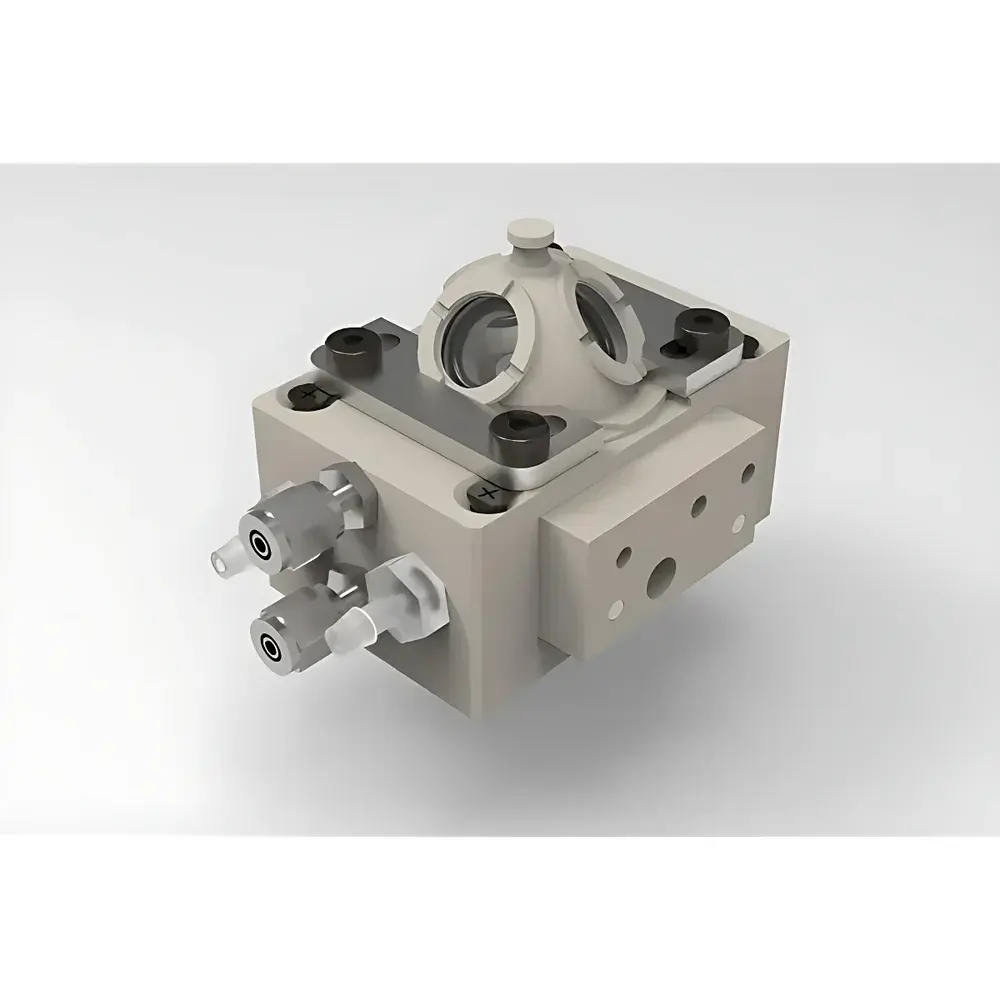
CEL-ISC-PME01 Metal-Electrode In-Situ Plasma Cell
| Brand | CEL (CNI) |
|---|---|
| Origin | Beijing, China |
| Manufacturer Type | Direct Manufacturer |
| Region Classification | Domestic (China) |
| Model | CEL-ISC-PME01 |
| Pricing | Upon Request |
| Construction Material | PEEK |
| Operating Temperature Range | −20 °C to +150 °C (cell body) |
| Pressure Rating | Ambient (1 atm) |
| Electrode Configuration | Dual metal electrodes (anode & cathode) |
| Discharge Gap | 2 mm (customizable) |
| Catalyst Cartridge Dimensions | Ø7 mm (OD) × Ø3 mm (ID) × 5 mm (H) or Ø6 mm (OD) × Ø2 mm (ID) × 5 mm (H) |
| Dielectric Barrier | Single- or dual-layer fused quartz |
| Optical Windows | IR-triple-view cap (BaF₂, ZnSe, SiO₂, or Al₂O₃ options) |
| Spectroscopic Compatibility | FTIR (Bruker, Thermo Fisher, Gangdong), Raman, and optical emission spectroscopy (OES) |
Overview
The CEL-ISC-PME01 Metal-Electrode In-Situ Plasma Cell is an engineered platform for real-time, spectroscopically coupled investigation of non-thermal plasma–catalyst interactions under controlled thermal and gas-phase conditions. Designed around the principles of dielectric barrier discharge (DBD), it enables spatially localized, low-temperature plasma generation directly within a catalytic reaction zone—facilitating mechanistic studies of plasma-assisted heterogeneous catalysis. Unlike conventional ex-situ reactors, the CEL-ISC-PME01 integrates high-transparency optical access with precise thermal management and electrode configurability, allowing simultaneous monitoring of surface adsorbates, gaseous intermediates, and excited-state species via complementary in situ techniques including Fourier-transform infrared (FTIR) spectroscopy, laser Raman spectroscopy, and atomic emission spectroscopy (AES). Its modular architecture supports both fundamental research into plasma–surface charge transfer and applied development of energy-efficient catalytic processes such as CO₂ conversion, NH₃ synthesis, VOC abatement, and selective hydrocarbon oxidation.
Key Features
- Modular optical caps: Triple-view IR cap (for transmission-mode FTIR) and single-view Raman cap—both interchangeable without disassembly of the main cell body.
- Multi-material window compatibility: Standard options include barium fluoride (BaF₂, 0.15–12 µm), zinc selenide (ZnSe, 0.5–20 µm), fused silica (SiO₂, 0.2–3.5 µm), and sapphire (Al₂O₃, 0.15–5.5 µm); custom substrates (e.g., CaF₂, MgF₂) available upon specification.
- Adjustable discharge geometry: Precise 2 mm inter-electrode gap (reconfigurable per experimental requirement), with option to vary electrode polarity, material (e.g., stainless steel, tungsten, nickel), and dielectric barrier configuration (single- or dual-quartz).
- Liquid-bath temperature control: Integrated jacket accommodates external chiller/heater units, enabling stable catalyst-zone temperature regulation from −20 °C to +80 °C—critical for decoupling thermal effects from plasma-specific activation pathways.
- PEEK-based structural integrity: Chemically inert, vacuum-compatible housing rated for continuous operation between −20 °C and +150 °C; compatible with reactive gases (O₂, H₂, NH₃, NOₓ, hydrocarbons) and corrosive precursors.
Sample Compatibility & Compliance
The CEL-ISC-PME01 supports solid catalysts in pellet, powder, or monolithic forms loaded into standardized cylindrical cartridges (Ø6–7 mm OD, 2–3 mm ID, 5 mm height). It interfaces seamlessly with commercial FTIR spectrometers (Bruker Tensor series, Thermo Fisher Nicolet iS series, Gangdong FTIR-650/850) using standard Harrick-type accessories. For Raman coupling, the single-view cap permits backscattering geometry with 532 nm or 785 nm excitation lasers. All optical interfaces meet ISO 10110 surface quality standards; window mounts comply with UHV-compatible kinematic design principles. The system operates at ambient pressure and does not require vacuum certification; however, optional O-rings and sealing protocols support integration into semi-closed gas-loop systems meeting ASTM D7269 and ISO 10477 guidelines for catalytic testing.
Software & Data Management
While the CEL-ISC-PME01 is a hardware-only reactor (no embedded firmware or controller), its operational parameters are fully compatible with third-party instrumentation software environments. Temperature logging is achieved via PT100 sensor outputs integrated into standard PID controllers (e.g., Huber Chiller software, Omega CNi16 series). Plasma power delivery is synchronized with oscilloscope-based discharge characterization (e.g., Tektronix MDO3000) and spectral acquisition software (OPUS, OMNIC, LabSpec). Full audit trails—including time-stamped temperature setpoints, gas flow rates, voltage/current waveforms, and spectral acquisitions—can be archived in accordance with GLP-compliant data governance frameworks. When deployed in regulated environments, the system supports 21 CFR Part 11–aligned metadata tagging through laboratory information management systems (LIMS) when paired with validated FTIR/Raman platforms.
Applications
- In situ monitoring of surface carbonate, formate, and carbonyl intermediates during plasma-driven CO₂ hydrogenation over Cu/ZnO/Al₂O₃.
- Time-resolved tracking of N–H and N=O vibrational modes in low-power plasma-assisted ammonia synthesis on Fe–Ru catalysts.
- Correlation of electron energy distribution functions (EEDF) with transient IR band intensities during VOC decomposition over MnOₓ/TiO₂.
- Plasma-induced defect formation and lattice oxygen mobility studies in perovskite oxides via Raman-active phonon mode shifts.
- Quantification of excited-state nitrogen species (N₂(A³Σᵤ⁺), N₂⁺(B²Σᵤ⁺)) via optical emission spectroscopy under variable power modulation.
FAQ
Can the CEL-ISC-PME01 be used under reduced pressure or vacuum conditions?
No—it is designed exclusively for ambient-pressure operation. Vacuum compatibility requires additional flange modifications and is not part of the standard configuration.
Is the cell compatible with synchrotron-based IR beamlines?
Yes, provided the beamline’s optical path accommodates the physical footprint and window transmission range; BaF₂ and ZnSe variants are routinely used at facilities including BESSY II and SOLEIL.
What safety certifications does the reactor carry?
As a passive reactor component, it carries no electrical certification; users must ensure full compliance of the connected plasma power supply (e.g., kHz–MHz AC/DC sources) with IEC 61000-6-3 and local high-voltage safety regulations.
How is catalyst loading performed without compromising optical alignment?
A removable cartridge holder allows catalyst insertion/extraction while maintaining fixed axial positioning relative to the optical axis—verified via alignment laser prior to each experiment.
Can the discharge gap be adjusted in situ?
No—gap adjustment requires mechanical reassembly. However, fine-tuning of plasma uniformity and power density is achievable via voltage ramping, frequency modulation, and gas composition control.



