
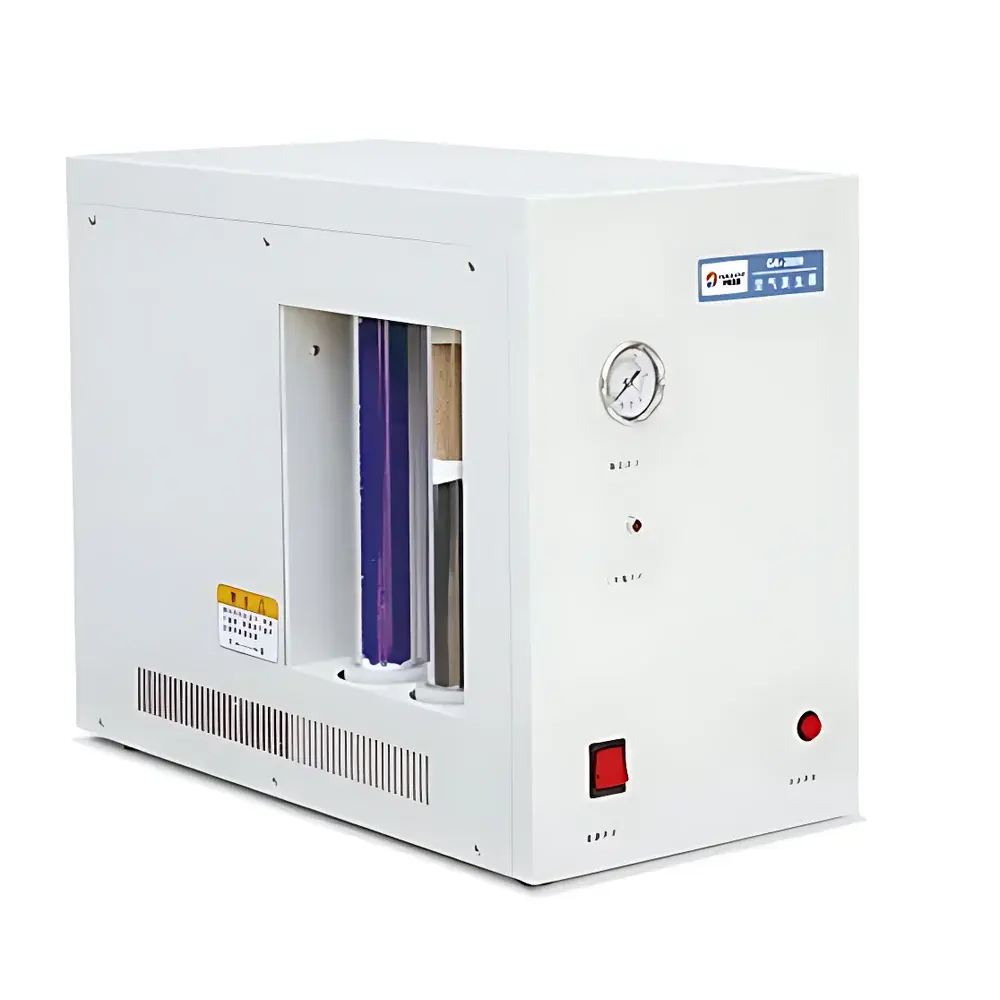
CHNTECH THA3L Air Generator
| Brand | CHNTECH |
|---|---|
| Origin | Beijing, China |
| Manufacturer Type | Direct Manufacturer |
| Country of Origin | China |
| Model | THA3L |
| Hydrocarbon Removal Principle | High-Temperature Catalytic Oxidation |
| Output Flow Rate | 0–3 L/min |
| Output Pressure | 0–0.4 MPa |
| Hydrocarbon Content | < 0.1 ppm (non-detectable by FID) |
| Dew Point | ≤ –40 °C (at 0.4 MPa) |
| Noise Level | ≤ 42 dB(A) |
| Power Supply | 220 V AC, 50 Hz |
| Operating Temperature | 15–40 °C |
| Relative Humidity | ≤ 70 % RH (non-condensing) |
| Power Consumption | 150 W |
| Dimensions (L×W×H) | 470 × 240 × 380 mm |
| Weight | 23 kg |
Overview
The CHNTECH THA3L Air Generator is an engineered solution for laboratories requiring continuous, high-purity, oil-free compressed air—specifically optimized for flame ionization detection (FID) in gas chromatography (GC) systems and as actuation gas for automated six-port valves. Unlike oil-lubricated compressors or bottled air sources, the THA3L employs a brushless DC scroll compressor coupled with a three-stage purification architecture—including particulate filtration, activated carbon adsorption, and high-temperature catalytic oxidation—to eliminate hydrocarbons, moisture, and oil vapors. Its core measurement principle relies on catalytic conversion of residual hydrocarbons at >350 °C over a proprietary Pt/Pd catalyst bed, ensuring consistent non-detectable hydrocarbon output (<0.1 ppm, verified by FID response). The system delivers stable flow and pressure across its full operational range (0–3 L/min at 0–0.4 MPa), with thermal management designed to maintain dew point performance ≤ –40 °C at maximum pressure—critical for preventing condensation-induced detector instability or valve stiction.
Key Features
- Oil-free scroll compressor with integrated thermal protection and low-vibration mounting—ensuring long-term mechanical stability and minimal interference with sensitive instrumentation.
- Three-stage purification train: 0.1 µm pre-filter, high-capacity activated carbon column, and high-temperature catalytic oxidizer (350–400 °C) for complete hydrocarbon abatement.
- Digital pressure regulation with real-time feedback control, enabling precise setpoint adjustment from 0 to 0.4 MPa without manual regulators or downstream regulators.
- Acoustically damped enclosure achieving ≤42 dB(A) noise emission—validated per ISO 3744 at 1 m distance—suitable for shared laboratory environments.
- Integrated safety circuitry including over-temperature shutdown, pressure relief valve (set at 0.45 MPa), and automatic compressor cycling to prevent overheating during extended operation.
- Front-panel LED indicators for power status, pressure readiness, and filter service alert—supporting predictive maintenance without diagnostic software dependency.
Sample Compatibility & Compliance
The THA3L is compatible with all GC-FID configurations requiring Class 0 (ISO 8573-1:2010) compressed air—particularly those compliant with ASTM D3612, USP , and ICH Q2(R2) method validation requirements. Its hydrocarbon-free output meets the stringent air purity specifications mandated for FID baseline stability and quantitative reproducibility (RSD < 0.5 % for replicate injections). The unit conforms to IEC 61000-6-3 (EMC emission limits) and IEC 61000-6-2 (immunity standards), and its electrical design complies with GB 4793.1–2019 (equivalent to IEC 61010-1). While not certified to UL/CSA, it is routinely deployed in GLP-compliant labs where instrument qualification (IQ/OQ/PQ) includes documented air purity verification via online FID monitoring or periodic GC–MS headspace analysis.
Software & Data Management
The THA3L operates as a standalone hardware platform with no embedded firmware-based data logging or network interface. All operational parameters—including runtime hours, cumulative compressor cycles, and filter service intervals—are tracked manually via lab logbooks or integrated into facility-wide CMMS platforms using discrete dry-contact signals (optional relay output module available upon request). For regulatory traceability, users are advised to implement periodic air quality verification protocols aligned with FDA 21 CFR Part 11 Annex 11 principles—e.g., scheduled hydrocarbon testing using calibrated FID response curves and dew point validation via chilled-mirror hygrometry. CHNTECH provides full technical documentation (including schematics, BOM, and calibration certificates for pressure transducers) to support audit readiness.
Applications
- Primary combustion air supply for GC–FID systems in environmental, petrochemical, and pharmaceutical QC laboratories.
- Actuation gas source for pneumatically driven six-port sampling valves in automated GC injectors and purge-and-trap concentrators.
- Carrier gas makeup air in dual-channel GC configurations requiring independent, synchronized air streams.
- Zero-air generation for ambient air monitoring calibrations when paired with ozone scrubbers and CO scrubbers (external modules).
- Support gas for FTIR spectrometers requiring dry, hydrocarbon-free purge lines.
FAQ
What is the expected service life of the catalytic converter under continuous operation?
The high-temperature catalyst is rated for ≥10,000 hours of continuous use at rated flow and ambient temperatures ≤35 °C; lifetime decreases proportionally with sustained operation above 38 °C or exposure to silicone vapors.
Can the THA3L be used with GC–MS systems?
It is not recommended as source gas for MS ion sources due to potential trace metal outgassing from the catalytic bed; however, it is fully suitable for MS detector auxiliary gases (e.g., make-up gas, collision gas) when verified via background mass scan.
Is routine calibration required?
No factory calibration is needed—the pressure transducer is pre-calibrated and traceable to NIM (China National Institute of Metrology); users should verify output dew point annually using an accredited chilled-mirror hygrometer.
Does the unit include an internal desiccant dryer?
No—moisture removal is achieved solely via refrigerated drying (integrated Peltier cooler) followed by catalytic oxidation; optional external desiccant dryers may be added for sub–60 °C dew point requirements.
What maintenance intervals apply to the filtration system?
The 0.1 µm particulate filter and activated carbon column require replacement every 6 months under typical lab use (8 h/day, 5 days/week); catalyst replacement is only necessary after confirmed hydrocarbon breakthrough or catastrophic moisture ingress.



