
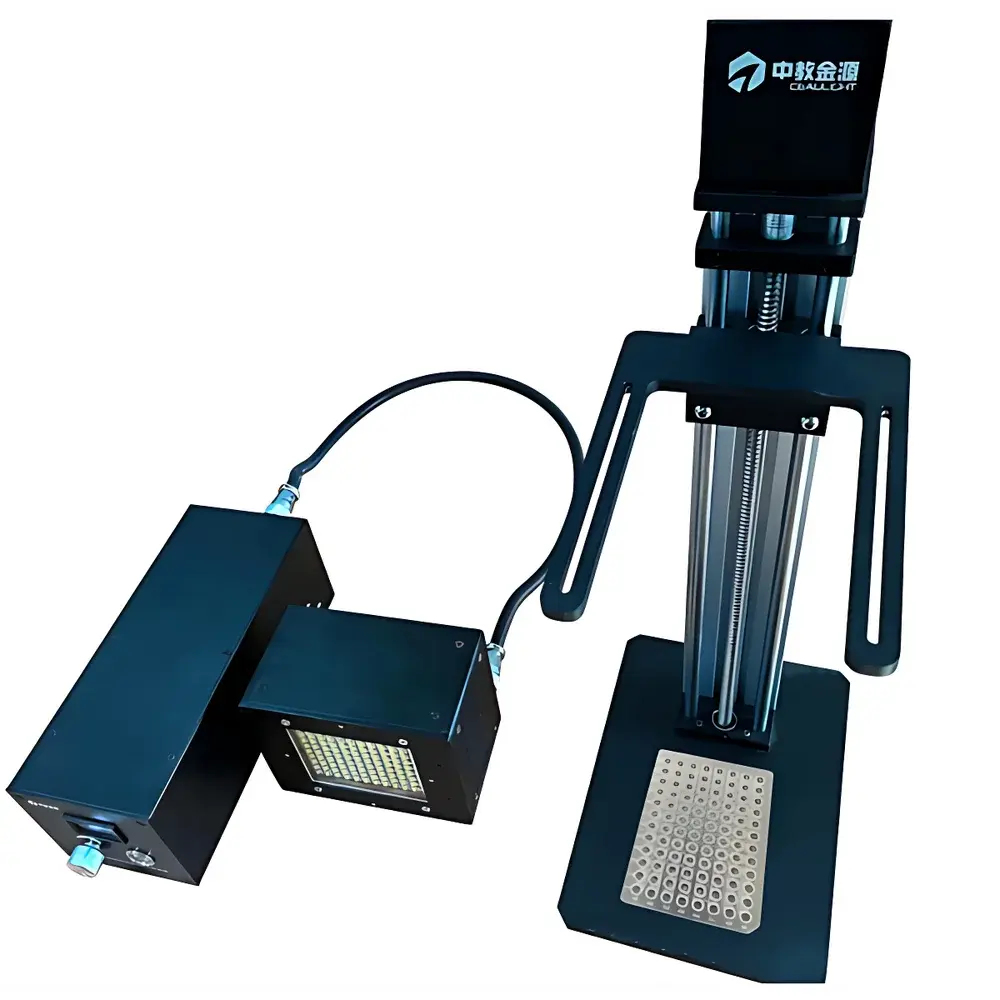
CEL-LED100HA-96 High-Uniformity Multi-Wavelength LED Illumination System for Photochemical Reactors
| Brand | CEAULIGHT (Zhongjiao Jinyuan) |
|---|---|
| Model | CEL-LED100HA-96 |
| Light Output Area | 108 mm × 90 mm |
| Irradiance Uniformity | <5% |
| Spectral Options | 365 nm–940 nm (FWHM ≤20 nm), White LED standard |
| Max Irradiance | <200 mW/cm² (measured with CEL-NP2000 radiometer) |
| Total Input Power | 240 W (AC 220 V ±0.01%) |
| LED Power Consumption | <200 W |
| Operating Current | <5.0 A (0.01 A resolution) |
| Minimum Lifetime | 10,000 h (except 365 nm) |
| Cooling | Separated forced-air cooling (optical path isolated from airflow) |
| Control Interface | Digital display showing real-time voltage and current |
| Optional Accessories | LMP400 motorized XYZ stage (400 mm vertical travel, horizontal/vertical irradiation capability) |
| Compliance | Designed for GLP-compliant photochemical workflows requiring traceable, stable, and wavelength-specific irradiation |
Overview
The CEL-LED100HA-96 is a high-precision, multi-wavelength LED illumination system engineered specifically for controlled photochemical experimentation in research laboratories and industrial R&D settings. Unlike broadband arc lamps (e.g., xenon or mercury vapor sources), this system delivers narrowband, spectrally defined irradiation via discrete high-power LED emitters—each with full-width-at-half-maximum (FWHM) bandwidth ≤20 nm—enabling rigorous wavelength-dependent reaction kinetics studies. Its 108 mm × 90 mm uniform irradiation field is optimized to fully illuminate standard 96-well microplates, Petri dishes, microfluidic chips, and planar photocatalytic substrates—making it ideal for high-throughput screening of photocatalysts, photobiological assays, optoelectrochemical cell testing, and solid-state luminescence characterization. The optical architecture integrates thermal management with physical separation of light and airflow paths, ensuring long-term radiometric stability (<0.5% drift over 4 h at rated output) and eliminating convective interference with sensitive samples.
Key Features
- Modular monochromatic LED array: 15 selectable wavelengths (365, 395, 405, 420, 455, 470, 500, 520, 590, 620, 660, 740, 850, 940 nm + white), all with FWHM ≤20 nm and calibrated spectral output.
- High spatial uniformity: <5% irradiance variation across the full 108 × 90 mm active area, verified per ISO/CIE standards using NIST-traceable radiometric mapping.
- Digitally regulated constant-current drive: Real-time monitoring of forward voltage and operating current (0.01 A resolution); enables precise intensity scaling without spectral shift.
- Dual-axis irradiation flexibility: Compatible with the LMP400 motorized platform for programmable vertical/horizontal sample positioning and oblique-angle illumination (±60°).
- Thermally robust design: Forced-air cooling system physically isolates the optical path from airflow, preventing sample desiccation, thermal gradient artifacts, or LED junction temperature drift.
- Energy-efficient operation: >80% reduction in power consumption versus equivalent-intensity xenon or mercury lamps; no warm-up time, no ozone generation, no UV-B/C hazard beyond selected band.
Sample Compatibility & Compliance
The CEL-LED100HA-96 supports diverse sample formats including 96-well plates (flat-bottom or tissue-culture treated), 35–150 mm Petri dishes, glass slides, quartz cuvettes (10 mm path), and custom planar reactors up to 120 mm × 100 mm. Its modular wavelength selection aligns with common photobiological action spectra (e.g., CIE S 026 for photobiomodulation, ASTM E2937 for photocatalytic degradation testing) and electrochemical standards (e.g., ASTM G173 for solar-weighted irradiance). The system’s digital control interface logs timestamped operational parameters (current, voltage, runtime), supporting audit-ready documentation for GLP, ISO/IEC 17025, and FDA 21 CFR Part 11–compliant environments when integrated with validated LIMS or ELN platforms.
Software & Data Management
While the base unit operates via standalone digital front-panel control, optional USB/RS-485 interfaces enable integration with LabVIEW, Python (PySerial), or MATLAB for automated irradiation protocols—including ramped intensity profiles, timed spectral switching, and synchronized data acquisition from external sensors (e.g., quantum sensors, potentiostats, or fluorescence detectors). All intensity settings are stored in non-volatile memory. Radiometric calibration certificates (traceable to NIST SRM 2252) are provided per wavelength channel, including spectral power distribution (SPD) curves and irradiance maps at 100 mm working distance.
Applications
- Photocatalysis: Screening TiO₂, g-C₃N₄, MOFs, and perovskite-based catalysts under monochromatic excitation to isolate band-gap–driven mechanisms.
- Photobiology: Dose-controlled UV-A/blue/red-light exposure for circadian rhythm studies, photodynamic therapy (PDT) agent evaluation, and optogenetic stimulation in adherent or suspension cultures.
- Photoelectrochemistry: Controlled bias-light illumination during linear sweep voltammetry (LSV) or impedance spectroscopy (EIS) of dye-sensitized or perovskite solar cells.
- Material science: Accelerated photodegradation testing of polymers, pigments, and coatings per ISO 4892-3 (fluorescent UV) or ASTM G154.
- Chemical kinetics: Time-resolved monitoring of photolysis rates (e.g., NO₂ decomposition, H₂O₂ cleavage) under reproducible photon flux conditions.
FAQ
What is the recommended working distance for optimal uniformity?
The specified <5% irradiance uniformity is guaranteed at a 100 mm sample-to-lamp distance. Uniformity degrades gradually beyond ±15 mm deviation; we recommend calibrating with a reference sensor at your specific setup.
Can multiple wavelengths be activated simultaneously?
Yes—the system supports concurrent activation of any combination of installed LED channels, enabling polychromatic irradiation experiments with independently adjustable intensities.
Is radiometric calibration included with shipment?
Each unit ships with a full spectral calibration report per installed wavelength, including SPD curves, peak wavelength accuracy (±1 nm), and absolute irradiance values (mW/cm²) measured at 100 mm using a calibrated thermopile detector.
How is safety compliance addressed for UV wavelengths?
The 365 nm module includes integrated interlock-compatible shutter control and optional UV-blocking acrylic shielding; full CE/IEC 62471 photobiological safety classification reports are available upon request.
What maintenance is required over the 10,000-hour lifetime?
No consumables or periodic recalibration are required. Routine inspection of air filters (every 6 months under continuous use) and verification of fan operation are sufficient to maintain thermal stability and output fidelity.





