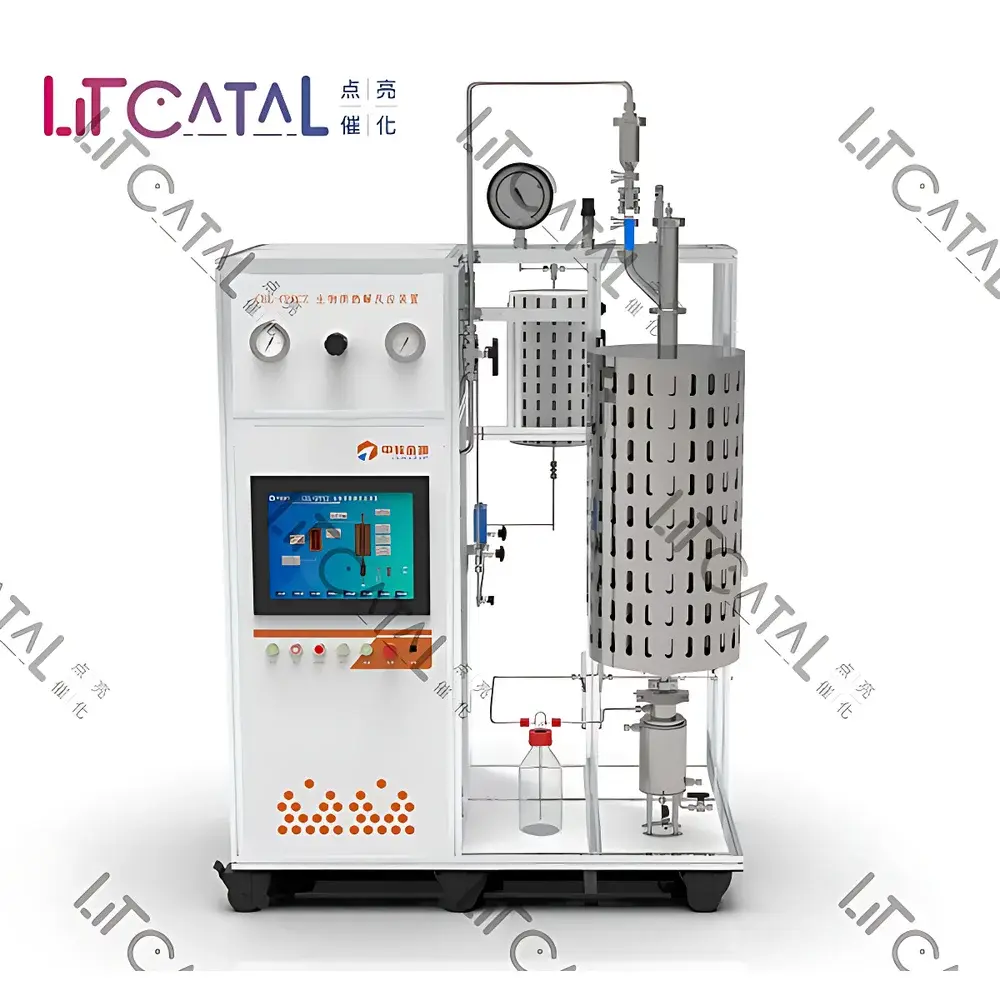
CEL-GPPCZ Custom Biomass Pyrolysis Reaction System by CEA (China Education Goldsource)
| Brand | CEA (China Education Goldsource) |
|---|---|
| Origin | Beijing, China |
| Manufacturer Type | OEM/ODM Producer |
| Country of Origin | China |
| Model | CEL-GPPCZ Custom Biomass Pyrolysis Reaction System |
| Pricing | Upon Request |
| Reactor Temperature Range | 0–1000 °C |
| Preheater Temperature Range | 0–700 °C |
| Tube Heating Jacket Temperature | 0–200 °C |
| Reactor Material | 310S Stainless Steel |
| Tubing Material | 316L Stainless Steel |
| Catalyst Bed Volume | < 400 mL |
| Operating Pressure | Atmospheric |
| Gas Flow Rate | 0–100 SLM (scalable gas channels) |
| Overall Dimensions | 1100 mm × 549 mm × 1664 mm |
| Mobility | Six swivel casters with locking mechanism |
| Control Interface | Industrial-grade touch-panel PC with integrated automation software |
| Safety Features | Over-temperature alarms at all thermal zones, interlocked emergency shutdown, proportional pressure relief valve, vacuum-compatible design |
Overview
The CEL-GPPCZ Custom Biomass Pyrolysis Reaction System is a fully integrated, software-controlled bench-scale thermochemical processing platform engineered for fundamental and applied research in thermal decomposition behavior of heterogeneous organic feedstocks. It operates on the principle of controlled inert-atmosphere pyrolysis—applying precisely ramped heating profiles to solid biomass (e.g., lignocellulosic residues, agricultural waste, animal manure), synthetic polymers (plastics, rubbers), and catalytically doped substrates under atmospheric or reduced pressure conditions. The system enables continuous-feed operation without reactor quenching, supporting time-resolved product evolution studies across solid, liquid (bio-oil condensates), and gaseous phases. Its modular architecture integrates high-temperature furnace zones, heated transfer lines, programmable mass flow control, real-time gravimetric condensate monitoring, and direct coupling to downstream analytical instrumentation—including GC, GC-MS, FTIR, and online micro-GC modules—thereby facilitating mechanistic reaction pathway analysis and kinetic modeling under reproducible laboratory conditions.
Key Features
- Triple-zone independent temperature control: preheater (0–700 °C), main reactor (0–1000 °C), and insulated tubing jacket (0–200 °C), each equipped with Pt100 RTD sensors and over-temperature cut-off interlocks
- Atmospheric or vacuum-compatible operation via integrated pressure regulation system, including proportional pressure relief valve and direct cylinder interface
- Continuous solid feeding capability through top-mounted lock-hopper assembly, enabling dynamic feedstock introduction during active pyrolysis
- Automated real-time mass tracking of condensed liquid products using precision load cells, synchronized with temperature and flow data streams
- Industrial touch-panel PC running proprietary control software with ISO-compliant audit trail logging, user-level access controls, and customizable experiment templates
- Structural frame fabricated from anodized aluminum extrusions; six locking swivel casters for lab mobility; tool-free panel access for maintenance and sensor calibration
- All wetted parts constructed from ASTM A269 Grade 316L stainless steel (tubing) and ASTM A213 Grade 310S stainless steel (reactor tube), ensuring corrosion resistance against acidic condensates and high-temperature oxidation
Sample Compatibility & Compliance
The CEL-GPPCZ accommodates a broad spectrum of solid and semi-solid feedstocks, including but not limited to: lignin-rich woody biomass (e.g., pine sawdust, bamboo chips), herbaceous residues (corn stover, rice husk), municipal solid waste fractions, waste tires, polyolefin plastics, and catalyst-doped composites (e.g., Ni/Al₂O₃, ZSM-5, activated carbon). Feed particle size range: ≤ 5 mm; moisture content tolerance: up to 20 wt%. The system conforms to general laboratory safety standards per IEC 61000-6-2 (EMC immunity) and UL 61010-1 (electrical safety). While not certified to specific regulatory frameworks such as FDA 21 CFR Part 11 out-of-the-box, its software architecture supports configuration for GLP/GMP-aligned workflows—including electronic signatures, version-controlled method storage, and immutable raw-data archiving—when deployed with validated IT infrastructure.
Software & Data Management
Control and data acquisition are managed via CEA’s proprietary PyroLab™ software suite, built on a deterministic real-time kernel with sub-second sampling resolution across all analog and digital I/O channels. The interface provides synchronized visualization of temperature ramps, gas flow profiles, condensate accumulation curves, and pressure transients. All experimental metadata—including operator ID, timestamped method parameters, calibration certificates, and hardware firmware versions—are embedded into HDF5-formatted binary data files. Export options include CSV (for spreadsheet analysis), MATLAB .mat, and direct SQL insertion into LIMS environments. Automated report generation complies with ISO/IEC 17025 documentation requirements, including uncertainty propagation for derived metrics (e.g., char yield, bio-oil selectivity).
Applications
- Kinetic parameter estimation for primary and secondary pyrolysis reactions using isoconversional methods (e.g., Kissinger-Akahira-Sunose)
- Catalyst screening and deactivation studies under realistic thermal cycling conditions
- Bio-oil fractional condensation profiling via temperature-gradient cold traps
- Gas composition mapping (H₂, CH₄, CO, CO₂, C₂–C₄ hydrocarbons) correlated with heating rate and residence time
- Co-pyrolysis interaction analysis between biomass and plastic blends
- Thermal stability assessment of emerging feedstocks (e.g., algae pellets, sewage sludge chars)
- Method development for ASTM E2554 (standard test method for determination of volatile matter in biomass) and ISO 18122 (solid biofuels — determination of ash content)
FAQ
Can the system operate under vacuum or controlled inert gas partial pressures?
Yes—the CEL-GPPCZ includes a vacuum-rated manifold with a proportional pressure relief valve and direct connection ports for N₂, Ar, or He supply cylinders. Absolute pressure control down to 10 mbar is achievable with optional vacuum pump integration.
Is remote monitoring and control supported?
The PyroLab™ software supports secure remote desktop access via TLS-encrypted VNC, provided network policies permit inbound connections to the industrial PC. Optional OPC UA server module enables integration into plant-wide SCADA or MES platforms.
What level of validation support does CEA provide for regulated environments?
CEA delivers IQ/OQ documentation packages upon request, including factory acceptance test (FAT) reports, sensor calibration certificates traceable to NIST standards, and software verification protocols aligned with GAMP5 principles.
Are consumables and spare parts available globally?
All critical components—including 310S reactor tubes, 316L Swagelok fittings, alumina insulation sleeves, and thermocouple assemblies—are stocked in CEA’s EU distribution hub (Germany) and US logistics center (Ohio), with typical lead times under 10 business days.
Does the system comply with CE or UKCA marking requirements?
The base configuration meets CE marking criteria per Machinery Directive 2006/42/EC and EMC Directive 2014/30/EU. UKCA compliance is attainable via third-party notified body assessment upon customer request.