
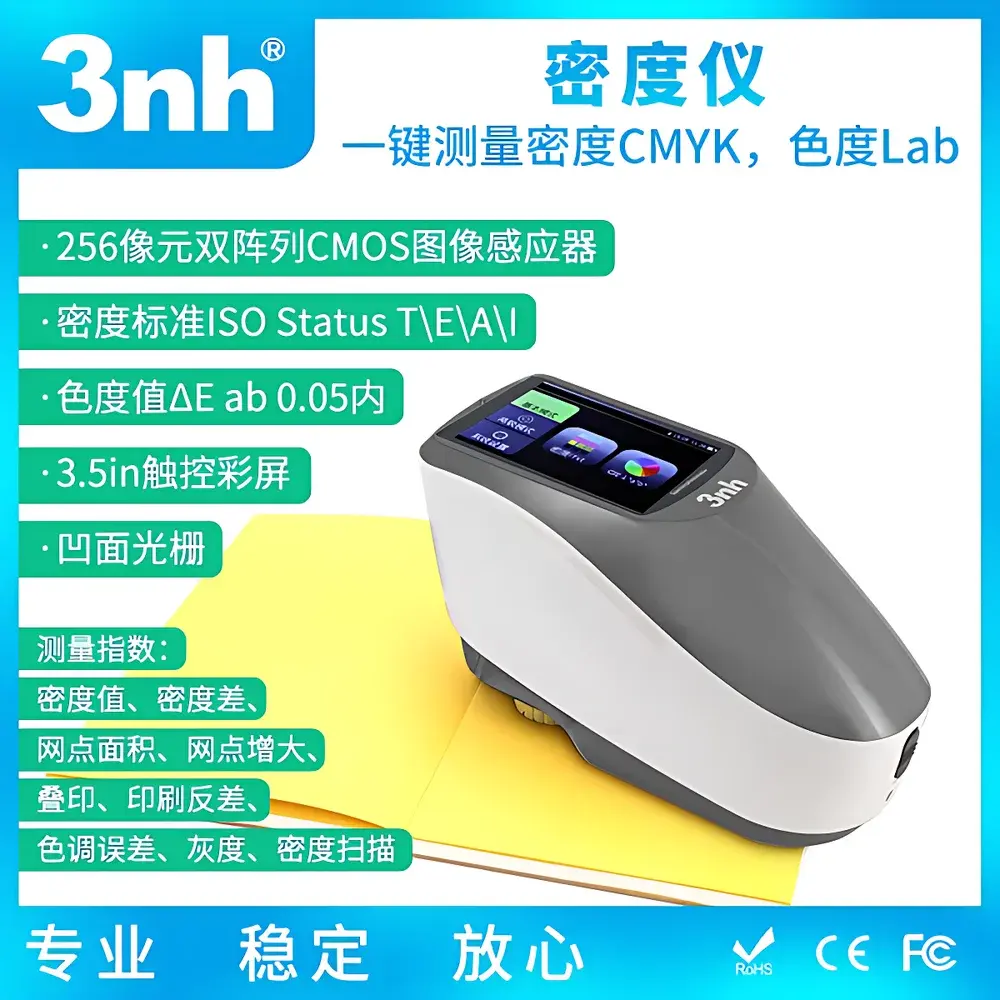
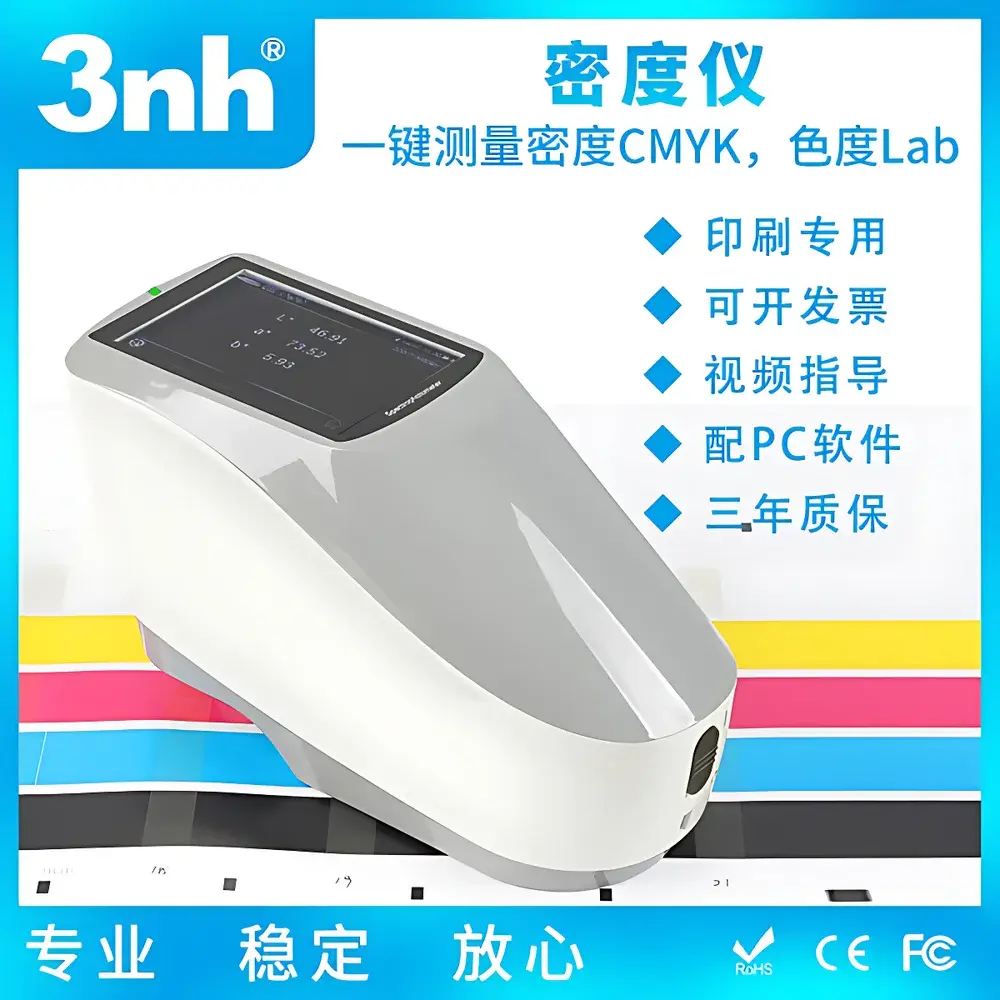
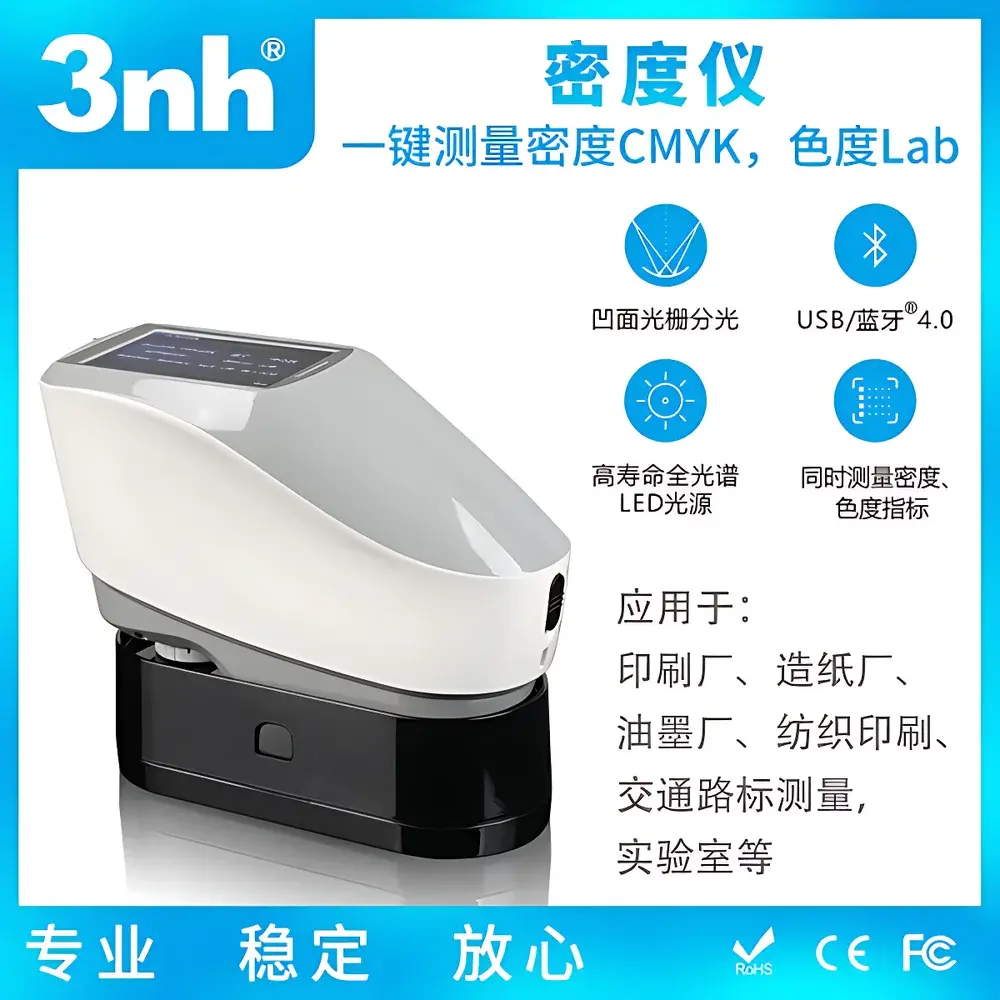
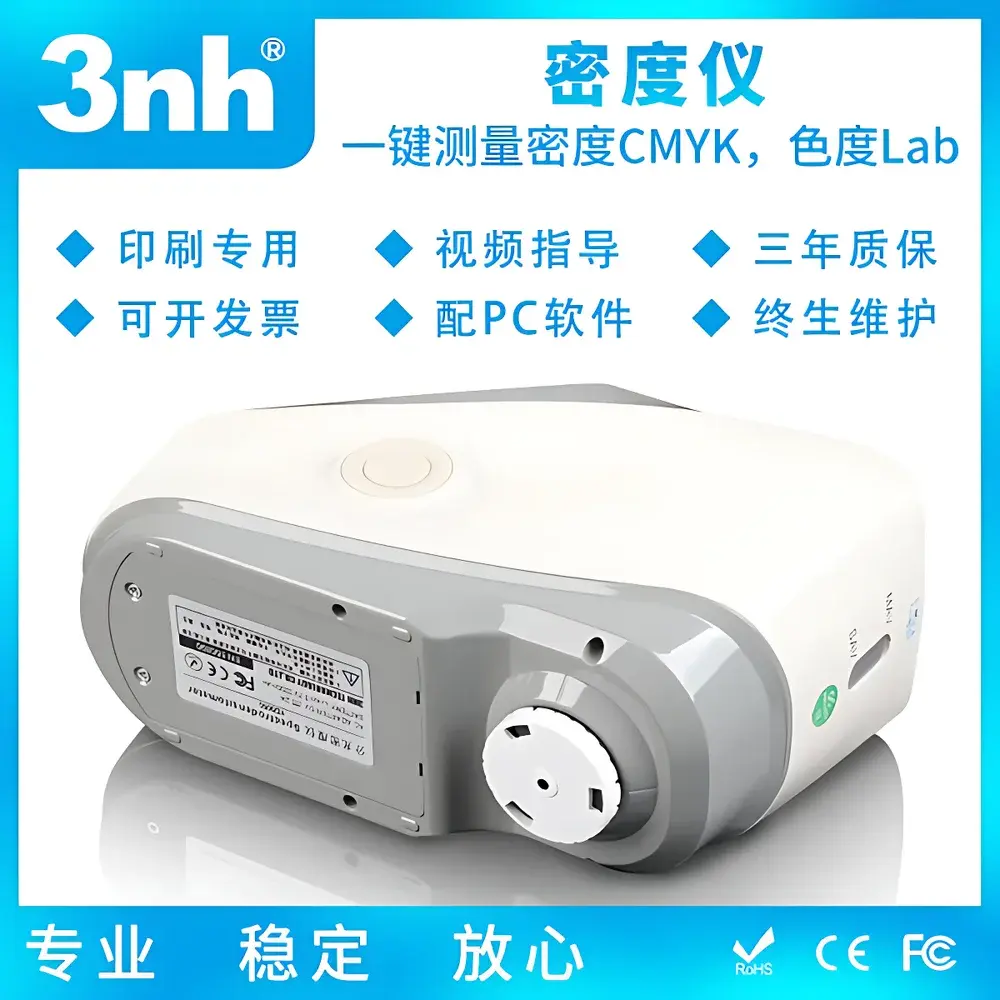
3nh YD5010 / YD5050 Portable Spectro-Densitometer with 45/0 Optical Geometry
| Brand | 3nh |
|---|---|
| Origin | Guangdong, China |
| Manufacturer Type | Original Equipment Manufacturer (OEM) & In-House R&D |
| Product Category | Spectrophotometric Densitometer |
| Instrument Type | Portable |
| Optical Geometry | 45/0 (45° annular illumination, 0° viewing) |
| Standard Compliance | ISO 5-4, ISO 13655 (M0/M1/M2/M3), CIE No. 15 |
| Illuminants | A, C, D50, D55, D65, D75, F2 (CWF), F7 (DLP), F11 (TL84), F12 (TL83/U30), F1, F3–F10 (TPL5), including UV-enhanced LED array |
| Spectral Range | 400–700 nm |
| Spectral Interval | 10 nm |
| FWHM | 10 nm |
| Repeatability | Density ≤ 0.01 D |
| Inter-instrument Agreement | ΔE*ab ≤ 0.2 (BCRA Series II, 14 tiles, M3 excluded) |
| Apertures | Φ2 mm / Φ4 mm / Φ8 mm (model-specific fixed aperture) |
| Detector | 256-element dual-array CMOS image sensor |
| Display | 3.5″ capacitive TFT color touchscreen |
| Interface | USB 2.0 + Bluetooth 2.1 |
| Data Storage | ≥10,000 measurements (YD5010) / ≥20,000 (YD5050) |
| Power | Rechargeable Li-ion battery (≥5,000 measurements per charge, ~8 h runtime) |
| Dimensions | 184 × 77 × 105 mm |
| Weight | ~600 g |
| Operating Environment | 0–40 °C, 0–85% RH (non-condensing), <2000 m altitude |
Overview
The 3nh YD5010 and YD5050 are portable spectro-densitometers engineered for precision optical density and colorimetric measurement in print production, packaging, and industrial quality assurance environments. Based on the CIE-recommended 45/0 geometric configuration—defined in CIE Publication No. 15 and standardized under ISO 5-4 and ISO 13655—the instruments deliver traceable, repeatable measurements of reflection density, spectral reflectance, and color difference across multiple industry-critical conditions. Unlike traditional filter-based densitometers, the YD50 series employs a concave holographic grating and dual-array 256-pixel CMOS detector to acquire full spectral data from 400 nm to 700 nm at 10 nm intervals (FWHM = 10 nm), enabling compliance with M0 (CIE A), M1 (CIE D50), M2 (UV-excluded), and M3 (M2 + polarizing filter) measurement modes. This spectral foundation supports rigorous implementation of ISO Status T, E, A, and I density definitions, as well as calculation of halftone-related metrics—including dot area, dot gain, trapping, print contrast, hue error, and grayness—essential for G7-certified workflows and ISO 12647 process control.
Key Features
- 45/0 optical geometry compliant with ISO 5-4 and CIE No. 15, ensuring compatibility with international print standards and eliminating directional bias in surface reflection measurement;
- Dual-mode LED illumination system with integrated UV channel, supporting all major ISO 13655 illuminants (A, D50, D65, F-series, etc.) without mechanical lamp switching or spectral drift;
- Fixed-aperture variants (Φ2 mm, Φ4 mm, Φ8 mm) optimized for specific use cases: fine-screen ink evaluation (YD5010-Φ2), general-purpose pressroom verification (YD5010-Φ4), and large-area substrate assessment (YD5050-Φ8);
- High-fidelity spectral acquisition using a concave grating and 256-element CMOS dual-array sensor, delivering high signal-to-noise ratio and long-term photometric stability;
- Capacitive 3.5″ TFT touchscreen interface with intuitive icon-driven navigation, real-time spectral curve visualization, and on-device pass/fail evaluation against user-defined tolerances;
- Dual communication architecture (USB 2.0 + Bluetooth 2.1) enables seamless integration into lab networks, factory floor SCADA systems, or mobile QA reporting platforms;
- Robust mechanical design featuring scratch-resistant optical window, sealed white calibration standard, and polarization filter kit for M3-compliant measurement of glossy or specular substrates;
- Extended onboard memory (10,000 entries for YD5010; 20,000+ for YD5050) with timestamped metadata, instrument ID, operator tag, and environmental logging (temperature/humidity if externally sensed);
- Comprehensive spectral output: %R(λ) reflectance curves, CMYK density values, CIE XYZ, LAB, LCh, Yxy coordinates, and ΔE*ab, ΔE94, ΔE00 color differences;
- Pre-calibrated observer angles (2° and 10°) and full support for ISO/CIE standard illuminants, eliminating need for manual spectral weighting or observer interpolation.
Sample Compatibility & Compliance
The YD50 series is validated for use across heterogeneous substrates common in graphic arts and industrial manufacturing: coated/uncoated papers, flexographic and gravure films, metallic inks, fluorescent pigments, textile dyeings, traffic signage materials, and electronic display overlays. Its 45/0 geometry minimizes texture-induced scatter errors on structured surfaces such as embossed stocks or woven fabrics. All hardware and firmware implementations adhere strictly to ISO 13655:2017 Annex B test protocols for M0–M3 validation, and density algorithms conform to ISO 5-4:2020 Annex A for Status T/E/A/I computation. The instrument meets electromagnetic compatibility (EMC) requirements per EN 61326-1 and safety standards per IEC 61010-1. While not FDA 21 CFR Part 11–certified out-of-the-box, audit-ready data export formats (CSV, XML, CxF/X3) and full traceability logs enable integration into GLP/GMP-compliant quality management systems when paired with validated PC software.
Software & Data Management
The included SpectraMagic NX-compatible PC software (downloadable from 3nh’s official domain) provides advanced analytical capabilities beyond onboard functionality: spectral database management, multi-instrument fleet calibration tracking, statistical process control (SPC) charting (X̄/R, Cp/Cpk), automatic report generation (PDF/Excel), and custom tolerance zone definition per job or substrate. Raw spectral data (.spc files) are stored with embedded EXIF-style metadata—including measurement mode, aperture, illuminant, observer, date/time, GPS coordinates (if enabled via Bluetooth-connected device), and operator ID—supporting full forensic traceability. Software supports batch analysis of dot gain curves, tone value increase (TVI) modeling per ISO 10128, and comparative spectral difference mapping (ΔR(λ)). Export options include CxF/X3 for cross-vendor color exchange, CGATS.17 for ICC profile development, and ASTM E308-compliant integrals for regulatory submissions.
Applications
- Pressroom process control: real-time monitoring of ink density, dot gain, and trapping during offset, flexo, and gravure printing;
- Prepress proof verification: spectral comparison of digital proofs against press standards under M1 (D50) or M3 (polarized D50) conditions;
- Ink formulation QC: quantification of pigment strength, metamerism index, and UV-fluorescence contribution in solvent- and water-based inks;
- Paper and board certification: whiteness (CIE Whiteness, Ganz), brightness (ISO 2470-1), and yellowness index (ASTM E313) measurement;
- Automotive and aerospace labeling: durability testing of printed markings under accelerated aging (pre/post UV exposure density shift analysis);
- Academic and metrology labs: reference-grade spectral reflectance acquisition for developing new color appearance models or validating BRDF approximations;
- Textile and packaging QA: batch-to-batch consistency checks for dyed fabrics, laminated pouches, and metallized foils under multiple illuminants.
FAQ
What is the difference between YD5010 and YD5050?
The YD5010 is configured with a single fixed aperture (Φ2 mm, Φ4 mm, or Φ8 mm selected at time of order) and stores up to 10,000 measurements. The YD5050 features expanded memory (≥20,000 entries), enhanced battery management firmware, and optional polarization filter integration for routine M3 operation.
Does the instrument support automatic M1/M2/M3 mode switching?
No—mode selection (M0–M3) is performed manually via software or instrument menu. Each mode requires corresponding hardware configuration (e.g., UV cutoff filter for M2; polarizer for M3), which must be physically installed prior to calibration.
Can spectral data be exported for third-party color science tools?
Yes—full 400–700 nm reflectance spectra are exportable in .spc (ASCII) and CxF/X3 formats, compatible with MATLAB, Python (colour-science package), and commercial tools like ColorThink Pro and ChromaChecker.
Is NIST-traceable calibration available?
3nh provides factory calibration against BCRA Series II ceramic tiles and NPL-traceable standards. End-user recalibration kits (including certified white tile and dark trap) are supplied; full NIST-traceable recalibration services are offered through authorized regional metrology partners.
How is measurement repeatability verified per ISO 13655?
Repeatability is assessed per ISO 13655:2017 Section 7.3: 30 consecutive measurements of a stable white tile at 5 s intervals after 30 min thermal stabilization. Reported repeatability (≤0.01 D density, ≤0.04 ΔE*ab) excludes M3 due to added optical path variability from the polarizer.




