
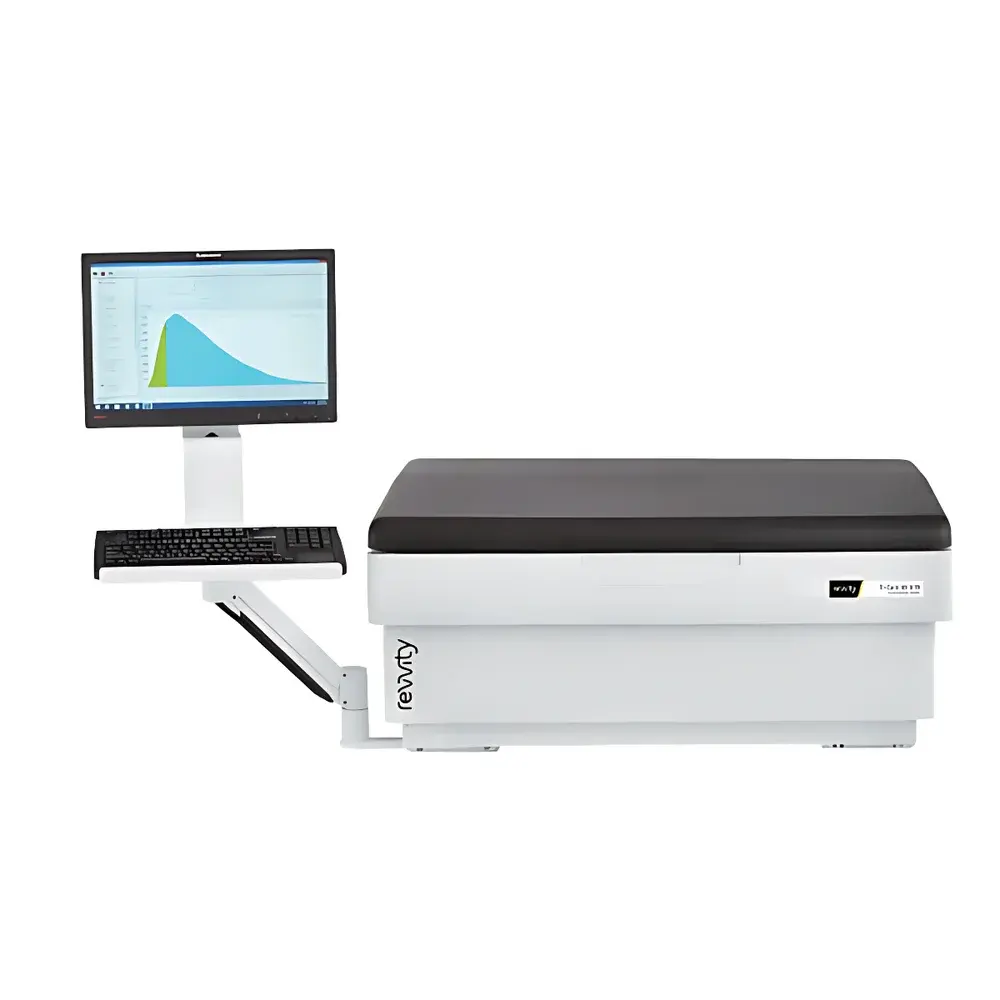
Revvity Quantulus GCT 6220 Liquid Scintillation Spectrometer
| Brand | Revvity |
|---|---|
| Origin | USA |
| Manufacturer | Revvity, Inc. |
| Type | Imported Instrument |
| Model | Quantulus GCT 6220 |
| Pricing | Upon Request |
Overview
The Revvity Quantulus GCT 6220 is a high-sensitivity liquid scintillation spectrometer engineered for ultra-low-activity alpha and beta radionuclide quantification in environmental, regulatory, and research laboratories. It operates on the principle of liquid scintillation counting (LSC), where radioactive decay events in a dissolved sample induce photon emission in an organic scintillation cocktail; these photons are detected by dual photomultiplier tubes (PMTs) operating in coincidence mode to suppress noise and enhance signal fidelity. The instrument’s core innovation lies in its integrated bismuth germanate (BGO) guard detector—fully surrounding the sample vial—and its proprietary Guard Compensation Technology (GCT), a patented background suppression methodology that dynamically corrects for residual cosmic and intrinsic detector background. This architecture enables reliable detection of activities approaching instrumental background levels—critical for compliance with stringent environmental monitoring requirements such as EPA Method 900 series, ISO 11704 (tritium in water), and ASTM D7283 (radiocarbon in biofuels).
Key Features
- Bismuth germanate (BGO) annular guard detector fully encircling the sample vial to intercept and veto external gamma and cosmic-ray-induced events
- Guard Compensation Technology (GCT): real-time background subtraction algorithm that improves net count precision without requiring ultra-low-background shielding infrastructure
- Pulse Amplitude Comparison (PAC) and Pulse Shape Analysis (PSA) for robust alpha/beta discrimination—essential for mixed-emitter samples (e.g., 226Ra/228Ra, 3H/14C)
- Active temperature stabilization (±0.1 °C) of the counting chamber to ensure long-term counting reproducibility and inter-laboratory comparability
- Compact, mobile benchtop design with casters and integrated cable management—optimized for shared-core facilities and regulated lab environments
- Support for standard glass or polyethylene vials (20 mL), eliminating need for specialized low-K glass or quartz, reducing consumable cost and workflow complexity
Sample Compatibility & Compliance
The Quantulus GCT 6220 accommodates aqueous, organic, and heterogeneous samples—including filtered groundwater, acid-digested soil extracts, ethanol-blended fuels, biological digests, and chromatographic fractions—when prepared in compatible scintillation cocktails (e.g., Ultima Gold™ AB, Insta-Gel™ XF). It meets performance criteria outlined in ISO/IEC 17025 for testing laboratories and supports audit-ready data integrity under FDA 21 CFR Part 11 when operated with validated Revvity LSC software (v5.0+). Its detection capability aligns with regulatory thresholds defined in EPA 900.0 (tritium), EPA 903.0 (radium isotopes), and IAEA Technical Reports Series No. 488 (environmental 14C). The system is routinely deployed in GLP-compliant environmental monitoring programs and nuclear decommissioning site characterization.
Software & Data Management
Controlled via Revvity LSC Software Suite, the instrument provides full audit trail functionality—including user login tracking, parameter change logs, electronic signatures, and immutable raw-data archiving. The software implements automated quench correction (tSIE, SQP(E)), spectral deconvolution for multi-nuclide analysis, and customizable reporting templates compliant with ISO 14855 (biodegradability studies using 14C) and OECD Test Guidelines. Data export supports CSV, XML, and LSC-specific .LSC formats for integration into LIMS platforms. Optional 2D barcode reader enables unambiguous sample traceability from vial to report—critical for chain-of-custody documentation in regulatory submissions.
Applications
- Radiocarbon dating of archaeological and geological samples up to 51,000 years BP using benzene synthesis protocols
- Tritium (3H) quantification in drinking water at sub-1 Bq/L levels per ISO 11704
- Simultaneous 226Ra and 228Ra determination in groundwater following EPA 903.1
- 14C analysis in bioethanol (≤1% v/v) for renewable fuel certification per EN 15440
- Strontium-90 in food matrices via 90Y ingrowth measurement
- In-reactor tritium and 14C effluent monitoring during nuclear power plant operation and decommissioning
- ADME/PK studies employing 3H- or 14C-labeled compounds in preclinical development
FAQ
What is the typical background count rate for 3H in the Quantulus GCT 6220?
Typical background for 3H is ≤0.5 cpm in 20 mL low-potassium glass vials with standard scintillant—achievable without lead shielding due to BGO + GCT integration.
Can the system perform alpha/beta separation without pulse-shape analysis?
No—alpha/beta discrimination requires either PSA or PAC algorithms; hardware-based separation (e.g., phoswich detectors) is not implemented.
Is the instrument compliant with 21 CFR Part 11 for regulated pharmaceutical or environmental labs?
Yes—when configured with Revvity LSC Software v5.2+, it provides full electronic record and signature capabilities including role-based access control and audit trail generation.
Does the system support automated sample changers?
Yes—the GCT 6220 integrates with the Revvity AutoSampler 2000, enabling unattended processing of up to 200 vials per run with barcode validation.
What calibration standards are recommended for routine performance verification?
NIST-traceable 3H and 14C standards (e.g., NIST SRM 4969, 4970) are used for energy calibration and efficiency verification; background vials (cocktail-only) are measured daily per ISO/IEC 17025 internal quality control requirements.







