
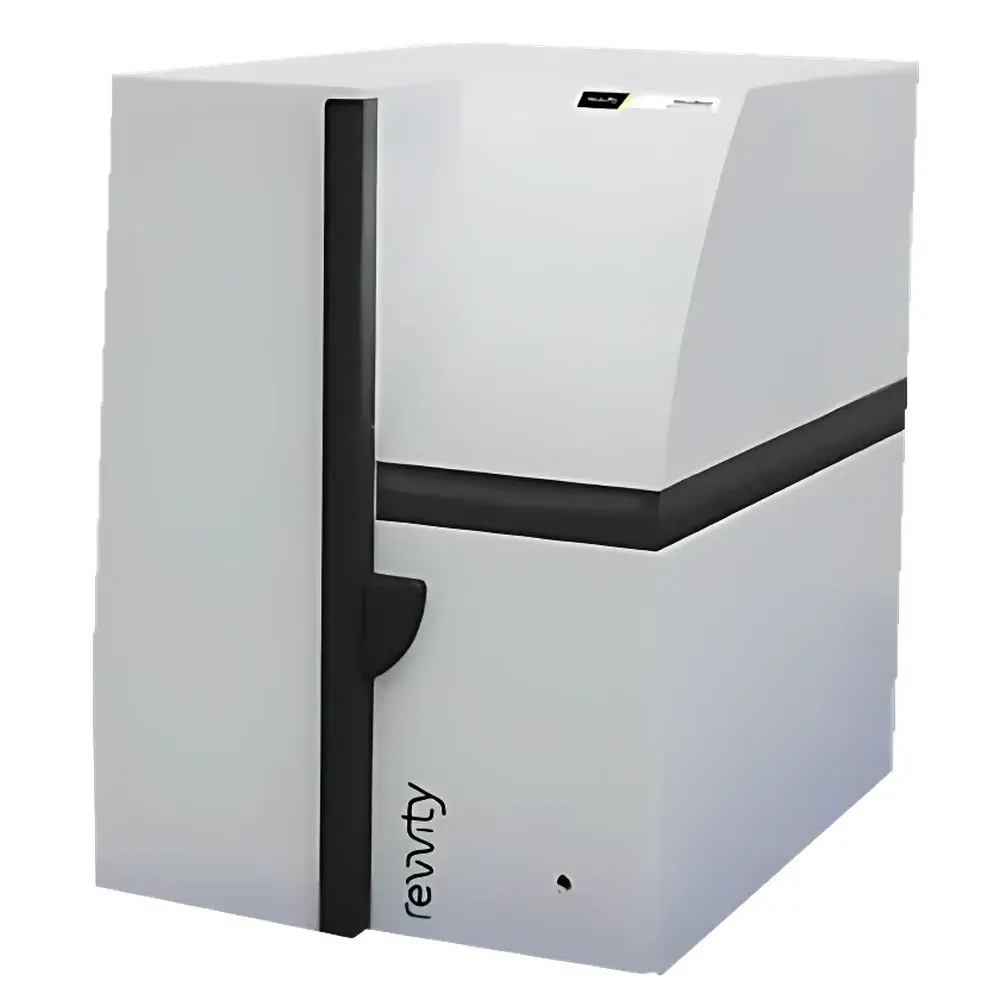
Revvity MicroBeta2 Microplate Scintillation and Luminescence Counter
| Brand | Revvity |
|---|---|
| Origin | USA |
| Manufacturer Type | Original Equipment Manufacturer (OEM) |
| Product Origin | Imported |
| Model | MicroBeta2 |
| Pricing | Available Upon Request |
Overview
The Revvity MicroBeta2 is a high-throughput, multi-detector microplate scintillation and luminescence counter engineered for quantitative radiometric and bioluminescent/chemiluminescent assays in life science, pharmaceutical, and environmental research laboratories. It operates on the principle of liquid scintillation counting (LSC), where radioactive decay events—primarily from low-energy beta emitters such as 3H and 14C—are converted into measurable photons via interaction with organic scintillant cocktails. Simultaneously, the system supports ultra-sensitive luminescence detection—including flash and glow chemiluminescence and bioluminescence—without hardware reconfiguration. Its solid-state photomultiplier tube (PMT) array architecture enables simultaneous, independent counting across all wells of standard 96-, 384-, and 1536-well microplates, eliminating sequential scanning delays and ensuring high reproducibility across large-scale screening campaigns.
Key Features
- Multi-detector solid-state PMT array optimized for parallel well interrogation—no mechanical movement or dwell-time limitations
- Dual-mode capability: fully integrated liquid scintillation counting (LSC) and luminescence (LUM) measurement in a single platform
- Support for heterogeneous assay formats including ScintiPlate™, FlashPlate™, and SPA (Scintillation Proximity Assay) microplates
- Flexible sample compatibility: accommodates microplates, filter membranes (e.g., GF/B, GF/C), and centrifuge tubes (e.g., 12 × 75 mm) without accessory swaps
- Advanced quench correction algorithms—including external standard ratio (ESR), tSIE, and spectral index of the sample (SIS)—for accurate activity quantification across variable matrix compositions
- Low-background shielding design compliant with ANSI N42.22 and IEC 61000-6-3 standards for electromagnetic compatibility and radiation noise suppression
Sample Compatibility & Compliance
The MicroBeta2 is validated for isotopes commonly used in biomedical and environmental tracer studies: 3H, 14C, 32P, 33P, 51Cr, and 125I. Its detector geometry and optimized optical coupling ensure high efficiency (>60% for 3H; >95% for 125I) while maintaining linearity over five orders of magnitude (0.1–106 dpm/well). The instrument meets ISO/IEC 17025 requirements for testing laboratories and supports audit-ready operation under GLP and GMP environments. Data integrity features include electronic signatures, user access levels, and full 21 CFR Part 11–compliant audit trails when used with WinSpectral software.
Software & Data Management
Controlled by Revvity’s WinSpectral v5.x software, the MicroBeta2 provides intuitive assay setup, real-time count monitoring, automated background subtraction, and customizable report generation. Raw data are stored in vendor-neutral .csv and .xls formats; metadata—including plate map, acquisition parameters, calibration history, and operator ID—is embedded per run. The software supports integration with LIMS via ASTM E1384-compliant interfaces and includes built-in tools for dose-response curve fitting (e.g., 4PL, 5PL), Z’-factor calculation, and statistical outlier detection. All processing algorithms are documented per ISO/IEC 17025 clause 7.2.2 for method validation transparency.
Applications
- High-throughput radioligand binding and receptor internalization assays
- Cell proliferation and cytotoxicity studies using 3H-thymidine or 14C-leucine incorporation
- Environmental radioisotope analysis in water, soil, and biological matrices (e.g., 14C-labeled pesticide degradation)
- SPA-based kinase and protease activity screening in drug discovery pipelines
- Luciferase reporter gene assays for promoter activation, siRNA knockdown validation, and CRISPR functional genomics
- Radioimmunoassay (RIA) and immunoradiometric assay (IRMA) quantification in clinical and regulatory testing
FAQ
Does the MicroBeta2 require liquid nitrogen or Peltier cooling for PMT operation?
No—the system uses thermally stabilized solid-state PMTs operating at ambient temperature with factory-calibrated gain stability over 12-month intervals.
Can it quantify alpha-emitting isotopes such as 226Ra or 239Pu?
Not natively; the MicroBeta2 is optimized for beta and gamma/X-ray emitters. Alpha detection requires specialized scintillant chemistry and vacuum-compatible sample chambers not supported by this platform.
Is remote monitoring or networked cluster operation supported?
Yes—WinSpectral supports centralized instrument management across LAN/WAN via secure HTTP(S) API endpoints and scheduled email alerts for run completion or error conditions.
What maintenance protocols are recommended to ensure long-term counting stability?
Annual performance verification per ASTM D7282 (standard test method for liquid scintillation counting systems) is advised, including background check, efficiency calibration with traceable standards, and optical path inspection.
How does the MicroBeta2 handle high-quench samples common in environmental digests or tissue homogenates?
It employs dual-channel pulse-height analysis combined with dynamic quench correction models that auto-select optimal correction method based on sample spectral profile and count rate distribution.
Related Products







