
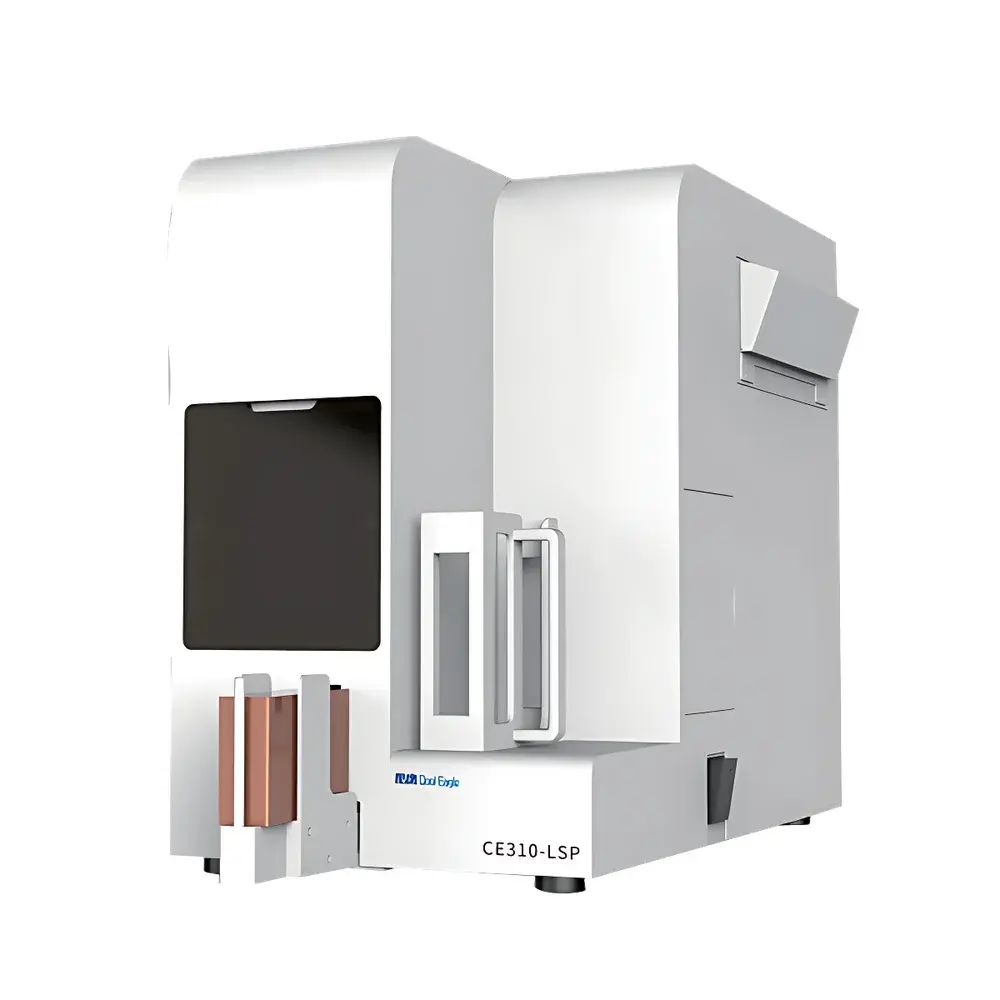
Cool Eagle CE310-LSP UV Laser Slide Labeling System
| Brand | HISTO |
|---|---|
| Origin | Zhejiang, China |
| Manufacturer Type | Authorized Distributor |
| Country of Origin | China |
| Model | CE310-LSP |
| Power Supply | AC 100–240 V, 50–60 Hz |
| Dimensions (L×W×H) | 440 × 220 × 380 mm |
| Weight | 25 kg |
| Operating Temperature | −5 to 40 °C |
| Power Consumption | 120 W |
| Maximum Load Capacity | 150 slides |
| Collection Capacity | 100 slides per tray |
| Printing Speed | >15 slides/min |
| Laser Resolution | 0.01 mm |
| Character Size Support | 1 mm × 1 mm Chinese characters |
| Air Handling | Vacuum-based dual-stage adsorption (liquid + solid phase), integrated duct cleaning function |
Overview
The Cool Eagle CE310-LSP UV Laser Slide Labeling System is an industrial-grade, non-contact labeling instrument engineered for high-throughput, permanent marking of standard microscope glass slides (75 × 25 mm) in histopathology, clinical diagnostics, and biobanking laboratories. Unlike thermal transfer or inkjet systems, the CE310-LSP employs a solid-state UV laser source operating at 355 nm wavelength, enabling cold ablation of surface coatings without thermal distortion or substrate degradation. This process produces chemically stable, abrasion-resistant alphanumeric identifiers directly on coated or uncoated glass—fully compliant with CAP, CLIA, and ISO 15189 pre-analytical traceability requirements. The system integrates motion control, real-time vacuum exhaust management, and embedded template editing into a compact benchtop architecture optimized for integration into automated slide processing lines or standalone QC workflows.
Key Features
- UV laser marking technology eliminates consumables—including ribbons, inks, solvents, or adhesives—reducing total cost of ownership and eliminating cross-contamination risk.
- Optical resolution of 0.01 mm supports legible printing of 1 mm × 1 mm Chinese characters, Latin script, barcodes (Code 128, DataMatrix), and custom logos—ensuring readability under 10× objective magnification.
- Parallelized mechanical workflow: slide feeding, positioning, laser marking, and ejection occur concurrently; non-printing cycle time is strictly limited to ≤2 seconds per slide.
- Vacuum-driven air handling module replaces conventional fans, incorporating sequential liquid-phase scrubbing and solid-phase activated carbon filtration to capture volatile organic compounds (VOCs) and particulate byproducts generated during laser ablation.
- Integrated duct self-cleaning protocol activates automatically after each batch, minimizing maintenance intervals and sustaining filtration efficiency across extended operation.
- Front-access ejection path enables ergonomic retrieval by personnel stationed on either side of the instrument—critical for shared workbenches or LIMS-integrated staging zones.
- Modular collection trays feature standardized dimensions and mechanical interlocks; fully loaded trays can be swapped mid-run without interrupting labeling continuity, serving both as output containers and transport carriers for downstream staining or scanning.
Sample Compatibility & Compliance
The CE310-LSP accommodates standard 1 mm-thick microscope slides (75 × 25 mm), including silanized, APES-coated, poly-L-lysine, and charged glass variants. It supports slides with or without pre-applied tissue sections, provided surface topography remains within ±5 µm flatness tolerance. No substrate pre-treatment is required. The system meets IEC 61000-6-3 (EMC emission limits) and IEC 60825-1:2014 Class 4 laser safety standards, with interlocked access doors and visible status indicators. All firmware logs—including timestamped print events, tray swaps, and maintenance alerts—are stored locally with optional Syslog forwarding for GLP/GMP audit trail integration.
Software & Data Management
The CE310-LSP runs on a Linux-based embedded OS with a responsive touchscreen interface. Template design occurs entirely within the native editor—no external software, file imports, or context switching required. Users define variable fields (e.g., accession number, date, operator ID) linked to CSV/Excel import or manual entry. Print jobs support batch serialization, incremental counters, and conditional logic (e.g., “if section = ‘brain’, append ‘BRA’ prefix”). Audit logs record user login/logout, template modifications, and error codes with microsecond timestamps—fully compatible with FDA 21 CFR Part 11 electronic signature readiness when deployed with network authentication.
Applications
- Pre-analytical specimen identification in surgical pathology labs processing >500 slides/day.
- Biorepository sample tracking where long-term label permanence (>10 years archival stability) is mandated.
- Research core facilities requiring traceable slide annotation for multi-institutional studies governed by MIAME or MINSEQE reporting standards.
- Quality control validation of slide barcoding systems prior to deployment of whole-slide imaging platforms.
- Regulatory submission preparation (e.g., FDA IDE, CE-IVDR) where demonstrable chain-of-identity from specimen receipt to diagnosis is auditable.
FAQ
Does the CE310-LSP require routine optical alignment or laser recalibration?
No—solid-state UV laser diode and galvanometric scanner are factory-aligned and sealed; no user-serviceable optics are accessible.
Can the system interface with LIS/HIS via HL7 or ASTM E1384?
Yes—RS-232 and Ethernet ports support configurable ASCII command protocols; HL7 ADT/Ack message mapping is achievable via optional middleware configuration.
Is the printed mark resistant to xylene, ethanol, and hematoxylin-eosin staining protocols?
Yes—laser-induced surface modification creates sub-micron structural changes in glass, surviving ≥20 cycles of standard deparaffinization and staining without fading or delamination.
What is the expected service life of the UV laser source?
Rated for ≥20,000 hours of operational lifetime under continuous duty cycle, with output power monitored and logged in real time.
Are replacement collection trays available as consumables?
Yes—trays are sold in packs of five (P/N: CE-TRAY-100), manufactured to ISO 9001-certified tolerances with serialized traceability.



