
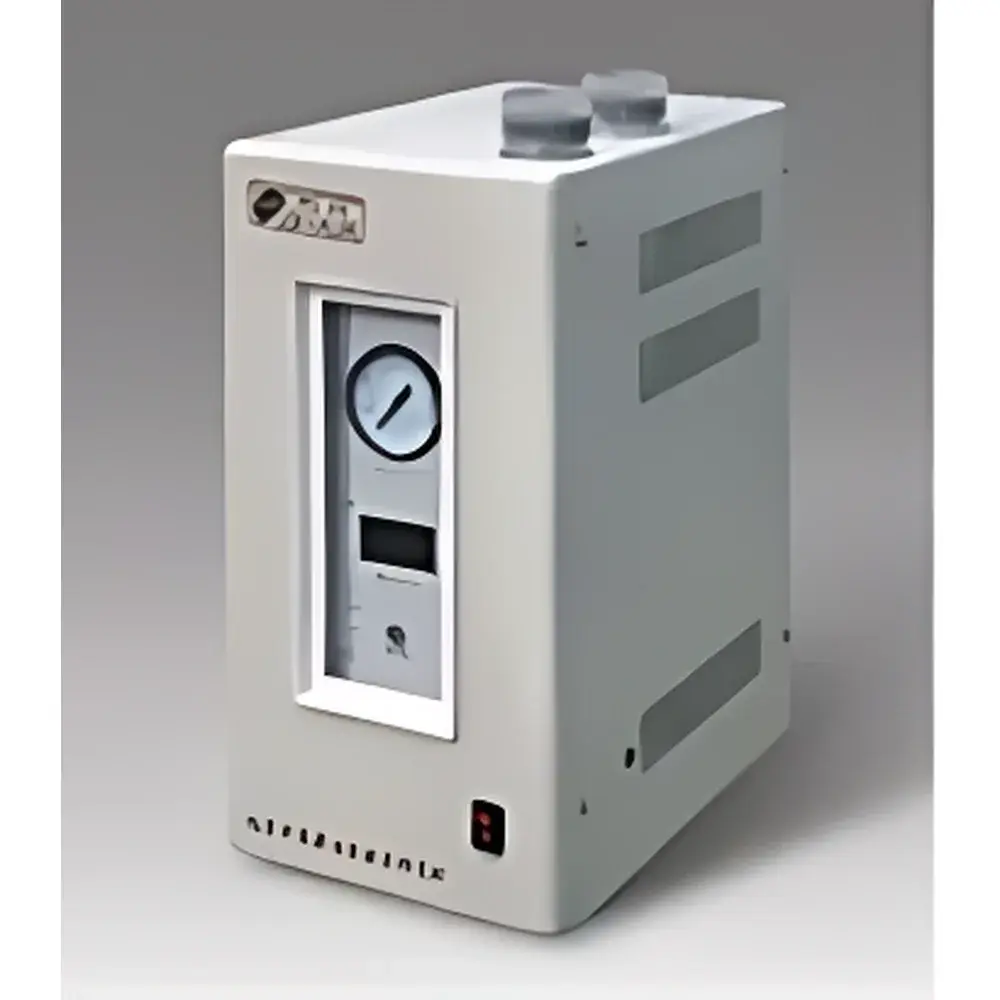
Brookfield SPH-500 High-Purity Hydrogen Generator
| Hydrogen Purity | 99.999% |
|---|---|
| Flow Rate | 0–500 mL/min |
| Output Pressure | 0–0.4 MPa / 0–0.6 MPa (dual-range adjustable) |
| Pressure Stability | < 0.001 MPa |
| Power Supply | 220 V ±10%, 50 Hz |
| Power Consumption | 250 W |
| Dimensions | 370 × 330 × 180 mm |
| Net Weight | ~11 kg |
Overview
The Brookfield SPH-500 High-Purity Hydrogen Generator is an electrolysis-based gas generation system engineered for continuous, on-demand production of ultra-high-purity hydrogen (99.999%) in analytical laboratory environments. Designed specifically to serve as a stable, reliable carrier or fuel gas source for gas chromatography (GC), GC–MS, and other gas-dependent instrumentation, the SPH-500 eliminates the logistical, safety, and cost constraints associated with high-pressure hydrogen cylinders. Its membrane-separated alkaline electrolysis architecture ensures consistent gas output with minimal maintenance, while integrated pressure regulation and real-time flow control enable seamless integration into automated analytical workflows.
Key Features
- Electrolytic hydrogen generation via PEM-free alkaline cell stack with stainless-steel electrodes and proprietary diaphragm separation—ensuring long service life and resistance to electrolyte carryover.
- Dual-range pressure regulation (0–0.4 MPa and 0–0.6 MPa), selectable via front-panel switch, accommodating both low-backpressure detectors (e.g., TCD) and higher-pressure applications (e.g., capillary column inlet systems).
- Real-time digital display of both output pressure and flow rate; closed-loop feedback control maintains constant pressure (< ±0.001 MPa deviation) and dynamically adjusts flow (0–500 mL/min) to match instrument demand.
- Twin-stage stainless-steel filtration: first stage removes particulates and moisture; second stage incorporates oxygen-scavenging catalyst (pre-activated, non-regenerable) to reduce residual O₂ to < 0.1 ppm—critical for baseline stability in sensitive GC detectors.
- Low-sulfur silicone elastomer seals throughout internal gas pathways minimize sulfur contamination, preventing detector poisoning and ensuring reproducible retention times in sulfur-sensitive analyses (e.g., ASTM D5504, UOP 163).
- Integrated safety architecture includes automatic alkali backflow prevention, over-pressure shutoff, electrolyte level monitoring, and thermal cutoff—fully compliant with IEC 61010-1 requirements for laboratory electrical equipment.
Sample Compatibility & Compliance
The SPH-500 is compatible with all standard GC configurations requiring hydrogen as carrier, make-up, or fuel gas—including split/splitless injectors, FID, NPD, and pulsed discharge helium ionization detectors (PDHID). It meets key regulatory expectations for trace gas purity in pharmaceutical QC (USP , EP 2.2.43), environmental analysis (EPA Method 8260D), and petrochemical testing (ASTM D3588, D7165). While not certified to ISO/IEC 17025 calibration standards out-of-box, its performance metrics align with GLP-compliant operational qualification (OQ) protocols. The unit supports 21 CFR Part 11–ready software logging when paired with optional data acquisition modules.
Software & Data Management
The SPH-500 operates as a standalone hardware platform with no embedded firmware-based user interface beyond LED indicators and tactile switches. However, analog 0–5 V DC outputs for pressure and flow are provided for external SCADA or LIMS integration. Optional RS-232/USB interface modules (sold separately) enable remote status monitoring, event logging, and audit-trail generation—supporting GMP-aligned record retention per FDA guidance on electronic records. All operational parameters—including cumulative runtime, electrolyte refill cycles, and safety event logs—are timestamped and exportable in CSV format.
Applications
- Carrier gas supply for capillary GC systems operating at 1–3 mL/min, including method transfers from helium-based protocols under EPA and ISO harmonized methods.
- Fuel gas for flame ionization detectors (FID), delivering stoichiometric H₂:air ratios without cylinder-induced pulsation artifacts.
- Make-up gas for electron capture detectors (ECD) and nitrogen phosphorus detectors (NPD), where ultra-low oxygen content prevents baseline drift and signal suppression.
- On-site hydrogen supply for portable GC–MS field units used in environmental site assessments and emergency response scenarios.
- Research-grade hydrogen source for catalytic reaction screening, hydride generation AAS, and fuel cell test benches requiring continuous, low-particulate gas feed.
FAQ
What electrolyte solution is required, and how often must it be replenished?
The SPH-500 uses a 25–30% aqueous potassium hydroxide (KOH) solution. With typical GC usage (300 mL/min, 8 h/day), electrolyte top-up is required every 4–6 weeks; full replacement is recommended every 6 months or after 1,200 operating hours.
Does the generator require periodic catalyst regeneration or filter replacement?
The oxygen-scavenging filter is pre-loaded and non-regenerable; replacement is advised every 12 months or after 3,000 L of total H₂ output. Stainless-steel particulate filters are cleanable via ultrasonic bath and do not require scheduled replacement.
Can the SPH-500 be integrated into a networked lab infrastructure with centralized monitoring?
Yes—via optional communication modules supporting Modbus RTU or ASCII protocol over RS-232/USB, enabling integration with LabVantage, Thermo Fisher SampleManager, or custom Python-based monitoring dashboards.
Is the unit suitable for Class I, Division 1 hazardous locations?
No—the SPH-500 is rated for general laboratory use (IP20) and must be installed in ventilated, non-classified areas per NFPA 55 and local fire codes. Hydrogen venting must be routed externally via dedicated exhaust ducting.
How does the SPH-500 ensure compliance with GC method validation requirements?
It delivers documented pressure stability, flow linearity, and purity certification (via third-party GC–TCD verification report available upon request), satisfying IQ/OQ/PQ elements required under ISO/IEC 17025 and pharmacopeial monographs for gas-dependent analytical methods.
Related Products



