
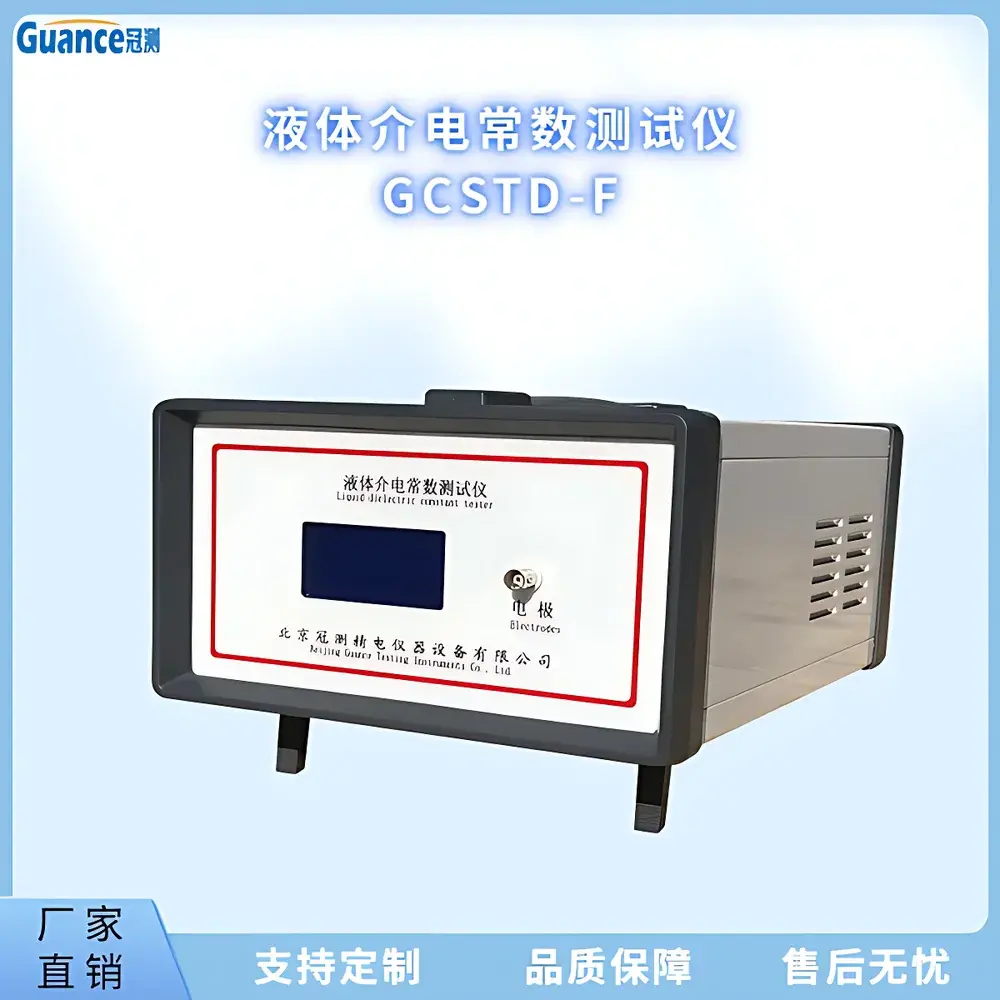
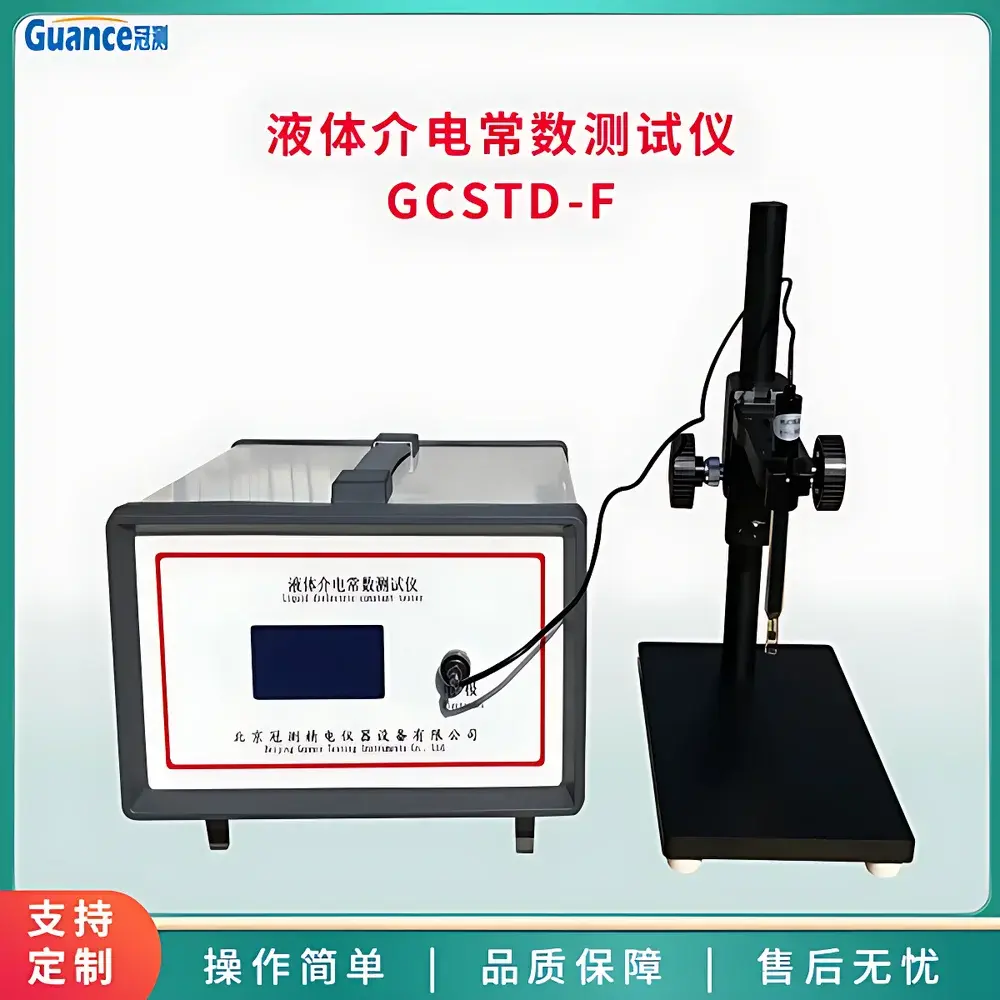
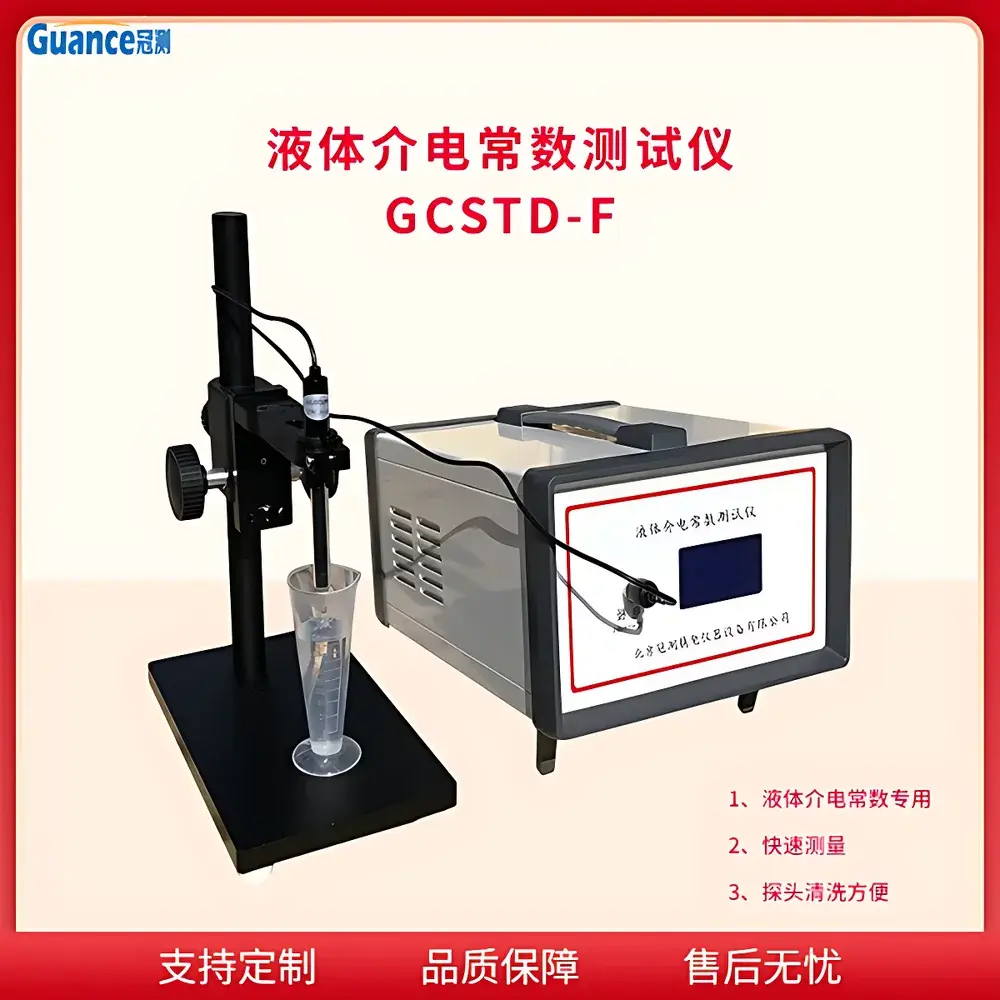
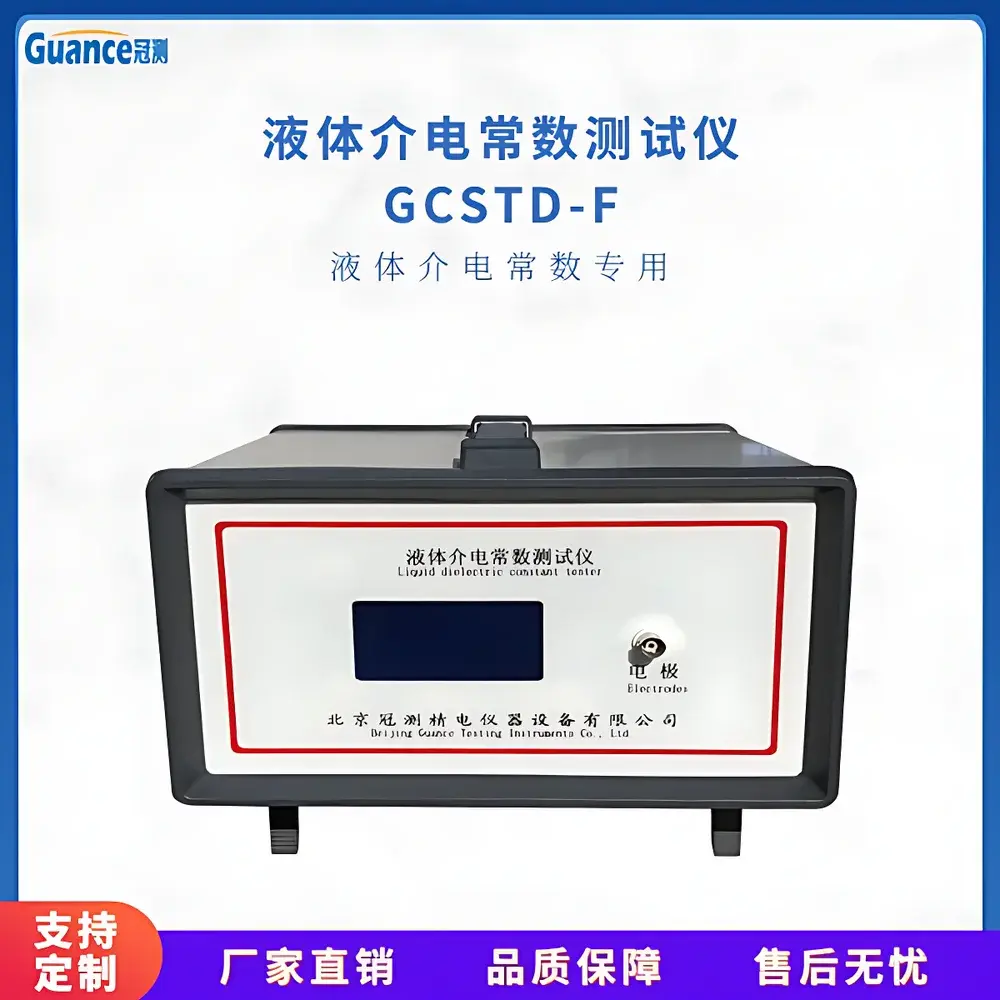
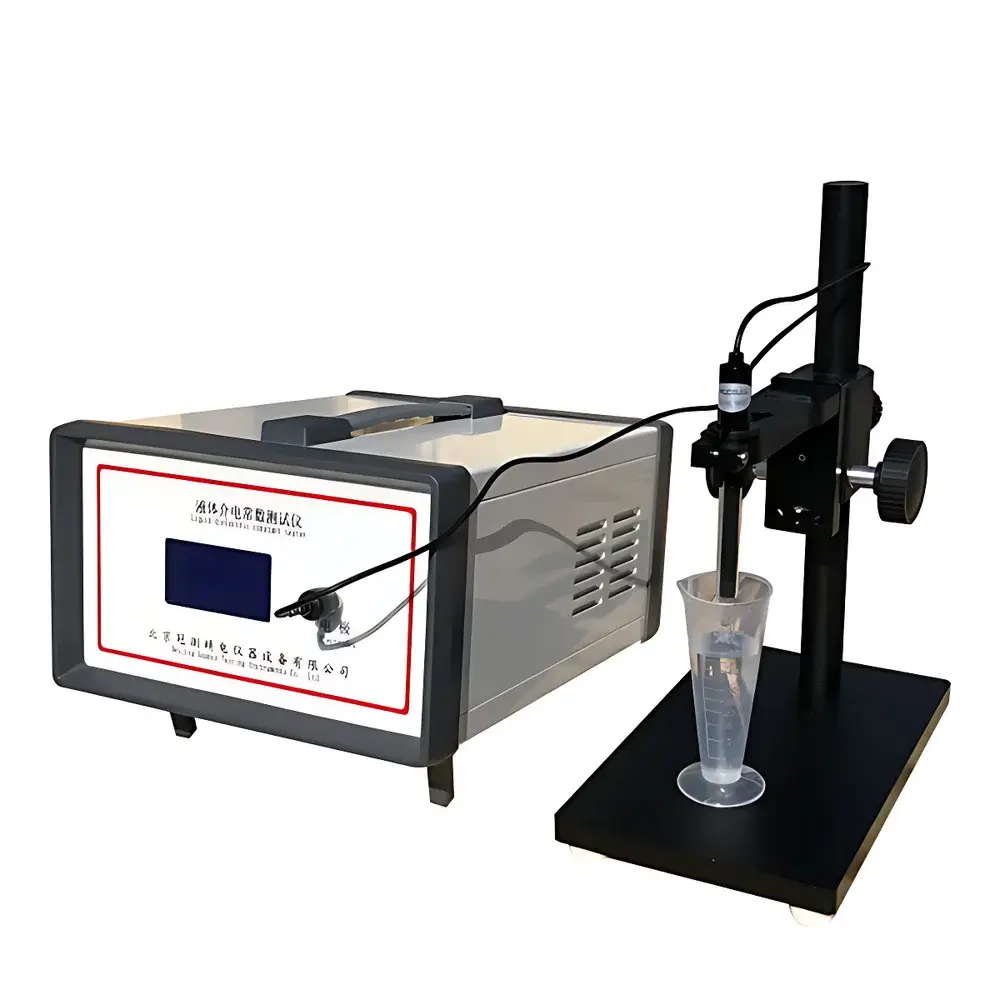
GuanCe Instruments GCSTD-F5 Liquid Dielectric Constant Meter
| Brand | GuanCe Instruments |
|---|---|
| Origin | Beijing, China |
| Manufacturer Type | Authorized Distributor |
| Country of Origin | China |
| Model | GCSTD-F5 |
| Price | USD 1,280 (FOB Beijing) |
Overview
The GuanCe Instruments GCSTD-F5 Liquid Dielectric Constant Meter is a precision benchtop instrument engineered for the accurate determination of relative permittivity (εr) and dissipation factor (tan δ) of homogeneous liquid dielectrics across a fixed-frequency AC excitation range. It operates on the principle of parallel-plate (cylindrical coaxial) capacitance measurement under controlled electric field conditions—specifically utilizing a guarded cylindrical electrode geometry to minimize fringing field effects and ensure high reproducibility in εr calculation. The system applies a stable sinusoidal voltage signal at a defined test frequency (typically 1 kHz or 10 kHz, configurable per calibration protocol), measures the resulting current-phase relationship, and computes εr via the fundamental relation: εr = Cliquid/Cvacuum, where Cliquid is the measured capacitance with the sample filling the inter-electrode volume. This method conforms to the underlying framework of ASTM D924 and IEC 60247 for insulating liquid characterization, supporting routine quality control and material screening in R&D laboratories.
Key Features
- Precision-machined coaxial cylindrical electrode assembly fabricated from 316 stainless steel, ensuring long-term dimensional stability and corrosion resistance against polar and non-polar solvents.
- Fixed-gap geometry maintained by six non-conductive nylon spacers—eliminates mechanical drift and enables traceable geometric calibration without recalibration after routine cleaning.
- Open-access electrode design facilitates rapid sample loading, visual inspection, and residue-free cleaning—critical for sequential testing of chemically diverse liquids (e.g., hydrocarbons, alcohols, esters, ionic liquids).
- No disassembly required during maintenance: electrode integrity is preserved by prohibiting unscrewing of spacer mounts, thereby safeguarding inter-cylinder concentricity and gap uniformity per ISO/IEC 17025 metrological requirements.
- Integrated temperature stabilization interface supports optional external Peltier or water-bath coupling for isothermal measurements between 15 °C and 40 °C (ambient referenced).
Sample Compatibility & Compliance
The GCSTD-F5 is validated for use with low-to-moderate conductivity (<1 µS/cm), non-viscous (<50 cP), and non-particulate liquid dielectrics—including transformer oils, silicone fluids, glycols, acetone, ethanol, chloroform, and deionized water. It is not suitable for conductive electrolytes, suspensions, or volatile solvents with vapor pressures exceeding 10 kPa at 25 °C unless operated inside a sealed, vented fume hood. All measurements comply with the electrical safety provisions of IEC 61010-1 and electromagnetic compatibility standards IEC 61326-1. Data reporting aligns with GLP documentation practices, including operator ID, timestamp, ambient temperature/humidity, and electrode cleaning history—enabling audit readiness for ISO 9001 and ISO/IEC 17025 accredited labs.
Software & Data Management
The instrument interfaces via RS-232 or USB-to-serial adapter to Windows-based configuration and acquisition software (included). The application provides real-time capacitance and phase-angle display, automatic εr and tan δ computation using user-defined reference constants, and export to CSV or Excel formats. Audit trails record all parameter changes, measurement initiations, and calibration events with digital signatures. While the GCSTD-F5 does not natively support FDA 21 CFR Part 11 electronic signature functionality, its data output format is fully compatible with validated LIMS and ELN platforms that enforce electronic record integrity, version control, and user access logging.
Applications
- Quality assurance of insulating oils in power transformer manufacturing and maintenance (per IEEE C57.106).
- Formulation development of dielectric coolants for high-power electronics and EV battery thermal management systems.
- Structure-property correlation studies in physical chemistry—e.g., hydrogen bonding strength estimation in alcohol–water mixtures via εr deviation from ideal mixing models.
- In-process monitoring of solvent purity in pharmaceutical synthesis, where trace water or protic impurities induce measurable εr shifts.
- Educational laboratory instruction in electromagnetism and materials science curricula, illustrating macroscopic polarization response as a function of molecular dipole moment and packing density.
FAQ
Can the electrode be disassembled for deep cleaning?
No. Disassembly will alter the calibrated inter-cylinder spacing and concentricity, invalidating measurement traceability. Only solvent immersion and ultrasonic cleaning of the fully assembled electrode are permitted.
What cleaning protocol is recommended after measuring hydrocarbon samples?
Rinse thoroughly with analytical-grade acetone or ethanol, followed by gentle drying with oil-free compressed air. Avoid heat drying or wiping with cloth to prevent static charge retention or surface scratching.
Is temperature compensation built into the instrument?
The GCSTD-F5 does not include an integrated temperature sensor. However, it provides a dedicated analog input for external Pt100 or thermistor probes, enabling manual or automated εr correction using standard polynomial models (e.g., ASTM D1169 for oils).
Does the system meet regulatory requirements for GMP environments?
While the hardware itself is not GMP-certified, its measurement methodology, data export structure, and operational documentation support integration into GMP-compliant workflows when paired with site-specific validation protocols (IQ/OQ/PQ) and qualified software.
What is the typical measurement repeatability for pure ethanol at 25 °C?
Under controlled lab conditions (±0.1 °C bath, cleaned electrodes, 3 replicate fills), the coefficient of variation (CV) for εr is ≤0.35% (n=10), consistent with published literature values for ethanol (εr ≈ 24.3 at 25 °C, 1 kHz).



