
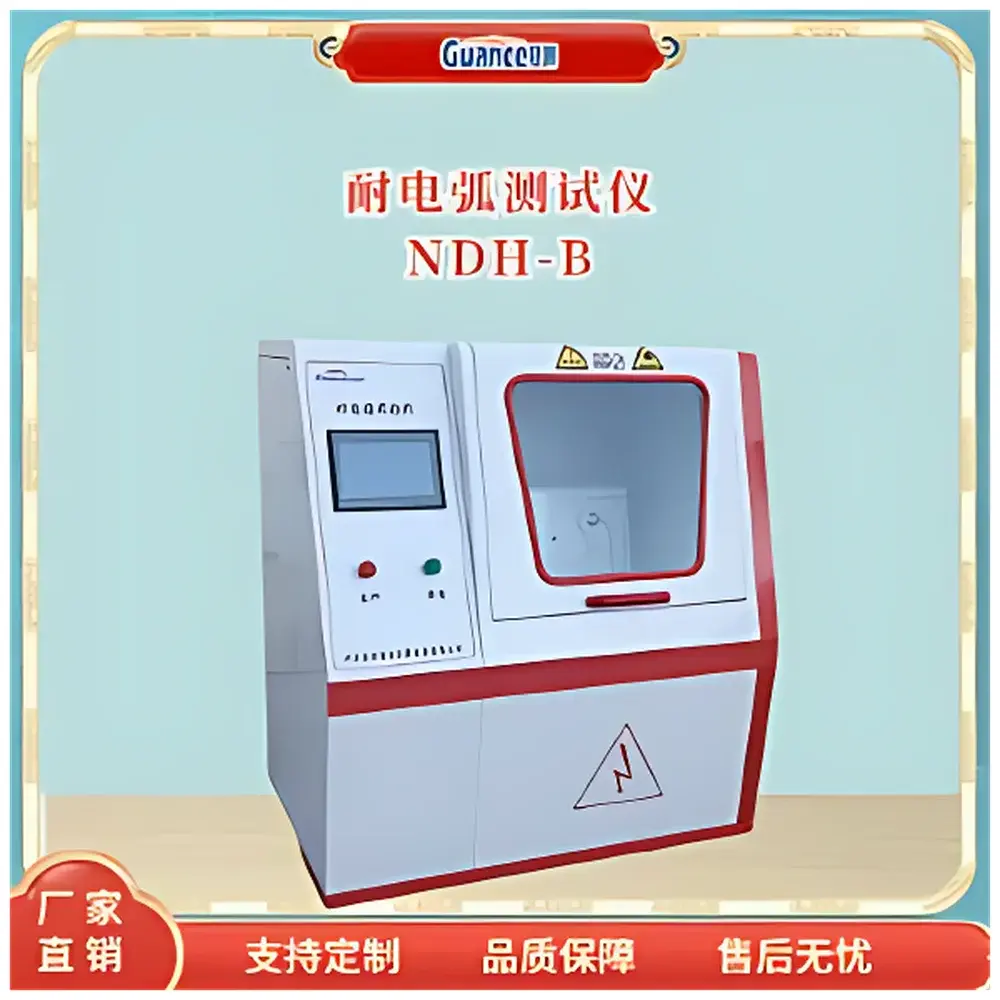
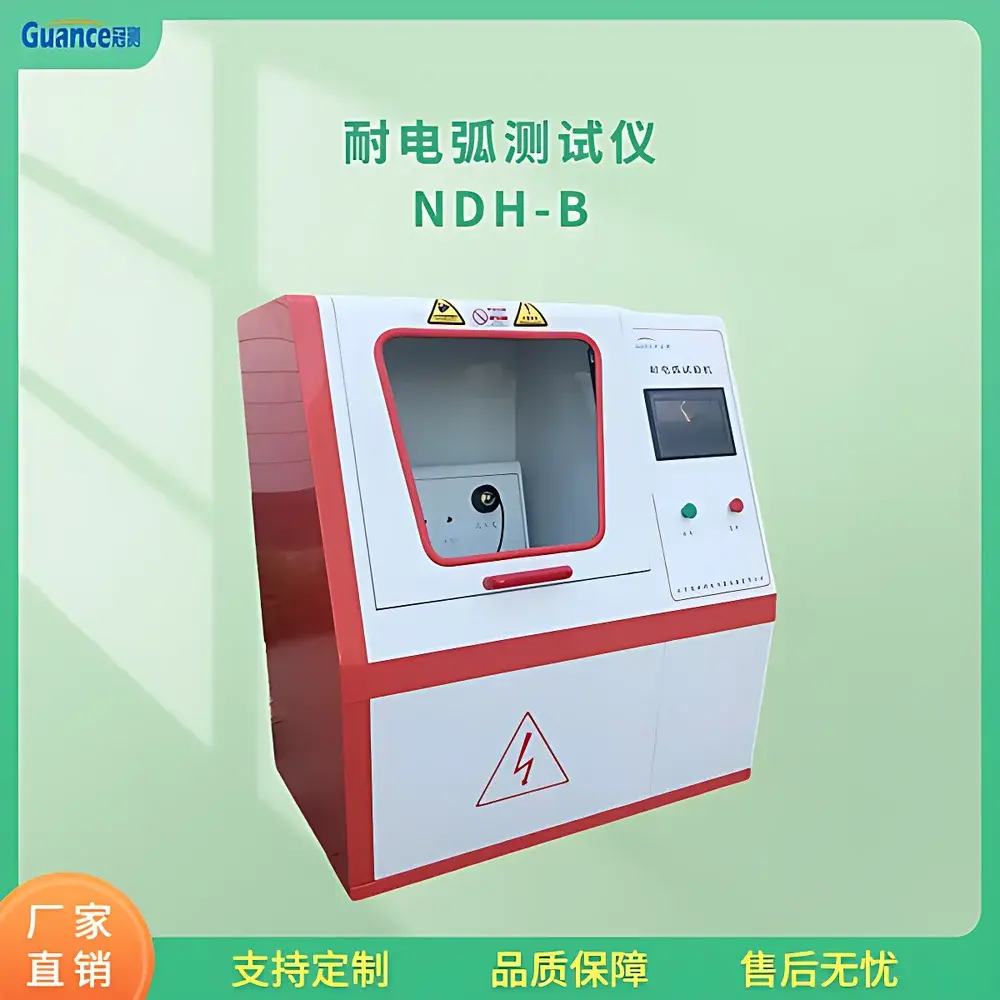
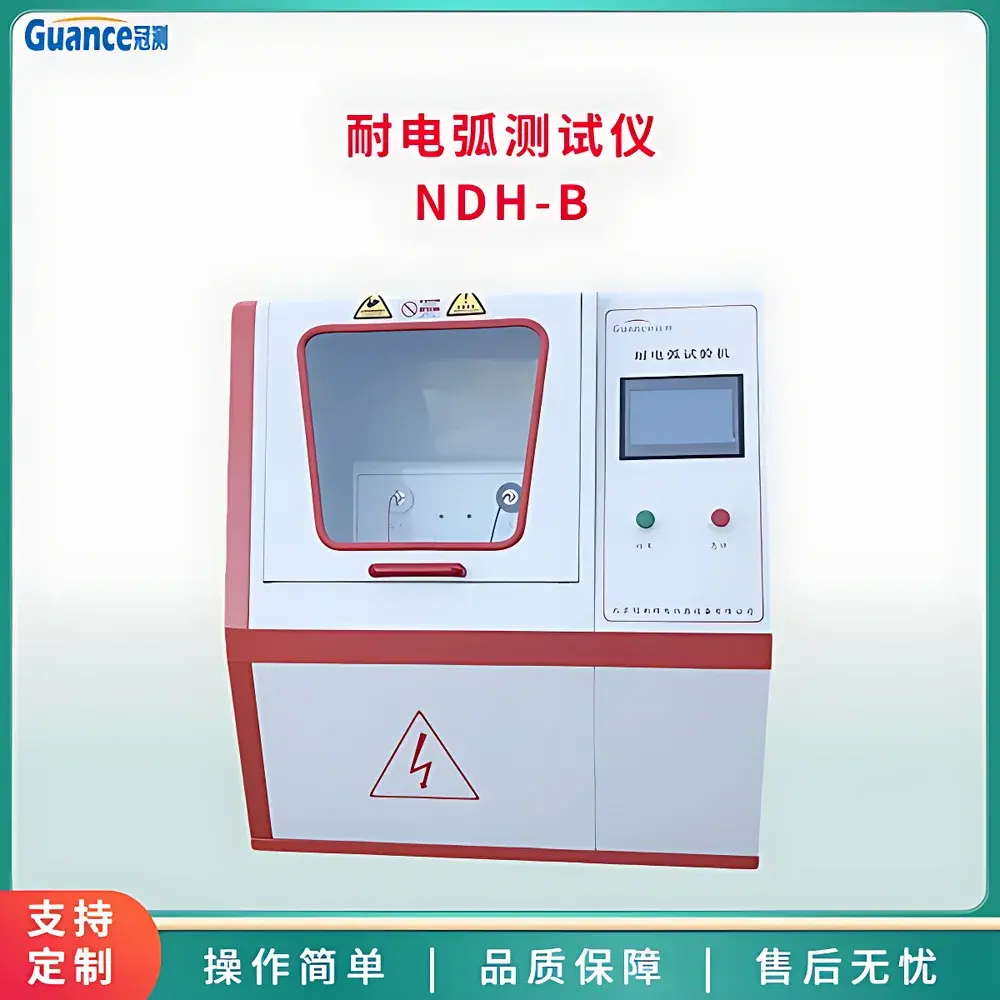
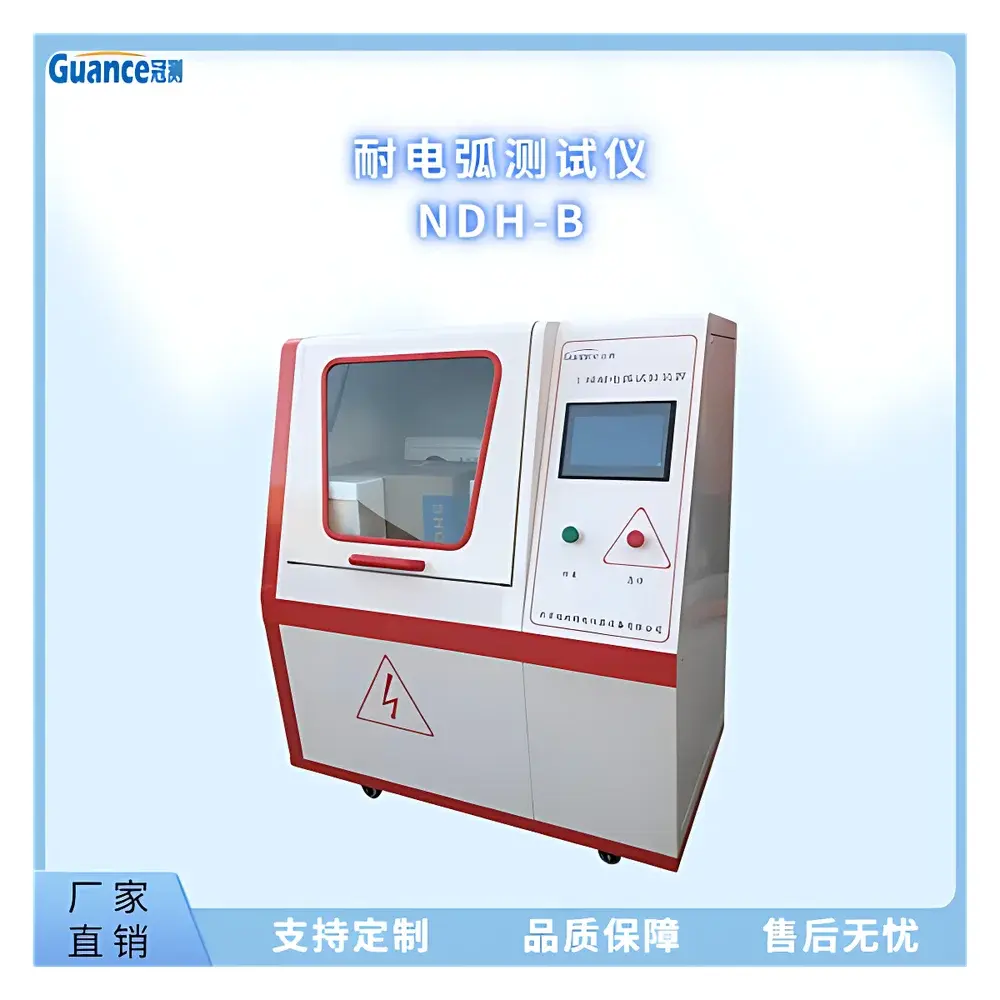
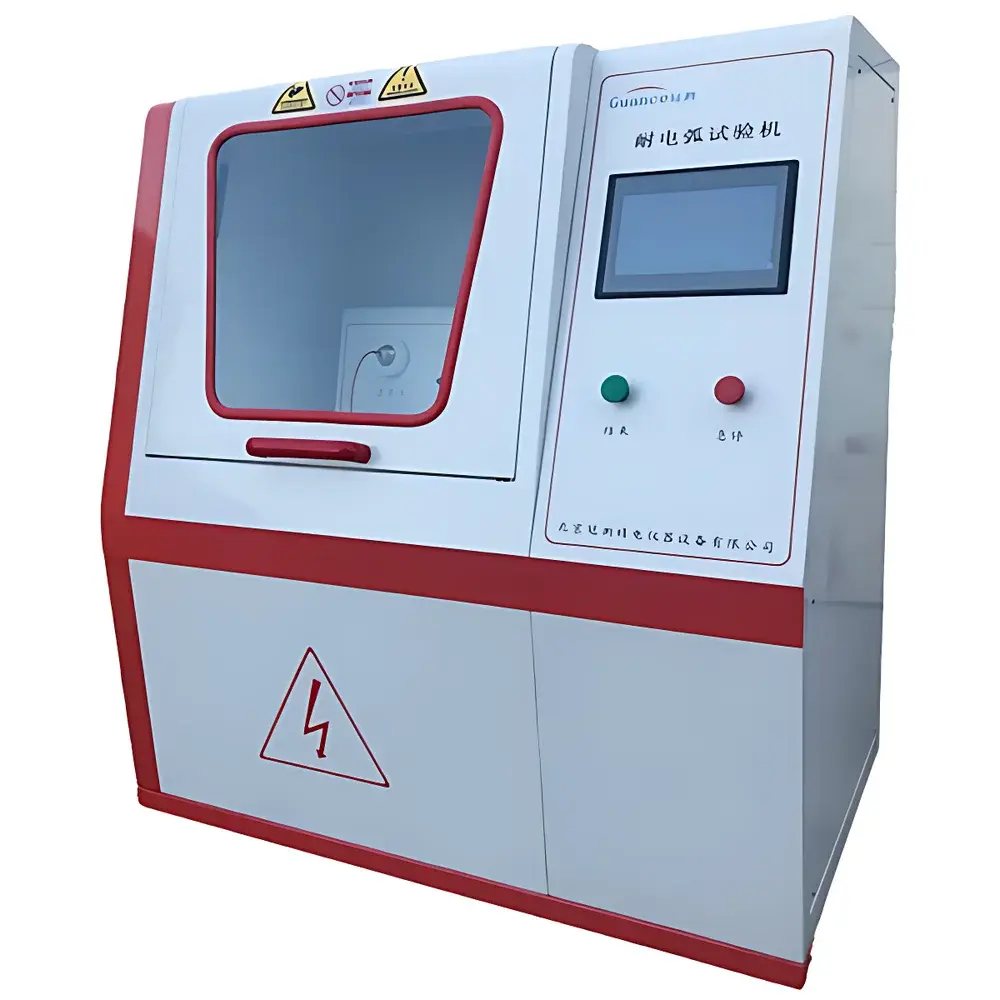
Guance NDH-B Arc Resistance Tester
| Brand | Guance Instruments |
|---|---|
| Origin | Beijing, China |
| Manufacturer Type | Authorized Distributor |
| Product Category | Domestic |
| Model | NDH-B |
| Instrument Type | Electronic Universal Testing Machine |
| Arc Voltage Range | 0–17.5 kV AC (adjustable to 12.5 kV nominal) |
| Arc Current Range | 10–40 mA (discrete steps) |
| Electrode Gap | 6.35 ± 0.1 mm (IEC), 6.0 ± 0.1 mm (ASTM) |
| Electrode Force | 0.5 ± 0.05 N |
| Electrode Material | Tungsten Rod |
| Arc Timing Accuracy | < ±1 ms |
| Voltage Regulation Accuracy | ±1% |
| Current Control Accuracy | ±3% |
| Current Measurement Accuracy | ±1.5% |
| Input Power | 220 V AC / 50 Hz |
| Ambient Operating Conditions | 23 ± 2 °C, 50 ± 5 % RH |
| Transformer & Variac Capacity | 3 kVA each |
Overview
The Guance NDH-B Arc Resistance Tester is a precision-engineered instrument designed for quantitative evaluation of the arc resistance of solid insulating materials under high-voltage, low-current electric arc discharge conditions. It operates on the principle of controlled arcing between two tungsten electrodes spaced at standardized gaps (6.0 mm per ASTM D495 or 6.35 mm per IEC 61621), while applying a nominal test voltage of 12.5 kV and programmable current levels (10–40 mA). The device measures the time elapsed—from initiation of arcing until material failure (e.g., tracking, carbonization, or ignition)—as the primary performance metric, expressed in seconds. This test method directly correlates with real-world insulation degradation mechanisms observed in electrical equipment such as motor windings, circuit breakers, printed wiring boards, and household appliance housings. The NDH-B complies strictly with GB/T 1411–2002 (identical to IEC 61621:1997), ASTM D495, UL 746A, and IEC 149, and was developed under technical supervision by the National Standardization Technical Committee on Electrical Insulating Materials.
Key Features
- Integrated left-right modular architecture: left side houses the shielded test chamber with tempered glass viewing door, high-voltage transformer, variac, and electrode assembly; right side contains the control cabinet with Siemens PLC, industrial-grade HMI touchscreen, and safety interlock circuitry.
- Programmable test execution: preloaded IEC and ASTM test sequences enable automatic voltage ramping, timed arc pulsing (on/off intervals per standard-defined protocols), real-time current monitoring, and post-test auto-zeroing.
- Dual-current verification: simultaneous analog ammeter readout and digital software display ensure traceable current validation during arcing cycles.
- Enhanced operational safety: active high-voltage warning beacon, grounded shielding, protective series resistors in low-voltage control paths, and electromagnetic interference (EMI)-hardened PLC communication.
- Inert gas purging port: enables nitrogen or argon atmosphere introduction during testing—critical for oxidation-sensitive materials or research-grade repeatability under controlled ambient chemistry.
- Self-calibration support: integrated voltage and current verification routines simplify routine metrological checks and facilitate ISO/IEC 17025-compliant calibration documentation.
Sample Compatibility & Compliance
The NDH-B accepts flat, rigid specimens conforming to standardized dimensions: minimum 5 samples per test batch, thickness 3.0 ± 0.4 mm, surfaces smooth and free of burrs or contaminants. Compatible materials include thermosetting resins (e.g., phenolic, epoxy), laminates (G-10, FR-4), insulating varnishes, silicone elastomers, and reinforced plastics used in electrical enclosures and busbar insulation. All test procedures adhere to internationally recognized quality frameworks: data integrity supports GLP and GMP environments; audit trails comply with FDA 21 CFR Part 11 requirements when paired with validated software extensions; and hardware design meets IEC 61000-4 immunity standards for industrial electromagnetic environments.
Software & Data Management
The embedded HMI interface provides real-time visualization of arc voltage, current waveform status, elapsed time, and failure detection events. Test logs—including timestamped parameter sets, operator ID, environmental readings (temperature/humidity), and pass/fail classification—are stored locally in non-volatile memory and exportable via USB to CSV or PDF formats. Optional Ethernet connectivity enables integration into centralized LIMS platforms. Firmware supports firmware version logging, user access levels (admin/operator), and electronic signature capture for regulated workflows. All data structures align with ASTM E2500 and ISO/IEC 17025 clause 7.7 requirements for measurement traceability and result reproducibility.
Applications
- Qualification testing of insulating components in low-voltage switchgear and motor control centers (MCCs).
- R&D screening of halogen-free flame-retardant polymer formulations for EV battery enclosures.
- Comparative arc resistance ranking of prepreg systems used in aerospace-grade PCB substrates.
- Quality assurance of epoxy-mica tape for stator bar insulation in medium-voltage generators.
- Regulatory submission support for UL recognition, CE marking, and CCC certification of electrical appliances.
FAQ
What standards does the NDH-B fully support?
It implements GB/T 1411–2002, IEC 61621:1997, ASTM D495–2022, UL 746A, and IEC 149 without modification—no firmware patches or external adapters required.
Is inert gas purging mandatory for standard tests?
No—it is an optional feature for specialized applications; default operation occurs in ambient air per IEC and ASTM protocols.
Can the NDH-B be integrated into an automated lab network?
Yes—via Modbus TCP or optional OPC UA gateway, enabling remote start/stop, parameter upload, and real-time telemetry to SCADA or MES systems.
How is electrical safety ensured during high-voltage operation?
Through triple redundancy: mechanical interlock on the test chamber door, optically isolated PLC-triggered HV cutoff, and passive grounding of all exposed metal surfaces per IEC 61010-1.
What maintenance is required for long-term accuracy?
Annual verification of electrode gap and force using certified gauges; biannual calibration of HV divider and shunt resistor against NIST-traceable standards.



