
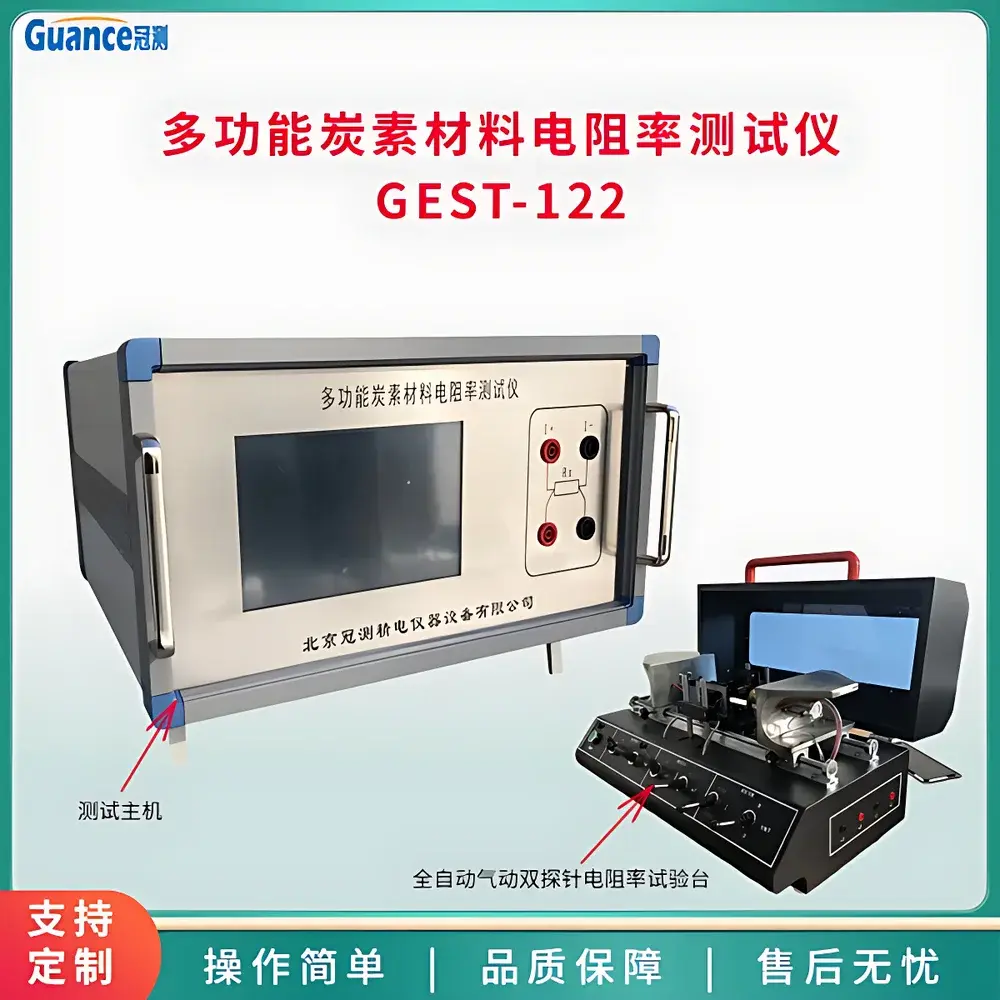
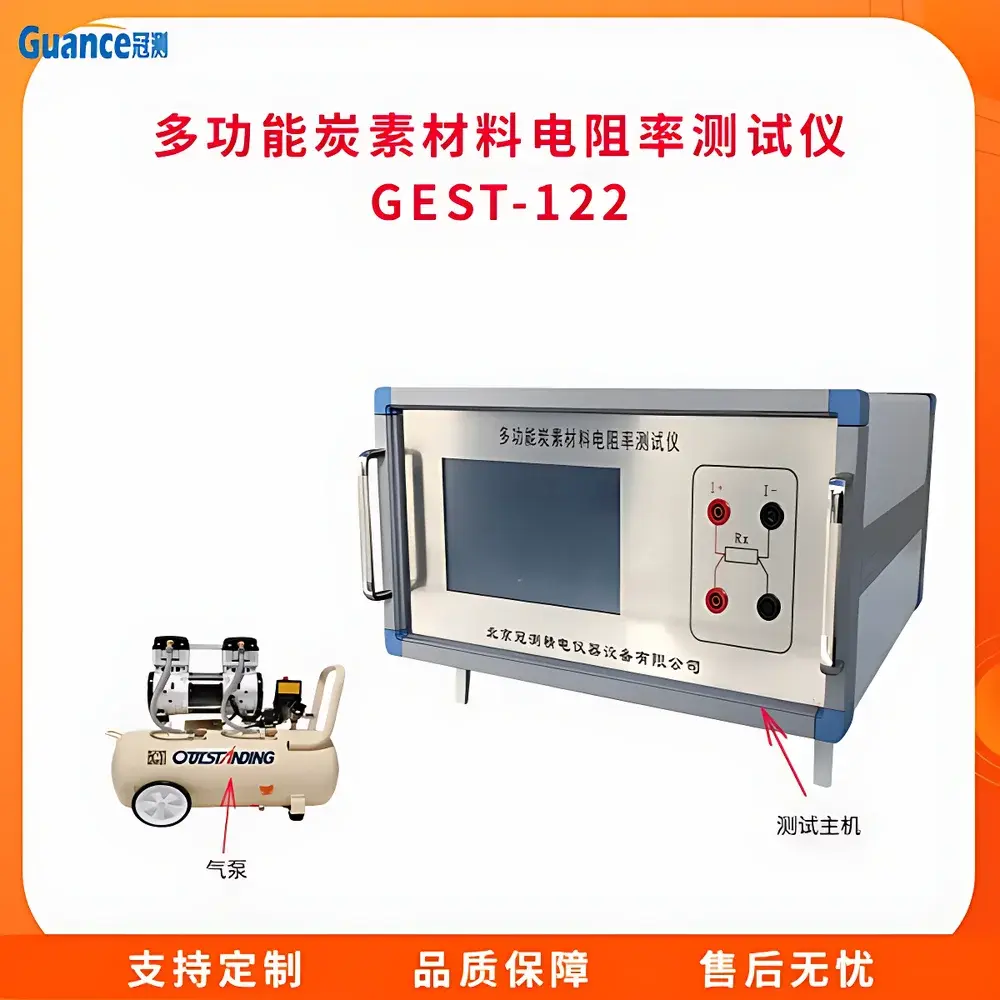
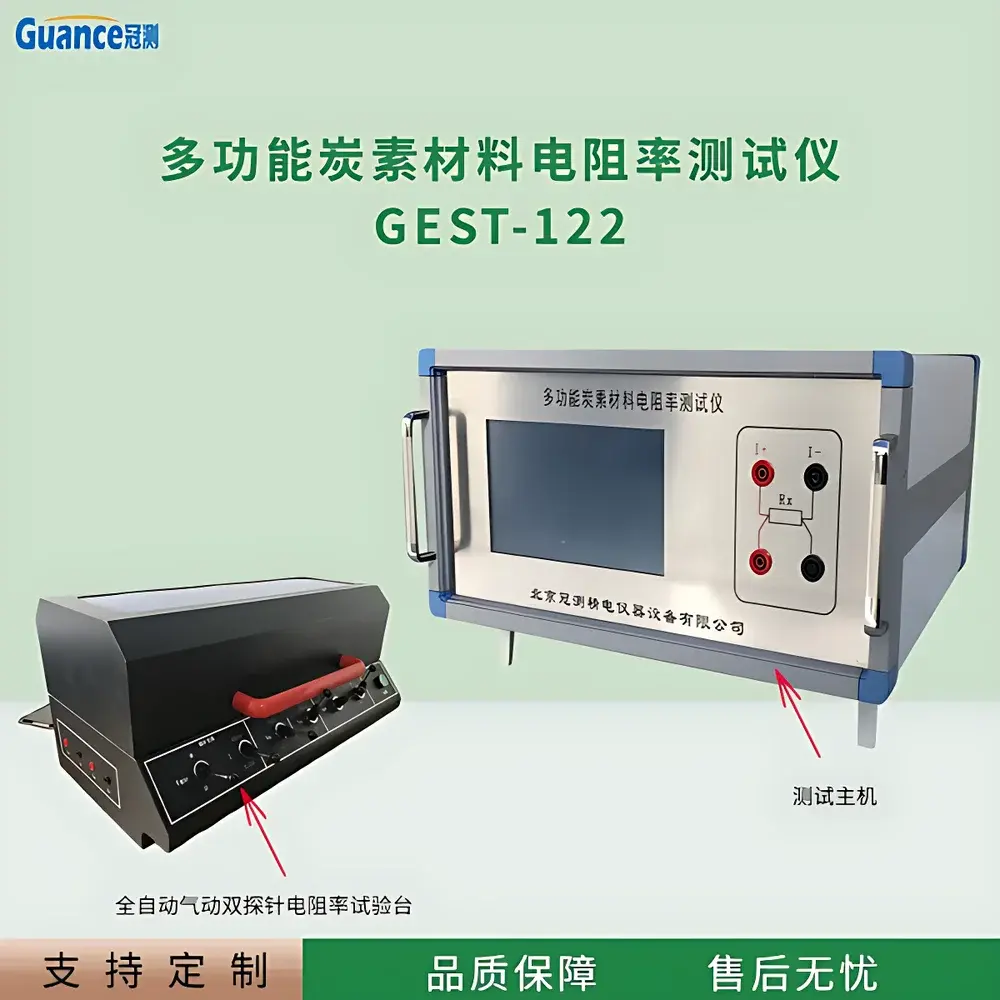
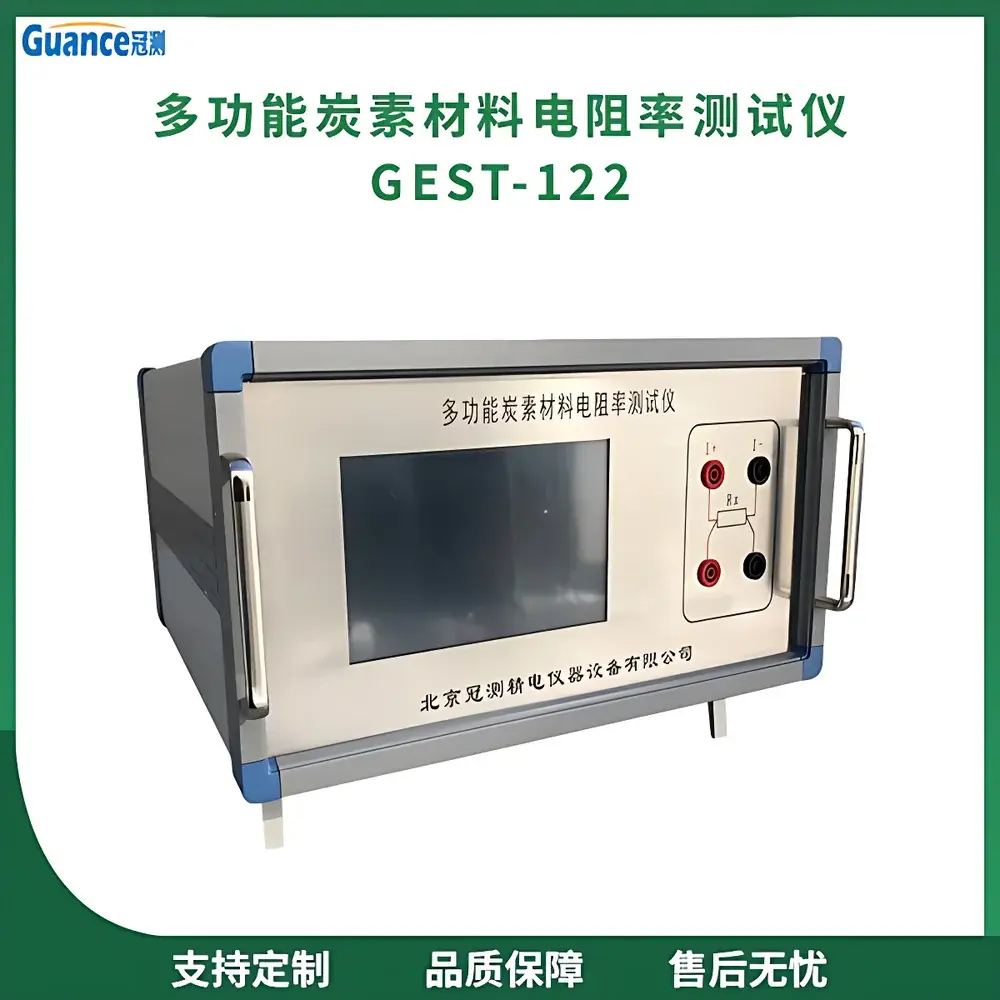
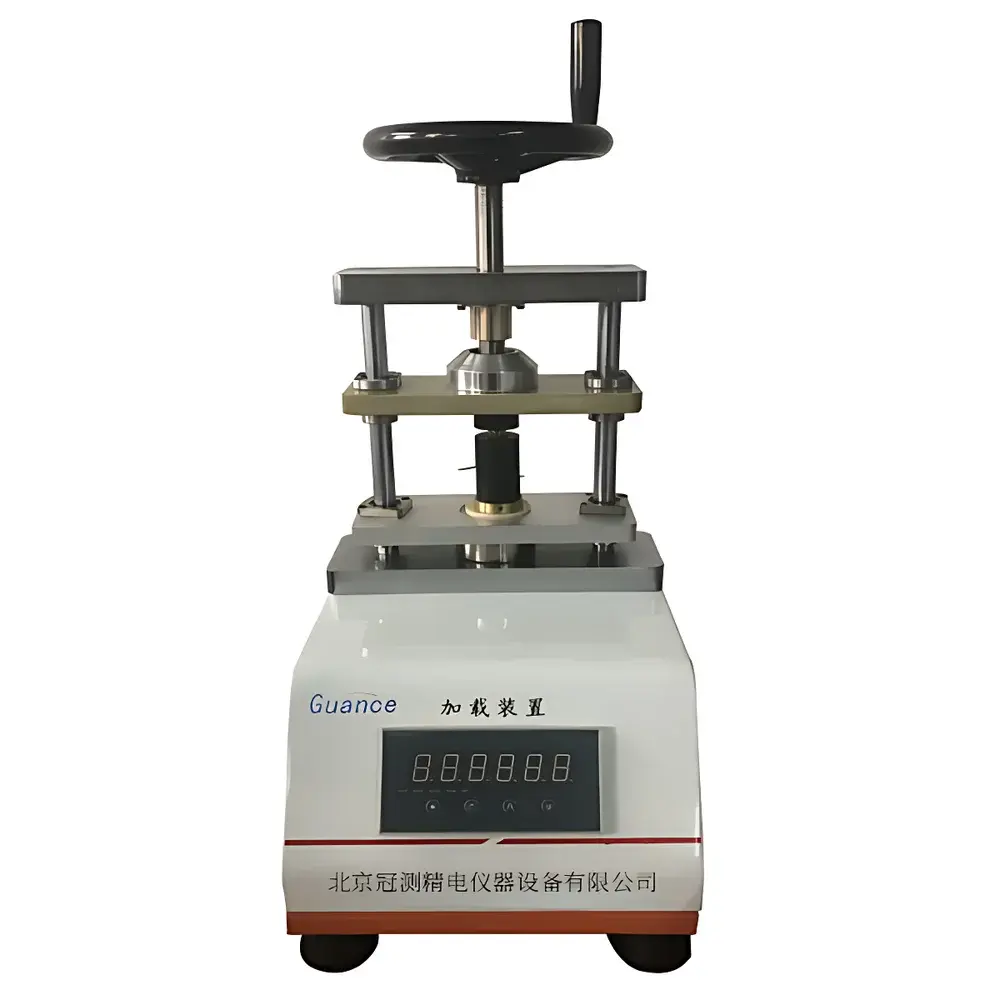
GuanCe GEST-122 Multi-Format Carbonaceous Material Resistivity Tester
| Brand | GuanCe |
|---|---|
| Origin | Beijing, China |
| Manufacturer Type | Authorized Distributor |
| Origin Category | Domestic (PRC) |
| Model | GEST-122 |
| Price | USD 1,420 (FOB Beijing) |
| Standards Compliance | YS/T 587.6–2006, GB/T 24525–2009, GB/T 24521–2009, GB/T 3782–2016 |
| Measurement Principle | Four-Terminal (Kelvin) DC Resistivity Method |
| Sample Forms | Powders (with die compaction), Solid Blocks, Rods |
| Display & Interface | 7-inch Capacitive Touchscreen with Onboard Data Logging |
| Output | Thermal Printer Support (Optional), USB Data Export |
| Power Supply | AC 220 V ±10%, 50 Hz |
| Dimensions (W×D×H) | 320 × 300 × 150 mm |
| Weight | 8.2 kg |
Overview
The GuanCe GEST-122 Multi-Format Carbonaceous Material Resistivity Tester is a precision-engineered, four-terminal (Kelvin) DC resistivity measurement system designed for laboratory and quality control environments handling heterogeneous carbon-based materials. It implements the fundamental principle of volumetric resistivity determination—applying a known DC current across a defined sample geometry while measuring the resulting voltage drop to compute resistivity (ρ) via ρ = R × A / L, where R is measured resistance, A is cross-sectional area, and L is electrode spacing. Unlike generic ohmmeters, the GEST-122 eliminates contact resistance errors through true four-probe excitation and sensing, ensuring metrological traceability for both low-resistivity conductors (e.g., graphite rods, sintered anodes) and higher-resistivity semiconducting powders (e.g., calcined petroleum coke, lithium-ion battery anode precursors). Its architecture conforms to the physical measurement frameworks specified in YS/T 587.6–2006 (powder compaction under controlled pressure), GB/T 24525–2009 (solid carbon blocks), and GB/T 3782–2016 (acetylene black)—making it suitable for ISO/IEC 17025-accredited labs requiring standardized reporting.
Key Features
- Dual-mode test interface: Dedicated, standards-aligned workflows for powder compaction (with integrated pressure calibration) and solid specimen measurement (using adjustable four-point probe fixtures)
- Modular electrode system: Interchangeable electrode sets—including stainless-steel powder dies (25 mm diameter, 10 kN max compaction force), tungsten-carbide block-contact probes, and graphite rod holders—enabling rapid reconfiguration without recalibration
- High-stability DC source: Programmable current output (1 mA to 100 mA, 0.1% accuracy) with automatic polarity reversal to suppress thermoelectric offset
- Embedded 24-bit ADC with auto-ranging: Resolves resistance from 10 µΩ to 2 MΩ (±0.15% reading + 0.05% full scale), supporting resistivity ranges from 10−6 Ω·m (graphite) to 102 Ω·m (low-conductivity coke)
- Touchscreen HMI with GLP-compliant logging: Timestamped measurements stored locally with operator ID, environmental conditions (optional external sensor input), and audit trail metadata
- Thermal printer interface (optional) and USB mass storage export for CSV-formatted datasets compatible with LIMS integration
Sample Compatibility & Compliance
The GEST-122 supports three primary material formats under standardized geometries: (1) Free-flowing or agglomerated powders (e.g., calcined coke, synthetic graphite, Si/C composites), tested in ASTM D3417-compliant cylindrical dies at pressures up to 10 MPa; (2) Rectangular or cylindrical solid blocks (≥10 mm × 10 mm × 20 mm), per GB/T 24525–2009 using collinear four-point probe alignment; and (3) Cylindrical rods (Ø6–30 mm, L ≥ 50 mm), per GB/T 24521–2009 with axial current injection and potential sensing. All test configurations maintain strict adherence to electrode spacing tolerances (±0.2 mm) and surface contact requirements (Ra ≤ 0.8 µm). The instrument’s firmware embeds calculation modules that automatically apply correction factors for non-ideal geometries (e.g., finite-sample edge effects per Smoluchowski approximation) and temperature compensation (via optional Pt100 input). It satisfies documentation requirements for FDA 21 CFR Part 11 (when paired with validated software and electronic signature protocols) and supports internal GLP/GMP audits through immutable data logs.
Software & Data Management
The onboard firmware provides a dedicated, menu-driven interface accessible via the 7-inch capacitive touchscreen—designed for glove-compatible operation in industrial QC labs. Test sequences are preconfigured per standard: users select “YS/T 587.6 Powder Mode” or “GB/T 24525 Block Mode”, enter sample ID and batch number, then initiate automated current ramping, voltage acquisition, and resistivity computation. All raw data (I, V, T, P, time) and derived values (ρ, σ, % deviation from reference) are timestamped and stored in a non-volatile internal memory (≥10,000 records). USB export generates ISO 8601-compliant CSV files containing column headers compliant with ASTM E1318 data exchange conventions. No cloud connectivity or third-party software dependency is required—ensuring data sovereignty and compatibility with air-gapped environments typical in battery material manufacturing facilities.
Applications
This instrument serves critical metrology functions across carbon-intensive industries: qualification of calcined petroleum coke feedstock for aluminum anode production (per YS/T 587.6); incoming inspection of graphite electrodes used in electric arc furnaces; R&D screening of silicon-carbon composite anodes for next-generation Li-ion batteries; process validation of binder pyrolysis in carbon fiber precursor tapes; and quality release testing of acetylene black conductive additives (per GB/T 3782–2016). Its dual-format capability eliminates cross-contamination risks associated with repurposing single-mode testers and reduces capital expenditure by consolidating two traditionally separate test stations into one calibrated platform—particularly valuable for contract testing labs serving multiple clients across cathode, anode, and refractory supply chains.
FAQ
Does the GEST-122 comply with international calibration traceability requirements?
Yes—the instrument’s current source and voltage measurement circuits are factory-calibrated against NIST-traceable standards, and calibration certificates include uncertainty budgets per ISO/IEC 17025 Annex A.
Can it measure anisotropic resistivity in oriented graphite samples?
No—it performs isotropic bulk resistivity measurement only; directional (in-plane vs. through-thickness) analysis requires specialized multi-axis probe arrays not supported by this model.
Is temperature control integrated?
No—ambient temperature measurement is supported via optional external Pt100 input, but active thermal conditioning of samples or electrodes is outside its scope.
What maintenance is required for long-term stability?
Annual verification of electrode contact resistance and die dimensional integrity is recommended; no consumables or routine recalibration are needed under normal operating conditions.
Is firmware upgrade capability available?
Yes—updates are delivered via USB stick and preserve all historical data and user-configured test templates.



