
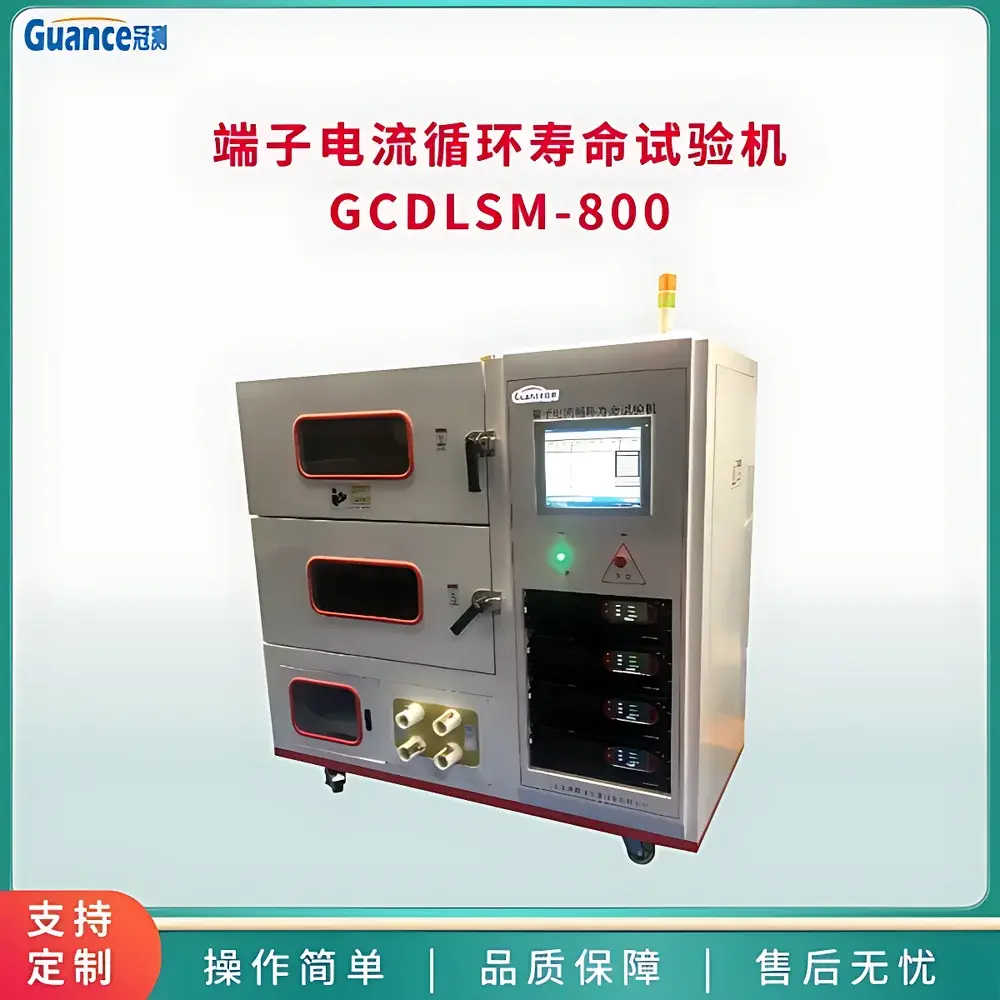
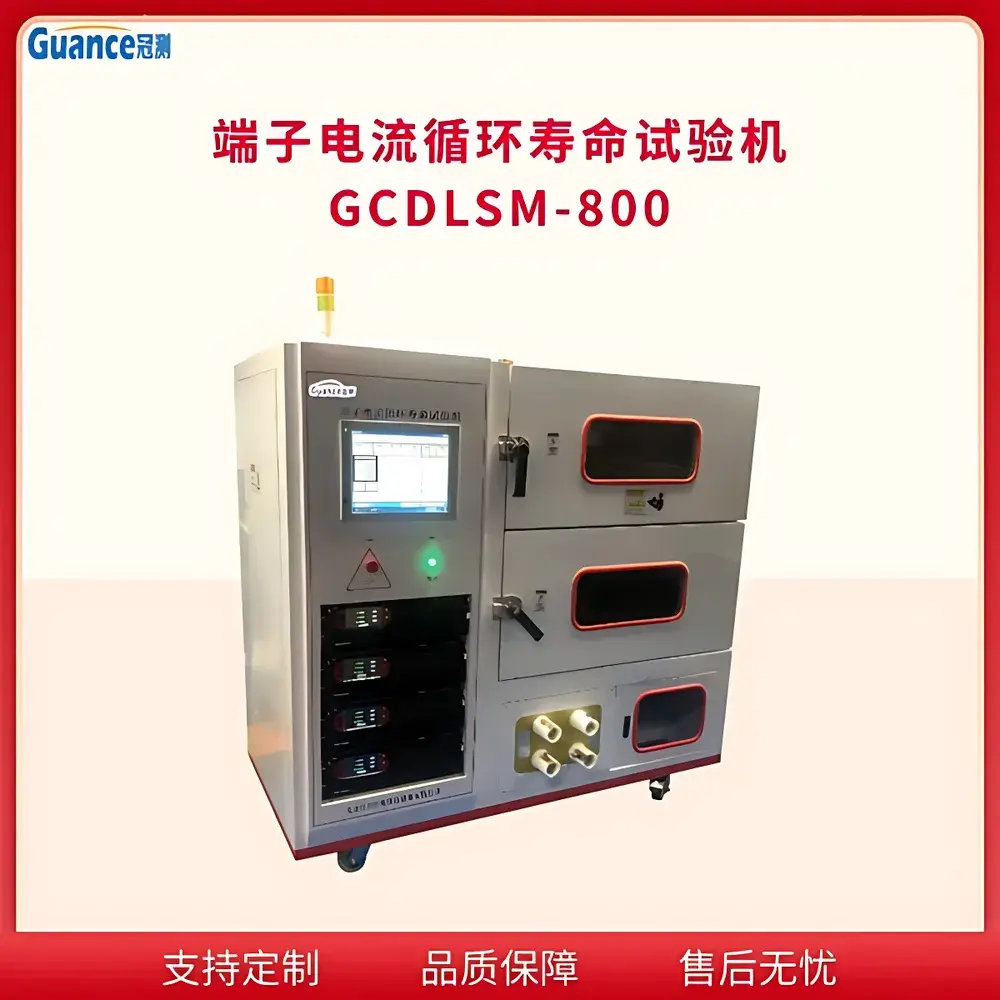
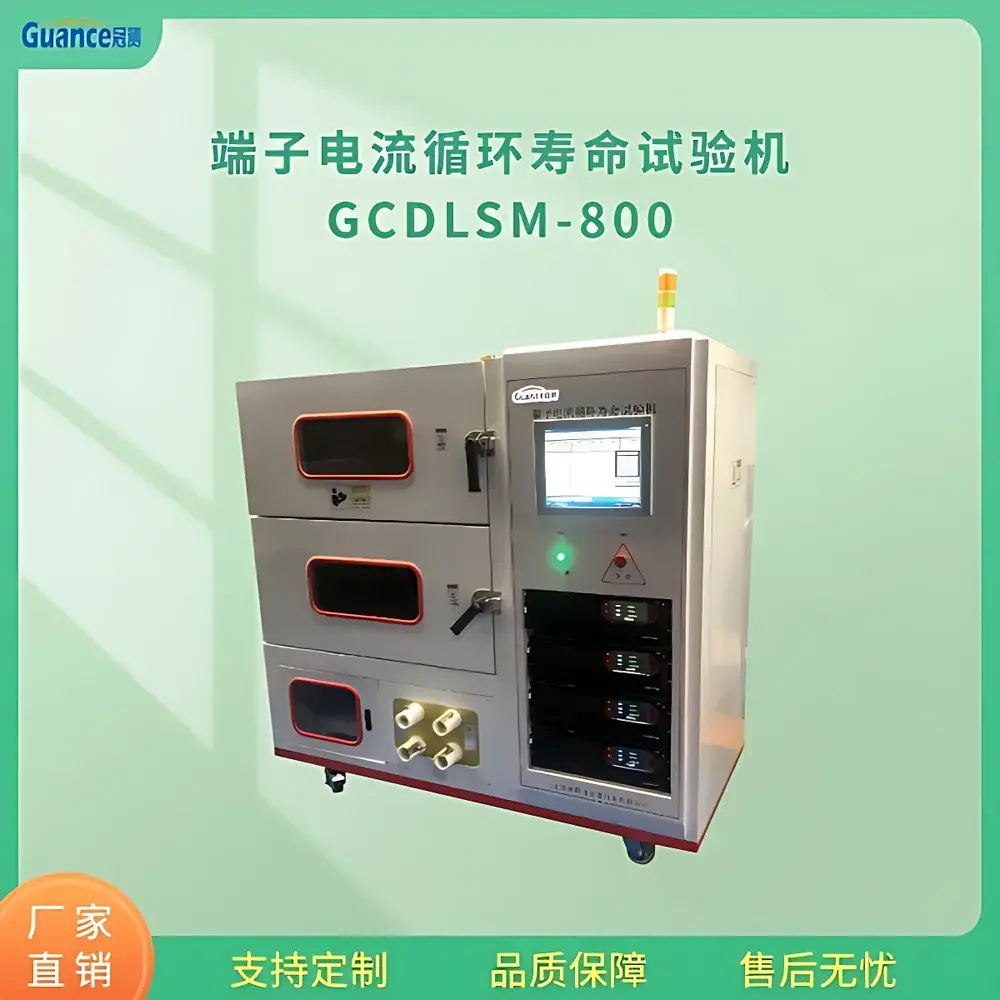
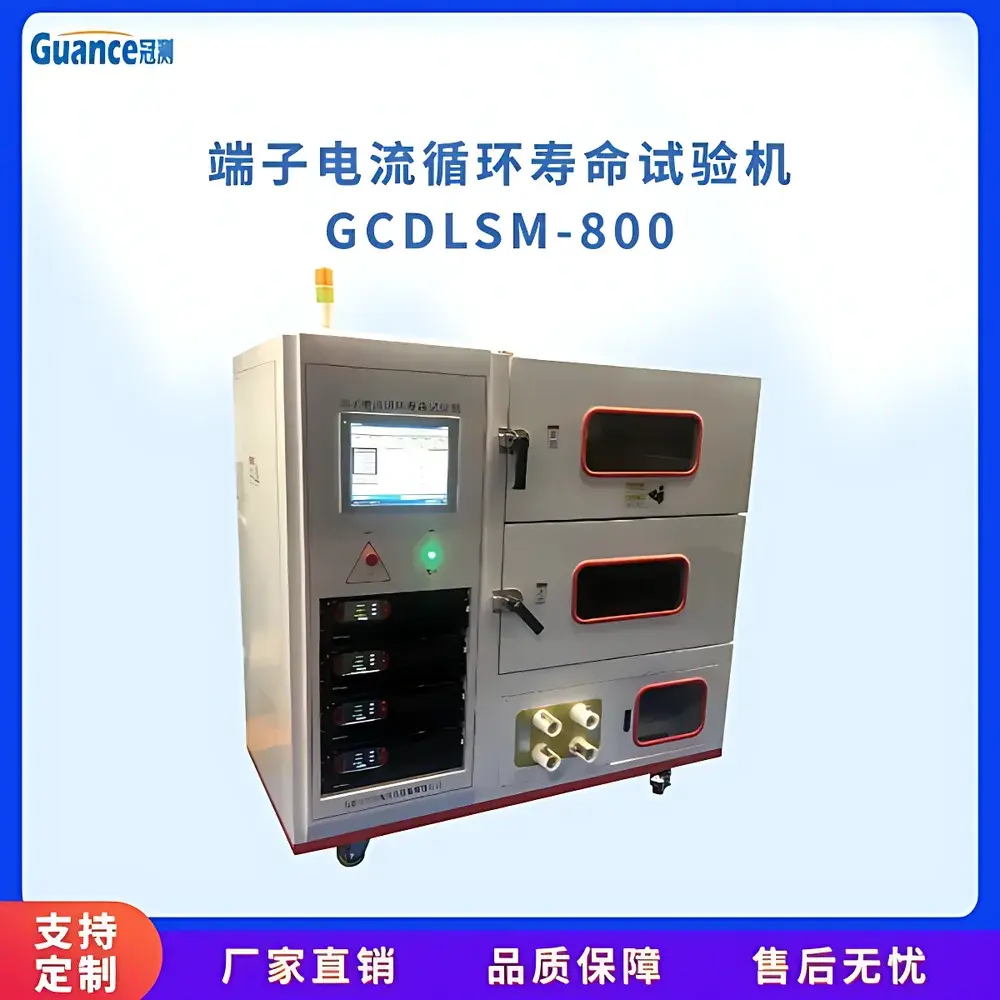
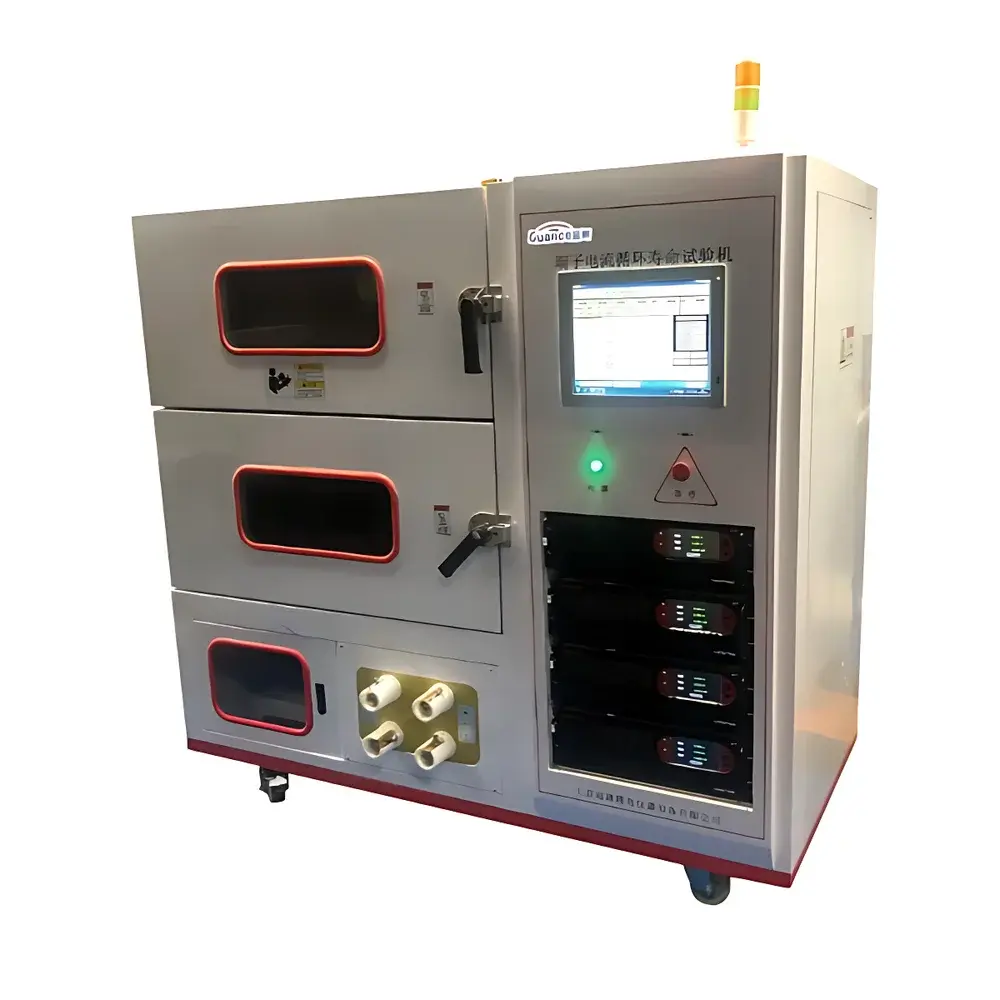
GuanCe Instruments GCDLSM-800 Terminal Current Cycling Life Tester
| Brand | GuanCe Instruments |
|---|---|
| Origin | Beijing, China |
| Manufacturer Type | Authorized Distributor |
| Country of Origin | China |
| Model | GCDLSM-800 |
| Price | USD 2,350 (FOB Beijing) |
| Power Supply | 380 V / 50 Hz |
| Rated Power | 32 kW |
| Heating Chamber Quantity | 2 |
| Chamber Internal Dimensions (per layer) | 960 mm (L) × 400 mm (H) × 400 mm (D) |
| Temperature Range | Ambient to 250 °C |
| Temperature Control Accuracy | ±2 °C |
| Heating Method | PID-controlled resistive heating (3 kW per chamber) |
| Temperature Sensing | Dual PT100 sensors per channel — one for chamber ambient (Sensor A), one for terminal surface contact (Sensor B) |
| Current Channels | 4 independent DC channels |
| Max. Current per Channel | 800 A |
| Current Control | Programmable on/off timing per channel (duration and cycle count user-defined) |
| Data Logging | Real-time synchronized acquisition of temperature (A & B) and current (per channel) with timestamped CSV export |
| Software Features | Cycle definition, thermal profile scheduling, pass/fail threshold setting, audit-ready event log, data encryption and backup |
| Compliance Support | Designed to support ISO 16750-4 (road vehicles – electrical loads), MIL-STD-202 Method 210 (current surge), and SAE J1128 (low-voltage primary cable) test protocols |
| Physical Dimensions | 1500 mm (L) × 900 mm (W) × 1700 mm (H) |
| Net Weight | ~400 kg |
Overview
The GuanCe Instruments GCDLSM-800 Terminal Current Cycling Life Tester is an engineered system for accelerated reliability validation of crimped, soldered, or welded electrical terminals used in high-current wiring harnesses. It operates on the principle of thermomechanical stress induction: by subjecting terminals to repeated cycles of rated DC current under controlled elevated temperature conditions, the instrument accelerates interfacial degradation mechanisms—including oxidation at contact interfaces, creep deformation in soft metals (e.g., copper, aluminum), and thermal expansion mismatch between conductor and termination hardware. Unlike simple continuity testers, the GCDLSM-800 integrates simultaneous thermal and electrical load control across four independent channels, enabling statistically robust multi-sample evaluation within a single test run. Its dual-chamber architecture supports parallel testing under identical or differentiated thermal profiles—critical for comparative qualification of terminal designs, plating systems, or crimp tooling parameters.
Key Features
- Four fully isolated 800 A DC power channels, each with independent programmable on/off timing, cycle counting, and fault detection—no cross-channel interference during failure events.
- Dual-zone heating chambers (2 × 960 × 400 × 400 mm internal volume), each equipped with 3 kW resistive heating elements and precision PID temperature regulation (±2 °C stability from ambient to 250 °C).
- Dual-sensor thermal monitoring per channel: PT100 Sensor A measures ambient chamber air temperature; PT100 Sensor B (with flexible lead routing) enables direct surface contact measurement on the terminal or wire insulation—supporting both IEC 60512-5-1 compliant surface-temperature-based conditioning and chamber-air referencing.
- Real-time synchronized data acquisition at ≥1 Hz resolution: time-stamped current (per channel), chamber ambient temperature, and terminal surface temperature—exportable as ISO/IEC 17025-compliant CSV files with embedded metadata (operator ID, test plan version, calibration traceability flags).
- Industrial-grade control software with role-based access, electronic signature capability, and 21 CFR Part 11–ready audit trail (including parameter change history, start/stop timestamps, and manual override logs).
- Structural design optimized for long-term unattended operation: reinforced steel frame, forced-air cooling for power electronics, and modular cabling trays accommodating up to 120 mm² conductors with strain relief.
Sample Compatibility & Compliance
The GCDLSM-800 accommodates terminals mounted on wires ranging from 6 AWG to 0000 AWG (10–120 mm²), including insulated and bare variants. Fixturing supports standard automotive FAKRA, USCAR-2, and MIL-DTL-22992 connectors, as well as custom crimp configurations via adjustable busbar mounting plates. Test methodology aligns with key international standards: ISO 16750-4 Annex C (cyclic current loading under temperature), MIL-STD-202 Method 210 Condition D (high-current endurance), and SAE J1128 Clause 5.4.2 (thermal cycling with load). Optional documentation packages include IQ/OQ protocols, calibration certificates traceable to NIM (National Institute of Metrology, China), and raw data archiving templates compliant with GLP and automotive APQP requirements.
Software & Data Management
The embedded Windows-based control suite provides deterministic real-time scheduling of up to 999 cycles per channel, with individual configuration of dwell time (on/off), ramp rates (if enabled via external DC source integration), and thermal soak periods. All test parameters are stored in encrypted XML project files. Post-test analysis includes automatic identification of resistance drift trends (derived from V/I slope), time-to-failure annotation, and statistical summary (mean cycles to open-circuit, standard deviation, Weibull shape parameter estimation). Data exports include full-resolution time-series datasets and PDF reports containing test configuration, environmental conditions, pass/fail status per channel, and operator verification signatures—formatted for direct inclusion in PPAP submissions or regulatory dossiers.
Applications
- Automotive Tier-1 suppliers validating terminal integrity for EV battery interconnects (e.g., busbar joints, cell-to-module links) under 400–800 A continuous load at 105–150 °C.
- Aerospace wiring system qualification per AS50881 and RTCA DO-160 Section 20, particularly for high-amperage landing gear and APU harnesses.
- Military electronics manufacturers verifying MIL-DTL-22992 Class D terminations subjected to combined thermal shock and current overload per MIL-STD-810G Method 503.5.
- R&D labs correlating crimp force, barrel geometry, and plating thickness (Sn, Ag, Ni) with electromigration onset thresholds using accelerated life modeling (e.g., Black’s equation fitting).
- Quality assurance departments performing lot acceptance testing (LAT) on production batches against AQL Level II sampling plans per ISO 2859-1.
FAQ
What safety certifications does the GCDLSM-800 carry?
The system complies with GB/T 3836.1–2021 (Explosive Atmospheres), GB 4793.1–2007 (Electrical Safety for Laboratory Equipment), and CE marking per Machinery Directive 2006/42/EC and EMC Directive 2014/30/EU. Full test reports available upon request.
Can the system integrate with existing MES or LIMS platforms?
Yes—via OPC UA server interface (included) or Modbus TCP protocol; REST API for test initiation, status polling, and result retrieval is available as optional firmware module.
Is remote monitoring supported?
Standard Ethernet connectivity enables browser-based live view of all channels’ current/temperature curves, chamber status, and alarm history—accessible over secure VPN without exposing the control network.
What maintenance intervals are recommended?
Biannual verification of PT100 sensor calibration (traceable to NIM), annual inspection of busbar contact resistance (<50 µΩ per joint), and quarterly cleaning of air filters and heat sink fins.
Does the software support automated reporting for ISO/IEC 17025 accreditation?
Yes—the report generator embeds instrument calibration IDs, uncertainty budgets, environmental condition logs, and digital signatures meeting ILAC-P14 requirements for accredited testing laboratories.



