
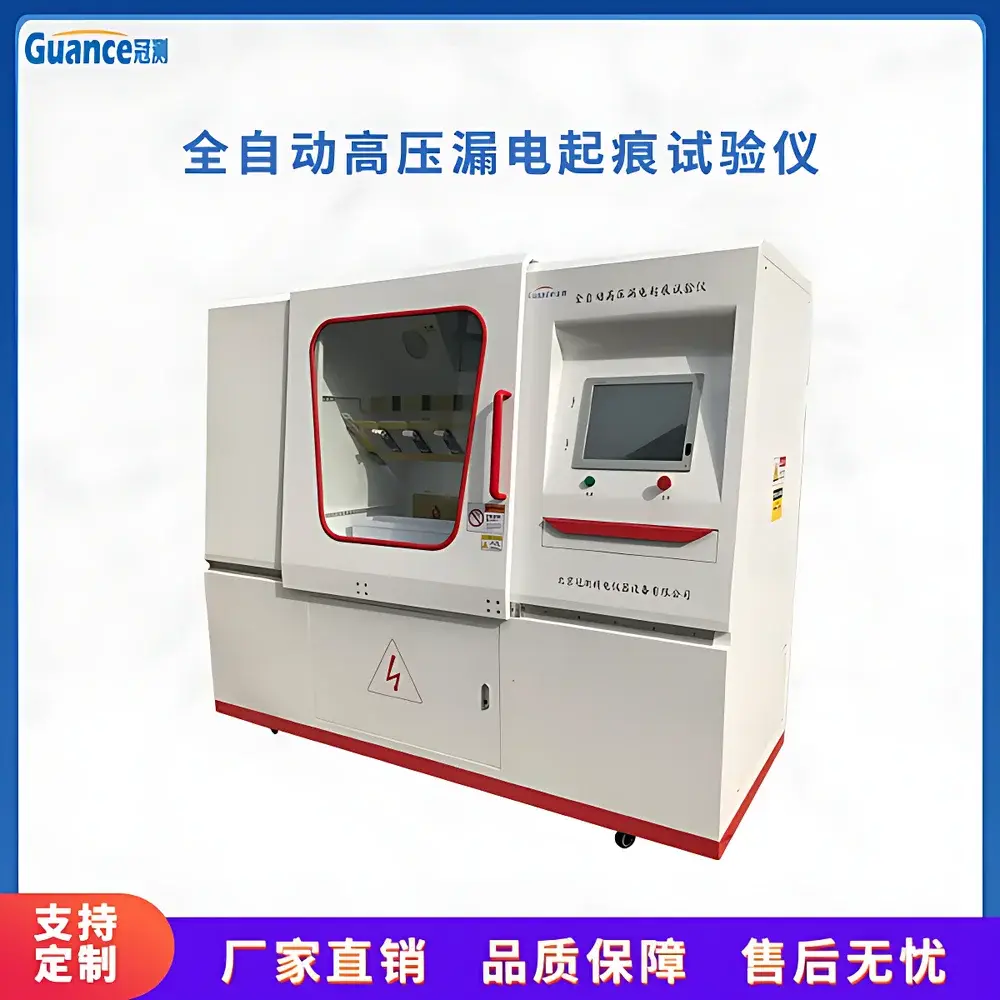
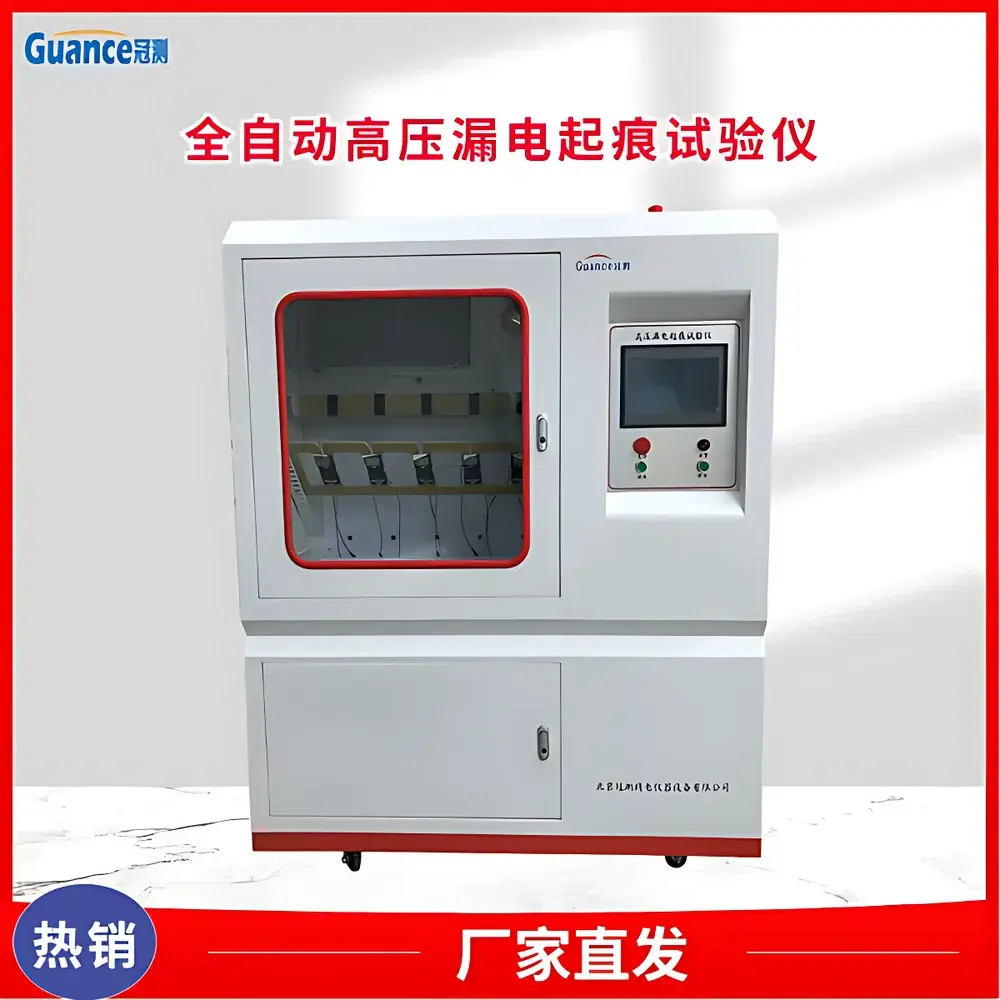

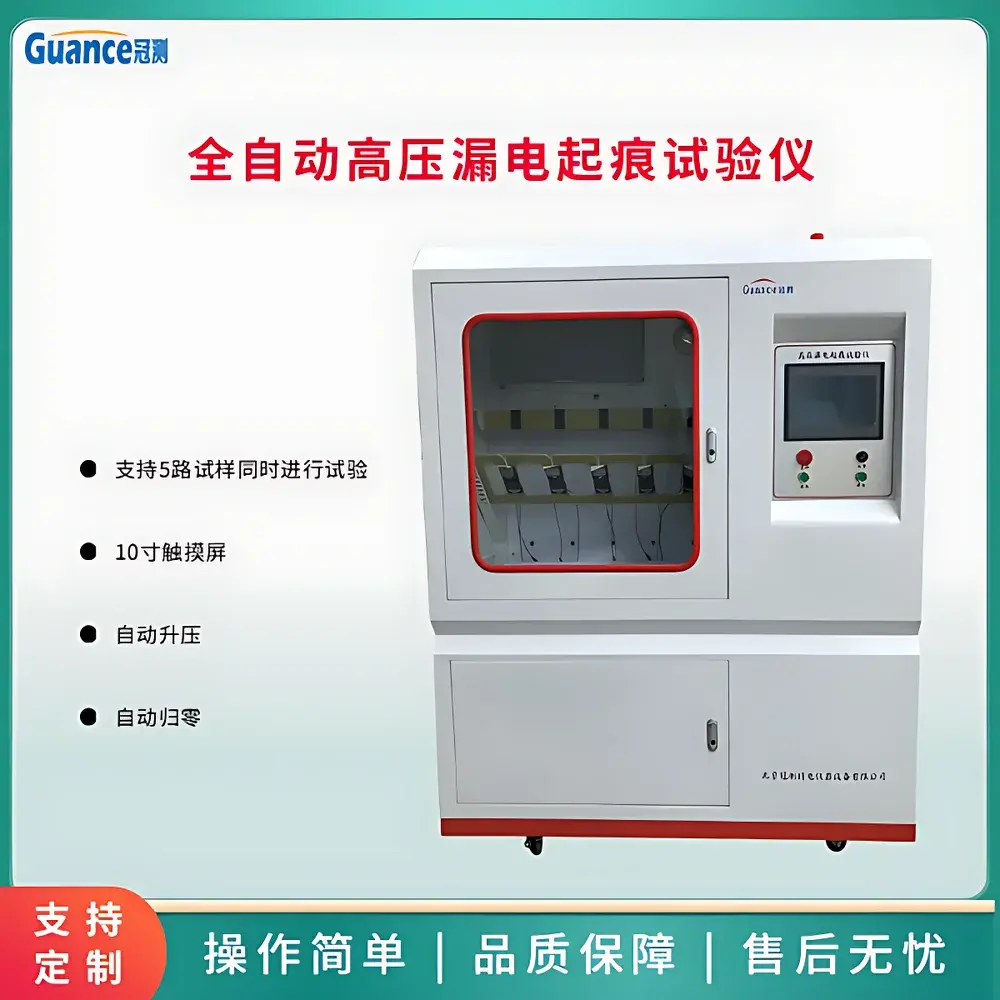
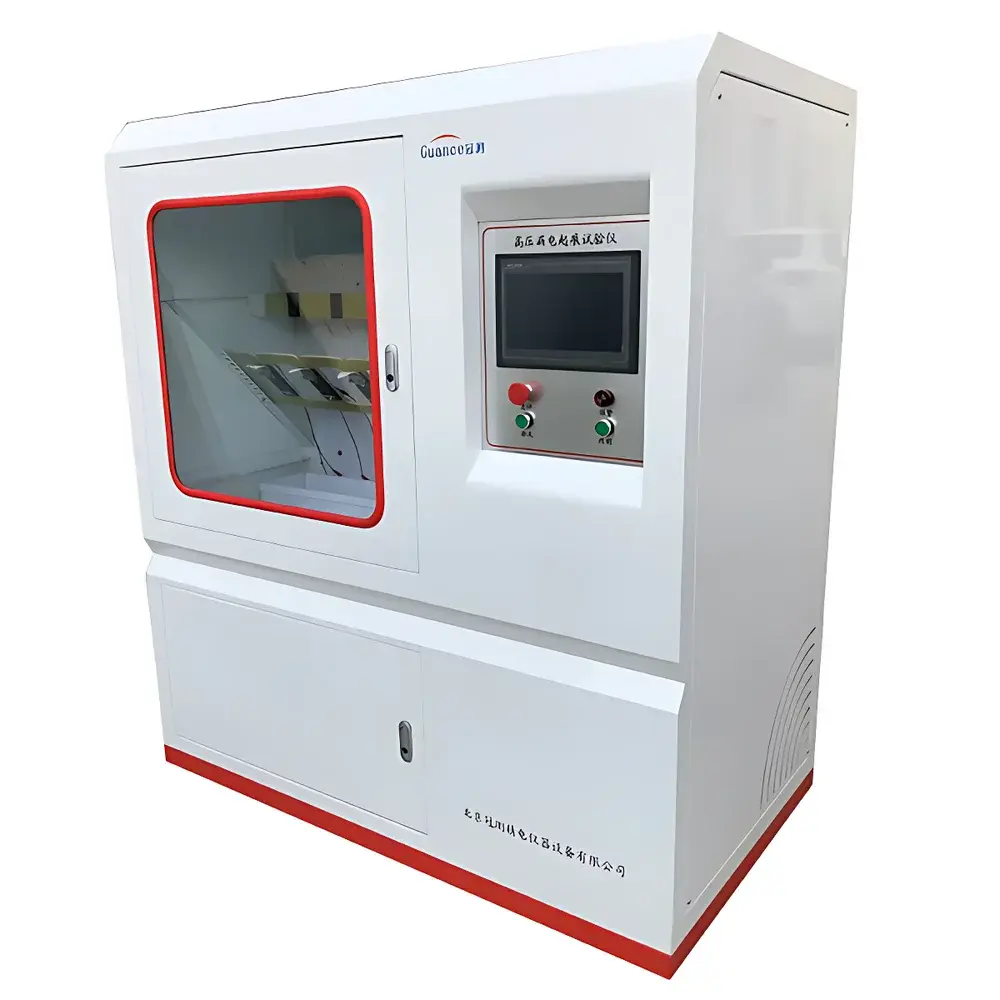
GuanCe Instruments NLD-AI3 High-Voltage Tracking and Erosion Tester
| Brand | GuanCe Instruments |
|---|---|
| Origin | Beijing, China |
| Manufacturer Type | Authorized Distributor |
| Country of Origin | China |
| Model | NLD-AI3 |
| Instrument Type | Electronic Universal Testing Machine |
| Voltage Output | AC 100–8000 V / DC 100–8400 V |
| Electrical Capacity | 7 kVA |
| Electrode Spacing | (50 ± 0.5) mm |
| Electrode Material | 304 Stainless Steel |
| Test Specimens | 5 parallel channels |
| Voltage Drop | ≤5% |
| Input Power | AC 220 V, 50 Hz |
| Test Methods | Constant Voltage Method & Stepwise Voltage Method |
| Compliance | GB/T 6553–2003, IEC 60587:1984 |
Overview
The GuanCe Instruments NLD-AI3 High-Voltage Tracking and Erosion Tester is an engineered solution for evaluating the comparative resistance of solid insulating materials—such as silicone rubber, epoxy resins, polymeric composites, and ceramic-coated substrates—to electrical tracking and erosion under contaminated, humid, and high-voltage stress conditions. Based on the principles of surface conduction, electrochemical degradation, and carbonized path formation, the instrument applies controlled AC or DC voltage across inclined test specimens while delivering calibrated contaminant solution (e.g., ammonium chloride + deionized water) via precision peristaltic dosing. This replicates real-world service environments where insulators are exposed to industrial pollution, coastal salt mist, or condensation-induced leakage currents. Designed in strict accordance with GB/T 6553–2003 and IEC 60587:1984, the NLD-AI3 delivers reproducible, standardized assessment of Comparative Tracking Index (CTI) and Proof Tracking Index (PTI), supporting material qualification for high-reliability applications in power transmission, railway signaling, EV charging infrastructure, and aerospace electrical systems.
Key Features
- Parallel 5-channel testing architecture: Enables simultaneous evaluation of five independent specimens under identical environmental and electrical conditions—significantly improving throughput and inter-sample comparability.
- Siemens PLC-based control system with optical isolation: Ensures electromagnetic immunity in high-voltage environments; guarantees stable acquisition of leakage current (0–100 mA range) and applied voltage (AC/DC) without signal drift or cross-talk.
- 10-inch industrial HMI touchscreen interface: Provides real-time visualization of per-channel voltage, instantaneous leakage current, peak historical current, cumulative test duration (in minutes), and programmable drip rate.
- Configurable over-current protection: User-definable trip thresholds (0–100 mA) trigger automatic high-voltage disconnection for the affected channel only—preserving continuity of remaining tests.
- Peristaltic liquid delivery with on-screen flow calibration: Eliminates pulsation and ensures volumetric repeatability; drip volume and interval are adjustable and continuously monitored during operation.
- Dual-compartment fluid management: Separates fresh contaminant reservoir from used solution collection—preventing cross-contamination and maintaining consistent electrolyte conductivity throughout test sequences.
- Auto-ramp voltage control and zero-return functionality: Supports both constant-voltage and stepwise-voltage protocols; automatically ramps to target voltage and returns to 0 V post-test for operator safety.
- Integrated ventilation and task lighting: Dedicated exhaust ducting evacuates corrosive vapors (e.g., chlorine gas generated during electrolysis); LED illumination enables visual inspection of tracking progression without opening the chamber.
- Oil-immersed high-voltage transformer with autotransformer regulation: Delivers stable output with ≤5% voltage sag under load; fixed-turns-ratio design ensures minimal waveform distortion and long-term calibration stability.
- Field-accessible voltage and current calibration routines: Allows periodic metrological verification using traceable reference standards—supporting GLP-compliant documentation and audit readiness.
Sample Compatibility & Compliance
The NLD-AI3 accommodates standard rectangular or prismatic specimens (typically 100 mm × 100 mm × 3–6 mm thick) mounted at a 45° inclination per IEC 60587 requirements. Compatible materials include thermosetting plastics (e.g., phenolics, melamines), thermoplastics (e.g., PBT, PET), filled elastomers, laminated composites, and coated ceramics. All mechanical fixtures—including electrode holders, drip nozzles, and specimen supports—are constructed from high-dielectric-strength composite polymers and 304 stainless steel to prevent parasitic conduction paths. The system meets national and international regulatory expectations for electrical safety (IEC 61010-1), electromagnetic compatibility (IEC 61326-1), and test method validity. It supports full traceability for ISO/IEC 17025-accredited laboratories and aligns with quality system requirements under FDA 21 CFR Part 11 when integrated with compliant data archiving protocols.
Software & Data Management
While the NLD-AI3 operates via embedded PLC logic and local HMI, its digital outputs (voltage, current, time, drip count) are accessible via RS-485 Modbus RTU for integration into laboratory information management systems (LIMS) or SCADA platforms. All operational parameters—including start time, voltage profile, current thresholds, and pass/fail status per channel—are timestamped and stored in non-volatile memory. Exportable CSV logs enable post-test statistical analysis of tracking onset time, erosion depth progression, and failure sequence correlation. Optional firmware upgrades support configurable alarm logging, electronic signature capture, and audit trail generation—facilitating compliance with GMP/GLP documentation standards.
Applications
- Qualification of insulating housings for medium-voltage switchgear and distribution transformers
- Development and validation of arc-resistant polymer formulations for rail traction equipment
- CTI/PTI certification of encapsulation resins used in photovoltaic junction boxes
- Comparative aging studies of silicone rubber outdoor insulators under simulated coastal fog conditions
- Material screening for EV battery pack enclosures subjected to thermal cycling and humidity ingress
- Supporting ASTM D3638, UL 746A, and IEC 60112 test derivations where applicable
FAQ
What standards does the NLD-AI3 explicitly comply with?
The instrument is configured and validated to meet GB/T 6553–2003 and IEC 60587:1984 for electrical tracking and erosion testing.
Can the NLD-AI3 perform both AC and DC high-voltage tests?
Yes—it delivers adjustable AC output from 100 V to 8,000 V RMS and DC output from 100 V to 8,400 V, with independent regulation and monitoring per channel.
Is remote data export supported?
Raw test data (voltage, current, time, drip events) are available via RS-485 Modbus RTU; CSV export is enabled through the HMI USB port.
How is operator safety ensured during high-voltage operation?
Interlocked access door circuitry immediately de-energizes all HV circuits upon opening; redundant grounding, optical isolation, and oil-immersed transformer design further mitigate shock risk.
Does the system support automated pass/fail classification?
The device records time-to-failure and tracks whether each specimen reaches the specified number of 50 drops without forming a conductive track; final classification (e.g., CTI value) requires post-test evaluation per standard-defined criteria.



