
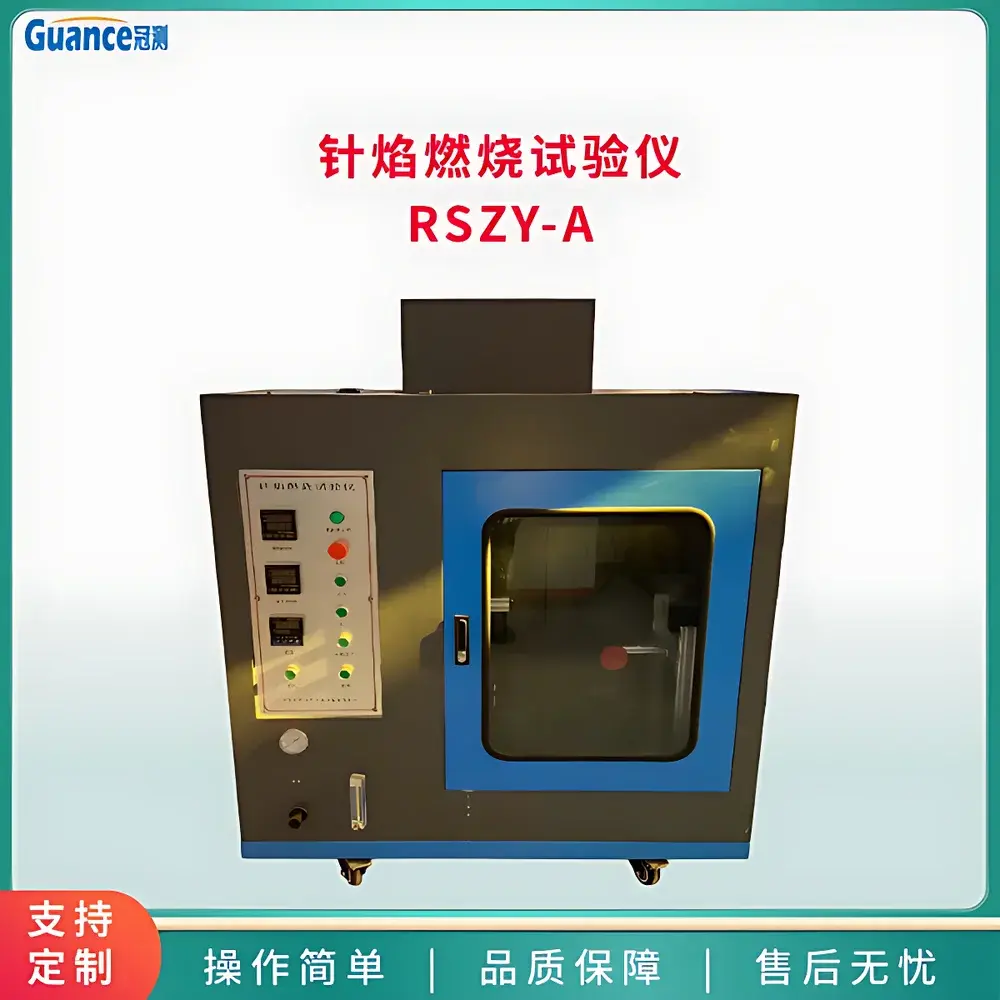
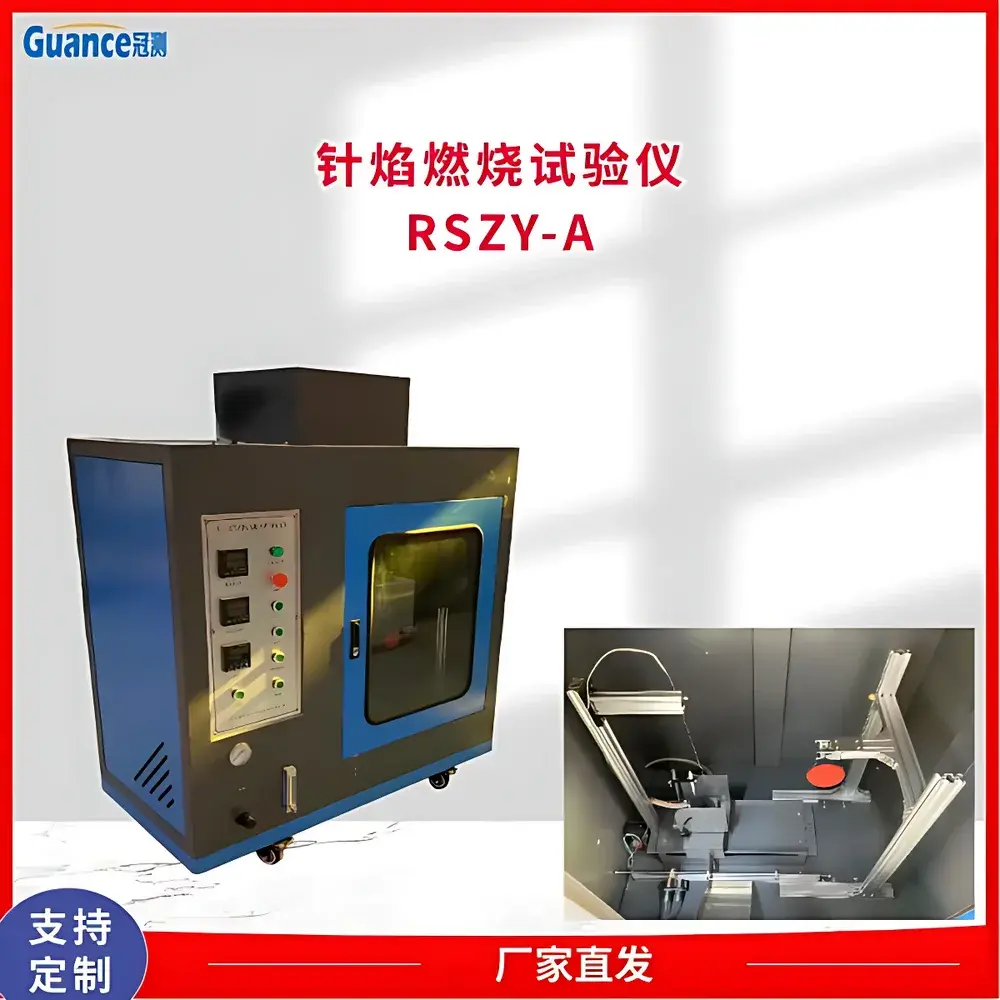
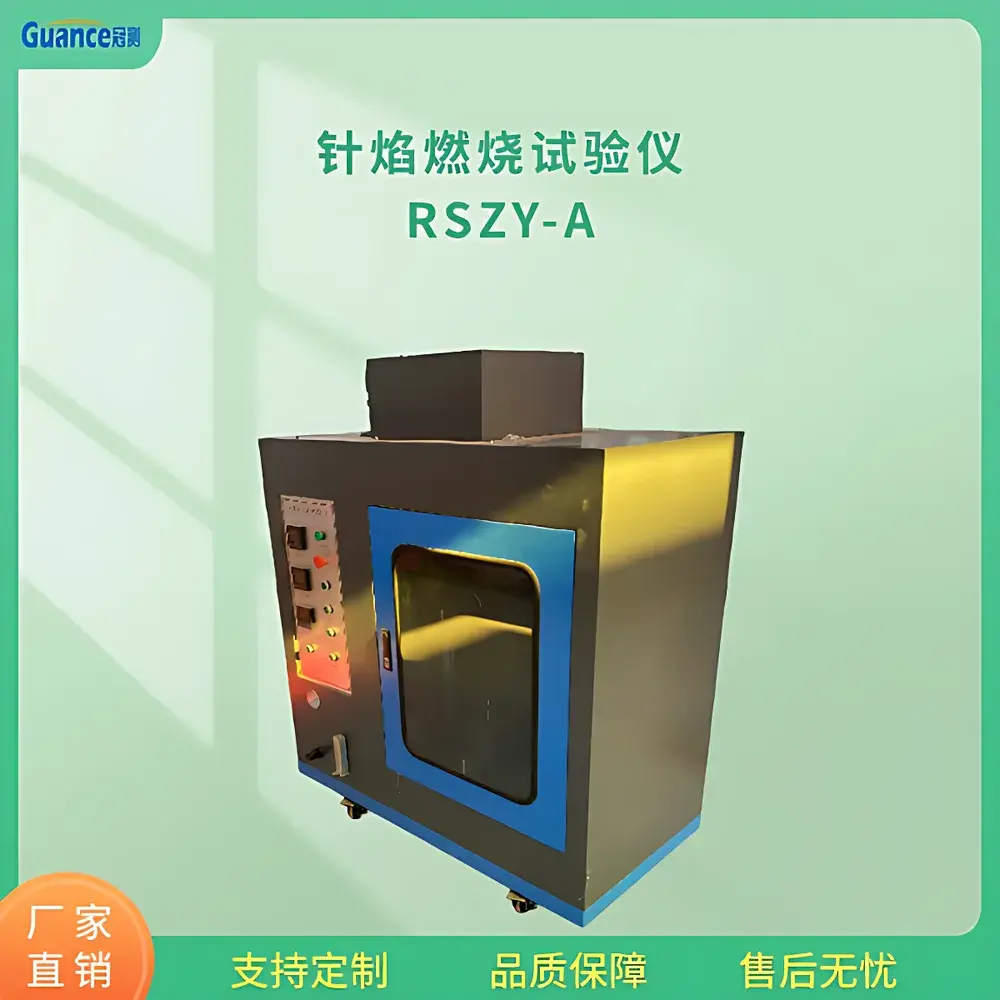
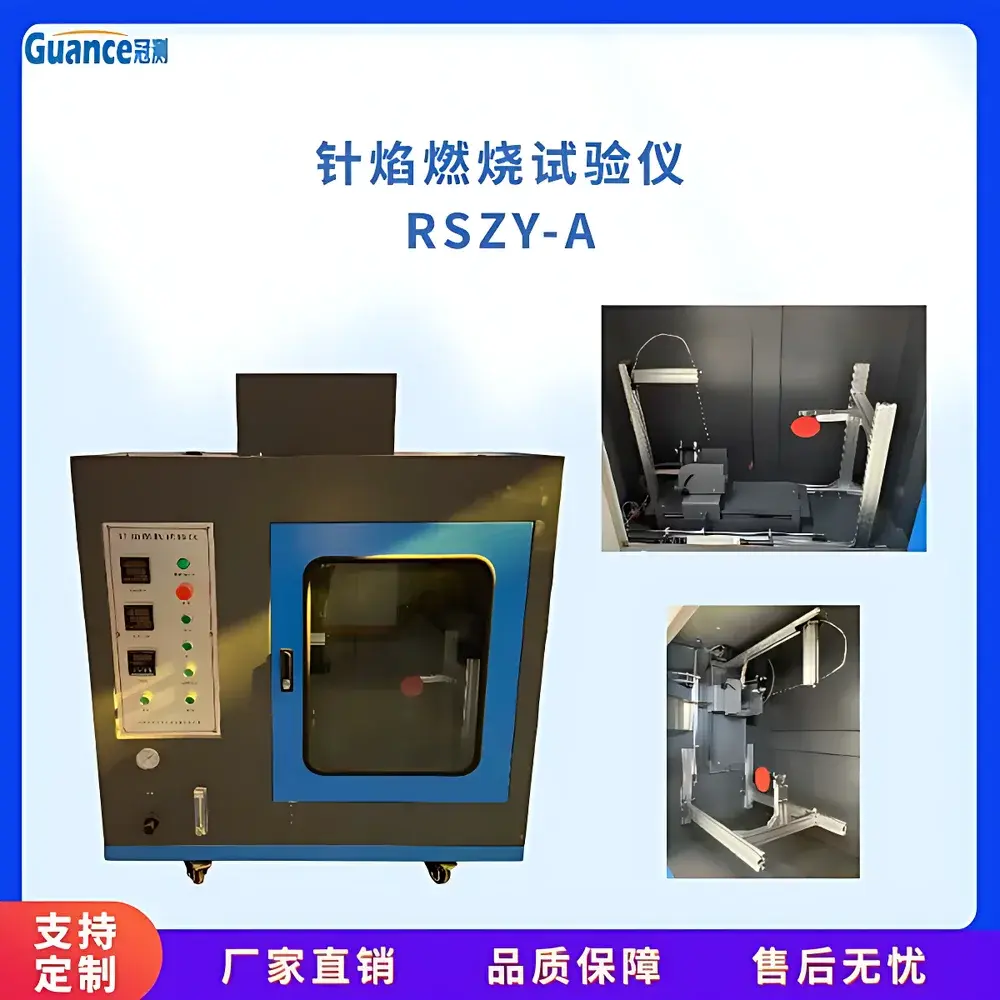
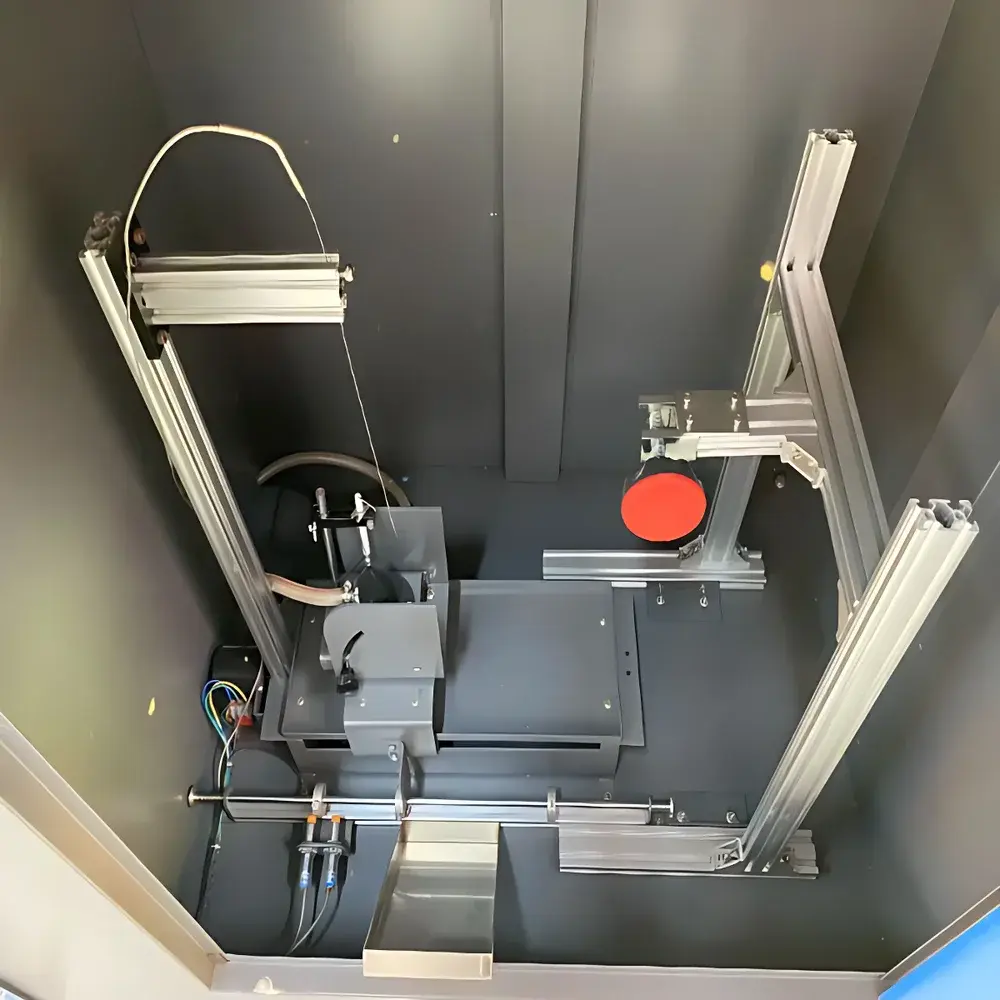
GuanCe Instruments RSZY-A Needle Flame Test Chamber
| Brand | GuanCe Instruments |
|---|---|
| Origin | Beijing, China |
| Manufacturer Type | Authorized Distributor |
| Country of Origin | China |
| Model | RSZY-A |
| Price | USD 1,550 (FOB Beijing) |
| Application Field | Electrical & Electronic Equipment |
| Test Object | Electrical/Electronic Components and Liquid Dielectrics |
| Repeatability Error | < ±1% |
| Primary Use | Evaluates flammability of electrical/electronic products and liquid dielectrics under standardized small-flame ignition conditions per IEC 60695-2-2 / GB/T 5169.5 |
Overview
The GuanCe Instruments RSZY-A Needle Flame Test Chamber is a precision-engineered combustion test system designed to perform needle flame tests in strict accordance with international fire safety standards—including IEC 60695-2-2, IEC 60695-2-10, IEC 60695-2-13, GB/T 5169.5–2008, GB 4706.1–2005, UL 746A, ASTM D3874–2004, DIN 695, and VDE 0471. The instrument implements the controlled application of a calibrated, low-energy flame generated by a standardized needle burner to assess whether materials or assemblies ignite, sustain combustion, or propagate flame under defined thermal stress. Its operational principle relies on reproducible flame geometry, precise gas flow regulation, and traceable temperature profiling—enabling objective pass/fail evaluation of material self-extinguishing behavior within prescribed time limits (1–999.9 s). This chamber serves as a critical compliance tool for product safety certification in electrical appliance manufacturing, component qualification, and quality assurance laboratories operating under ISO/IEC 17025-accredited frameworks.
Key Features
- Stainless steel construction (304 grade) ensures long-term corrosion resistance, dimensional stability, and ease of cleaning in laboratory environments.
- Adjustable needle burner with nominal inner diameter Ø0.5 mm ±0.1 mm, outer diameter ≤Ø0.9 mm, and length ≥35 mm—fully compliant with IEC 60695-2-2 geometric tolerances.
- Dual-position burner mount: vertically aligned for flame height calibration (2–4 mm), and precisely tiltable to 45° for standardized test orientation.
- Integrated high-accuracy pressure gauge and fine-adjustment flow control valve enable stable LPG (95% butane, optionally propane) delivery at certified flow rates.
- Digitally programmable timer with 0.1 s resolution supports pre-set ignition duration and after-flame time measurement—critical for repeatable pass/fail determination.
- Automated burner return mechanism engages upon test completion, minimizing operator intervention and enhancing procedural consistency.
- Dedicated ventilation system with independent exhaust ducting and LED task lighting ensures safe fume extraction and unobstructed visual observation during testing.
- Flame height adjustable to 12 mm ±1 mm via micrometer-scale burner positioning; verified using optional certified copper reference mass (φ4 mm, 0.58±0.01 g) and K-type insulated thermocouple (Ø0.5 mm, imported armored).
Sample Compatibility & Compliance
The RSZY-A accommodates standard test specimens up to 150 mm × 150 mm × 15 mm, mounted on a 10 mm thick pine board overlaid with standard silk paper (12–30 g/m²), as specified in IEC 60695-2-2 Annex A. It supports both solid components (e.g., insulating housings, terminal blocks, PCB substrates) and liquid dielectrics applied to absorbent substrates. All mechanical, thermal, and timing parameters are traceably aligned with the requirements of IEC 60695-2-2 Clause 7 and GB/T 5169.5–2008 Section 5. The system’s repeatability error (< ±1%) meets internal QA benchmarks for inter-laboratory comparability and supports GLP-compliant documentation when paired with validated calibration records and audit-ready test logs.
Software & Data Management
The RSZY-A operates as a standalone hardware platform without embedded software. However, its digital timer output can be interfaced via TTL or RS-232 (optional adapter) to external data acquisition systems for timestamped event logging. For regulatory submissions (e.g., CB Scheme, UL Listing, CCC certification), users typically integrate test records—including specimen ID, flame duration, observed ignition behavior, and post-test residue assessment—into LIMS or QMS platforms supporting ISO/IEC 17025 clause 7.7 (result reporting) and FDA 21 CFR Part 11 (if electronic signatures are employed). Optional temperature calibration verification kits include NIST-traceable thermocouple calibration certificates and documented validation protocols suitable for internal audit or third-party accreditation review.
Applications
- Pre-certification flammability screening of plastic enclosures, connectors, and wiring harnesses for household appliances and IT equipment.
- Qualification of insulating materials used in power supplies, transformers, and motor windings exposed to localized overheating risks.
- Verification of flame-retardant additive efficacy in polymer formulations intended for electronics-grade applications.
- Root cause analysis of field failures involving ignition propagation in printed circuit board assemblies.
- Supporting technical documentation for CE marking (EN 60335-1), UL recognition (UL 60335-1), and China CCC mandatory certification (GB 4706.1).
FAQ
What flame gases are compatible with the RSZY-A chamber?
The system is calibrated for 95% butane (reference gas per IEC 60695-2-2); propane may be substituted with recalibration of flow rate and flame temperature verification.
Is the flame temperature profile independently verifiable?
Yes—using the optional temperature calibration kit (K-type thermocouple + copper reference mass), users can validate the 100°C ±2°C to 700°C ±3°C heating ramp within 23.5 s ±1.0 s per IEC 60695-2-2 Annex B.
Does the RSZY-A meet requirements for ISO/IEC 17025 accredited testing?
When operated with documented calibration certificates, traceable gas supply, and standardized test procedures, it satisfies Clause 6.4 (equipment) and Clause 7.2 (method validation) for accredited flammability testing.
Can test results be exported for regulatory submission?
While the unit lacks native export functionality, all timing and observational data are manually recorded or captured via external DAQ systems compliant with 21 CFR Part 11 audit trail requirements.
What maintenance intervals are recommended?
Burner tip inspection and cleaning every 50 test cycles; pressure regulator and flow valve calibration annually or per ISO/IEC 17025 internal schedule.



