
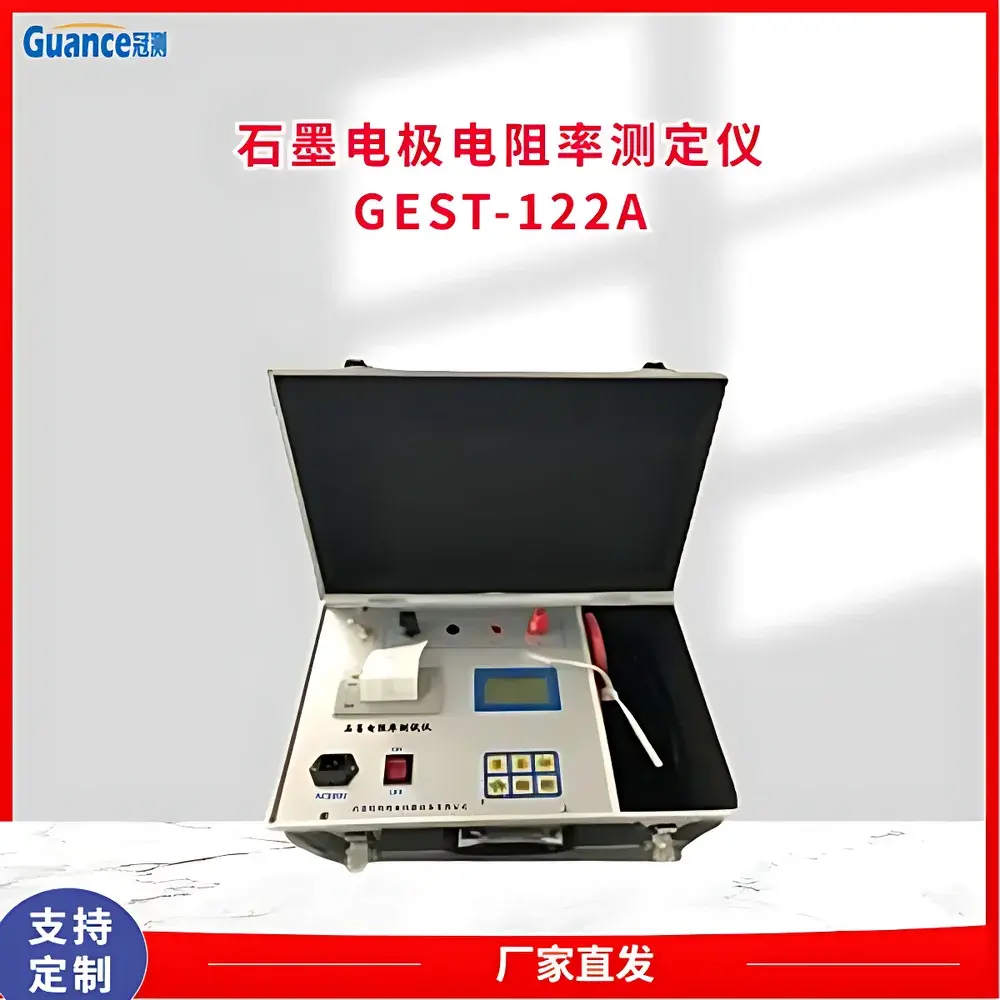
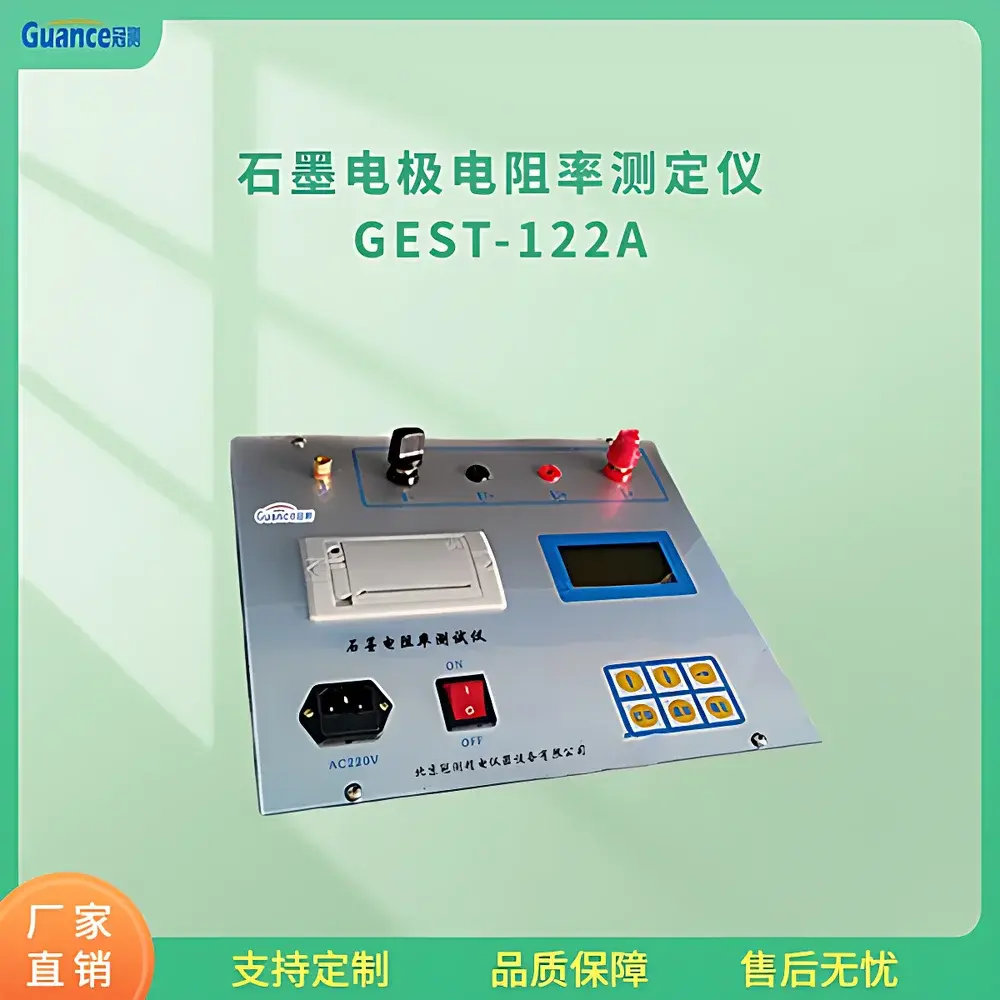
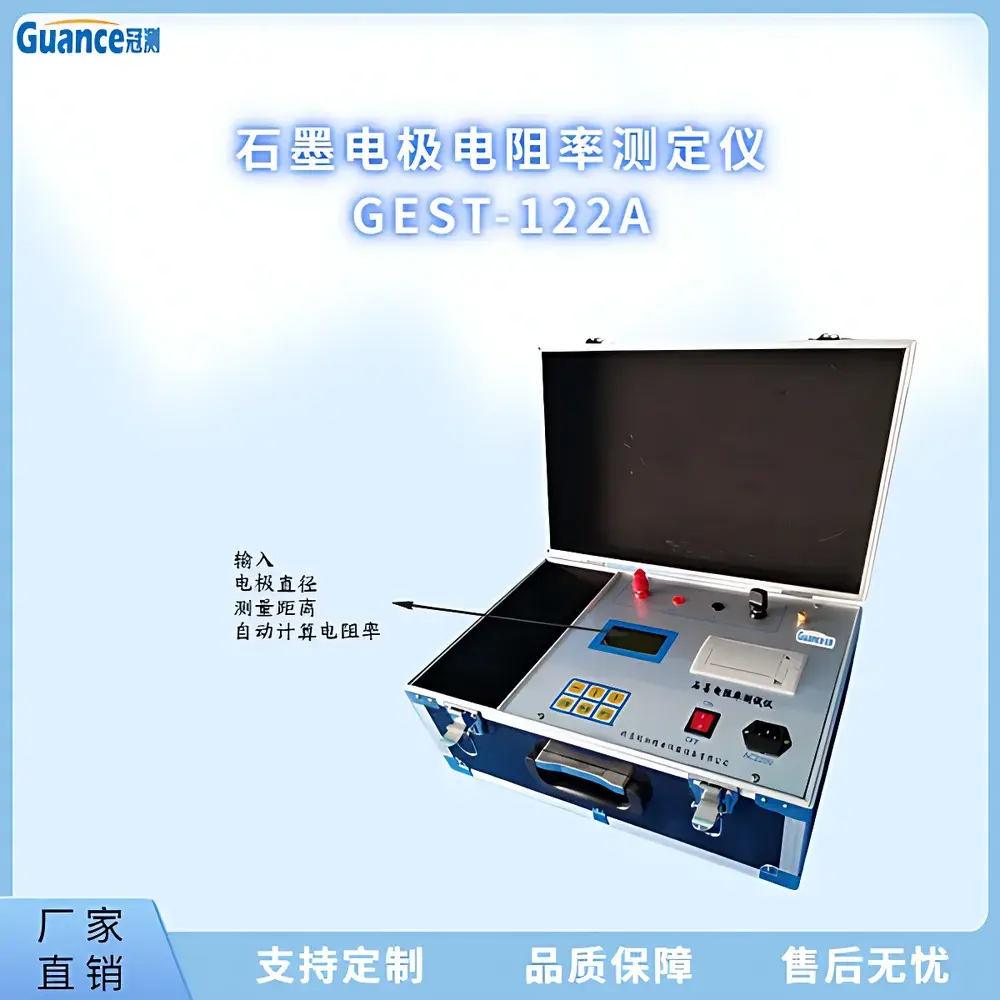
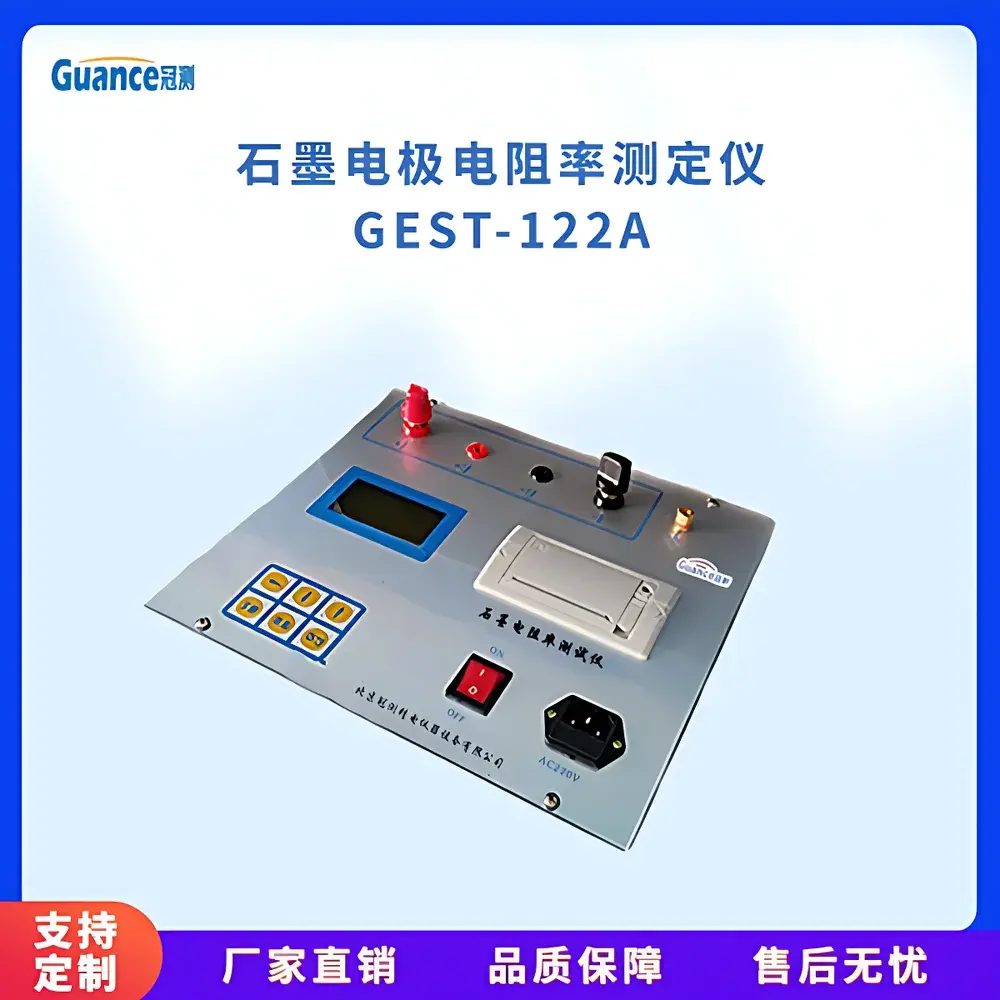
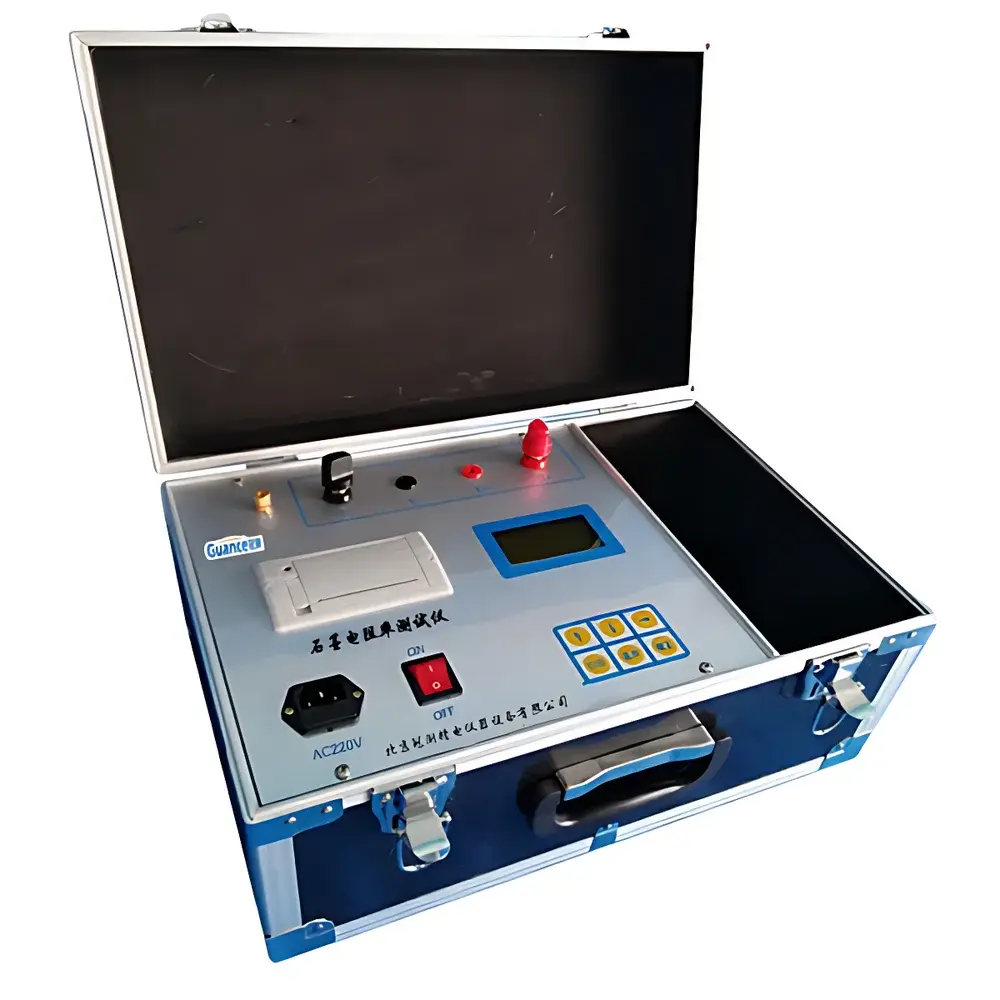
GuanCe Instruments GEST-122A Portable High-Current DC Resistivity Tester for Graphite Electrodes
| Brand | GuanCe Instruments |
|---|---|
| Origin | Beijing, China |
| Manufacturer Type | Authorized Distributor |
| Country of Origin | China |
| Model | GEST-122A |
| Output Current | 35 A |
| Resistance Measurement Range | 0.2 µΩ to 200 mΩ |
| Resolution | 0.1 µΩ |
| Accuracy Class | 0.5 |
| Operating Temperature | −10 °C to +50 °C |
| Operating Humidity | 0–80 % RH (non-condensing) |
| Power Supply | AC 220 V ±10 %, 50 Hz ±1 Hz |
| Weight | 4 kg |
Overview
The GuanCe Instruments GEST-122A is a portable, micro-ohmmeter-class DC resistivity tester engineered specifically for the precise measurement of bulk electrical resistivity in graphite electrodes and carbonaceous materials. It operates on the four-terminal (Kelvin) measurement principle, eliminating lead and contact resistance errors by separating current injection and voltage sensing paths. The instrument delivers a stable, high-current DC excitation of up to 35 A—critical for achieving low-noise, high signal-to-noise ratio measurements in low-resistance samples (down to 0.2 µΩ). Designed in strict compliance with GB/T 24525–2009 (Determination of Electrical Resistivity of Carbonaceous Materials), GB/T 24521–2009 (Determination of Electrical Resistivity of Coke), and YB/T 120–1997 (Electrical Resistivity Test Method for Carbon Materials), the GEST-122A supports standardized quality control workflows in electrode manufacturing, metallurgical carbon production, and raw material certification laboratories.
Key Features
- High-current DC source (35 A) optimized for low-resistance graphite and carbon samples, minimizing thermal drift and contact instability during measurement
- Four-wire Kelvin configuration with dedicated current and potential terminals ensures traceable, contact-resistance-free resistivity determination
- Micro-ohm resolution of 0.1 µΩ and full-scale range from 0.2 µΩ to 200 mΩ—enabling detection of subtle batch-to-batch variations in electrode homogeneity
- Integrated microcontroller architecture provides automated zero calibration, current ramping control, and real-time stability monitoring
- Compact, field-deployable design (4 kg, integrated handle) with ruggedized housing suitable for workshop, furnace line, or warehouse environments
- Class 0.5 accuracy per IEC 60584 and GB/T 7676 standards—validated for use in ISO/IEC 17025-accredited testing laboratories
Sample Compatibility & Compliance
The GEST-122A is validated for cylindrical and rectangular graphite electrode specimens conforming to standard dimensions defined in GB/T 24525–2009 (e.g., Ø25 mm × 100 mm rods, or 25 mm × 25 mm × 100 mm prisms). It accommodates both as-received sintered electrodes and machined test coupons. Sample contact is achieved via spring-loaded copper probes or configurable brass clamps (accessory kit optional), ensuring repeatable pressure and surface area engagement. All measurement protocols align with national and industry-specific metrological requirements—including mandatory documentation of ambient temperature, sample geometry, and current polarity reversal sequences to mitigate thermoelectric EMF interference. The instrument’s calibration certificate includes traceability to CNAS-accredited reference standards (e.g., NIM SRM-1001), supporting audit readiness for GB/T 19001 (ISO 9001), GB/T 24001 (ISO 14001), and internal QC/QA procedures.
Software & Data Management
While the GEST-122A operates as a standalone benchtop unit with an LCD display and manual keypad interface, it supports optional RS-232 serial output for integration into laboratory data acquisition systems. When connected to compliant host software (e.g., LabVIEW-based custom modules or GuanCe’s GEST-DataLink v2.1), users can log timestamped resistivity values, trigger automatic averaging across polarity-reversed cycles, and export CSV-formatted reports including measurement uncertainty estimates derived from repeatability studies (n ≥ 5 per sample). Audit trail functionality—including operator ID, calibration date, and environmental condition stamps—is available under GLP-compliant deployment modes. Firmware updates are delivered via USB flash drive and retain full backward compatibility with historical calibration records.
Applications
- Quality assurance of graphite electrodes used in electric arc furnaces (EAFs) and submerged arc furnaces (SAFs)
- In-process verification of resistivity uniformity across electrode cross-sections during extrusion and baking stages
- Raw material screening of petroleum coke, needle coke, and calcined anthracite prior to paste mixing
- Research-grade correlation studies between resistivity, density, and grain structure in synthetic graphite grades
- Third-party verification for ISO 5436–1 (Geometrical Product Specifications) and ASTM D3764 (Standard Practice for Carbon and Graphite Products)
FAQ
What standards does the GEST-122A comply with for graphite resistivity testing?
It fully implements GB/T 24525–2009, GB/T 24521–2009, and YB/T 120–1997—covering specimen preparation, current application methodology, and calculation of volume resistivity (ρ = R × A / L) in SI units (Ω·m).
Can the instrument measure resistivity of non-graphite carbon materials?
Yes—provided the material exhibits bulk DC conductivity > 1 S/m and geometric dimensions fall within specified limits; validation against ASTM D3764 or ISO 11713 is recommended for non-standard forms.
Is external calibration required before first use?
The unit ships with a factory calibration certificate traceable to NIM standards; however, users must perform initial zero-offset verification and contact resistance check using shorting bars per Section 6.2 of GB/T 24525–2009.
How is temperature compensation handled during measurement?
The GEST-122A does not incorporate automatic temperature compensation; users must record ambient temperature manually and apply correction factors per material-specific resistivity vs. temperature coefficients (e.g., α ≈ 0.0003 K⁻¹ for polycrystalline graphite).



