
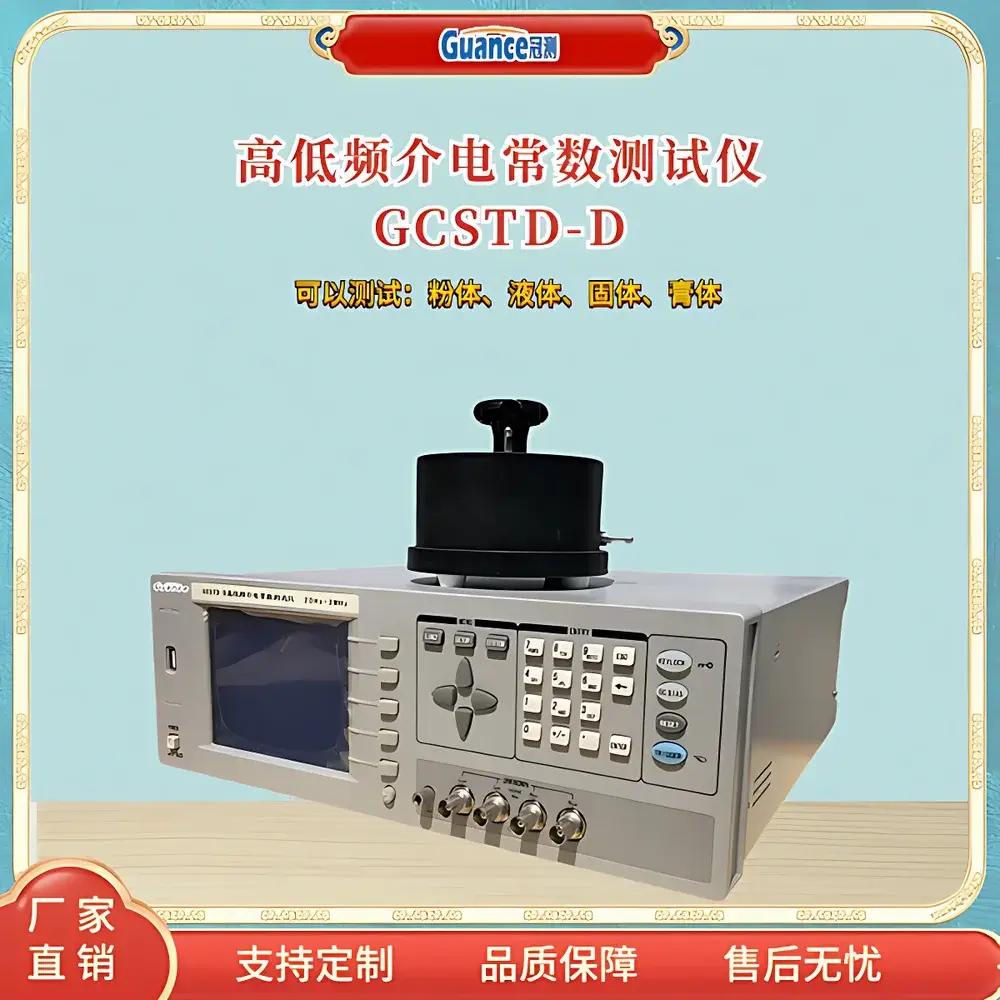
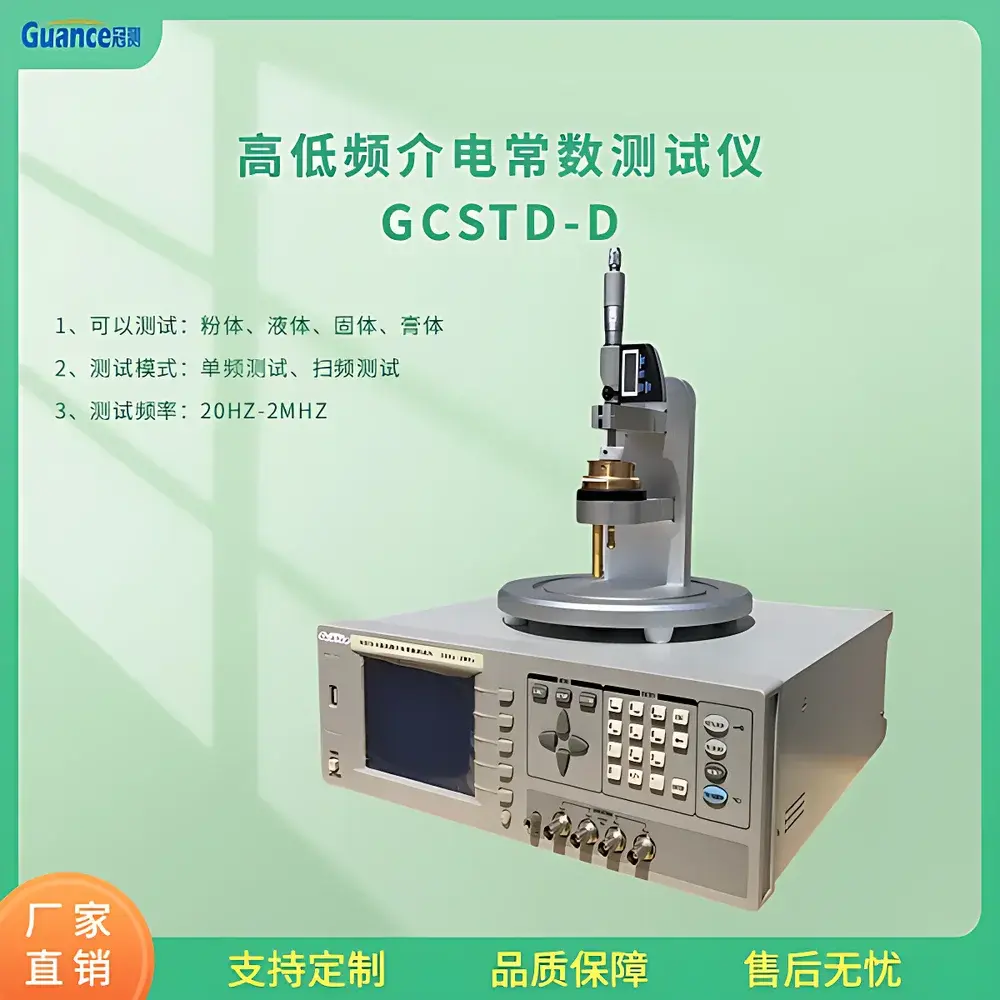
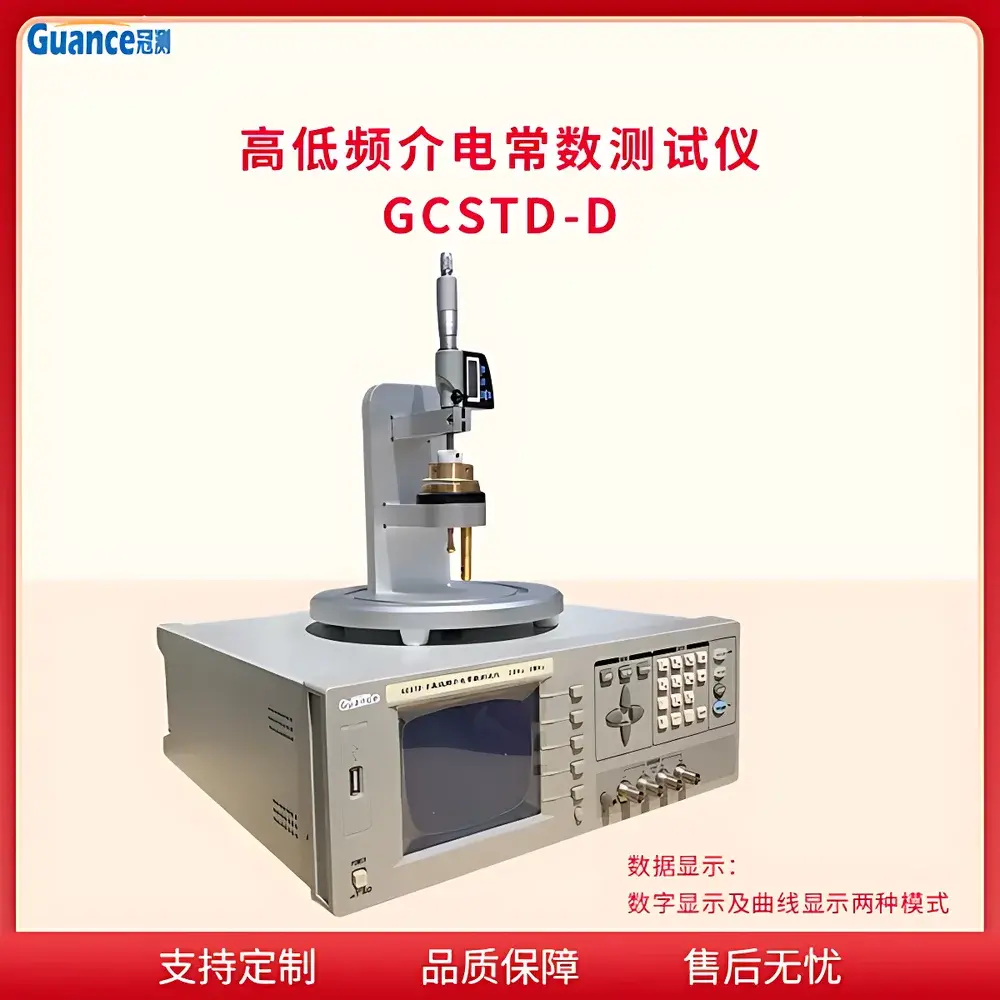
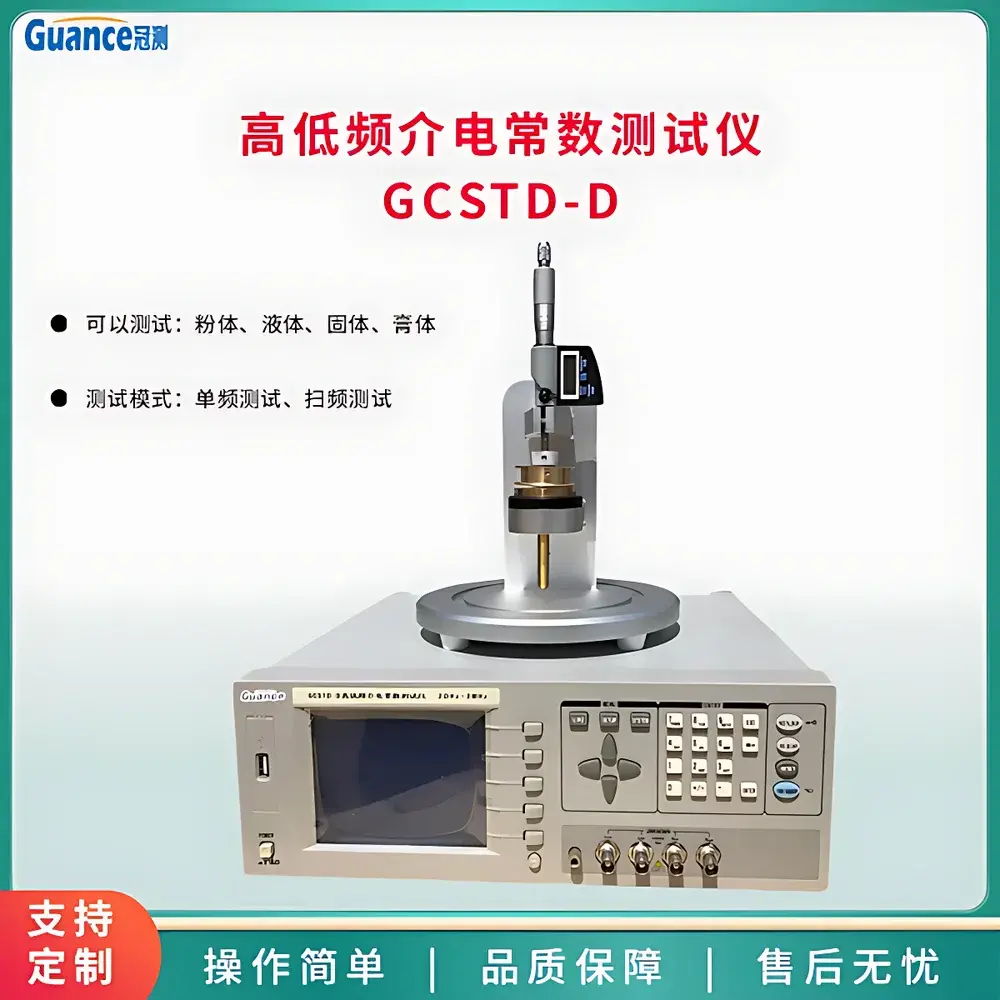
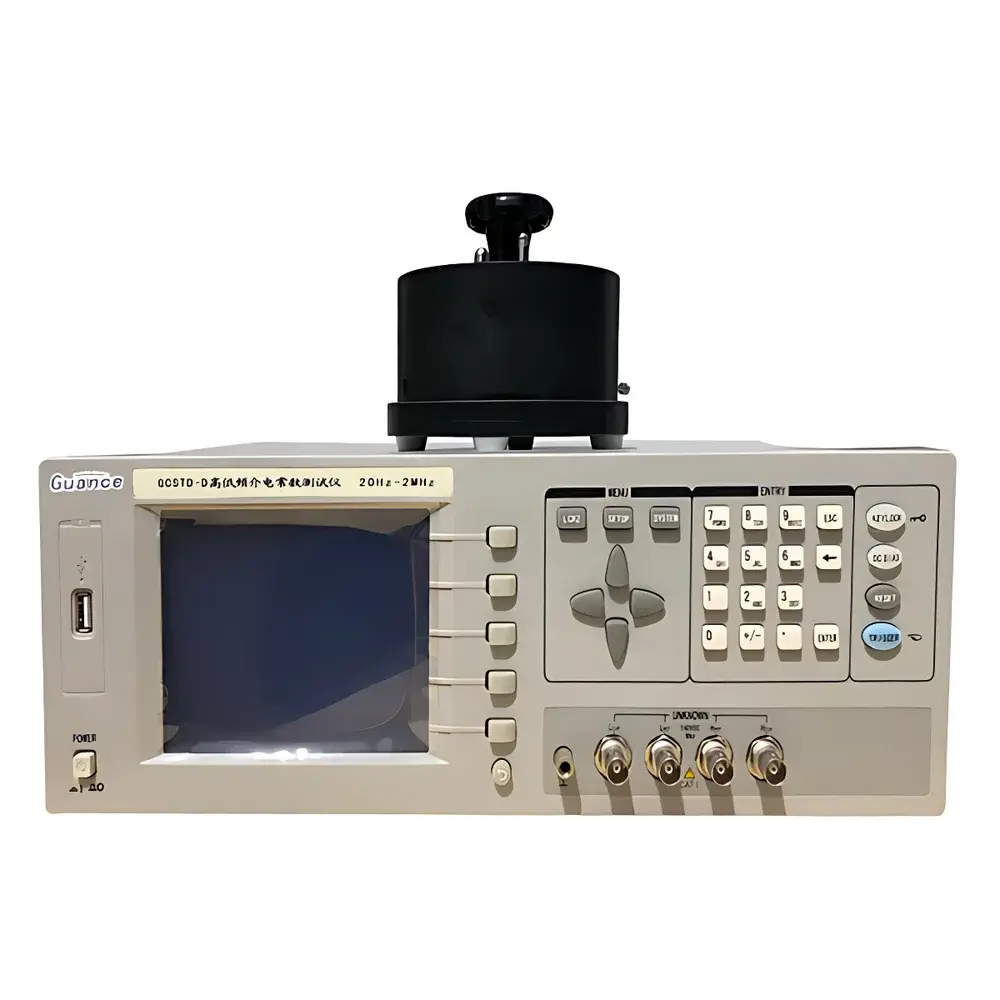
GuanCe Instruments GCSTD-D3 High-Low Frequency Dielectric Constant Analyzer
| Brand | GuanCe Instruments |
|---|---|
| Origin | Beijing, China |
| Manufacturer Type | Authorized Distributor |
| Country of Origin | China |
| Model | GCSTD-D3 |
| Price | USD 1,850 (FOB Beijing) |
| Frequency Range | 20 Hz – 2 MHz (10 mHz resolution) |
| Test Signal Level | 10 mV – 5 Vrms (1 mV step) |
| Basic Accuracy | ±0.1% |
| Measurement Speed | Up to 200 readings/sec |
| Display | 320×240 dot-matrix LCD |
| Impedance Parameters | 22 configurable combinations (e.g., C–D, C–Q, L–Q, R–X, Z–θ) |
| Electrode Options | Fixed parallel-plate electrodes (Ø38 mm standard, Ø50 mm optional), liquid cell (15 mL capacity), powder cell (customizable volume), and non-contact electrode module |
| Sample Types | Solids (flat or irregular), liquids, powders, pastes |
| DC Bias | Internal ±10 V / 100 mA |
| ALR/ALC | Automatic Level Control with V/I monitoring |
| Scan Modes | 10-point list sweep, graphical frequency/amplitude sweep |
| Memory | 20 instrument setups |
| Interface | USB Host/Device, RS232, GPIB (optional), LAN (optional) |
| Compliance | GB/T 1409–2006, GB/T 1693–2007, ASTM D150–18, IEC 60250:2019 |
Overview
The GuanCe Instruments GCSTD-D3 High-Low Frequency Dielectric Constant Analyzer is a precision impedance spectroscopy platform engineered for quantitative characterization of dielectric properties across the 20 Hz to 2 MHz frequency band. It operates on the principle of AC impedance measurement using a four-terminal (Kelvin) configuration to minimize parasitic effects and ensure high reproducibility in capacitance (C), dissipation factor (D), loss tangent (tan δ), and complex permittivity (ε* = ε′ − jε″) determination. Designed for laboratories engaged in materials science R&D, quality control of insulating polymers, and electrical component validation, the GCSTD-D3 supports standardized test protocols required by GB/T 1409–2006 (equivalent to IEC 60250), GB/T 1693–2007, and ASTM D150–18. Its architecture integrates a stable low-noise signal generator, high-speed synchronous detection circuitry, and temperature-compensated analog front-end — enabling reliable measurements under ambient lab conditions without requiring climate-controlled enclosures.
Key Features
- Wide dynamic frequency coverage from 20 Hz to 2 MHz with 10 mHz resolution, supporting both power-frequency (50/60 Hz) and audio-frequency dielectric profiling
- Programmable test signal level (10 mV–5 Vrms, 1 mV steps) with automatic level control (ALC) to maintain constant voltage/current excitation across variable sample impedance
- 22 selectable impedance parameter pairs including C–D, L–Q, R–X, Z–θ, Y–B, and complex permittivity-derived outputs (ε′, ε″, tan δ)
- Dual-mode electrode compatibility: contact-type parallel-plate electrodes (standard Ø38 mm, optional Ø50 mm), calibrated liquid cell (15 mL), and modular powder cells for bulk density-corrected permittivity analysis
- Integrated ±10 V / 100 mA DC bias source for C–V profiling of semiconductors and ferroelectric materials; expandable to ±40 A via externally synchronized TH1776 current sources
- Real-time graphical sweep capability — frequency sweeps, amplitude sweeps, and bias sweeps — with overlay and delta-difference display modes
- Full compliance with GLP data integrity requirements: timestamped measurement logs, user-accessible audit trail, and 20 non-volatile setup storage locations
Sample Compatibility & Compliance
The GCSTD-D3 accommodates heterogeneous sample geometries and physical states without requiring extensive specimen preparation. Solid samples — whether rigid plates, flexible films, or irregularly shaped ceramics — are measured using guarded parallel-plate electrodes with mechanical pressure calibration. Liquid dielectrics (e.g., transformer oils, electrolytes, solvents) are evaluated in a shielded, temperature-stabilized 15 mL cell conforming to ASTM D924 geometry specifications. Powdered materials (e.g., ferrites, Li-ion cathode precursors) are analyzed using volumetrically defined compression cells, with permittivity results corrected for packing density per ISO 21371 Annex B. All measurement routines align with traceable national and international standards: GB/T 1409–2006 (capacitance and tan δ at industrial frequencies), GB/T 1693–2007 (rubber dielectrics), ASTM D150–18 (AC loss and permittivity of solid insulators), and IEC 60250:2019 (dielectric properties of solid insulating materials). Instrument firmware includes preloaded test templates matching these standards’ procedural sequences.
Software & Data Management
Data acquisition and post-processing are managed via the embedded GC-Analyzer v3.2 firmware, supporting direct CSV export, real-time graphing, and multi-curve overlay. The USB Host interface enables firmware updates and measurement log transfers to FAT32-formatted USB drives without PC dependency. For automated integration into QA/QC workflows, the GCSTD-D3 provides SCPI-compliant command sets over RS232 and optional GPIB/LAN interfaces — compatible with LabVIEW™, MATLAB®, and Python-based test automation frameworks. All measurement files include embedded metadata: operator ID, timestamp, environmental temperature/humidity (when connected to optional external sensors), electrode type, calibration status, and applied bias conditions. Audit trails meet FDA 21 CFR Part 11 requirements for electronic records and signatures when used with validated network authentication and role-based access controls.
Applications
- Electrical insulation qualification: permittivity and loss tangent mapping of epoxy resins, silicone rubbers, polyimide films, and ceramic substrates per IEC 60250
- Energy storage material development: C–V profiling of dielectric layers in MLCCs, interfacial polarization analysis in solid-state electrolytes
- Pharmaceutical excipient screening: moisture-dependent ε′/tan δ trends in microcrystalline cellulose, lactose, and amorphous silica
- Geopolymer and cementitious material research: early-age hydration kinetics inferred from broadband dielectric dispersion
- Quality assurance of printed circuit board laminates: glass transition detection via ε″ peak shift in FR-4 and polyimide composites
- Magnetic material characterization: complex permeability extraction (μ′, μ″) from impedance spectra of MnZn/NiZn ferrites
FAQ
Does the GCSTD-D3 support temperature-controlled measurements?
Yes — while the base unit does not include an integrated thermal chamber, it features analog and digital I/O ports for synchronization with external temperature controllers (e.g., Linkam LTS420) and real-time logging of thermocouple inputs.
Can it measure anisotropic materials such as layered composites?
Yes — using orthogonal electrode orientation (in-plane vs. through-thickness) with appropriate fixture adapters, directional permittivity components can be extracted under controlled pressure and alignment.
Is calibration traceable to national metrology institutes?
Factory calibration is performed using NIST-traceable LCR standards (Keysight E4980AL reference suite); full calibration certificates with uncertainty budgets are provided upon request.
What is the minimum sample thickness required for solid measurements?
For reliable contact-mode measurement with Ø38 mm electrodes, minimum thickness is 0.1 mm; thinner films require guard-ring electrodes or non-contact RF probes (available as accessories).
How is electrode polarization error mitigated at low frequencies?
The instrument applies low-frequency correction algorithms based on Cole–Cole model fitting and offers optional DC bias nulling to suppress interfacial charge accumulation effects below 1 kHz.



