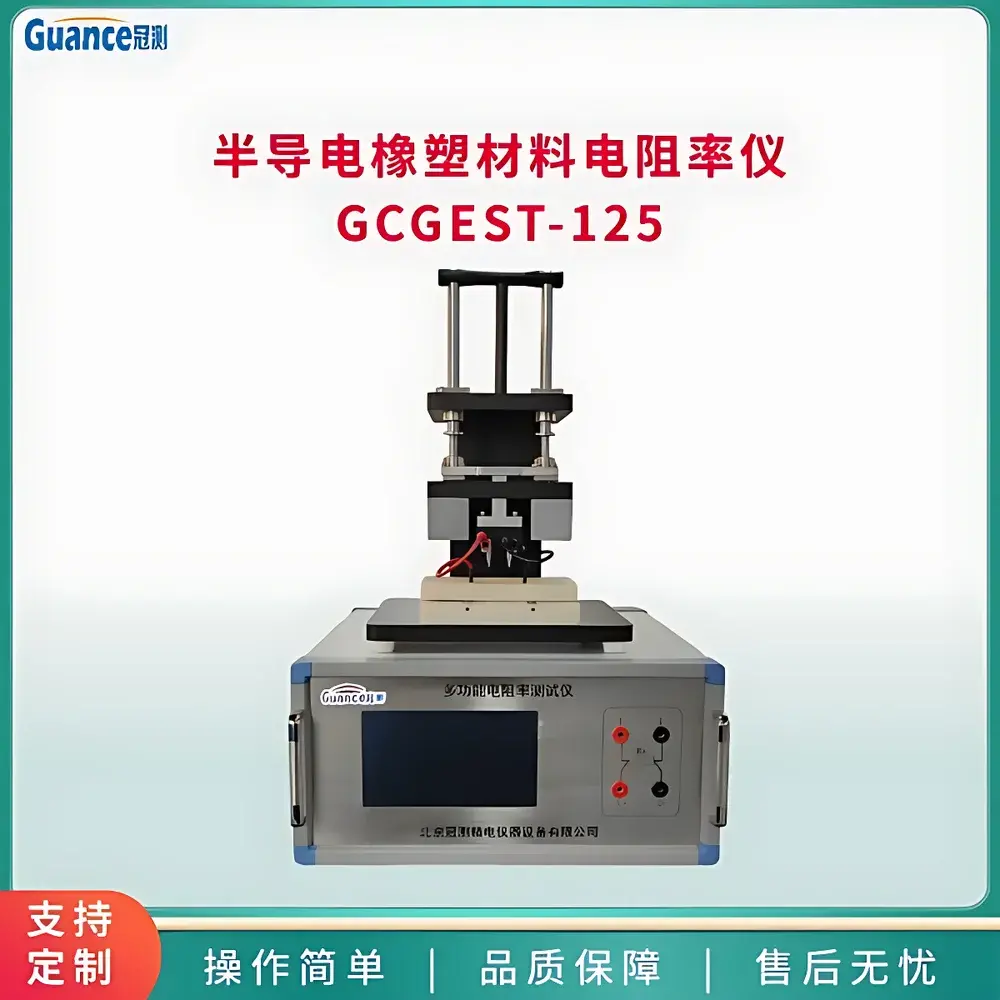
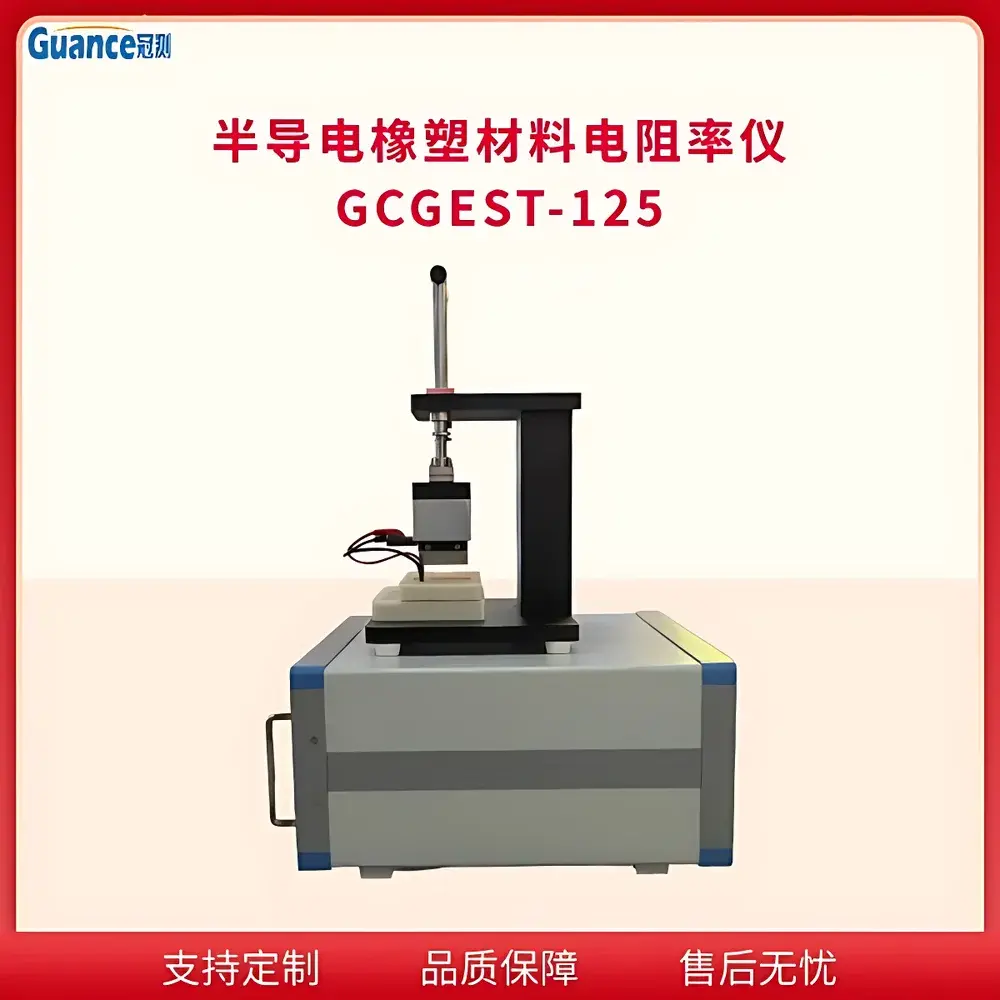
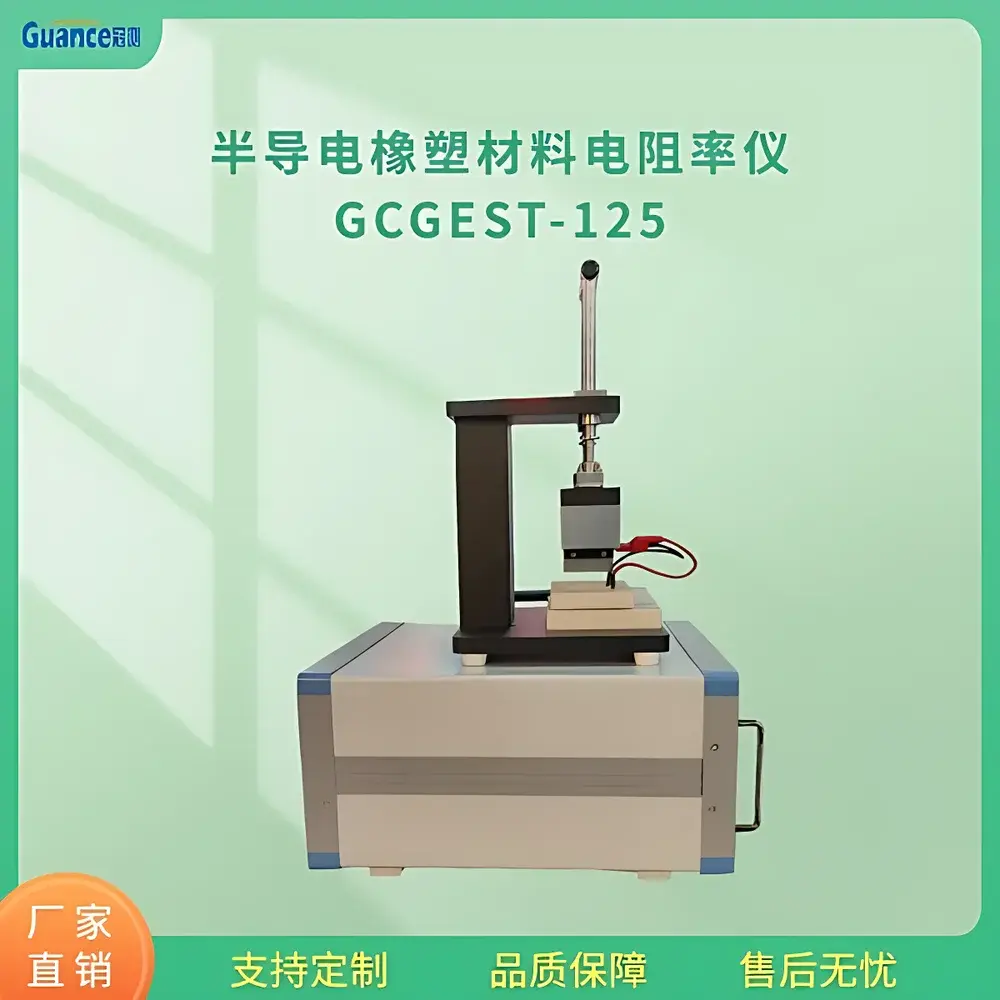
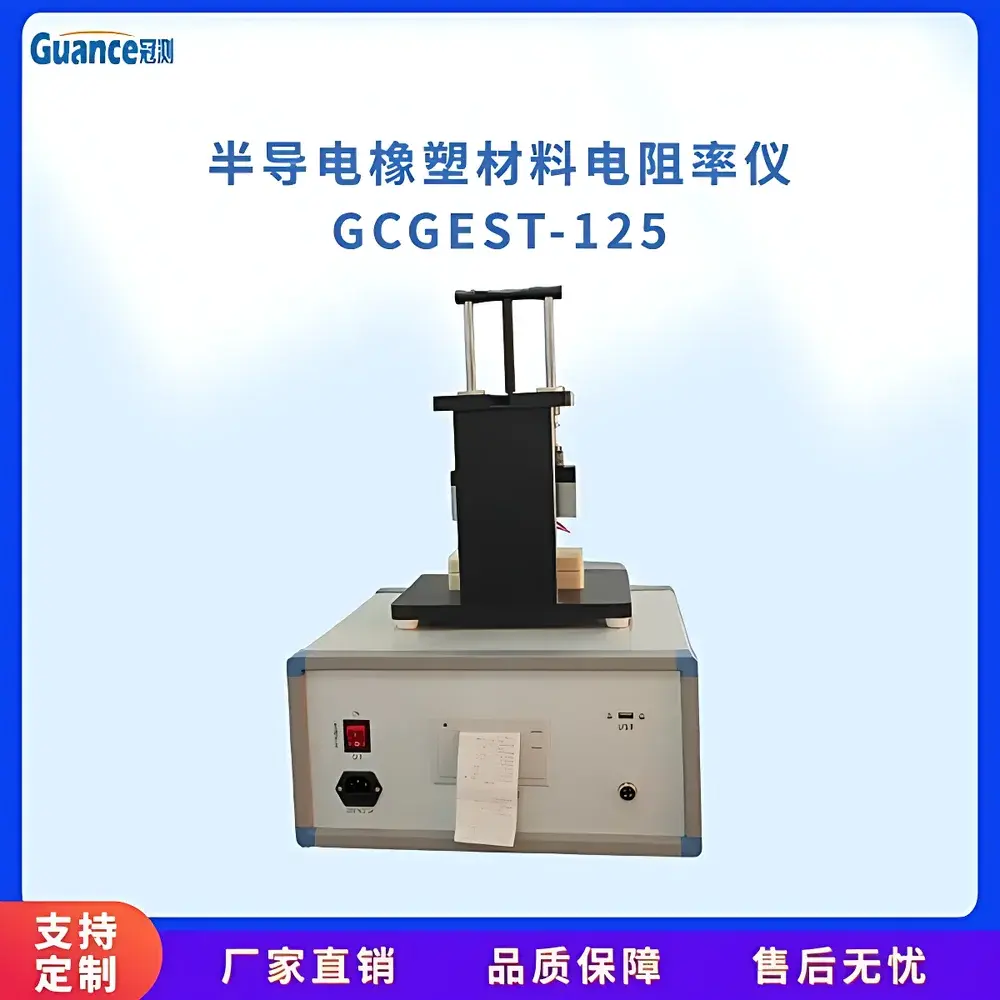
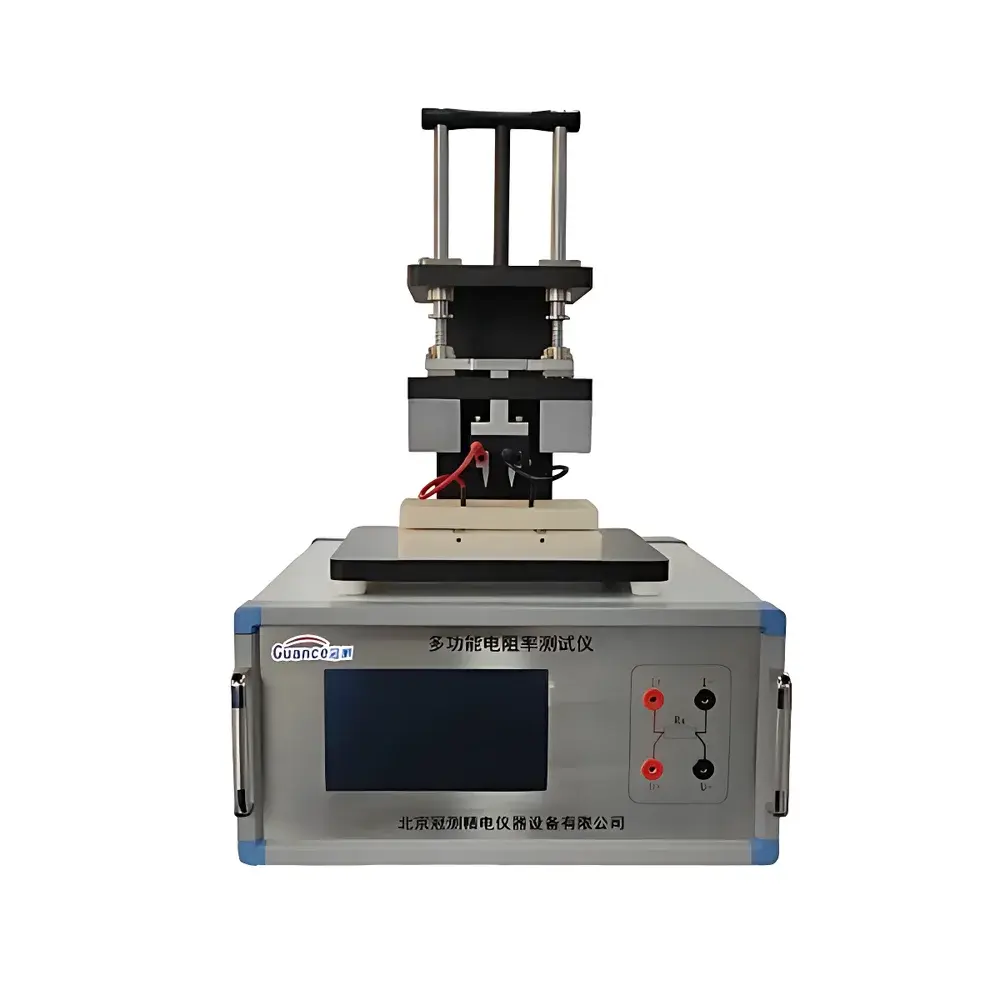
GuanCe GCGEST-125 Semiconductor-Specific Volume Resistivity Tester
| Brand | GuanCe |
|---|---|
| Origin | Beijing, China |
| Manufacturer Type | Authorized Distributor |
| Country of Origin | China |
| Model | GCGEST-125 |
| Price | USD 1,560 (FOB Beijing) |
| Measurement Principle | Four-Terminal DC Voltage-Current Method (Constant Current Source + High-Impedance Voltmeter) |
| Resistivity Range | 1.0×10⁻⁴ – 1.0×10⁵ Ω·cm |
| Resolution | 1.0×10⁻⁶ Ω·cm |
| Voltage Ranges | 2 mV / 20 mV / 200 mV / 2 V |
| Voltage Accuracy | ±(0.5% rdg + 2 digits) for 20 mV–2 V range |
| Current Outputs | 10 μA, 100 μA, 1 mA, 10 mA, 100 mA |
| Current Accuracy | ±(0.5% rdg + 2 digits) |
| Electrode Contact Width | 5 mm |
| Electrode Contact Force | 0.6 N |
| Sample Thickness Input | Manual entry via front-panel keypad |
| Display | Triple 4½-digit LED (voltage, thickness, resistivity) |
| Power Supply | 220 V ±10%, 50/60 Hz, <50 W |
Overview
The GuanCe GCGEST-125 Semiconductor-Specific Volume Resistivity Tester is a precision benchtop instrument engineered for the quantitative determination of volume resistivity (ρ) in semiconductive polymeric and elastomeric materials—particularly those used in cable shielding, EMI/EMC shielding layers, antistatic packaging, and conductive composites. It operates on the four-terminal (Kelvin) DC voltage-current method per ASTM D257, IEC 60093, and GB/T 3048.3–2007, eliminating lead and contact resistance errors to ensure traceable, high-reproducibility measurements. Unlike generic LCR meters or multimeters, the GCGEST-125 integrates a stabilized constant-current source and a high-input-impedance digital voltmeter within a single calibrated architecture, enabling direct ρ calculation using the geometric correction factor: ρ = R × (A / t), where R is measured resistance, A is electrode contact area, and t is sample thickness—entered manually by the operator for real-time compensation.
Key Features
- Four-terminal measurement topology with dedicated current sourcing and voltage sensing terminals, minimizing parasitic resistance effects
- Five programmable DC current excitation levels (10 μA to 100 mA), optimized for low-conductivity (10⁻⁴ Ω·cm) and moderately conductive (10⁵ Ω·cm) samples without manual range switching
- Triple 4½-digit LED display showing simultaneous readings of applied voltage (mV/V), user-entered sample thickness (mm), and calculated volume resistivity (Ω·cm)
- Electrode assembly featuring brass measuring electrodes (5 mm contact width) and stainless-steel support frame, delivering consistent 0.6 N contact force per ISO 8510-2 requirements
- Compliance-ready design: full alignment with GB/T 3048.3–2007, GB/T 15738–2008, GB/T 15662–1995, and GB/T 2439–2001 test protocols—including mandatory sample geometry tolerances (width: 10.0 ± 0.2 mm; thickness uniformity ≤5% deviation from mean)
- Low power consumption (<50 W) and line-voltage tolerance (220 V ±10%, 50/60 Hz) suitable for continuous operation in QC labs and university teaching environments
Sample Compatibility & Compliance
The GCGEST-125 is validated for use with flat, solid, non-porous specimens of rubber, thermoplastic elastomers, carbon-black-filled polymers, and fiber-reinforced conductive plastics. Typical applications include testing extruded semiconductor jackets for power cables, molded antistatic housings for medical electronics, and sheet stock used in cleanroom flooring. Sample dimensions must conform to standardized geometries: length 70–150 mm, width 10.0 ± 0.2 mm, and thickness 3–4 mm (with local thickness variation ≤5% of mean). Three replicate specimens are required per test sequence to support statistical evaluation per ISO/IEC 17025 guidelines. The instrument’s measurement uncertainty budget—derived from voltage meter accuracy (±0.5% rdg + 2 digits), current source stability (±0.5% rdg + 2 digits), and electrode dimensional repeatability—is documented in the factory calibration certificate and supports GLP-compliant reporting.
Software & Data Management
While the GCGEST-125 operates as a stand-alone instrument with front-panel control, it includes an RS-232 serial interface (optional USB-to-serial adapter supported) for automated data logging into laboratory information management systems (LIMS) or custom Excel-based QA templates. Output format is ASCII text: timestamp, current setting, measured voltage, entered thickness, and computed ρ value—all synchronized without manual transcription. Audit trail functionality is maintained through external software; the instrument itself stores no historical data but provides real-time pass/fail indicators against user-defined upper/lower specification limits. For regulated environments (e.g., ISO 13485-certified medical device suppliers or automotive Tier-1 component labs), the system can be integrated with 21 CFR Part 11–compliant electronic lab notebooks (ELN) via middleware, ensuring electronic signature, change control, and data integrity per ALCOA+ principles.
Applications
- Quality control of extruded semiconductor shields in medium-voltage power cable manufacturing
- R&D screening of conductive polymer formulations (e.g., PP/PE + carbon nanotube or graphene additives)
- Process validation of compression-molded ESD-safe enclosures for aerospace avionics
- Educational laboratories conducting ASTM D257–based resistivity experiments in materials science curricula
- Third-party certification labs performing accredited testing per GB/T 15738–2008 for composite reinforcement materials
- Failure analysis of delaminated or oxidized conductive layers in field-aged cable accessories
FAQ
Does the GCGEST-125 comply with international standards such as ASTM D257 or IEC 60093?
Yes—the instrument implements the four-terminal DC method specified in ASTM D257, IEC 60093, and GB/T 3048.3–2007. Its current source stability, voltage measurement resolution, and electrode geometry meet the metrological requirements of these standards for volume resistivity determination in solids.
Can it measure surface resistivity as well as volume resistivity?
No—the GCGEST-125 is configured exclusively for volume resistivity (ρ) using parallel-plate electrode geometry. Surface resistivity (σₛ) requires concentric ring electrodes per ASTM D257 Annex A3 and is outside this model’s mechanical and firmware scope.
Is calibration traceable to national metrology institutes?
Each unit ships with a factory calibration certificate traceable to CNAS-accredited reference standards (equivalent to NIST/PTB). Optional annual recalibration services include uncertainty statements compliant with ISO/IEC 17025:2017.
What maintenance is required for long-term accuracy?
Routine maintenance consists of periodic cleaning of brass electrodes with isopropyl alcohol and verification of contact force using a calibrated load cell every 6 months. No internal user-serviceable components exist; all adjustments require authorized service technician access.
Is technical support available in English for overseas customers?
Yes—GuanCe provides remote application engineering support, English-language operating manuals, and video-based troubleshooting guides. Local distributor partners in EU, North America, and Southeast Asia offer on-site installation and IQ/OQ documentation support upon request.