
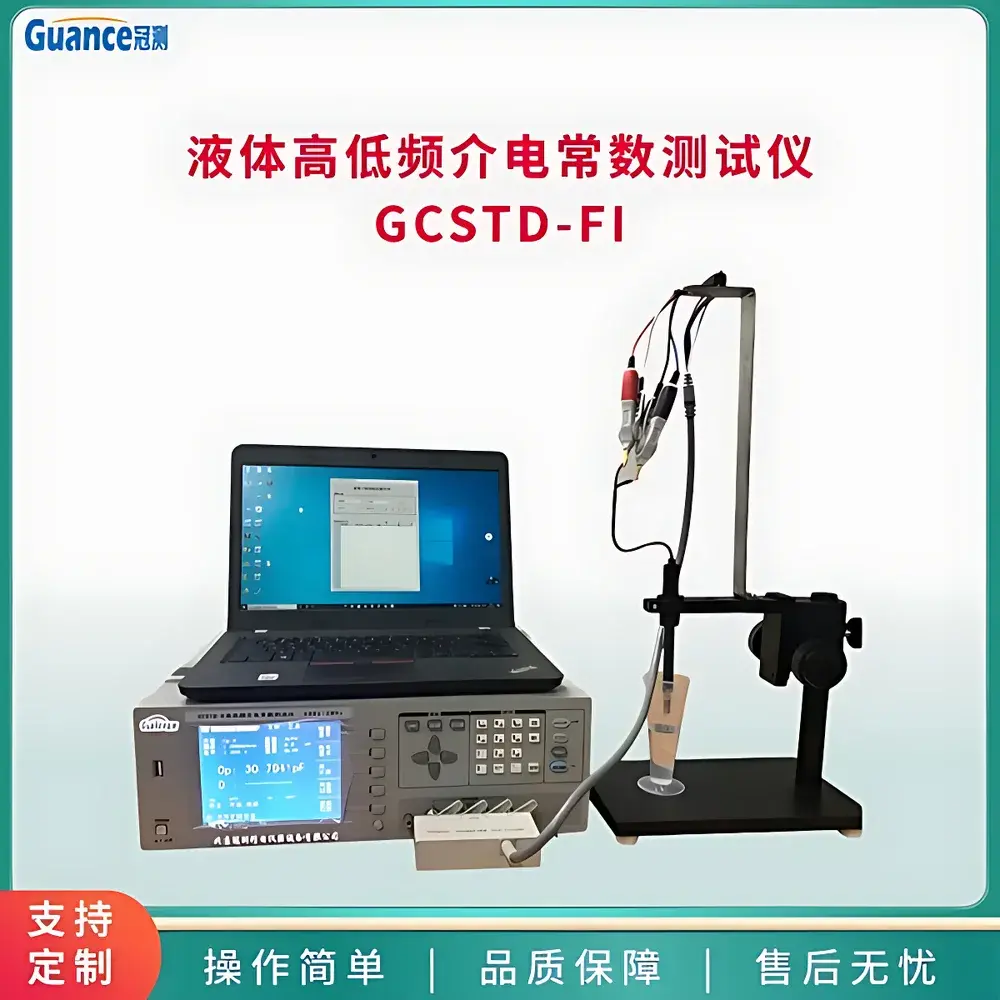
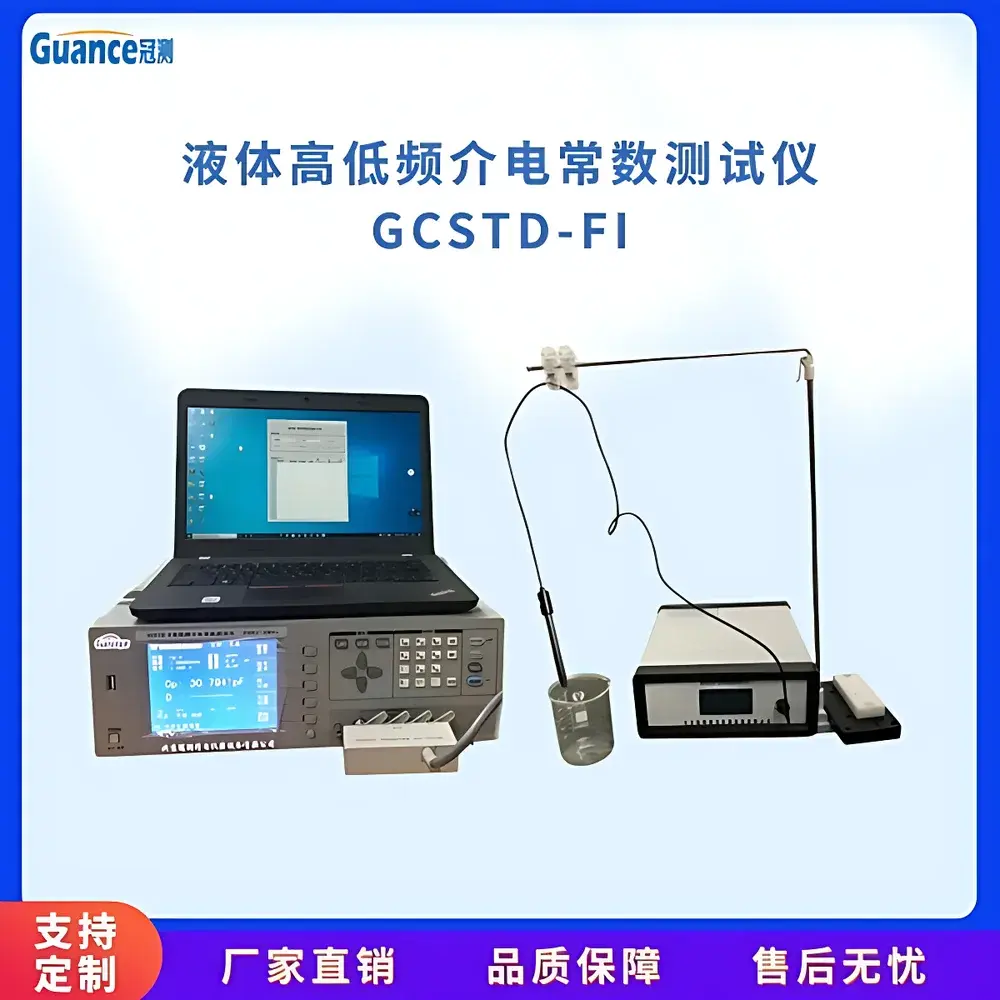
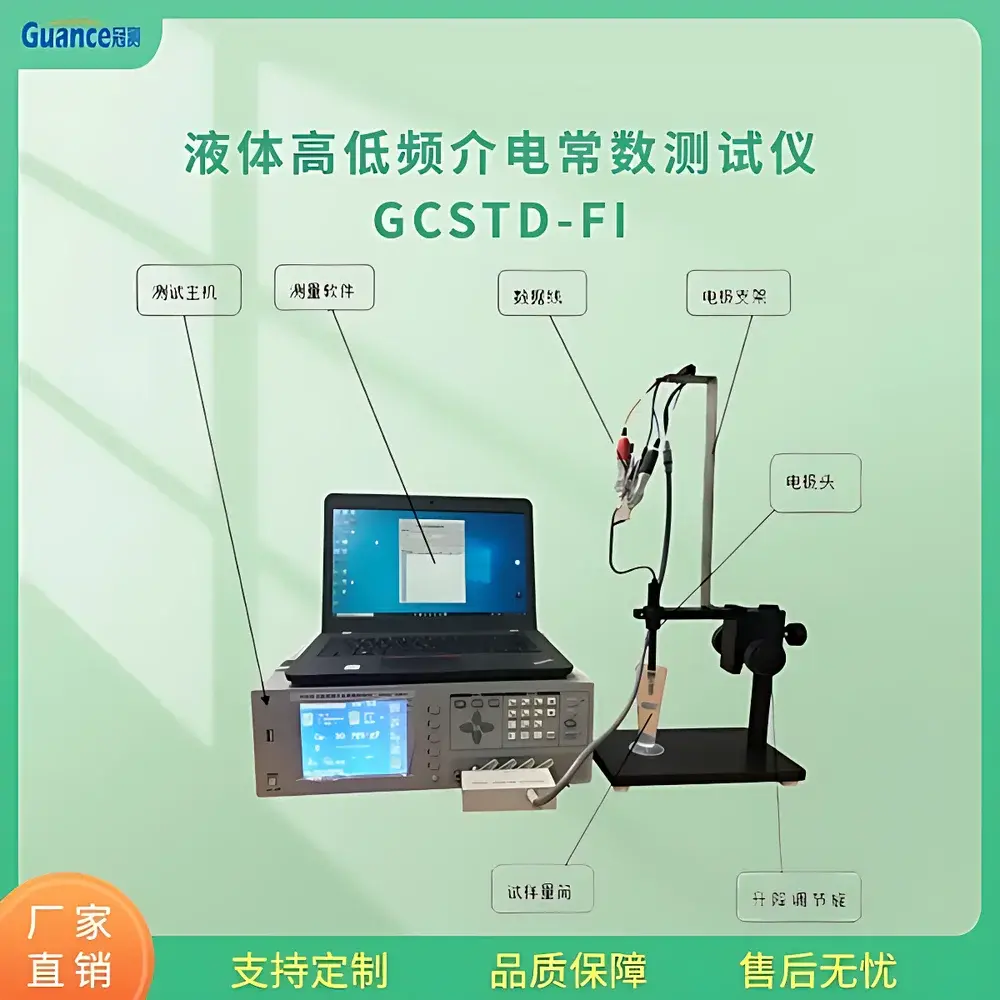
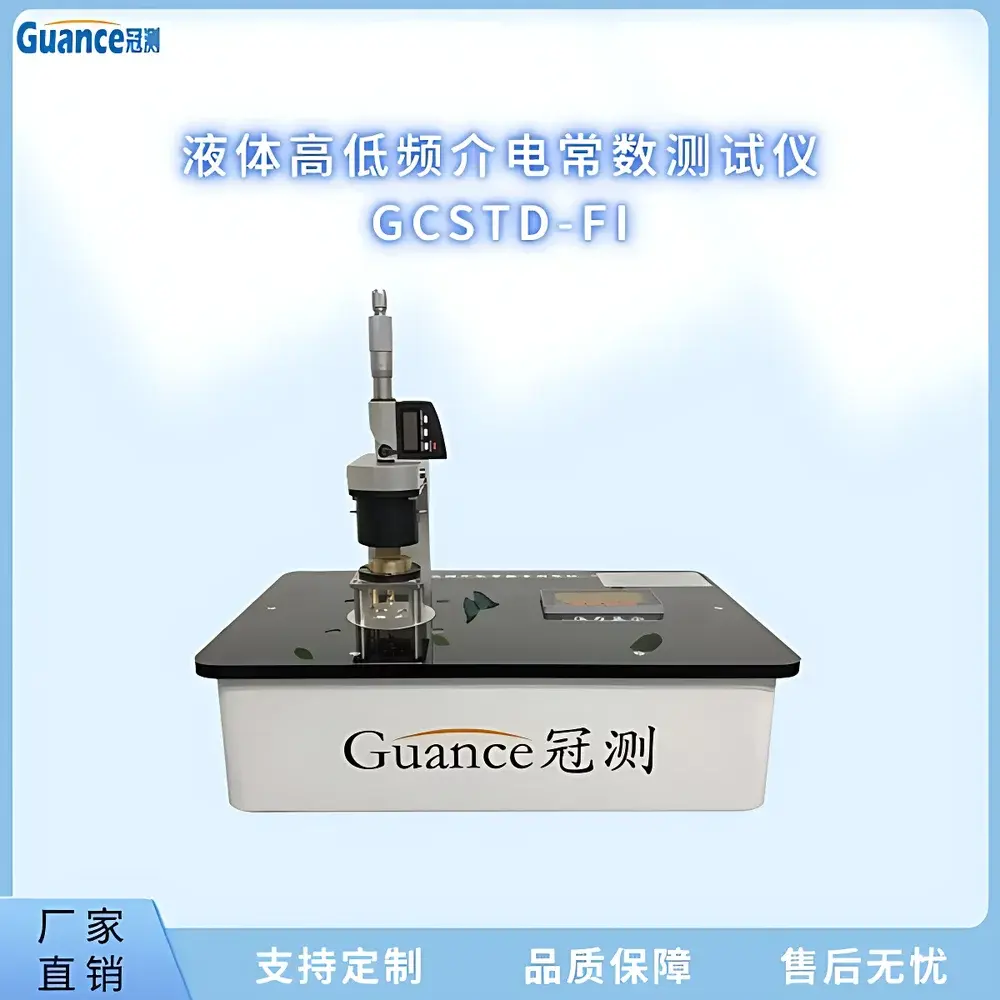
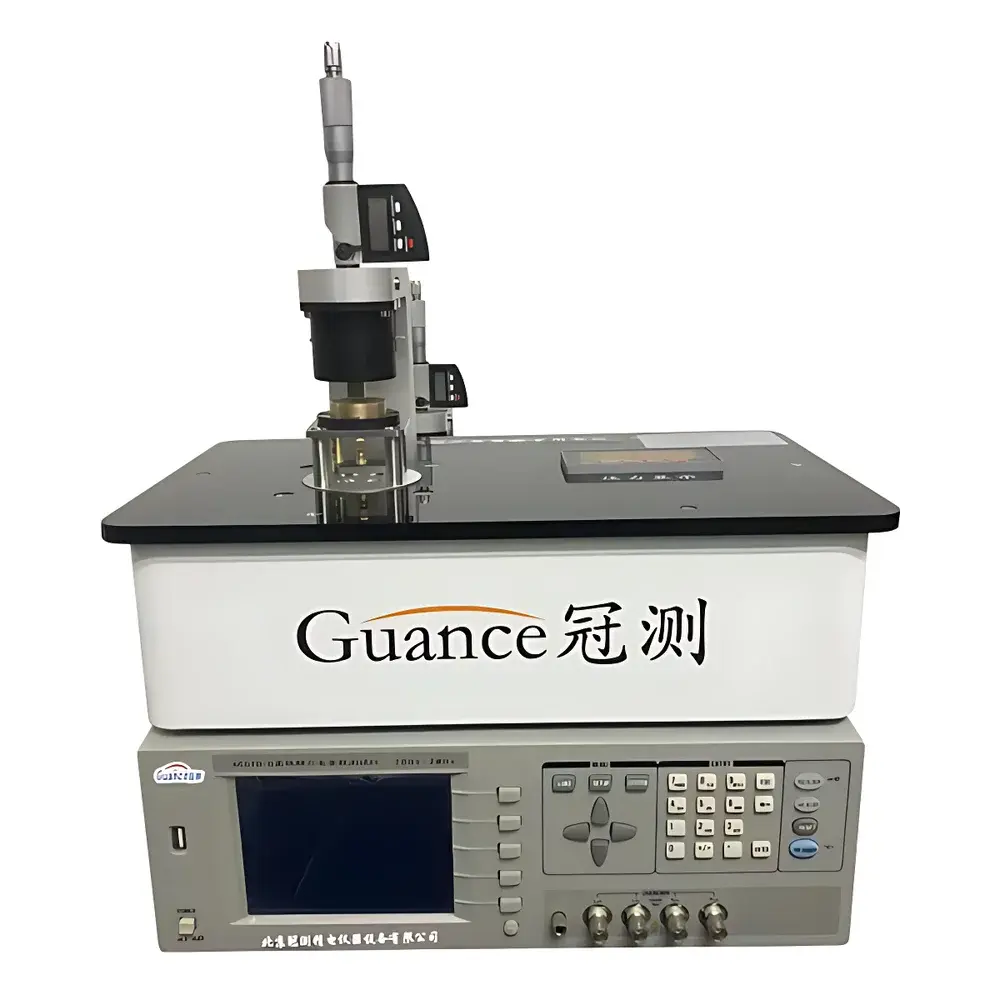
GuanCe Instruments GCSTD-FI2 Low-Frequency Dielectric Constant Analyzer for Liquids
| Brand | GuanCe Instruments |
|---|---|
| Origin | Beijing, China |
| Manufacturer Type | Authorized Distributor |
| Country of Origin | China |
| Model | GCSTD-FI2 |
| Price | USD 1,950 (FOB Beijing) |
| Measurement Principle | Two-Terminal Capacitance-Based Dielectric Spectroscopy at Fixed 10 kHz |
| Compliance | GB/T 1409–2006, GB/T 5654–2007, GB/T 21216–2007, GB/T 1693–2007, GB/T 5594.4–1985 |
| Accuracy | ±2% of reading |
| Repeatability & Linearity | ±0.2% |
| Electrode Type | External coaxial cylindrical electrode (316 stainless steel outer/inner cylinders, nylon spacers, PTFE-insulated) |
| Excitation Signal | 10 kHz sine wave, RMS amplitude selectable: ~7 V (range 1–20), ~0.7 V (range 1–200) |
Overview
The GuanCe Instruments GCSTD-FI2 Low-Frequency Dielectric Constant Analyzer is a dedicated benchtop instrument engineered for precise, repeatable measurement of relative permittivity (dielectric constant, εr) and dissipation factor (tan δ) of liquid dielectrics at a fixed frequency of 10 kHz. It operates on the principle of two-terminal capacitance spectroscopy: the sample liquid serves as the dielectric medium between concentric cylindrical electrodes, and the system determines εr by measuring the complex impedance response under sinusoidal excitation. Designed specifically for low-frequency characterization—distinct from RF or microwave dielectric analyzers—the GCSTD-FI2 targets applications where bulk polarization, ionic conduction, and interfacial relaxation dominate the response, such as in insulating oils, transformer fluids, lubricants, polar solvents, and ionic liquid formulations. Its fixed 10 kHz operation aligns with key Chinese national standards (GB/T 5654–2007, GB/T 21216–2007) for routine quality control and R&D screening of electrical insulation liquids.
Key Features
- Fixed-frequency 10 kHz excitation ensures stable, interference-resistant measurements optimized for low-loss and moderate-conductivity liquids.
- Removable coaxial cylindrical electrode assembly fabricated from 316 stainless steel (electrode surfaces) with precision-machined geometry; spacing maintained by six non-conductive nylon spacers to guarantee dimensional repeatability.
- Dual-range capacitance measurement capability: Range 1–20 (RMS voltage ≈ 7 V) for low-εr hydrocarbons (e.g., mineral oil, n-hexane); Range 1–200 (RMS voltage ≈ 0.7 V) for higher-permittivity polar liquids (e.g., ethanol, ethylene glycol, aqueous solutions).
- Open-structure electrode design enables rapid sample loading, full visual inspection, and thorough solvent-based cleaning without disassembly—critical for eliminating cross-contamination between samples with differing chemical affinities.
- Calibration traceability supported via standardized reference liquids (e.g., air, deionized water, certified transformer oil) per GB/T 1409–2006 Annex B procedures.
- Rugged mechanical architecture with PTFE-insulated connections and corrosion-resistant materials ensures long-term stability in laboratory and light industrial environments.
Sample Compatibility & Compliance
The GCSTD-FI2 is validated for use with non-aggressive, non-viscous to moderately viscous liquids compatible with 316 stainless steel, nylon, and PTFE. Typical compliant samples include mineral insulating oils, silicone fluids, aliphatic/aromatic hydrocarbons, alcohols, ketones, esters, and low-conductivity aqueous electrolytes. It is not intended for highly corrosive media (e.g., concentrated acids/bases), suspensions, or conductive slurries. The analyzer conforms to multiple GB standards governing dielectric characterization of insulating materials—including GB/T 5654–2007 (liquid insulation), GB/T 21216–2007 (conductivity and loss determination), and GB/T 1693–2007 (rubber)—making it suitable for internal QC labs operating under Chinese regulatory frameworks. While not pre-certified to IEC 60247 or ASTM D924, its measurement methodology is technically aligned with those standards’ low-frequency capacitance bridge principles.
Software & Data Management
The GCSTD-FI2 operates in standalone mode with front-panel digital display and manual range selection. No proprietary software or PC interface is included; all readings are direct analog-to-digital conversions displayed as dimensionless εr values. For laboratories requiring electronic data capture, users may integrate the analog output (if equipped) or manually record results into LIMS or Excel-based tracking systems. The instrument supports GLP-compliant documentation when used with standardized test protocols, operator logs, and periodic verification using reference liquids. Audit trails are maintained externally via lab notebooks or digital records, consistent with ISO/IEC 17025 clause 7.7 requirements for result reporting integrity.
Applications
- Quality assurance of transformer and switchgear insulating oils per GB/T 5654–2007 specifications.
- Formulation development of dielectric coolants and heat-transfer fluids in electronics thermal management.
- Monitoring aging-induced oxidation and moisture ingress in lubricating oils via progressive εr drift.
- Screening polarity and hydrogen-bonding capacity of organic solvents for battery electrolyte research.
- Educational laboratories demonstrating Debye relaxation behavior and frequency-dependent permittivity in polar vs. nonpolar liquids.
- Raw material verification for capacitor-grade silicone oils and fluorinated fluids.
FAQ
What is the recommended cleaning procedure for the cylindrical electrode?
Immerse the intact electrode assembly in acetone or ethanol, then sonicate for 5–10 minutes. Rinse with fresh solvent and dry gently with filtered compressed air. Never disassemble the electrode—mechanical alignment is factory-calibrated and irreversible.
Can the GCSTD-FI2 measure conductivity directly?
No. It measures capacitance and dissipation factor at 10 kHz; DC or low-frequency conductivity must be derived indirectly using supplementary models and is not part of standard output.
Is temperature control integrated into the system?
No. The GCSTD-FI2 does not include a thermostatted cell or temperature sensor. For temperature-dependent studies, external jacketed cells and calibrated thermometers must be used with manual correction per GB/T 5654–2007 Section 8.
Does the instrument support automated calibration routines?
It supports manual zero and span adjustment using air (εr ≈ 1.0006) and reference liquids of known permittivity; no auto-calibration firmware is embedded.
What safety precautions apply during operation?
Ensure electrodes are fully dry before applying excitation voltage. Avoid contact with conductive residues or high-volatility solvents near live terminals. Operate only in well-ventilated areas when handling flammable liquids.



