
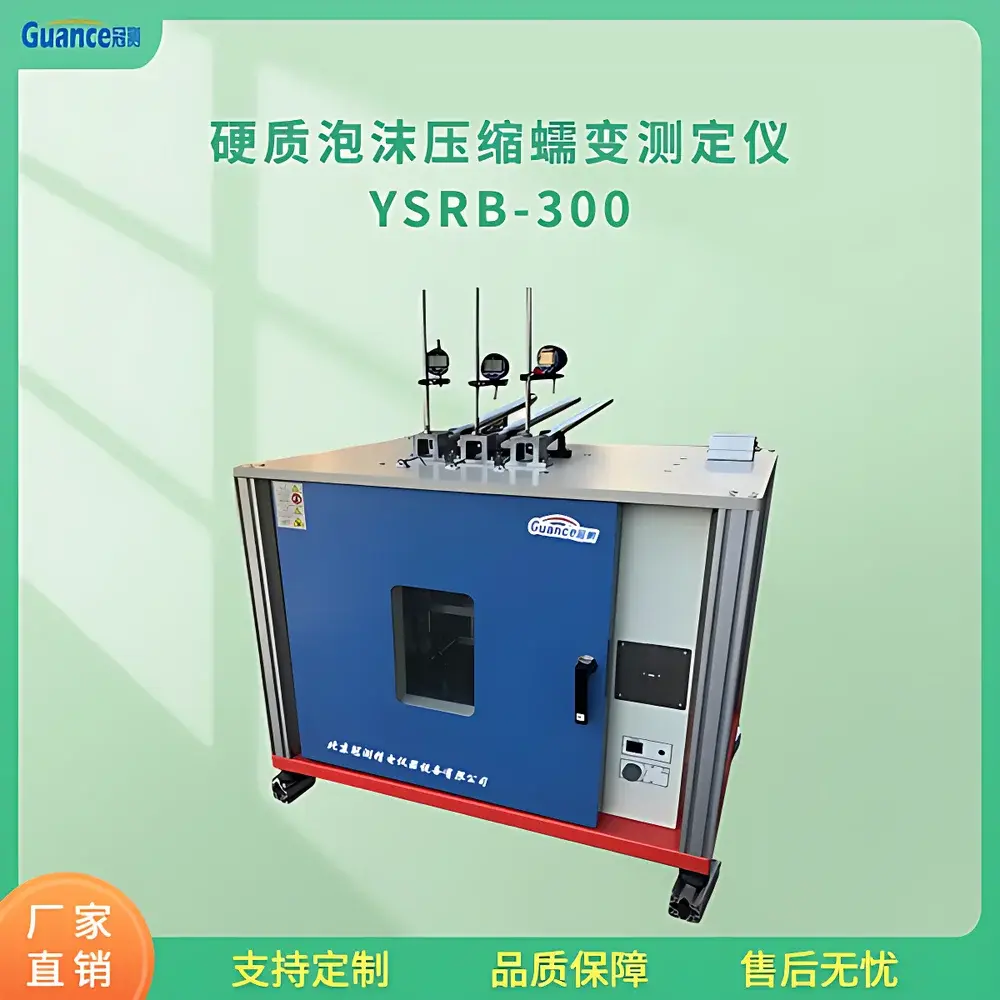
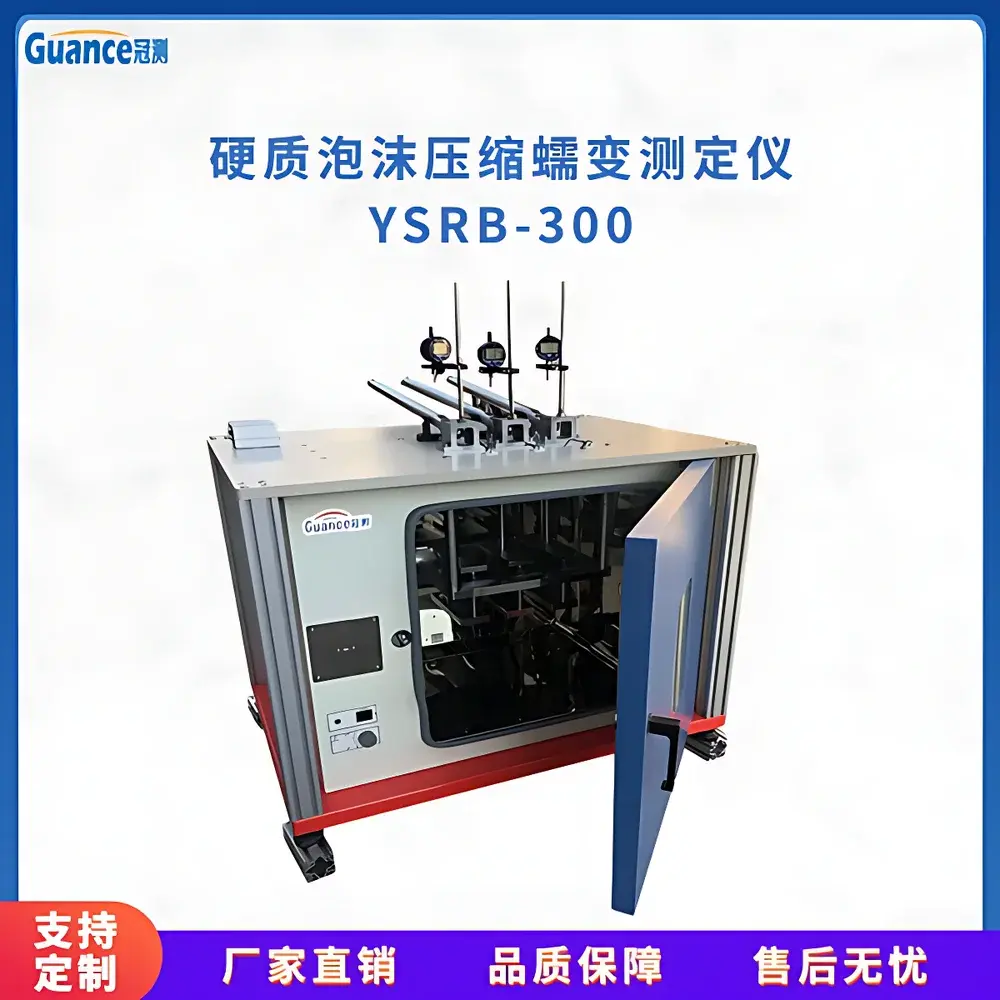
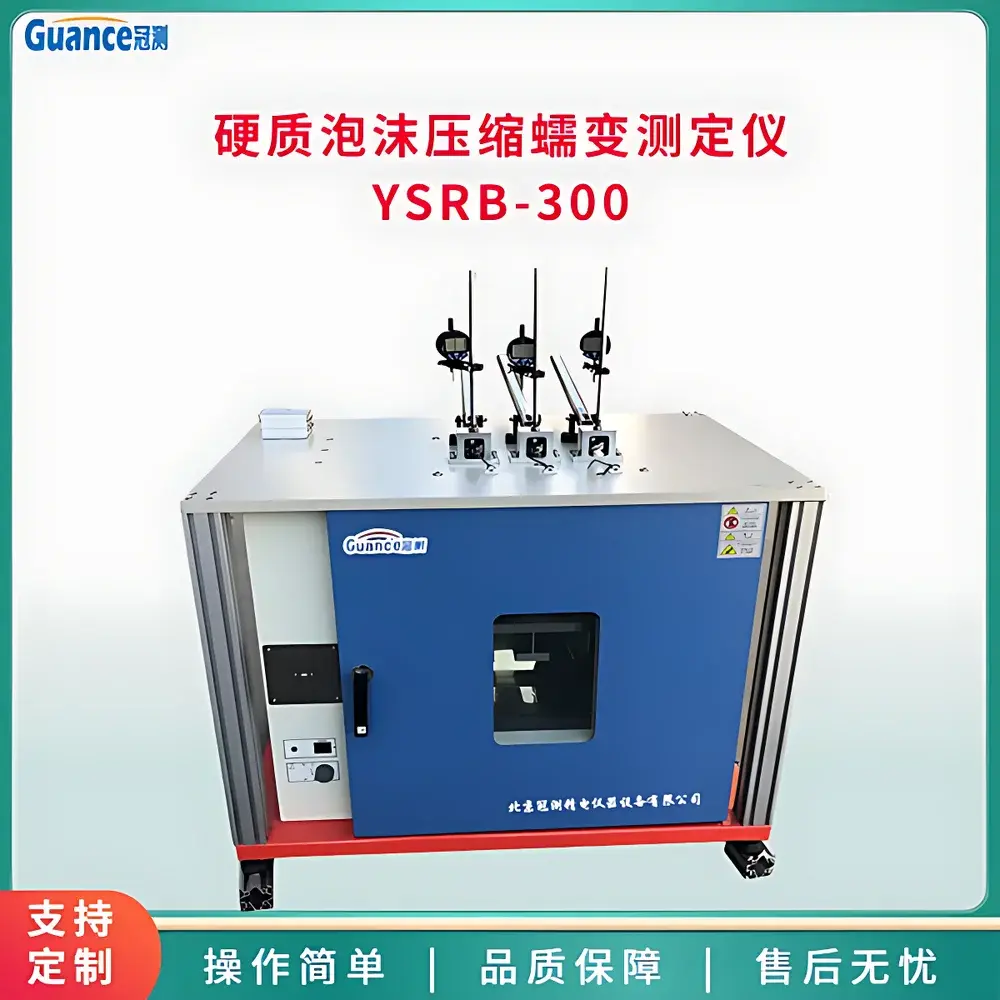
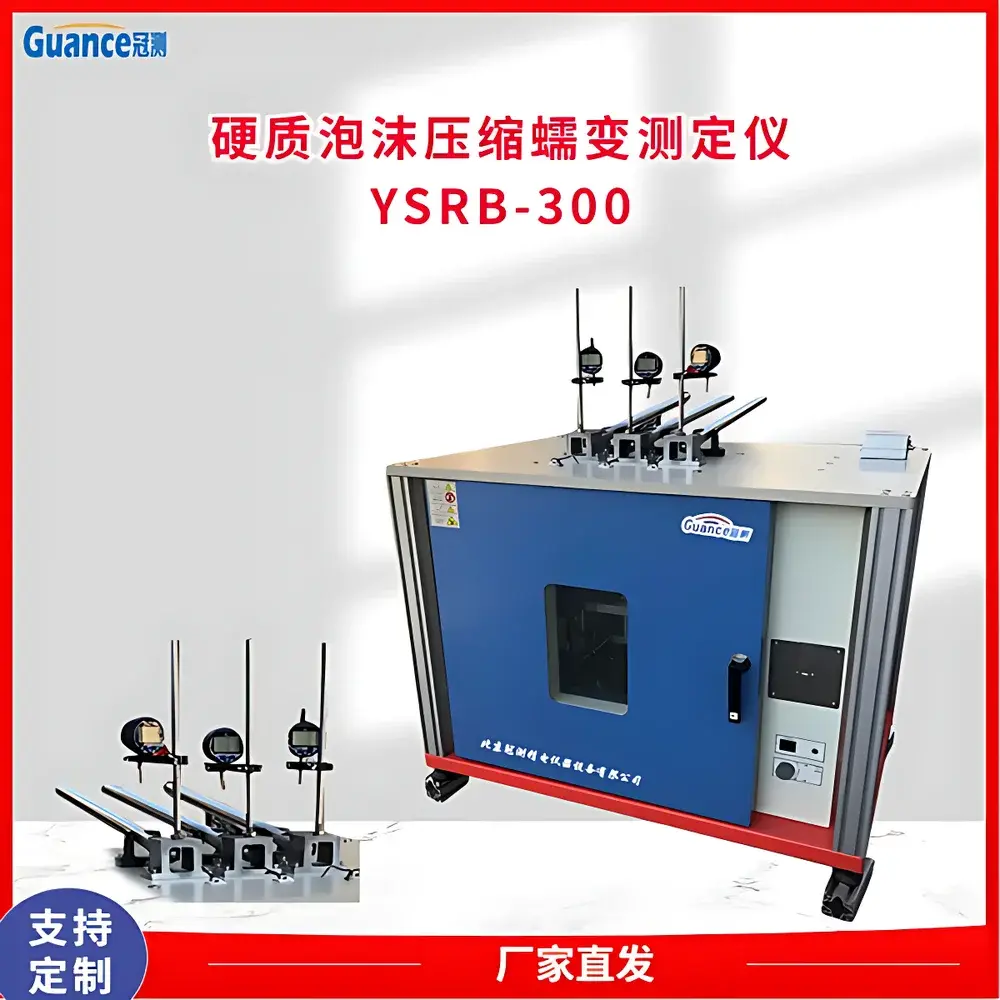
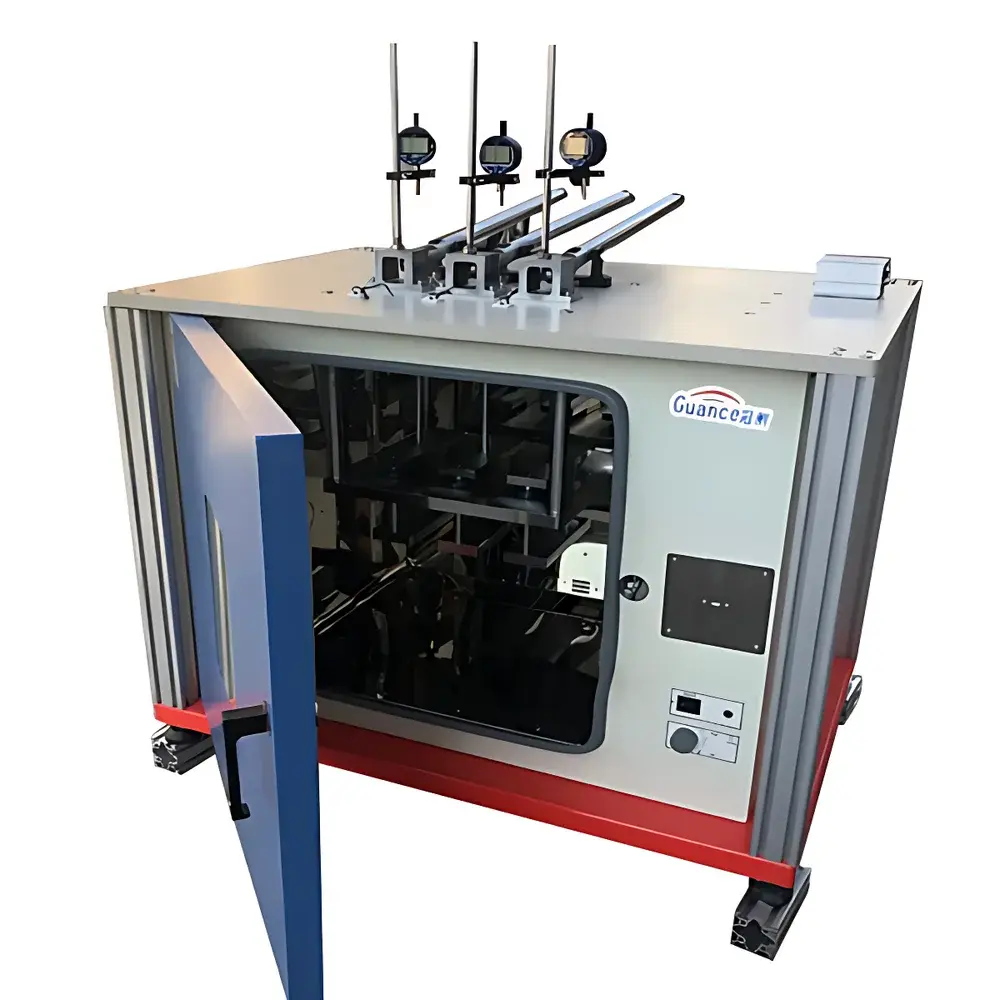
GuanCe Instruments YSRB-300.5 Intelligent Foam Creep Compression Tester
| Brand | GuanCe Instruments |
|---|---|
| Origin | Beijing, China |
| Manufacturer Type | Authorized Distributor |
| Country of Origin | China |
| Model | YSRB-300.5 |
| Price | USD 1,800 (approx.) |
| Heating Method | Air-bath |
| Test Channels | 3 |
| Temperature Range | Ambient to 300 °C |
| Temp. Stability | ±2 °C |
| Heating Rate | 50±3 °C/h or 10±2 °C/12 min |
| Temp. Resolution | 0.1 °C |
| Deformation Resolution | 0.002 mm |
| Specimen Dimensions | 50×50×50 mm or 40×40×20 mm |
| Platen Size | 50×50 mm (×3) |
| Recommended Load Range | 0–1 MPa |
| Chamber Internal Dimensions | 350×400×400 mm |
| Lever Compression Ratio | 1:32 |
| Loading Modes | Lever-weighted compression / Direct-weighted bending |
| Load Mass Set | 15 kg total (distributed across three independent test stations) |
Overview
The GuanCe Instruments YSRB-300.5 Intelligent Foam Creep Compression Tester is a precision-engineered thermal-mechanical testing system designed for the quantitative evaluation of time-dependent compressive and flexural deformation behavior in rigid polymeric foams under controlled elevated temperatures. It operates on the principle of sustained-load creep testing—applying constant mechanical stress while maintaining a precisely regulated thermal environment—and measuring dimensional change over time using high-resolution optical displacement transducers. This methodology aligns with fundamental viscoelastic characterization requirements defined in ISO 179-1 (flexural properties), ASTM D695 (compressive properties of rigid plastics), and specifically implements the test protocols outlined in GB/T 20672–2006 and DIN 53424 for thermal compression stability and high-temperature creep resistance assessment. The instrument supports dual-mode mechanical loading—lever-amplified compression and direct-weighted bending—enabling concurrent evaluation of both axial and flexural creep responses within a single thermal cycle.
Key Features
- Air-bath heating chamber with internal dimensions of 350 × 400 × 400 mm, capable of stable operation from ambient temperature up to 300 °C with thermal uniformity maintained within ±2 °C.
- Triple independent test channels, each equipped with dedicated load application mechanisms: two lever-ratio (1:32) compression stations and one direct-loading bending station.
- High-accuracy optical grating-based displacement measurement system, delivering sub-micron resolution (0.002 mm) and traceable calibration against NIST-traceable standards.
- Integrated intelligent controller with real-time PID temperature regulation, programmable ramp profiles (e.g., 50 ± 3 °C/h or 10 ± 2 °C per 12 min), and 0.1 °C temperature sensing resolution.
- Automated data acquisition architecture capturing synchronized temperature, load, and displacement signals at user-defined intervals; full experimental history stored with timestamped metadata.
- Modular weight set totaling 15 kg (comprising calibrated masses from 1 g to 2000 g), enabling precise static load application across the recommended stress range of 0–1 MPa.
- Color graphical interface displaying live deformation vs. time curves, thermal profile overlays, and real-time status indicators for all three test positions.
Sample Compatibility & Compliance
The YSRB-300.5 accommodates standard specimen geometries per GB/T 20672–2006 and DIN 53424: cubes of 50 × 50 × 50 mm and rectangular prisms of 40 × 40 × 20 mm. Its design ensures uniform thermal exposure and minimal edge-effect interference during both compression and bending tests. The system meets essential requirements for laboratory-grade thermal-mechanical instrumentation, including structural rigidity to minimize parasitic deflection, electromagnetic noise suppression in analog signal paths, and thermal shielding to prevent controller overheating. While not certified to IEC 61000-4 or CE directives out-of-the-box, it complies with core functional safety expectations for Class II laboratory equipment operating below 300 °C. All test reports generated include embedded compliance statements referencing GB/T 20672–2006, DIN 53424, and ASTM D2990 (creep properties of plastics).
Software & Data Management
The proprietary control software runs on Windows-based industrial PCs and provides role-based access control, audit-trail logging, and electronic signature support—features aligned with GLP and GMP documentation requirements. Raw sensor data (temperature, displacement, elapsed time) are saved in CSV and binary formats with checksum validation. Post-test analysis tools enable calculation of creep strain rate, time-to-rupture, and thermal expansion coefficients. Export functions support PDF report generation with embedded graphs, test parameters, operator ID, calibration dates, and instrument serial numbers. Data integrity safeguards include automatic backup to external storage, write-protection of historical datasets, and configurable retention policies meeting FDA 21 CFR Part 11 expectations for electronic records.
Applications
- Quantifying long-term dimensional stability of rigid polyurethane (PUR), phenolic, and melamine-formaldehyde foams used in aerospace insulation and fire-rated building panels.
- Evaluating thermal compression set in automotive seating foams subjected to cabin temperature extremes (>80 °C) over extended dwell periods.
- Supporting material qualification for ISO 11337-compliant fire barrier systems where creep-induced gap formation compromises flame spread resistance.
- Generating input parameters for finite element models simulating thermo-mechanical aging in packaging cushioning structures exposed to warehouse-level heat cycling.
- Validating batch-to-batch consistency in foam manufacturing via comparative creep modulus profiling at standardized temperatures (e.g., 120 °C, 180 °C, 250 °C).
FAQ
What standards does the YSRB-300.5 directly implement?
It executes test procedures defined in GB/T 20672–2006 and DIN 53424, with methodological compatibility to ASTM D2990, ISO 179-1, and ISO 604 for related mechanical property assessments.
Can the system perform simultaneous compression and bending tests?
Yes—three independent test stations allow concurrent execution: two under lever-amplified compressive load and one under direct bending load, all within the same thermal profile.
Is deformation measurement traceable to international metrology standards?
The optical grating transducers are factory-calibrated against reference artifacts certified to ISO/IEC 17025-accredited laboratories, with calibration certificates provided upon delivery.
What is the maximum allowable specimen height under full thermal expansion?
The vertical clearance above the platen is 120 mm at 300 °C, accommodating specimens with anticipated thermal growth up to 5% height increase without mechanical interference.
Does the software support automated pass/fail evaluation against specification limits?
Yes—the analysis module permits user-defined acceptance criteria (e.g., max creep strain ≤ 0.8% at 100 h, 200 °C), triggering visual alerts and flagging non-conforming results in summary reports.






