
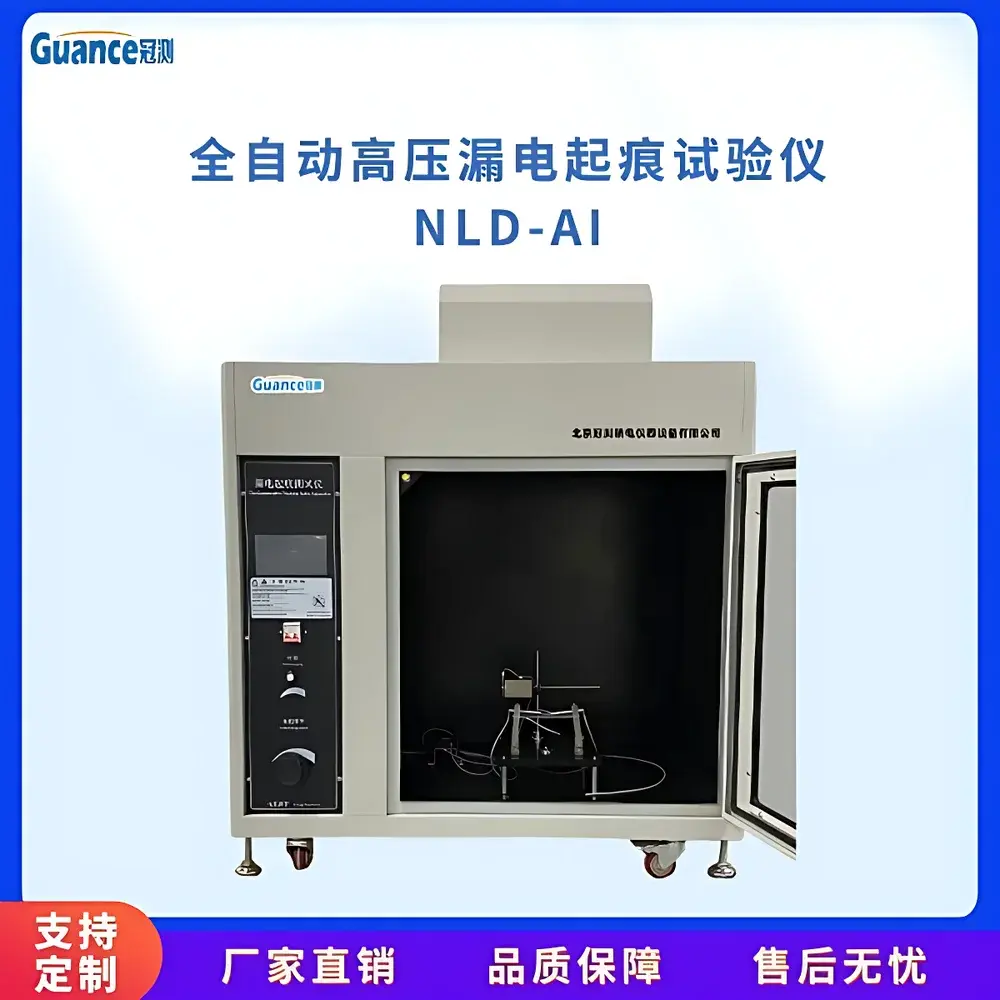
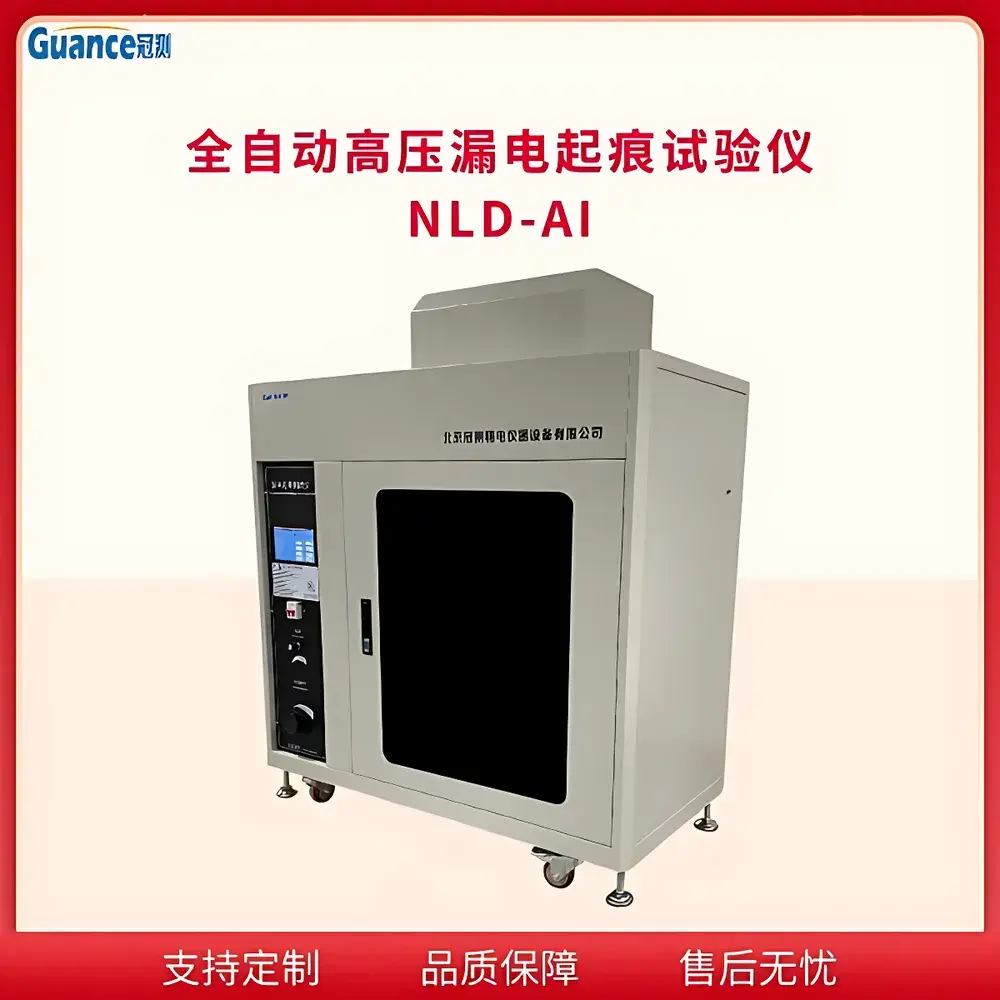
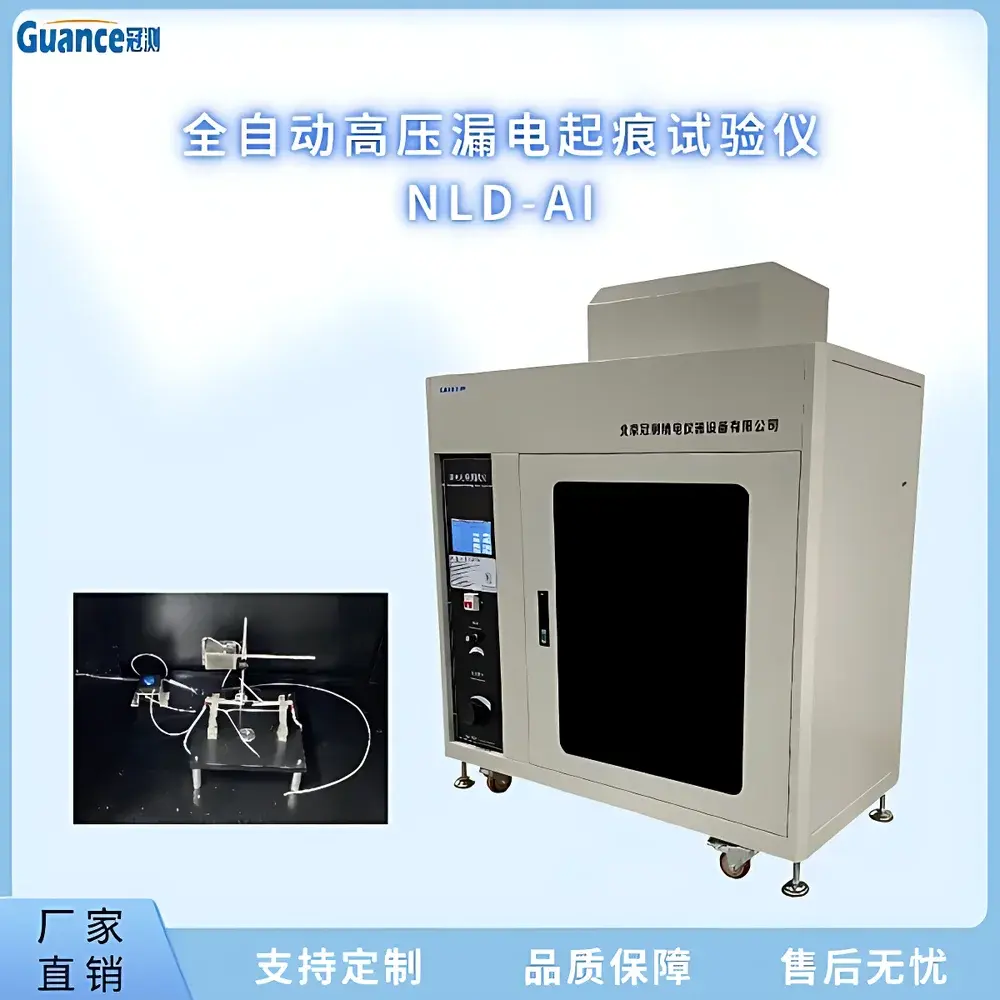
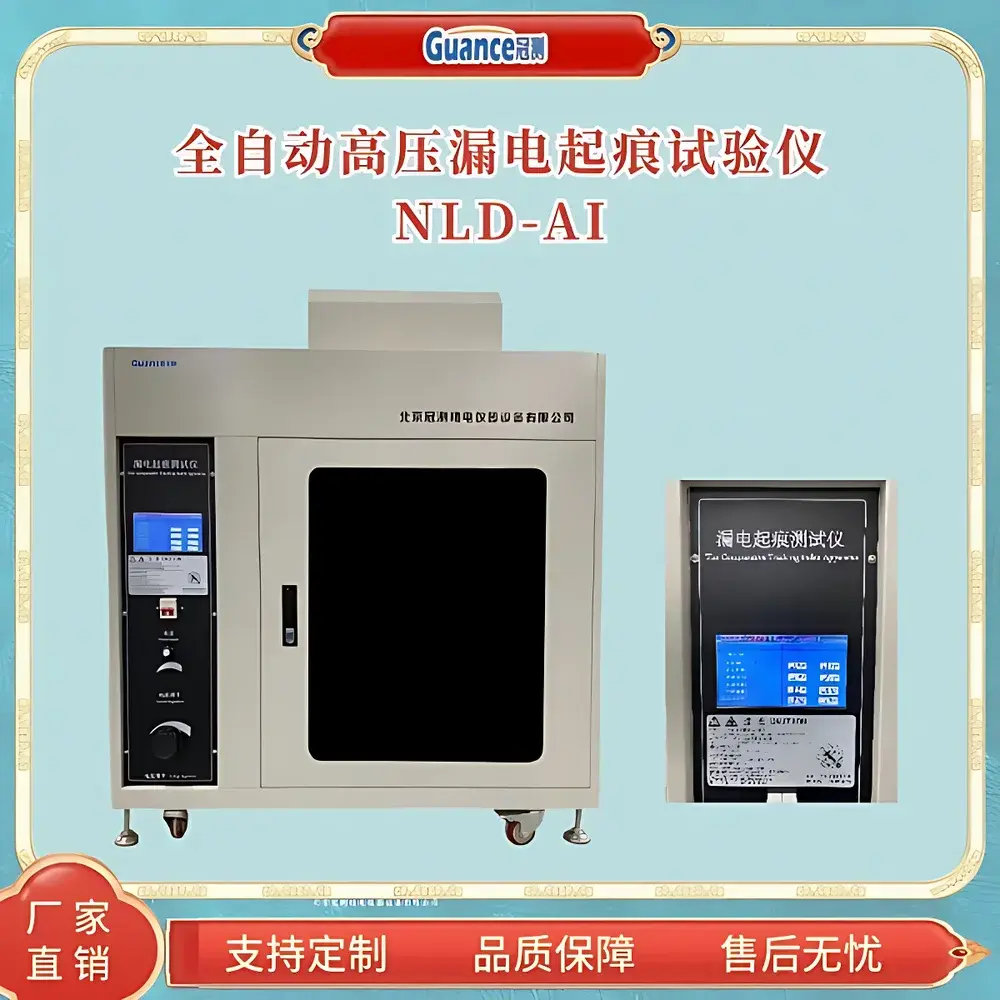
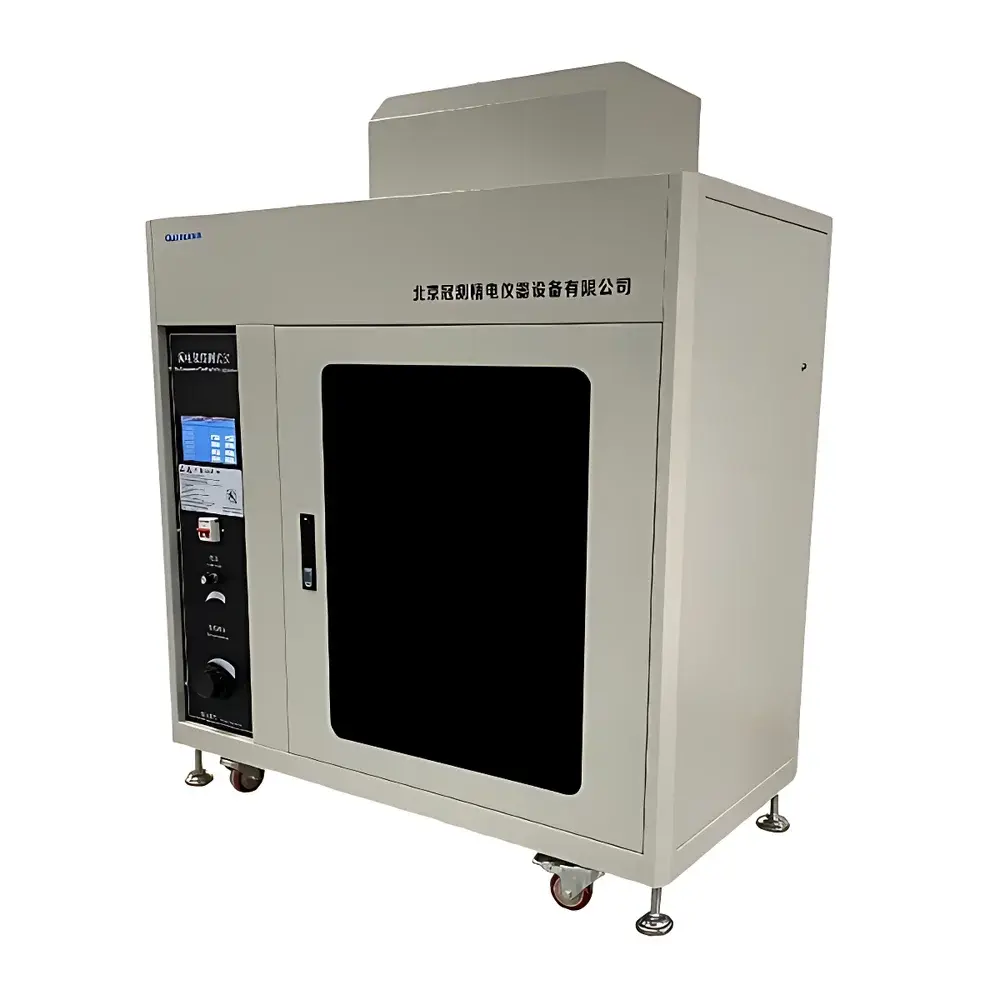
GuanCe Instruments NLD-AI5 High-Voltage Tracking Resistance Tester for Wires and Cables
| Brand | GuanCe Instruments |
|---|---|
| Origin | Beijing, China |
| Manufacturer Type | Authorized Distributor |
| Origin Category | Domestic (China) |
| Model | NLD-AI5 |
| Price | USD 1,950 (approx.) |
| Instrument Type | Electronic Universal Testing Machine |
| Standards Compliance | GB/T 6553–2003, IEC 60587:1984 |
| Test Method Modes | Constant Voltage Method, Stepwise Voltage Method |
| Voltage Supply | AC (48–62 Hz) and DC |
| Sample Channels | 5 independent parallel test circuits |
| Control System | Siemens PLC with optical isolation for voltage/current acquisition |
| Human Interface | 10-inch industrial touchscreen HMI |
| Leakage Current Alarm Range | 0–100 mA (user-configurable per channel) |
| Dropping System | Precision peristaltic pump with real-time flow display and on-screen adjustment |
| Voltage Regulation | Autotransformer + oil-immersed step-up transformer for low-voltage-drop stability |
| Safety Interlock | Door-open automatic high-voltage cutoff |
| Exhaust System | Dedicated fume extraction ducted outdoors |
| Illumination | Integrated LED internal lighting |
| Data Calibration | On-device voltage and current recalibration function |
| Test Duration Setting | Programmable (minutes) |
| Voltage Ramp & Reset | Auto-ramp to set voltage |
| Liquid Management | Separated fresh/drain reservoirs for contamination control |
| Real-time Monitoring | Per-channel voltage, instantaneous leakage current, peak leakage current, elapsed time |
Overview
The GuanCe Instruments NLD-AI5 High-Voltage Tracking Resistance Tester is an engineered solution for evaluating the comparative tracking index (CTI) and erosion resistance of solid electrical insulating materials—particularly polymeric insulation used in wire and cable systems, insulators, silicone rubber housings, and outdoor composite bushings. It operates in strict accordance with GB/T 6553–2003 and IEC 60587:1984, which define standardized procedures for assessing material performance under accelerated electrochemical stress. The instrument applies controlled AC (48–62 Hz) or DC high voltage across inclined solid specimens while introducing calibrated contaminant solution (e.g., ammonium chloride + distilled water) via gravity-fed droplets. Under sustained electrical stress, surface conduction paths develop, leading to localized carbonization (tracking), partial discharge, and eventual material degradation. The NLD-AI5 quantifies failure thresholds—including time-to-tracking, number of drops to failure, and voltage at first permanent tracking—enabling classification per IEC 60112 and direct correlation to end-use environmental severity (e.g., coastal, industrial, or tropical service conditions).
Key Features
- Five-Channel Parallel Testing: Simultaneous evaluation of five independent specimens under identical or individually programmed test conditions—significantly improving throughput for comparative material screening and batch qualification.
- Siemens PLC-Based Control Architecture: Industrial-grade programmable logic controller with optically isolated analog inputs ensures electromagnetic immunity in high-voltage environments, guaranteeing long-term signal integrity for leakage current and voltage measurements.
- 10-Inch Touchscreen HMI: Intuitive interface displays real-time per-channel parameters: applied voltage, instantaneous leakage current, peak historical current, elapsed test time, and peristaltic pump flow rate—all accessible without external software or PC dependency.
- Configurable Leakage Current Alarming: User-definable alarm thresholds (0–100 mA per channel) trigger immediate high-voltage disconnection for the affected circuit only, preserving data continuity for remaining active channels.
- Precision Peristaltic Dropping System: Flow rate digitally adjustable and continuously monitored on-screen; eliminates mechanical variability inherent in solenoid or gravity-only dispensers, ensuring repeatable drop volume and timing per IEC 60587 requirements.
- Dual-Liquid Reservoir Design: Physically segregated fresh solution tank and waste collection sump prevent cross-contamination and maintain consistent electrolyte conductivity throughout extended testing cycles.
- Oil-Immersed High-Voltage Transformer: Coupled with autotransformer pre-regulation, this configuration minimizes output impedance and suppresses voltage sag during high-current arcing events—critical for maintaining test validity during transient conduction phases.
- Integrated Safety Systems: Hardware-enforced door interlock cuts HV output within <50 ms of access door opening; dedicated exhaust ducting meets ISO 10648-1 Class 2 containment guidance for hazardous vapor management.
Sample Compatibility & Compliance
The NLD-AI5 accommodates standard 100 mm × 100 mm × 6 mm rectangular specimens mounted on a 45° incline per IEC 60587. Compatible materials include thermoset and thermoplastic insulating polymers (e.g., EPDM, XLPE, silicone rubber, phenolic resins), ceramic substrates with polymeric coatings, and filled composites used in high-voltage terminations. All operational parameters—including voltage ramp profiles, drop interval timing, and current threshold logic—are fully configurable to align with ASTM D2303 (for alternating current) and UL 746A tracking protocols. The system supports GLP-compliant audit trails when paired with optional external data logging (via Modbus RTU or Ethernet/IP), and its calibration traceability framework satisfies internal quality system requirements aligned with ISO/IEC 17025 clause 6.5.3.
Software & Data Management
While the NLD-AI5 operates autonomously via its embedded HMI, it provides native RS-485 (Modbus RTU) and optional Ethernet/IP connectivity for integration into centralized laboratory information management systems (LIMS) or SCADA platforms. All test logs—including timestamped voltage, current, drop count, and alarm events—are stored internally on non-volatile memory with overwrite protection. Data export is supported via USB flash drive in CSV format for post-processing in Excel, MATLAB, or statistical analysis packages. Firmware updates are performed offline using signed binary files, ensuring integrity verification prior to installation. No cloud dependency or proprietary runtime environment is required—consistent with ITAR- and FDA-regulated lab environments where air-gapped operation is mandated.
Applications
- Qualification of cable jacketing compounds for offshore wind turbine applications (IEC 61400-23)
- CTI determination of polymer blends for EV battery module housings (UN 38.3 thermal runaway mitigation)
- Comparative aging studies of silicone rubber insulators exposed to salt fog + UV preconditioning
- Supplier qualification testing per OEM specifications (e.g., Siemens, ABB, Nexans)
- Internal R&D validation of flame-retardant additives’ impact on surface tracking resistance
- Supporting certification submissions to TÜV Rheinland, SGS, or CSA Group for IEC 60695-2-10/11/12 compliance
FAQ
What standards does the NLD-AI5 directly support?
It is fully configured to execute GB/T 6553–2003 and IEC 60587:1984 test sequences, including constant voltage and stepwise voltage methods, with built-in timers, drop counters, and pass/fail logic per clause 8.2.
Can the instrument perform both AC and DC high-voltage tests?
Yes—dual-mode output supports sinusoidal AC (48–62 Hz, RMS) and stabilized DC, each with independent range selection and regulation feedback loops.
Is third-party calibration documentation available?
Factory calibration certificates (traceable to CNAS-accredited labs) are supplied with each unit; field recalibration procedures—including voltage divider and shunt resistor verification—are documented in the technical manual.
How is electrical safety ensured during maintenance?
All HV sections feature dual redundant grounding switches, visible disconnect indicators, and mandatory key-switch lockout before rear-panel access—compliant with IEC 61010-1 Edition 3 requirements for measurement category CAT III 1000 V.
Does the system meet electromagnetic compatibility (EMC) requirements for lab deployment?
Yes—the enclosure meets EN 61326-1:2013 Class A emission limits and EN 61000-4-x immunity standards (including surge, ESD, and conducted RF), verified by independent EMC testing reports.



