
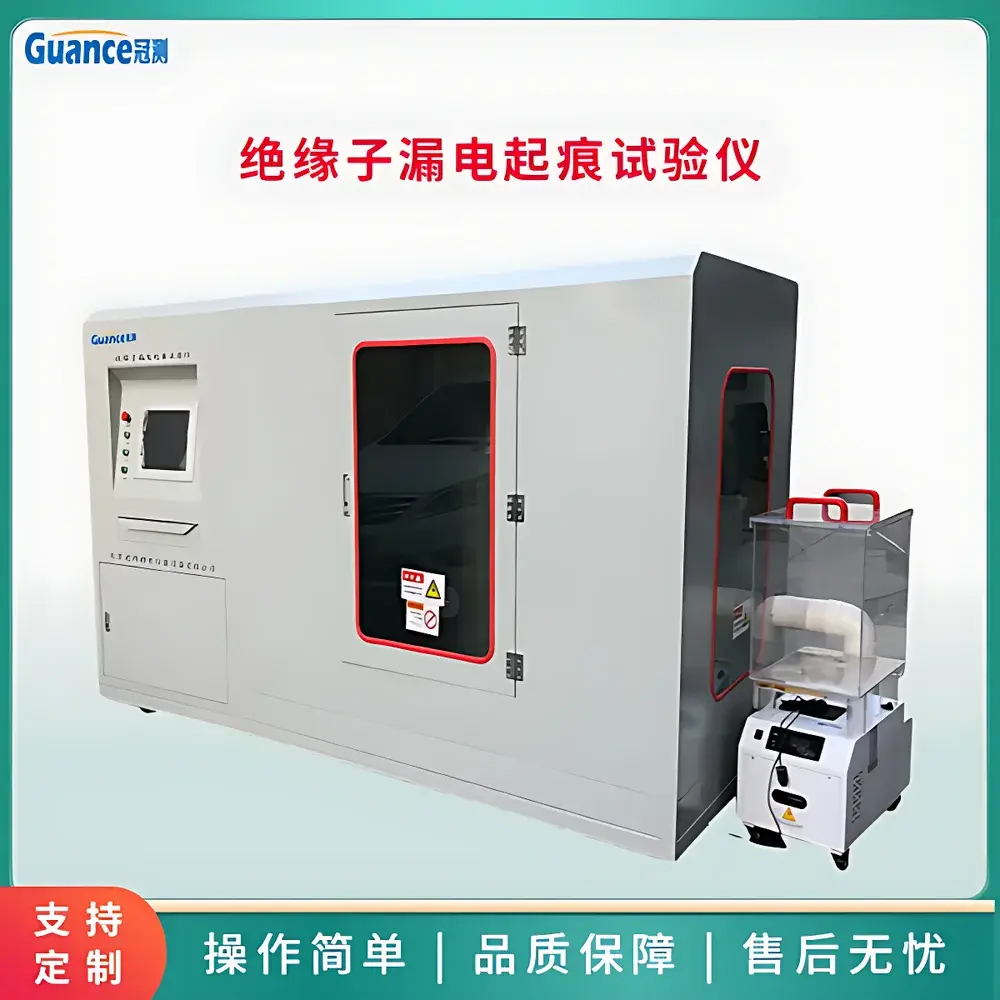
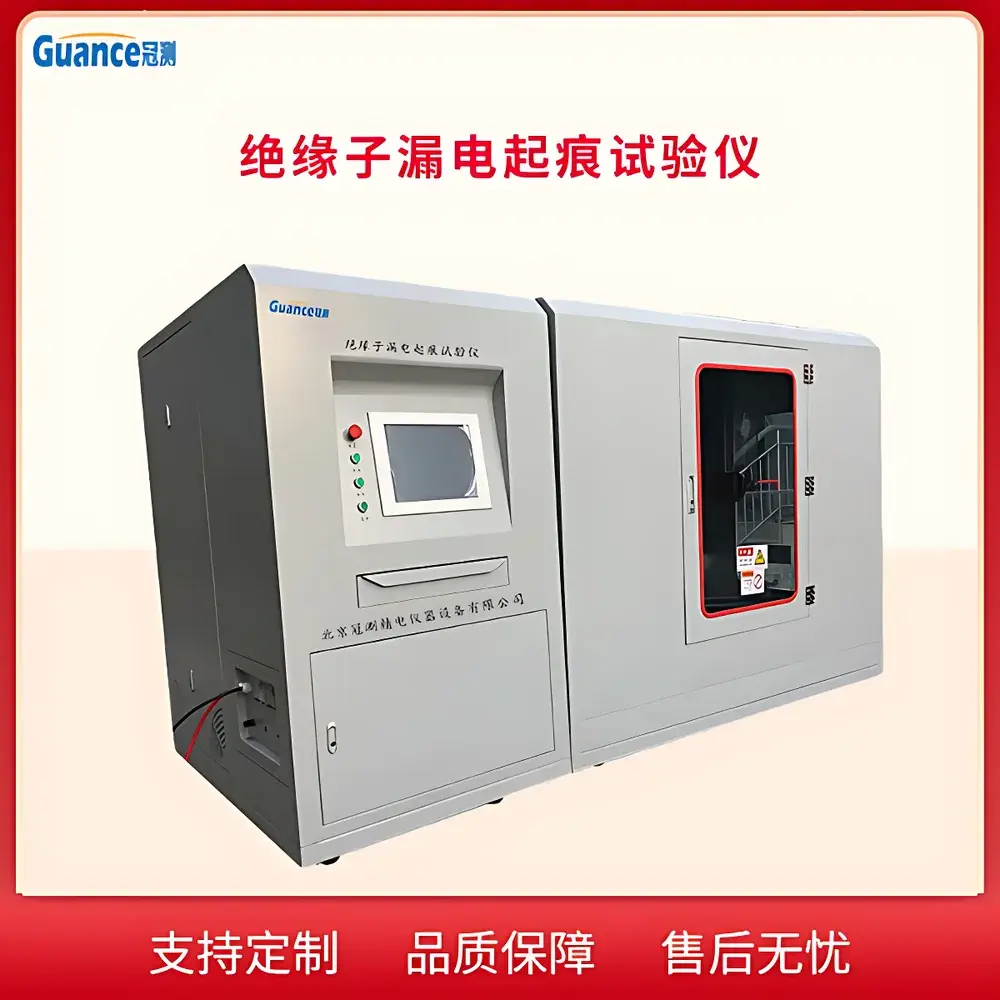
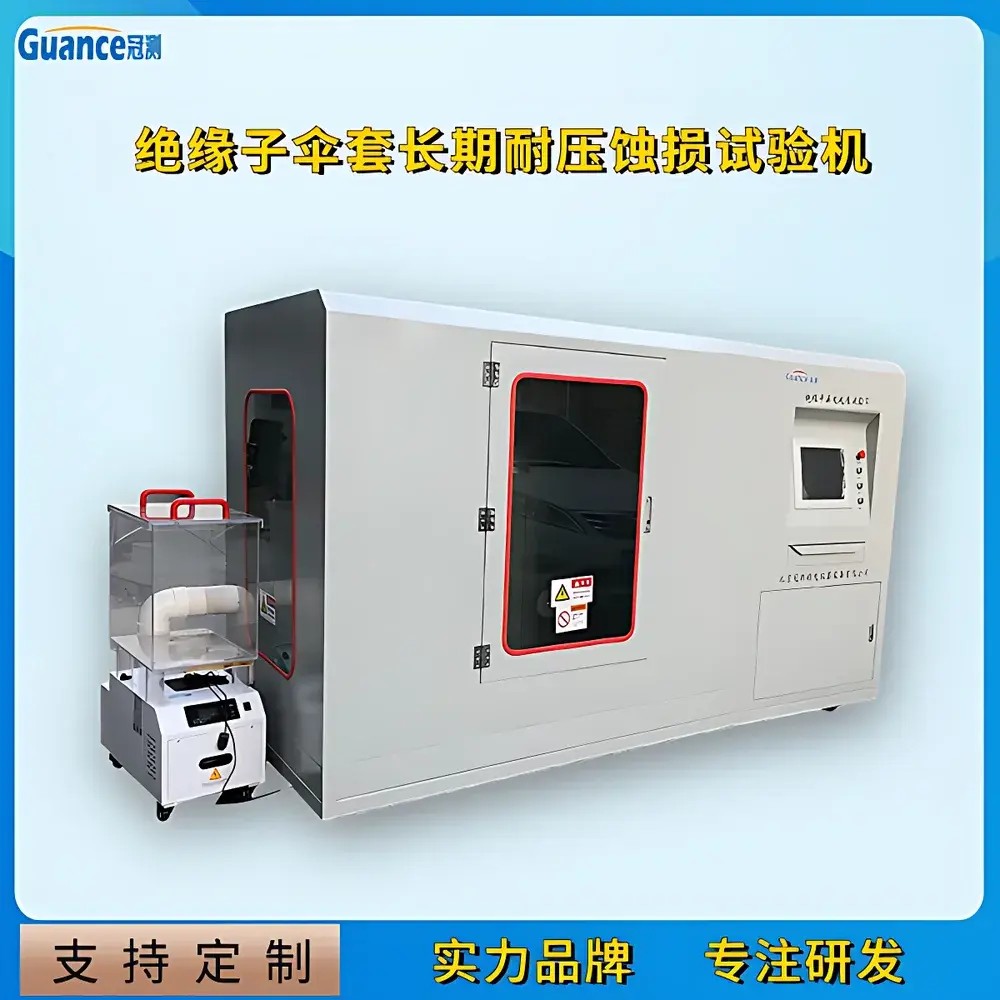
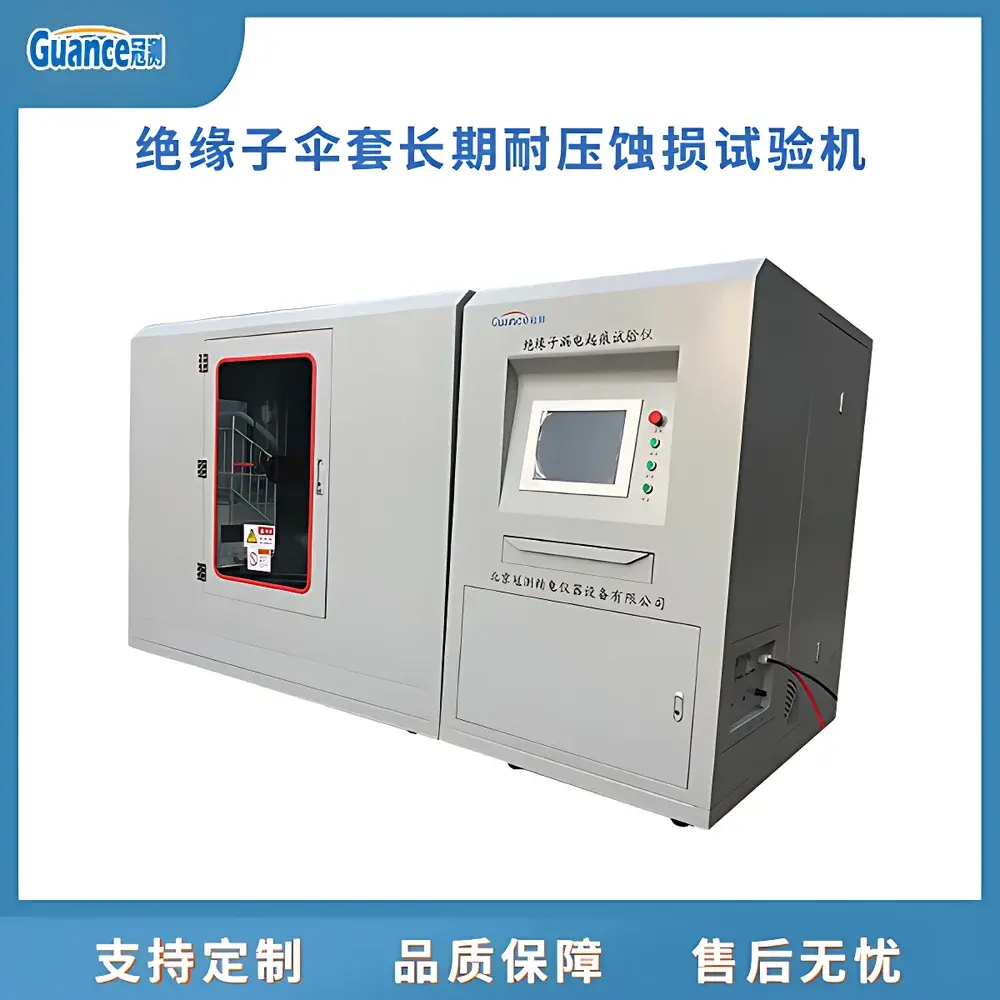
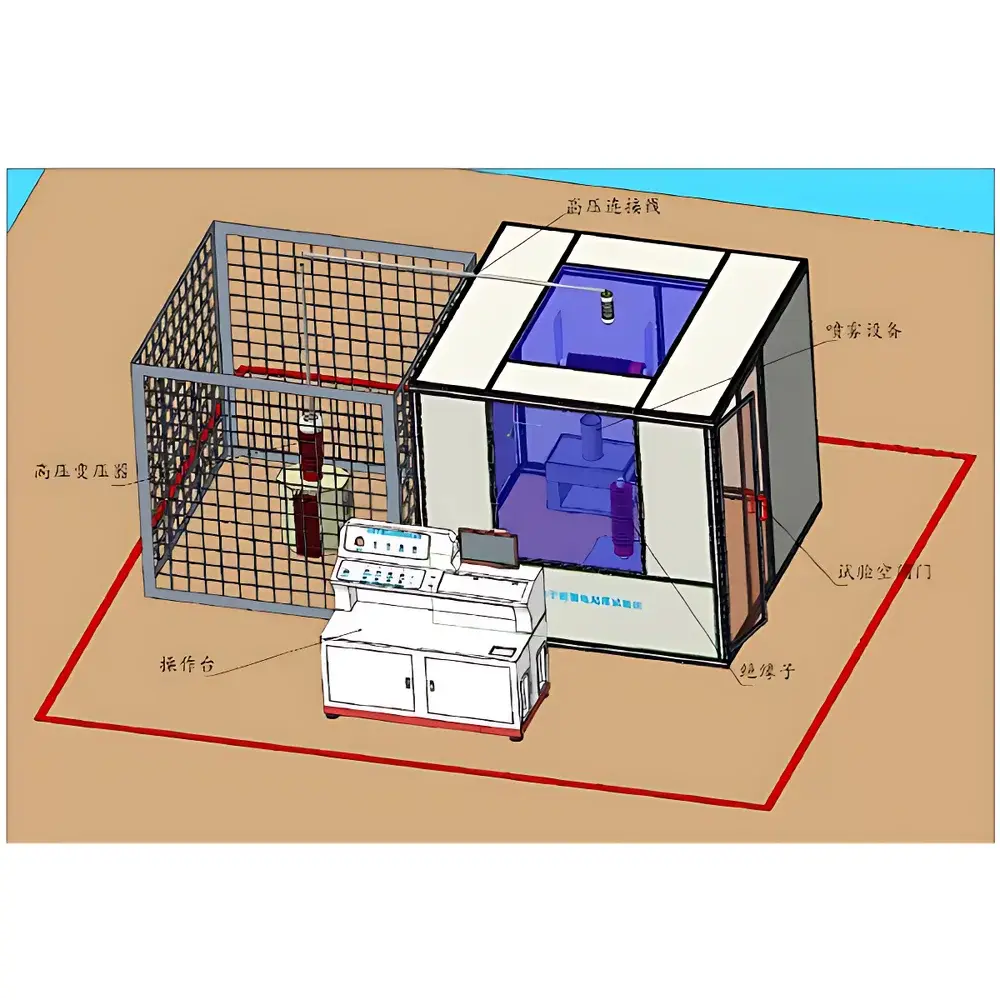
GuanCe NLD-AII Tracking Resistance Tester for Insulators
| Brand | GuanCe Instruments |
|---|---|
| Origin | Beijing, China |
| Manufacturer Type | Authorized Distributor |
| Product Category | Domestic |
| Model | NLD-AII |
| Instrument Type | Electronic High-Voltage Tracking Test System |
| Input Voltage | AC 220 V |
| Output Voltage Range | AC 0–50 kV / DC −50 to 0 kV (adjustable) |
| Electrical Capacity | 50 kVA |
| Voltage Accuracy | < ±2% |
| Current Output | ≥1 A (HV side) |
| Current Measurement Accuracy | < ±1% |
| Test Duration | 1000 h (continuous) |
| Fog Chamber Volume | 4 m³ (L×W×H = 2000 × 1200 × 1700 mm) |
| Nozzle-to-Specimen Distance | >400 mm (top & lateral) |
| Specimen Configuration | 1 horizontal + 1 vertical insulator |
| 雾化方� | �: Ultrasonic nebulization |
| 雾化速度 | 3 m/s |
| Salt Solution | NaCl + deionized water |
| Fog Density | (0.4 ± 0.1) L/m³·h |
| Particle Size Distribution | 5–10 µm |
| Safety Interlock | Door-activated HV cutoff & auto-zero |
| Control System | Embedded industrial computer |
| Dimensions (L×W×H) | 3400 × 1300 × 1800 mm |
| Weight | 300 kg |
Overview
The GuanCe NLD-AII Tracking Resistance Tester is a specialized high-voltage endurance test system engineered for evaluating the comparative tracking index (CTI) and long-term electrical erosion resistance of polymeric insulating materials used in high-voltage outdoor and indoor applications. It operates on the principle of accelerated electrochemical degradation under controlled saline fog and sustained AC/DC high voltage stress—mimicking real-world contamination and wetting conditions encountered by overhead line post-type composite insulators and polymer-housed station equipment. Designed in strict accordance with GB/T 20142–2006 and GB/T 22079–2008, the system subjects two standardized insulator specimens—one mounted horizontally and one vertically—to continuous 1000-hour exposure under precisely regulated salt fog concentration, particle size distribution, airflow velocity, and electric field intensity. This enables quantitative assessment of surface tracking path formation, carbonization progression, leakage current evolution, and eventual flashover behavior—providing critical data for material qualification, design validation, and compliance verification against national and utility-specific insulation performance criteria.
Key Features
- Integrated dual-mode high-voltage source: independently adjustable AC (0–50 kV) and DC (−50 to 0 kV) output with ≤2% voltage accuracy and real-time current monitoring (±1% full-scale accuracy)
- Ultrasonic salt fog generation system delivering stable aerosol at 3 m/s velocity, (0.4 ± 0.1) L/m³·h density, and tightly controlled 5–10 µm particle size—meeting GB-defined fog uniformity requirements
- 4 m³ sealed fog chamber with optimized internal geometry: minimum 400 mm clearance between specimens and chamber walls/ceiling to ensure laminar, non-turbulent fog distribution and eliminate edge-field distortion
- Embedded industrial control computer with deterministic real-time OS: supports uninterrupted 1000-hour test execution, automatic pause/resume with cumulative time logging, and hardware-enforced safety interlocks
- Dual-specimen fixture accommodating simultaneous horizontal and vertical mounting per GB/T 22079–2008 Clause 7.3.2, enabling direct comparison of orientation-dependent tracking susceptibility
- Comprehensive protection architecture: door-activated HV shutdown with forced zero-reset, programmable overcurrent threshold, mechanical upper/lower limit switches, and thermal overload monitoring on transformer windings
Sample Compatibility & Compliance
The NLD-AII accommodates standard cylindrical or post-type polymeric insulators with nominal diameters up to 200 mm and heights ≤800 mm. Specimens must conform to dimensional tolerances specified in GB/T 20142–2006 Annex A and GB/T 22079–2008 Section 6. Surface preparation, cleaning protocols, and pre-conditioning (e.g., drying at 50 °C for 24 h) follow Clause 5.2 of both standards. The system satisfies all physical and procedural requirements for Type Tests defined in IEC 60587 (equivalent technical basis for GB/T 20142), including fog chamber volume, salt solution composition (NaCl concentration 3.5 wt%), conductivity control (≤100 µS/cm), and electrode configuration. While not certified to UL 746A or ASTM D3638 directly, its operational parameters are traceable to those standards’ measurement principles and can support supplementary reporting for international utility tenders requiring cross-referenced test evidence.
Software & Data Management
The embedded control software provides ISO/IEC 17025-aligned data integrity features: time-stamped acquisition of voltage, leakage current, and elapsed test duration at configurable intervals (1 s to 10 min). All curves—including real-time I–t and V–t plots—are rendered with anti-aliasing and exportable in CSV format via USB 2.0 interface. Historical test records include operator ID, specimen ID, environmental logs (chamber temperature/humidity snapshots), and calibration metadata. Electronic reports comply with GLP documentation conventions: each report contains header block (test standard, date, instrument ID, calibration due date), summary table (pass/fail status per specimen, time-to-tracking, final leakage current), and raw data appendices. Audit trail functionality logs all parameter modifications, start/stop events, and emergency stops with user attribution and timestamp—supporting FDA 21 CFR Part 11 readiness when deployed in regulated QA environments.
Applications
- Qualification testing of silicone rubber, EPDM, and HTV/LTV silicone housing materials for transmission-class composite insulators
- Comparative evaluation of filler systems (e.g., alumina trihydrate vs. zinc borate) on tracking resistance enhancement
- Verification of hydrophobicity recovery kinetics after artificial aging under combined electrical-mechanical stress
- Root-cause analysis of field failures involving dry-band arcing and progressive carbon track propagation
- Supporting type approval submissions to State Grid Corporation of China (SGCC) and China Southern Power Grid (CSG) technical specifications
- Research into nanocomposite dielectrics where surface charge trapping and ion mobility govern erosion onset thresholds
FAQ
What standards does the NLD-AII explicitly support?
It is fully configured to execute test procedures defined in GB/T 20142–2006 and GB/T 22079–2008, including fog generation, voltage application, specimen mounting, and pass/fail evaluation criteria.
Can the system operate unattended for the full 1000-hour test duration?
Yes—the embedded controller maintains deterministic timing, monitors thermal and electrical limits continuously, and retains state across power interruptions; all safety interlocks remain active during autonomous operation.
Is the salt fog concentration actively regulated or manually set?
Concentration is manually preset via calibrated flowmeter and solution tank level; however, fog density stability is verified daily using gravimetric collection per GB/T 22079–2008 Annex B.
Does the system provide leakage current waveform analysis (e.g., harmonic content)?
No—the software captures RMS current only; spectral analysis requires external oscilloscope integration via analog output ports.
What maintenance is required for the ultrasonic nebulizer?
Daily descaling with 5% citric acid solution and quarterly replacement of piezoelectric transducers are recommended to sustain consistent 5–10 µm particle generation.



