
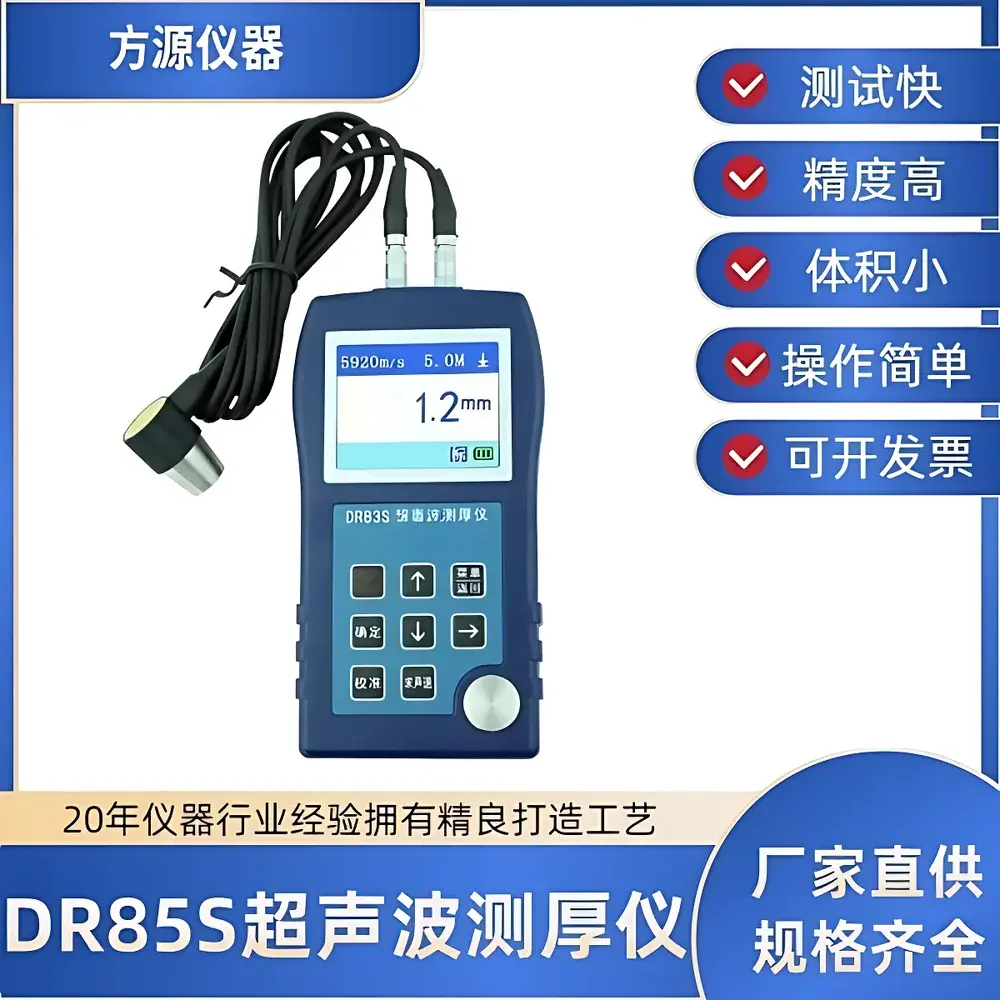
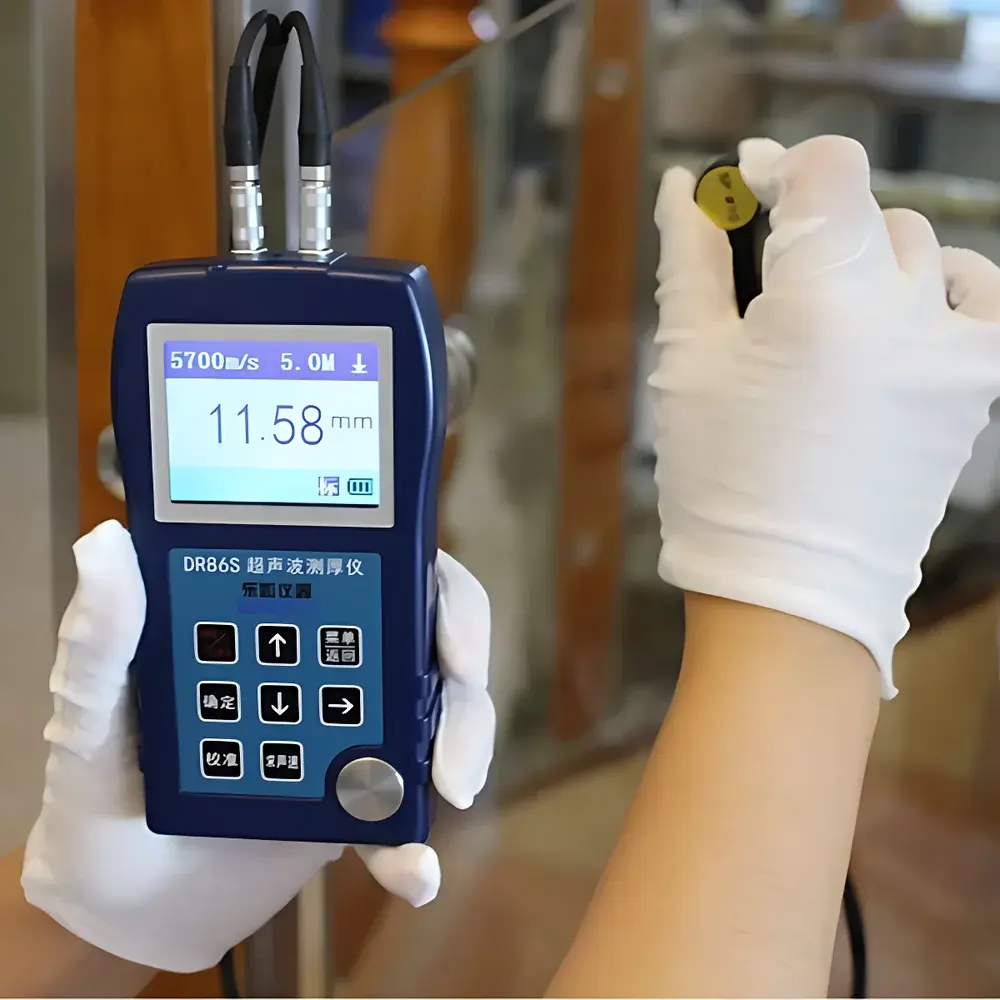
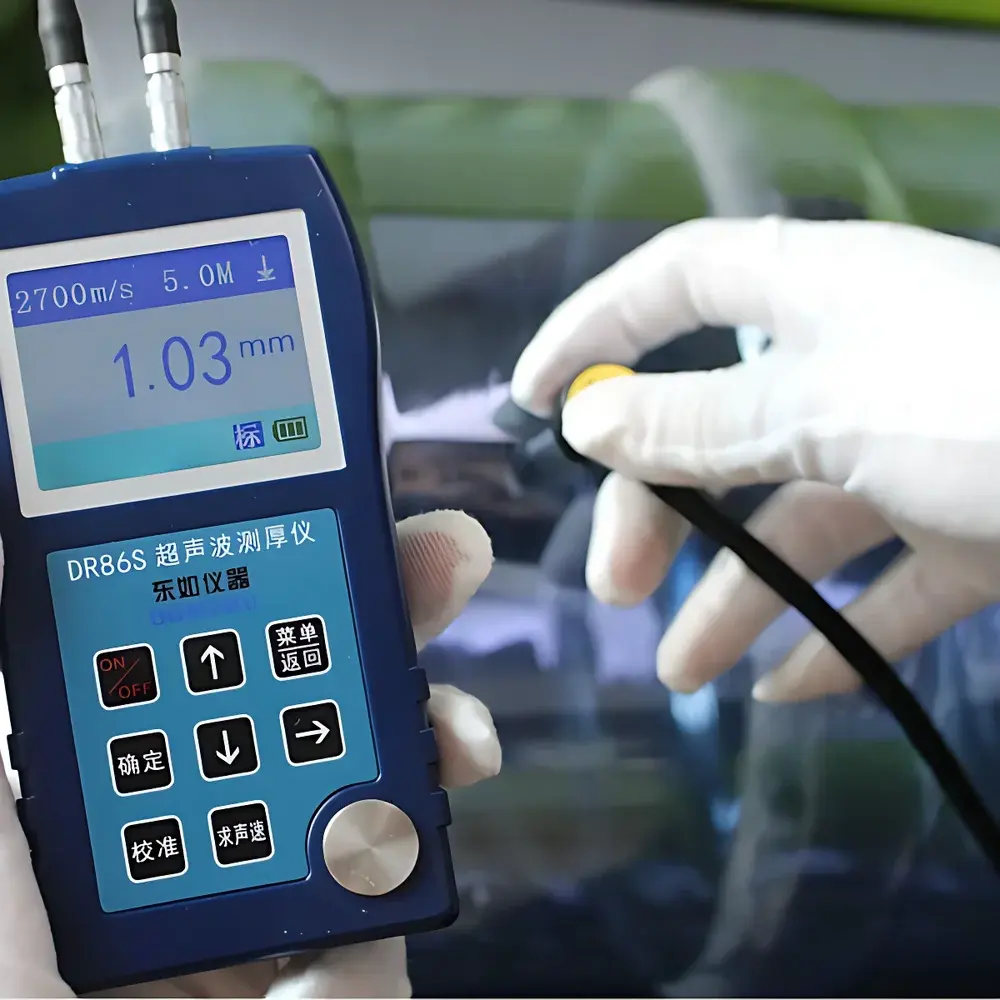
Fangyuan Instruments DR85S Ultrasonic Thickness Gauge
| Brand | Fangyuan Instruments |
|---|---|
| Origin | Guangdong, China |
| Manufacturer Type | Authorized Distributor |
| Country of Origin | China |
| Model | DR85S |
| Price | USD 85 (FOB Guangdong) |
| Measurement Principle | Pulse-Echo Ultrasonic |
| Standard Sound Velocity | 5920 m/s (steel) |
| Minimum Display Resolution | 0.01 mm |
| Minimum Thickness Measurable | 1.2 mm (steel) |
| Maximum Thickness Measurable | 300 mm (steel, depending on material and transducer) |
| Display | Dual-language (English/Chinese) LCD with backlight |
| Calibration | Manual zero & velocity calibration |
| Transducer Interface | Integrated single-element piezoelectric probe (5 MHz standard) |
| Operating Temperature | 0–40 °C |
| IP Rating | IP63 |
| Power | 2 × AA alkaline batteries (approx. 100 hrs continuous use) |
Overview
The Fangyuan Instruments DR85S Ultrasonic Thickness Gauge is a portable, microprocessor-controlled thickness measurement instrument engineered for precision and field reliability in non-destructive testing (NDT) applications. It operates on the pulse-echo ultrasonic principle: a high-frequency acoustic pulse (typically 5 MHz) is transmitted into the test material via a piezoelectric transducer; the time-of-flight between the initial pulse and the echo reflected from the back surface is measured and converted to thickness using the material’s sound velocity. This method enables accurate, single-sided measurements without requiring access to the rear surface—critical for in-service inspection of pipelines, storage tanks, pressure vessels, and structural components. The DR85S is validated for use across a broad range of engineering materials including carbon steel, stainless steel, aluminum, copper, plastics (e.g., PVC, PE, PP), glass (soda-lime and borosilicate), and composites—provided appropriate velocity calibration is performed per ASTM E797 and ISO 16809.
Key Features
- High-resolution digital display with adjustable backlight for low-light environments
- Dual-language interface (English and Chinese) supporting international field technicians and multilingual QA teams
- Manual velocity calibration function enabling accurate measurement across heterogeneous material sets
- Zero-offset calibration capability to compensate for couplant delay and transducer wear
- Rugged, IP63-rated housing resistant to dust ingress and water splashing during industrial site use
- Low-power design with battery life exceeding 100 hours under typical usage (2 × AA alkaline cells)
- Real-time thickness hold and min/max tracking modes for rapid screening of corroded or eroded zones
- Auto-sleep and power-off functions to conserve battery without compromising measurement continuity
Sample Compatibility & Compliance
The DR85S accommodates smooth, parallel-surfaced materials with minimum thicknesses as low as 1.2 mm (in steel) and up to 300 mm (in homogeneous, low-attenuation metals). Surface roughness, curvature, and grain structure influence achievable accuracy; optimal results are obtained on surfaces meeting ISO 11484 requirements for NDT contact surfaces. For plastics and glass, velocity must be determined empirically using reference standards traceable to NIST or national metrology institutes. The device complies with general electromagnetic compatibility (EMC) requirements per IEC 61326-1 and supports documentation practices aligned with ISO/IEC 17025 for calibration records. While not certified to EN 15317 or ASNT SNT-TC-1A Level II out-of-the-box, it serves as a qualified tool within user-defined QA/QC procedures compliant with API RP 570, ASTM A6/A6M, and ASME B31.4/B31.8 integrity management frameworks.
Software & Data Management
The DR85S operates as a standalone field instrument with no embedded data logging or PC connectivity. All measurements are displayed in real time and retained only in volatile memory until overwritten. Users are expected to record readings manually or integrate the gauge into broader inspection workflows using external digital loggers or mobile-based NDT reporting platforms (e.g., QualiTest, UltraTest Pro). For auditability, laboratories employing the DR85S should maintain calibration logs—including date, reference standard used, velocity value entered, operator ID, and environmental conditions—as part of their GLP/GMP or ISO 9001 quality system documentation. Traceable calibration certificates (per ISO/IEC 17025) are recommended annually or after any impact event affecting transducer alignment.
Applications
- In-service wall thickness monitoring of carbon steel piping in petrochemical and power generation facilities
- Quality control of extruded plastic tubing and injection-molded housings in manufacturing
- Thickness verification of tempered and laminated architectural glass prior to installation
- Corrosion mapping of ship hull plates and offshore platform structural members
- Validation of coating-substrate thickness in duplex systems where substrate metal is accessible
- Educational demonstrations of ultrasonic propagation physics in materials science labs
FAQ
What materials can the DR85S measure accurately?
It measures metals (steel, aluminum, copper), rigid plastics (PVC, ABS, polycarbonate), and flat glass—provided proper sound velocity calibration is applied for each material type.
Is the DR85S suitable for measuring corroded or pitted surfaces?
It provides reliable readings only on surfaces with minimal pitting and adequate acoustic coupling; heavily corroded or severely roughened surfaces require specialized transducers or alternative methods such as EMAT or phased array UT.
Does the device meet FDA or pharmaceutical industry requirements?
While not specifically designed for cGMP cleanroom environments, its mechanical construction and calibration traceability support use in pharma facility infrastructure inspection (e.g., stainless steel process piping), subject to internal validation protocols.
Can I export measurement data directly to a computer or LIMS?
No—the DR85S has no USB, Bluetooth, or serial output; data capture requires manual entry or integration via external handheld scanners or smart-device camera-based OCR tools.
What is the recommended recalibration interval?
Annual calibration is advised; however, frequency should be risk-assessed based on usage intensity, environmental exposure, and criticality of measurement outcomes per ISO 10012.



