
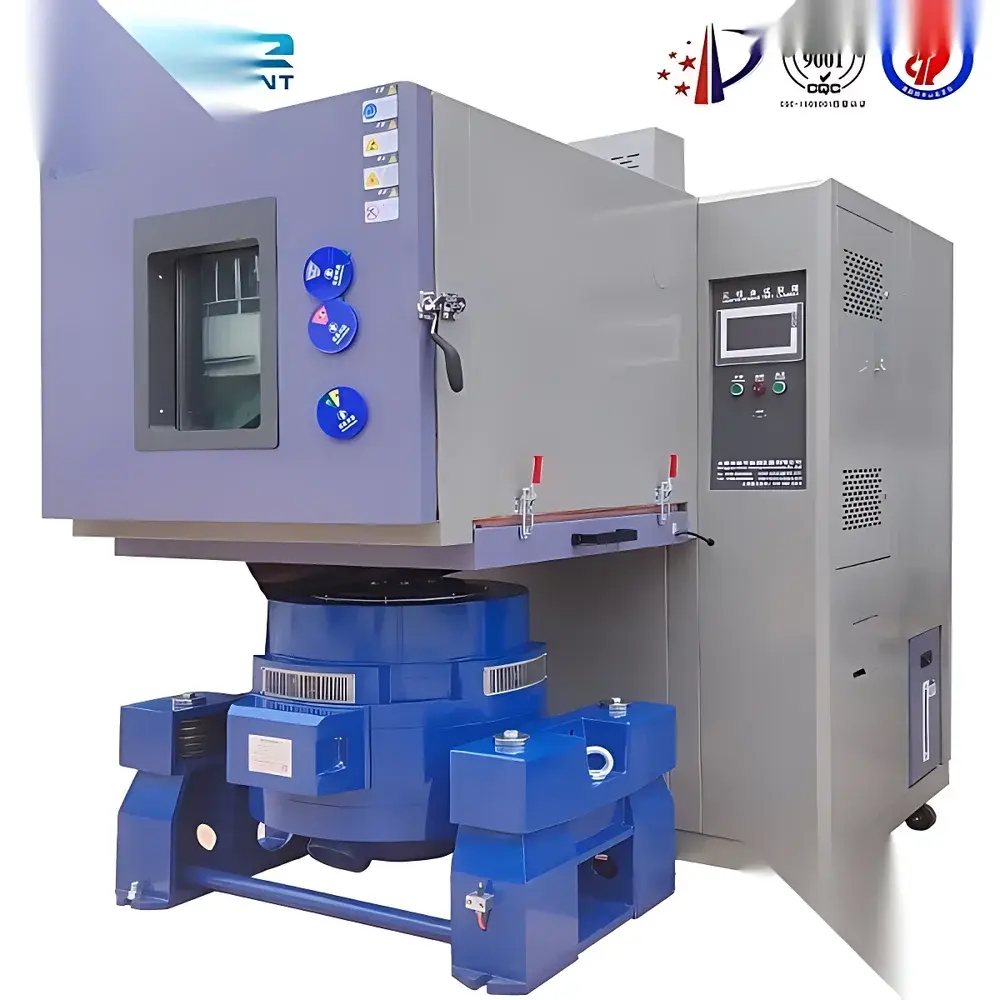
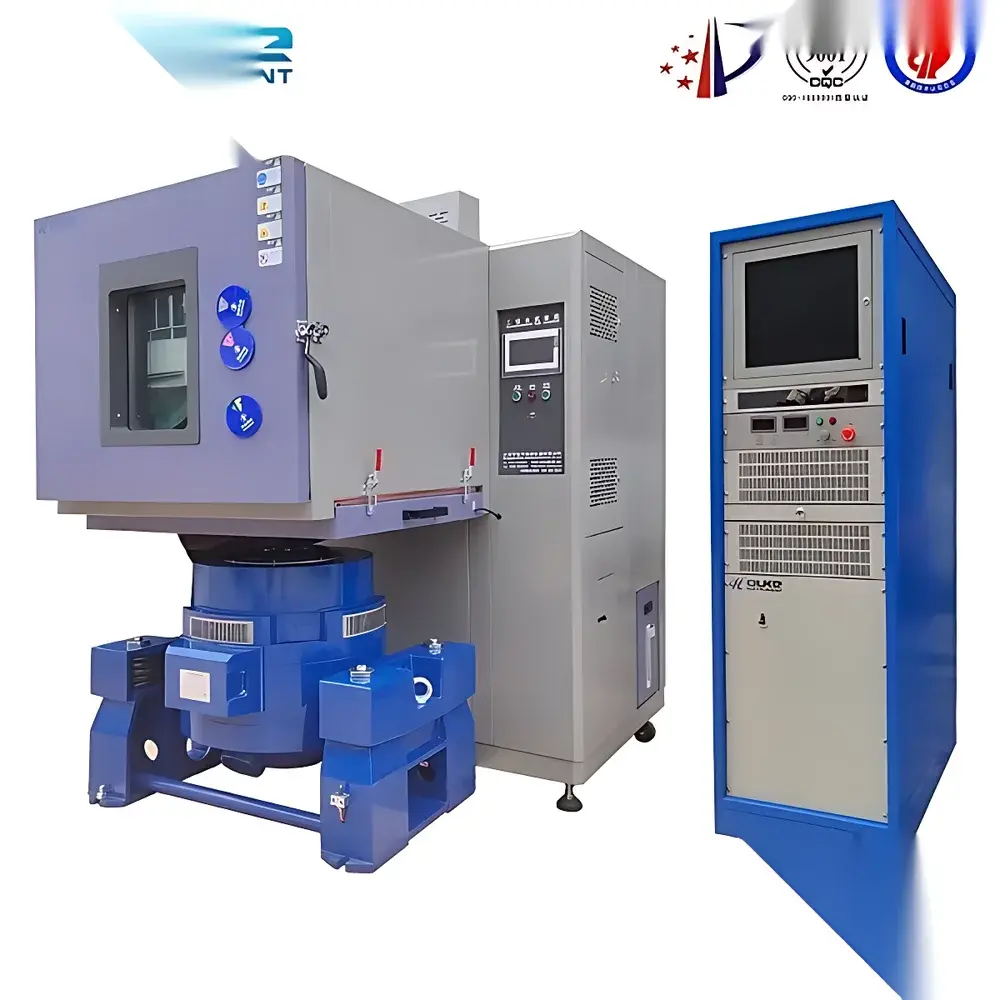
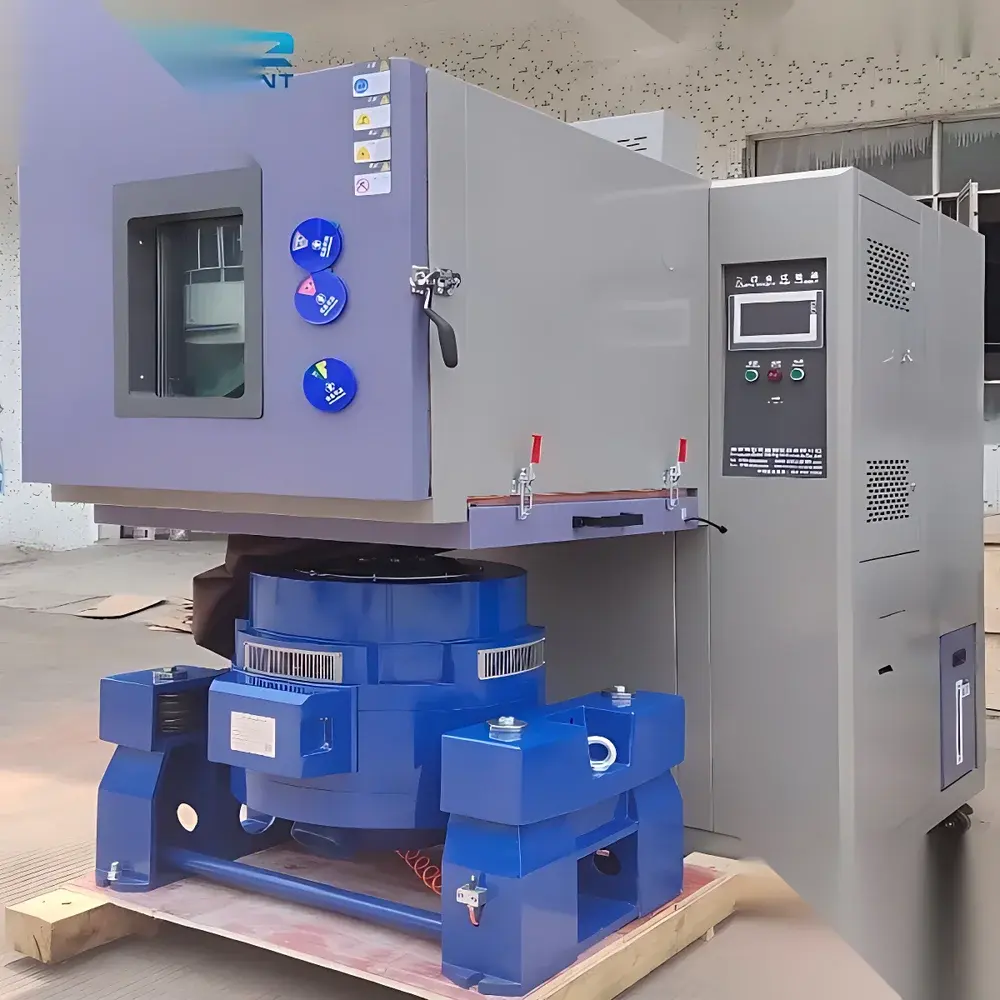
Combined Temperature-Humidity-Vibration Test Chamber – Triaxial Environmental Stress Screening System
| Brand | OEM / Custom-Built |
|---|---|
| Origin | Imported |
| Manufacturer Type | Authorized Distributor |
| Price | USD 21,500 (FOB) |
| Temperature Range | −70 °C to +150 °C |
| Humidity Range | 5–98% RH |
| Vibration Axes | X, Y, Z (Triaxial Electromagnetic Shaker Integration) |
| Control Resolution | 0.1 °C / 0.1% RH |
| Temp. Uniformity | ±2.0 °C |
| Humidity Uniformity | ±3.0% RH |
| Temp. Stability | ±0.5 °C / ±2.5% RH |
| Ramp Rate | +4.0 °C/min (heat-up), −1.0 °C/min (cool-down) |
| Refrigeration | Twin-stage cascade system with original Tecumseh/Tecumseh-derived hermetic compressors |
| Internal Construction | Mirror-finished SUS304 stainless steel |
| Insulation | High-density polyurethane foam (HCFC-free, thermal conductivity ≤0.022 W/m·K) |
| Interface | 7″ TFT-LCD touchscreen controller with RS-232/RS-485 and Ethernet (optional) |
| Compliance | Designed per IEC 60068-2-1, -2-2, -2-14, -2-64 |
Overview
The Combined Temperature-Humidity-Vibration Test Chamber (Triaxial Environmental Stress Screening System) is an integrated reliability validation platform engineered for simultaneous application of thermal cycling, controlled humidity, and multi-axis mechanical vibration stress. It operates on the principle of accelerated environmental stress screening (ESS), enabling detection of latent defects in electronic assemblies, automotive ECUs, aerospace avionics, and high-reliability PCBs during design verification and production lot acceptance testing. Unlike sequential or dual-combined chambers, this system synchronizes all three stress domains—temperature (−70 °C to +150 °C), relative humidity (5–98% RH), and triaxial vibration (X/Y/Z orthogonal excitation)—within a single test volume, eliminating inter-test handling errors and ensuring temporal correlation of stress interactions. The chamber employs a dual-stage cascade refrigeration architecture with hermetically sealed compressors, ensuring stable sub-zero operation without liquid nitrogen dependency. Thermal uniformity is maintained via a multi-blade centrifugal circulation fan array and optimized air baffle geometry, achieving ±2.0 °C spatial deviation across the working volume per IEC 60068-3-5.
Key Features
- Triaxial electromagnetic shaker integration with independent real-time control of X, Y, and Z axes—compatible with sine, random, shock, and mixed-mode profiles per ISO 10816-3 and MIL-STD-810H Annex G.
- Dual-stage cascade refrigeration system using environmentally compliant R-404A/R-23 refrigerant blends, rated for continuous operation at −70 °C with no performance derating.
- Mirror-polished SUS304 stainless steel interior (electropolished finish) and reinforced exterior housing with powder-coated SUS304 cladding—resistant to condensate corrosion and thermal fatigue.
- High-efficiency insulation layer composed of closed-cell polyurethane foam (density ≥45 kg/m³), certified for low thermal conductivity and zero halogen emission (IEC 61249-2-21).
- 7-inch industrial-grade TFT-LCD touchscreen controller with embedded PID algorithms, programmable ramp/soak sequences, and real-time graphical trend logging for temperature, humidity, and vibration acceleration (g-rms).
- Standard 50 mm diameter test port (left-side mounted) with silicone-sealed feedthrough and removable blanking plug—designed for signal line, thermocouple, or power cable routing under full environmental seal integrity.
Sample Compatibility & Compliance
This chamber accommodates samples up to 600 mm × 600 mm × 600 mm (W×D×H) and supports mounting fixtures compatible with industry-standard vibration table interfaces (e.g., 16-bolt ISO 10816 flange pattern). It meets structural and operational requirements for compliance with IEC 60068-2 series (climatic and dynamic tests), MIL-STD-810H Methods 502.7 (temperature), 507.6 (humidity), and 514.8 (vibration), as well as automotive-specific standards including ISO 16750-4 (electrical loads) and GMW3172 (environmental durability). All controllers include audit-trail-enabled event logging, password-protected parameter access levels, and data export in CSV/Excel format—supporting GLP/GMP documentation workflows. Optional 21 CFR Part 11-compliant software modules are available for regulated pharmaceutical and medical device validation.
Software & Data Management
The embedded controller firmware supports up to 100 programmable test profiles, each with up to 99 segments (ramp/soak/humidity/vibration coupling). Real-time synchronization between thermal-hygrometric and vibrational subsystems ensures phase-aligned stress application—critical for identifying resonance-induced solder joint failures or moisture-assisted creep deformation. Data is timestamped at 1 Hz resolution and stored internally (8 GB flash memory) with automatic rollover. Remote monitoring and control are enabled via Ethernet TCP/IP (Modbus TCP and proprietary API), allowing integration into factory MES systems. Exported datasets include full metadata (chamber ID, operator login, calibration status, sensor IDs), satisfying traceability requirements per ISO/IEC 17025 Clause 7.7.
Applications
- Accelerated life testing of automotive ADAS modules under combined thermal shock and road-simulation vibration.
- Qualification of avionics enclosures per DO-160 Section 25 (vibration) and Section 10 (temperature/humidity).
- Reliability screening of 5G base station RF front-end assemblies exposed to coastal humidity and wind-induced structural resonance.
- Process validation of conformal coating adhesion under cyclic condensation and mechanical flexure stress.
- Failure mode analysis of MEMS inertial sensors subjected to simultaneous thermal gradient and broadband random vibration.
FAQ
What is the maximum payload capacity for the integrated triaxial shaker?
The standard configuration supports up to 100 kg static load and 50 kg dynamic mass at 20 grms (5–2000 Hz); higher-capacity variants (up to 250 kg) are available upon request.
Does the system support humidity control below 10% RH?
Yes—optional desiccant-based dry-air purge module achieves 5% RH at 25 °C; performance below 10% RH is validated per ISO 12477 Annex B.
Can vibration profiles be triggered conditionally based on temperature thresholds?
Yes—the controller supports event-driven logic (e.g., “initiate random vibration when chamber reaches −40 °C ±0.3 °C”) with configurable hysteresis and delay timers.
Is third-party calibration certification included with delivery?
A NIST-traceable as-delivered calibration report (temperature, humidity, and accelerometer sensitivity) is provided; ISO/IEC 17025 accredited field calibration services are available separately.
What maintenance intervals are recommended for the refrigeration system?
Compressor oil and filter dryer replacement every 24 months; annual inspection of refrigerant charge and heat exchanger fin integrity per manufacturer’s service manual.



