
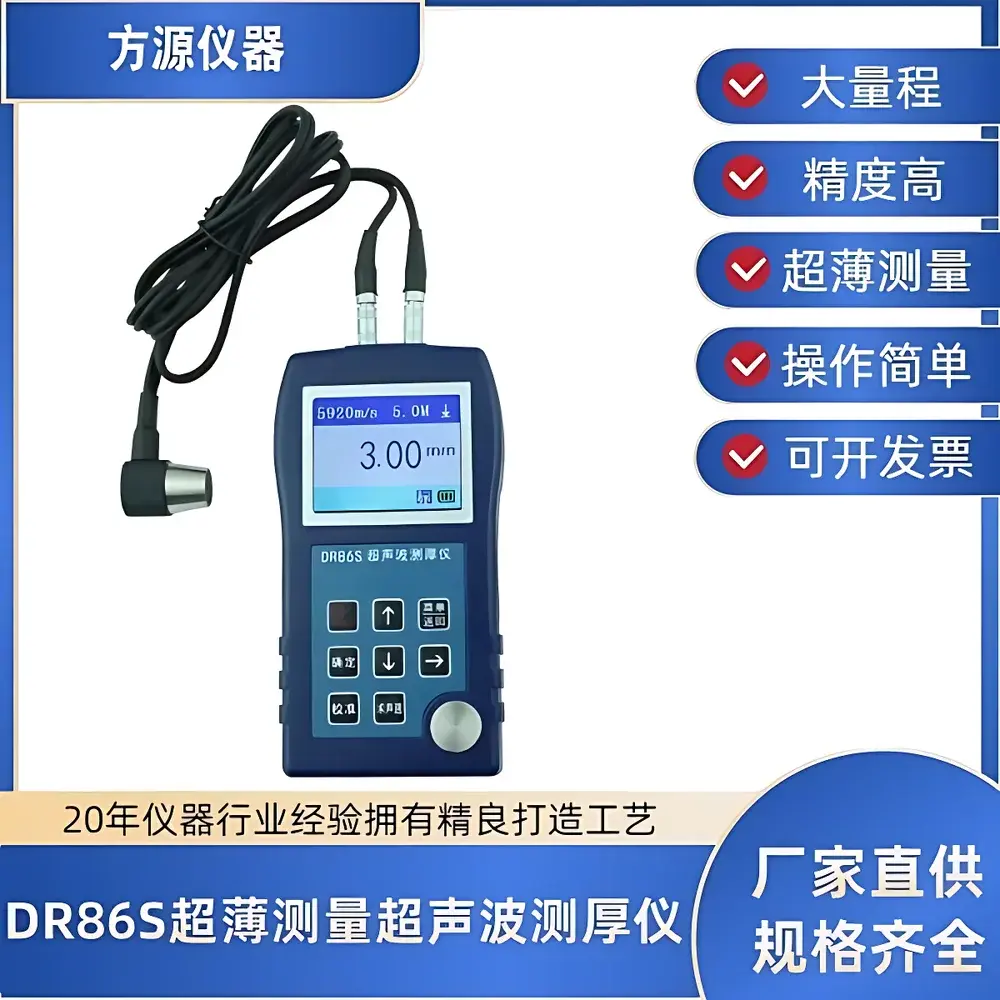
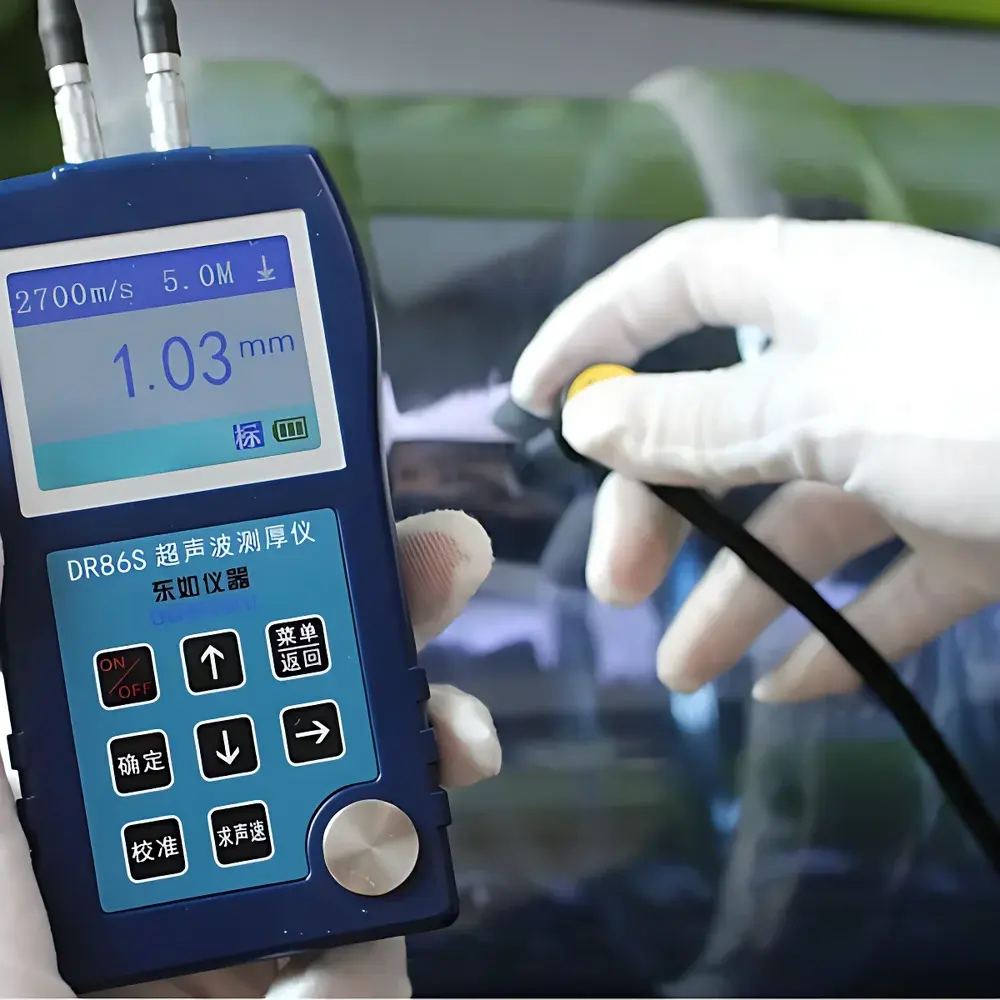
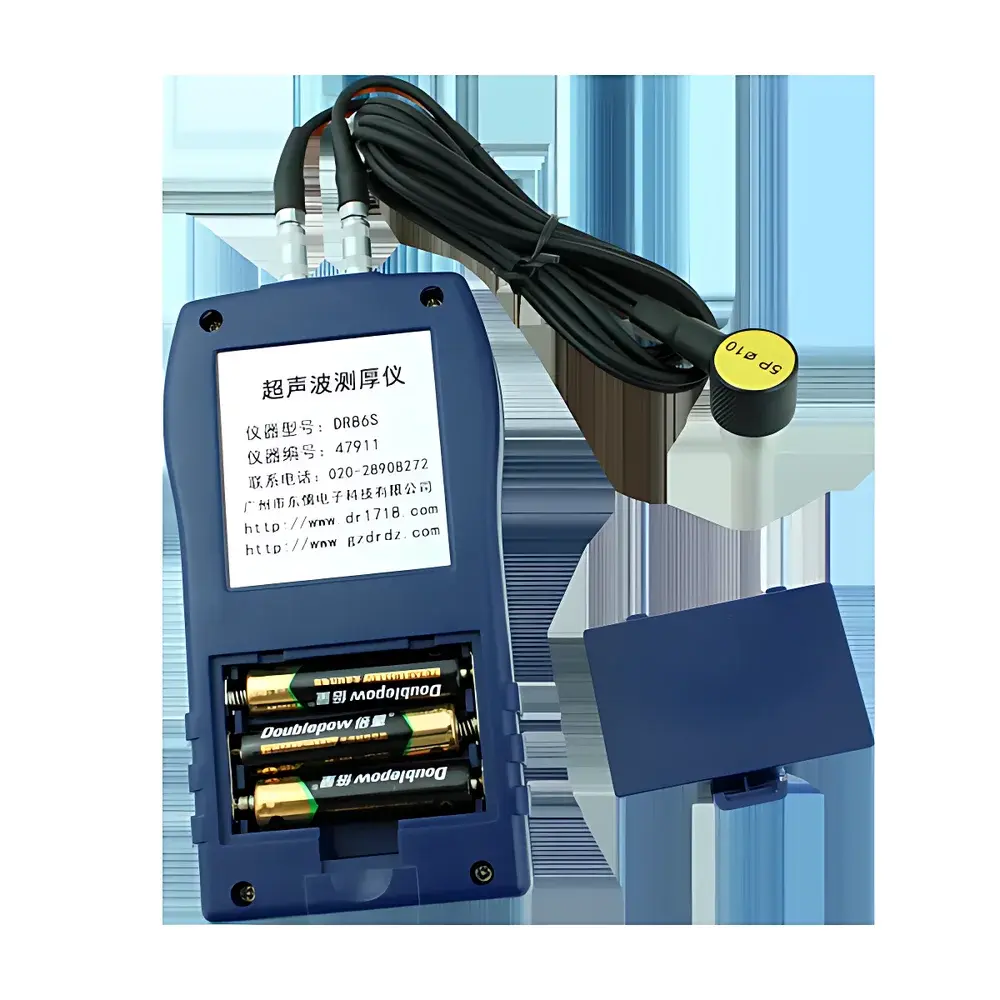
Fangyuan Instruments DR86S High-Precision Ultrasonic Thickness Gauge with Extended Range
| Brand | Fangyuan Instruments |
|---|---|
| Model | DR86S |
| Measurement Principle | Pulse-Echo Ultrasonic (Single-Transducer) |
| Thickness Range | 0.55–500 mm |
| Display Resolution | 0.01 mm |
| Measurement Accuracy | ±(0.5% H + 0.05) mm |
| Material Compatibility | Steel, Stainless Steel, Aluminum, Copper, Plastics, Glass, PVC, Acrylic, and Other Homogeneous Solid Materials |
| Transducer Frequency | Standard 5 MHz (compatible with optional 2/7.5/10 MHz probes) |
| Operating Temperature | –10 °C to 60 °C |
| Power Supply | Two AA alkaline batteries (approx. 100 hrs continuous operation) |
| IP Rating | IP63 |
| Compliance | ISO 2400:2019 (Ultrasonic thickness measurement — Calibration and verification procedures), ASTM E797/E797M-22 (Standard Practice for Measuring Thickness by Manual Ultrasonic Pulse-Echo Contact Method) |
Overview
The Fangyuan Instruments DR86S High-Precision Ultrasonic Thickness Gauge is an industrial-grade, single-transducer pulse-echo ultrasonic instrument engineered for non-destructive, contact-based thickness assessment of solid, homogeneous materials. It operates on the fundamental principle of time-of-flight (TOF) measurement: a short-duration ultrasonic pulse is generated by a piezoelectric transducer, transmitted into the test material, reflected from the back surface (or internal interface), and received by the same transducer. The gauge calculates thickness using the known acoustic velocity of the material and the measured round-trip transit time. Designed specifically for extended-range applications, the DR86S supports reliable measurements from 0.55 mm up to 500 mm—making it suitable for thick-walled piping, structural steel plates, pressure vessel shells, and composite laminates where conventional gauges reach operational limits. Its high-resolution 0.01 mm display and enhanced accuracy specification of ±(0.5% H + 0.05) mm enable traceable, repeatable data acquisition in field and workshop environments under variable thermal and surface conditions.
Key Features
- Extended measurement range of 0.55–500 mm—optimized for heavy-gauge metallic and non-metallic structures including carbon steel, stainless steel, aluminum alloys, cast iron, glass, and engineering plastics.
- High-resolution digital display with 0.01 mm readout resolution and real-time thickness stabilization algorithm to suppress signal noise during manual scanning.
- Velocity calibration function supporting both single-point and two-point calibration modes; user-definable sound velocity values from 1000 to 9999 m/s for material-specific optimization.
- Auto-zero and probe wear compensation routines ensure long-term stability without recalibration between routine inspections.
- Rugged, ergonomic housing with IP63-rated ingress protection against dust and water splashes; designed for daily use in industrial maintenance, NDT teams, and QA/QC laboratories.
- Battery-powered operation (2 × AA) with low-power circuitry delivering >100 hours of continuous runtime and auto-sleep functionality after 2 minutes of inactivity.
Sample Compatibility & Compliance
The DR86S is validated for use on flat or gently curved surfaces (minimum radius ≥25 mm) of acoustically conductive, non-porous solids. It is routinely deployed for wall thickness monitoring of ASME B31.4/B31.8 pipeline systems, API RP 570 inspection programs, and ISO 5577-compliant ultrasonic testing workflows. While not certified for explosive atmospheres or underwater immersion, its performance adheres to ISO 2400:2019 requirements for calibration traceability and measurement uncertainty estimation. When used with documented velocity calibration standards and reference blocks traceable to NIST or equivalent national metrology institutes, data generated meets GLP-aligned documentation requirements for integrity-critical applications such as boiler tube inspection or aerospace component life-cycle tracking.
Software & Data Management
The DR86S includes built-in data logging capability for up to 500 thickness readings per session, each tagged with date/time stamp and sequential index. Export is supported via optional USB-C adapter (sold separately) to standard CSV format for integration into CMMS platforms (e.g., SAP PM, IBM Maximo) or statistical process control (SPC) software. Firmware updates are performed via PC utility compatible with Windows 10/11; no proprietary cloud dependency or mandatory subscription model is required. Audit trail functionality—including operator ID entry, calibration log history, and parameter change timestamps—is available in advanced configuration mode to support FDA 21 CFR Part 11 readiness when paired with external electronic record systems.
Applications
- In-service corrosion mapping of aboveground and buried pipelines in oil & gas transmission networks.
- Pre-commissioning verification of wall thickness in ASME Section VIII pressure vessels and heat exchanger tubesheets.
- Quality assurance of extruded plastic profiles, laminated safety glass, and FRP storage tanks during manufacturing.
- Maintenance planning for marine hull plating, shipboard piping, and offshore platform structural members.
- Research-grade thickness profiling of polymer films, ceramic substrates, and coated metal foils in university and industrial R&D labs.
FAQ
What materials can the DR86S measure accurately?
It measures homogeneous, isotropic solids with consistent acoustic impedance—such as carbon steel, stainless steel, aluminum, copper, brass, PVC, acrylic, polycarbonate, and borosilicate glass. Porous, fibrous, or highly attenuative materials (e.g., rubber, concrete, wood) are outside its validated scope.
Does the DR86S require couplant during operation?
Yes—standard ultrasonic gel or glycerin must be applied between the transducer and test surface to ensure efficient acoustic coupling. Dry-contact or air-gap measurements are not supported.
Can the DR86S measure through paint or coating layers?
No—the DR86S operates in standard pulse-echo mode and does not incorporate dual-element or echo-to-echo algorithms. For coated substrate measurement, the DR87S variant is recommended.
Is velocity calibration necessary before each use?
Not strictly required if measuring the same material with identical geometry and temperature conditions—but best practice dictates verification using a certified reference block prior to critical measurements or after ambient temperature shifts exceeding ±5 °C.
How is measurement repeatability verified?
Repeatability is assessed per ISO 2400 Annex C: ten consecutive readings on a stable reference block yield a standard deviation ≤0.02 mm under controlled lab conditions; field repeatability typically remains within ±0.03 mm for trained operators on clean, flat surfaces.
Related Products



