
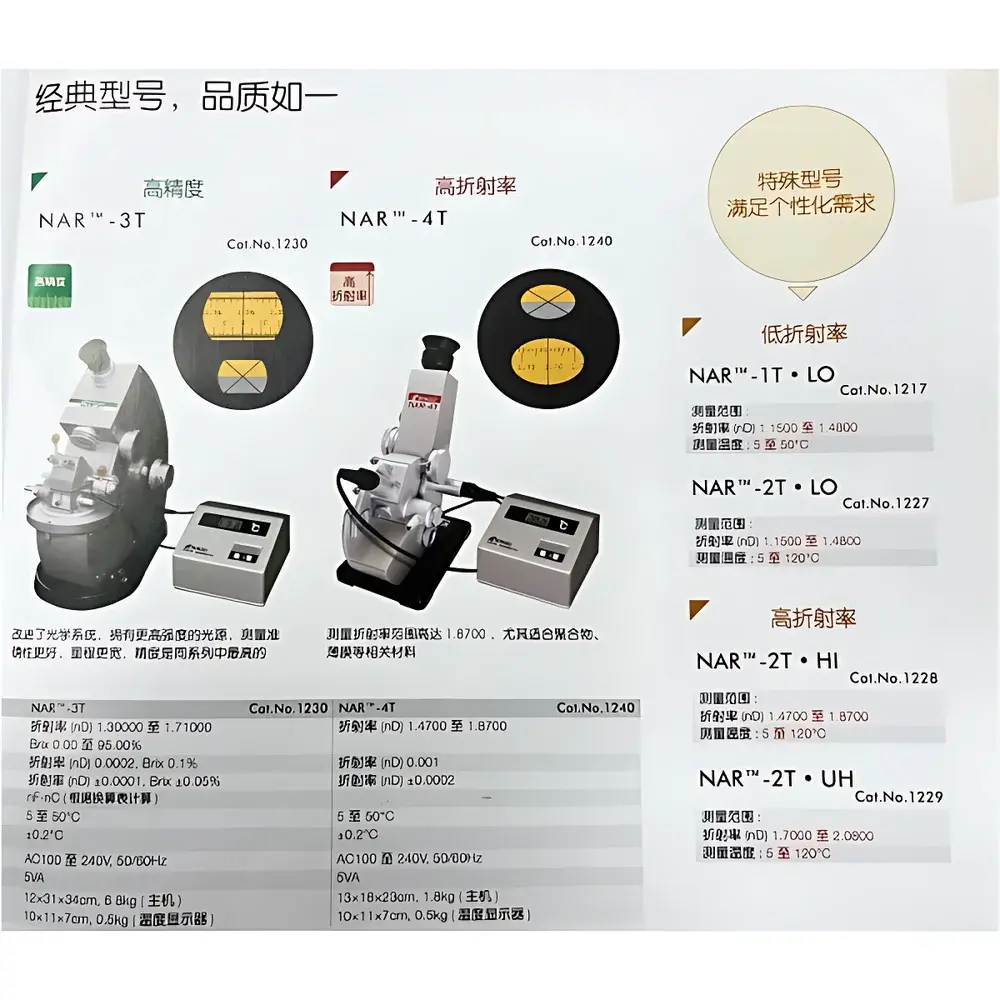
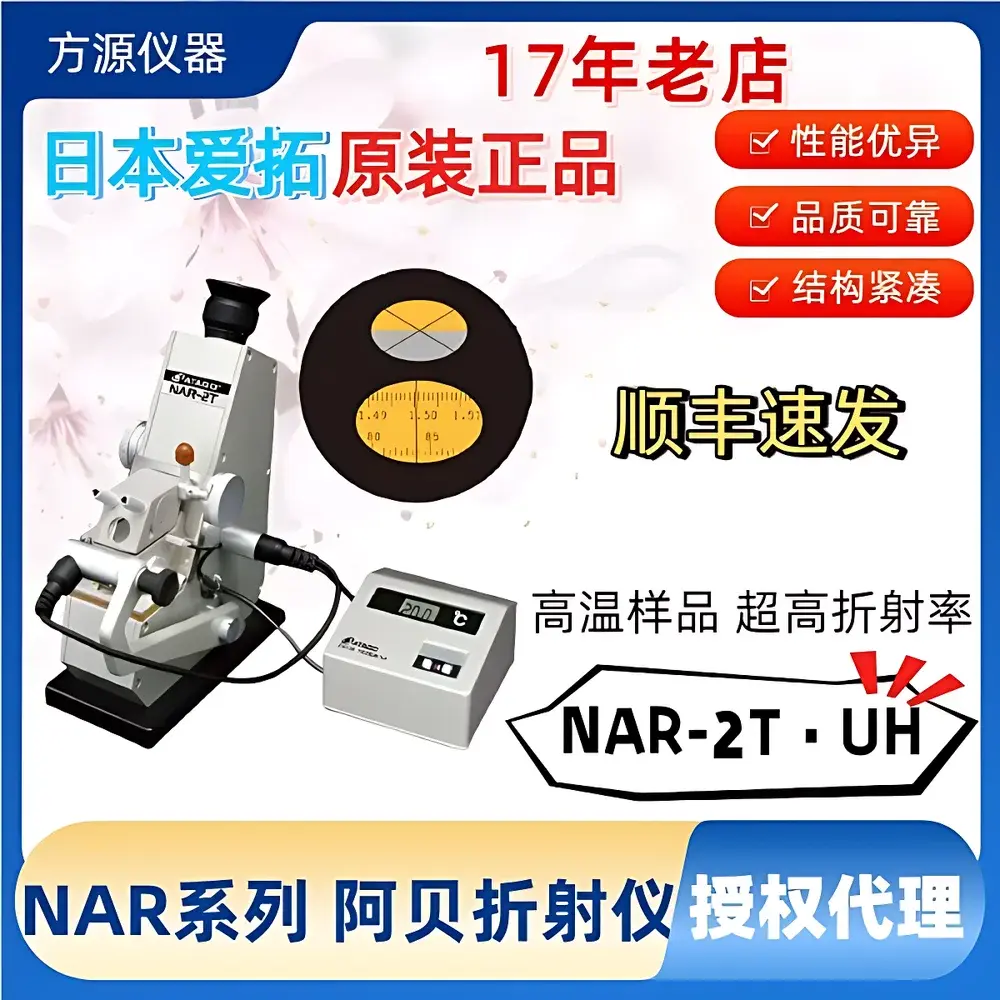
ATAGO NAR-2T·UH High-Index Abbe Refractometer
| Brand | ATAGO |
|---|---|
| Origin | Japan |
| Model | NAR-2T·UH |
| Measurement Range | 1.7000–2.0800 RIU |
| Accuracy | ±0.0002 RIU |
| Resolution | 0.001 RIU |
| Temperature Control | Integrated Peltier thermostating |
| Display | Digital LCD with real-time RI and temperature readout |
| Instrument Type | Benchtop Abbe refractometer |
| Compliance | Designed per ISO 21348 and JIS K 0061 standards |
Overview
The ATAGO NAR-2T·UH is a precision benchtop Abbe refractometer engineered for high-accuracy measurement of refractive index (RI) in materials with exceptionally high optical density—specifically targeting the extended range of 1.7000 to 2.0800 RIU. Unlike conventional Abbe instruments limited to organic solvents or aqueous solutions (typically <1.70 RIU), the NAR-2T·UH employs an optimized optical path, high-transmittance prisms made from specialized dense flint glass, and a stabilized sodium-D wavelength (589.3 nm) light source to maintain measurement integrity across ultra-high-index media. Its design adheres to the fundamental principle of critical angle refraction, where the boundary between sample and prism interface is optically analyzed via collimated illumination and precise angular detection. This instrument is routinely deployed in advanced materials R&D labs, optical glass manufacturing QA/QC, semiconductor wafer coating validation, and high-refractive-index polymer formulation—where deviations of ±0.0002 RIU directly correlate to compositional homogeneity, stoichiometric fidelity, or thin-film thickness consistency.
Key Features
- Extended refractive index range: 1.7000–2.0800 RIU—enabling characterization of sapphire, lanthanum-doped glasses, chalcogenide films, and high-n photoresists.
- High-resolution digital display with 0.001 RIU resolution and simultaneous real-time temperature readout (±0.1 °C).
- Integrated Peltier-based temperature control system (10–50 °C range, ±0.2 °C stability), ensuring thermal equilibrium prior to measurement and minimizing drift during sequential analysis.
- Optimized Abbe optical geometry with adjustable ocular focus, calibrated crosshair reticle, and anti-parallax viewing system for operator-independent endpoint determination.
- Robust aluminum alloy chassis with vibration-damping feet and ESD-safe surface finish—suitable for integration into cleanroom environments (ISO Class 5–7 compatible).
- Manual sample loading with precision-ground prism surface (polished to λ/4 flatness) and integrated prism cleaning port for residue-free operation with viscous or particulate-laden samples.
Sample Compatibility & Compliance
The NAR-2T·UH accommodates solid, semi-solid, and viscous liquid samples—including optical adhesives, spin-on glass precursors, molten chalcogenides, and annealed glass coupons—without requiring dilution or solvent exchange. Its high-index prism configuration eliminates total internal reflection failure modes common in standard refractometers when measuring n > 1.70 materials. The instrument complies with ISO 21348 (optical radiation standards for refractometry), JIS K 0061 (Japanese Industrial Standard for Abbe refractometers), and supports traceable calibration using certified reference oils (e.g., Cargille Series AA, n = 1.7200–2.0500). While not FDA 21 CFR Part 11–certified out-of-the-box, its manual operation mode meets GLP documentation requirements when paired with lab-controlled SOPs and external audit logs.
Software & Data Management
The NAR-2T·UH operates as a standalone instrument with no embedded software or USB connectivity. All measurements are recorded manually or via optional third-party digital capture (e.g., CCD camera + image analysis suite for reticle edge detection). For regulated environments, users integrate the unit into existing LIMS or ELN platforms through documented procedural controls. Calibration certificates—traceable to NMIJ (National Metrology Institute of Japan)—are supplied with each unit, including prism verification data at three points across the full range (1.7000, 1.8900, and 2.0800 RIU). Re-calibration intervals are recommended every 12 months or after 500 measurement cycles, per ATAGO Technical Bulletin TB-NAR-03.
Applications
- Quality assurance of high-refractive-index optical lens blanks (e.g., LaSF, SF6, TiO₂-doped crown glasses).
- In-process monitoring of sol-gel derived antireflective coatings during thermal curing.
- Batch release testing of specialty optical cements used in fiber-optic coupling assemblies.
- R&D validation of metamaterial substrates and photonic crystal slabs.
- Thermal expansion coefficient estimation via RI–temperature coefficient (dn/dT) profiling between 20–40 °C.
FAQ
What types of high-index materials can be measured reliably with the NAR-2T·UH?
Solid optical glasses, fused quartz doped with heavy metal oxides, chalcogenide glasses (As₂S₃, Ge₂₃Sb₇S₇₀), and high-n polymer films (e.g., polyimide derivatives with n > 1.85) — provided surface flatness ≤ 1 µm Ra and thermal stability during measurement.
Is temperature compensation automatic or user-adjusted?
Temperature is actively controlled via Peltier element; compensation is applied manually using built-in dn/dT correction tables for common substrate classes (supplied in operator manual).
Does the instrument support ASTM D1218 or ISO 17025-compliant reporting?
While the hardware satisfies metrological requirements of both standards, formal compliance requires lab-specific validation protocols, uncertainty budgeting (k=2), and documented environmental monitoring—not inherent to the device itself.
Can the prism be cleaned with acetone or other aggressive solvents?
No. Only lens-grade ethanol or isopropanol is approved for prism cleaning; chlorinated or aromatic solvents may degrade the prism’s anti-reflective coating and compromise optical alignment.





