
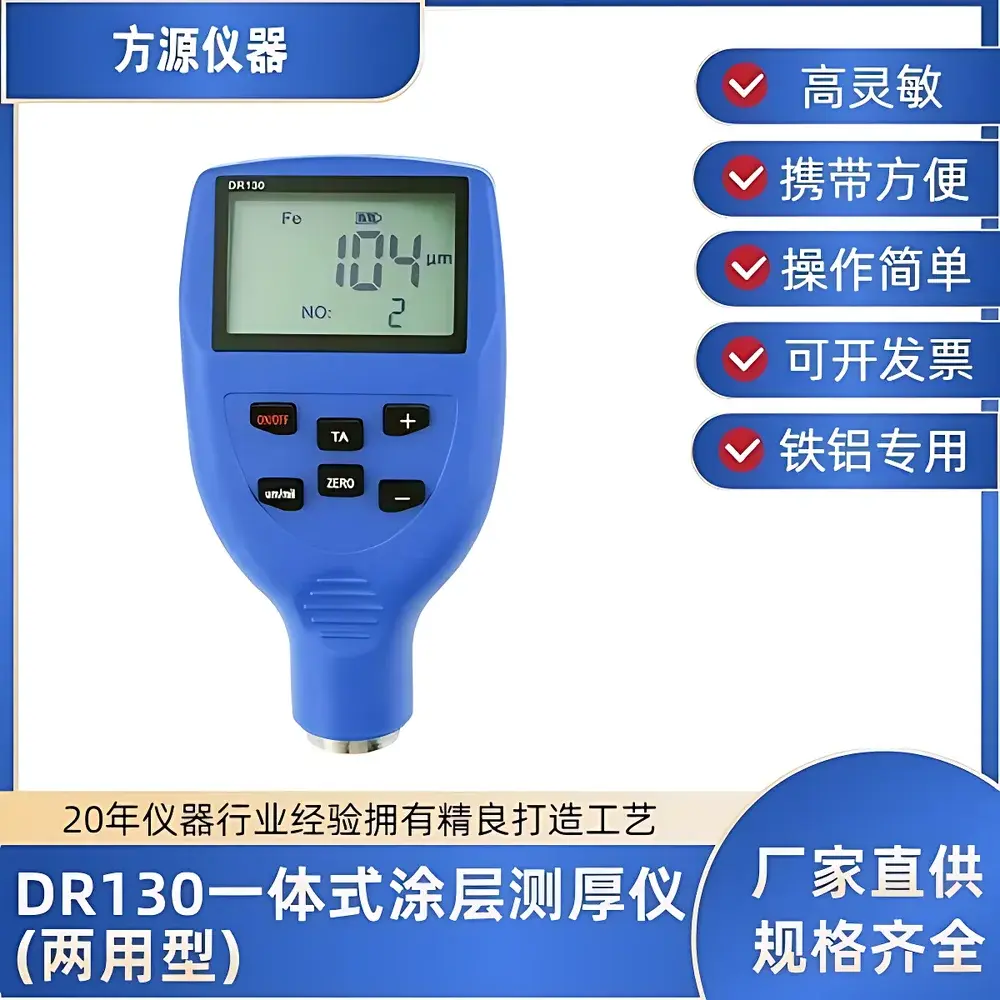

Fangyuan Instruments DR130 Coating Thickness Gauge for Electrophoretic, Enamel, Anti-Corrosion, Powder Coating & Paint Layers
| Brand | Fangyuan Instruments |
|---|---|
| Origin | Guangdong, China |
| Manufacturer Type | Authorized Distributor |
| Country of Manufacture | China |
| Model | DR130 |
| Price | USD 98 (excl. tax & shipping) |
| Measurement Principle | Dual-Mode Magnetic Induction (Fe) & Eddy Current (NFe) |
| Fe Range | 0–3500 µm |
| NFe Range | 0–2500 µm |
| Resolution | 0.1 µm (≤100 µm), 1 µm (>100 µm) |
| Accuracy | ±(1% + 1 µm) |
| Substrate Compatibility | Ferrous (steel, iron) & Non-Ferrous (aluminum, stainless steel, copper, chrome-plated) |
| Display | Backlit LCD with Real-Time Graphical Trend View |
| Data Storage | 1000 readings with timestamp & substrate ID |
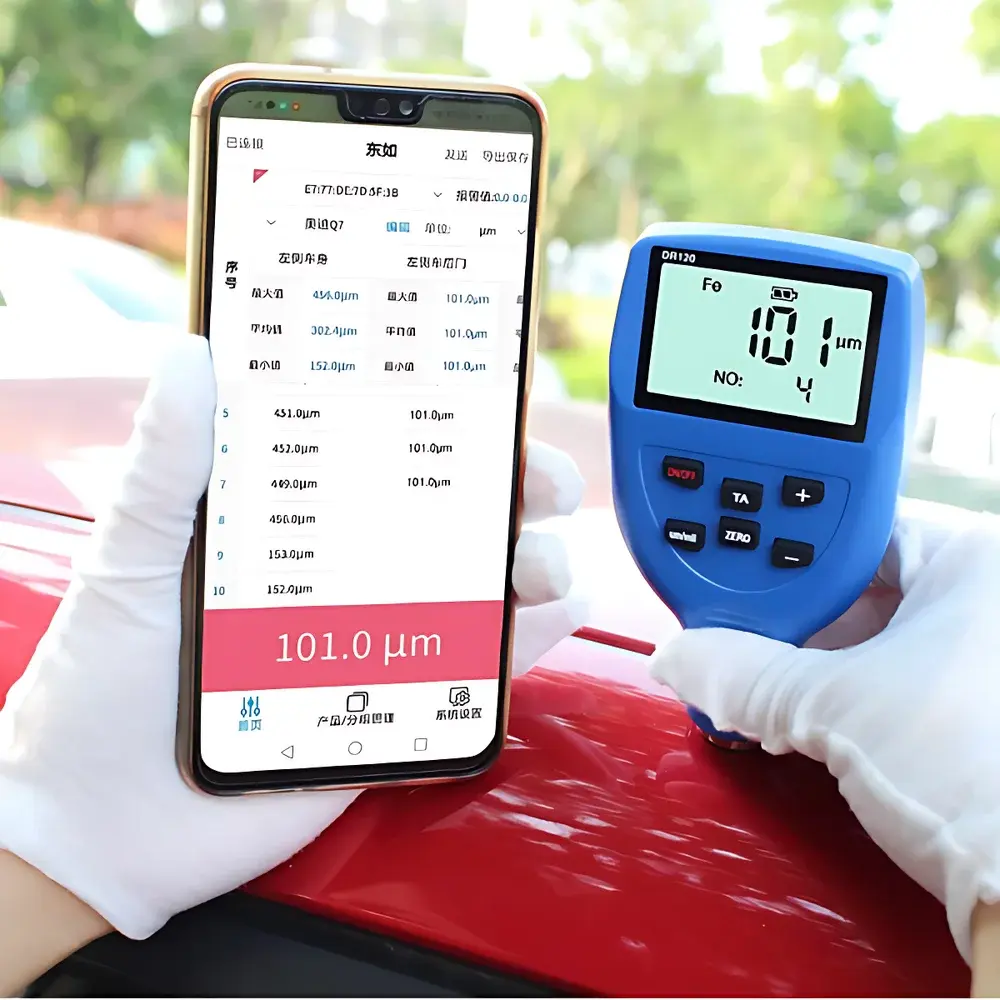
| Interface | USB-C for PC export (CSV/Excel) |
| Calibration | Factory-calibrated with optional 2-point user calibration (Fe/NFe) |
| Standards Compliance | ASTM D7091, ISO 2178, ISO 2360, GB/T 4956, GB/T 4957 |
Overview
The Fangyuan Instruments DR130 Coating Thickness Gauge is an industrial-grade, dual-sensor handheld instrument engineered for non-destructive measurement of coating thickness on both ferrous and non-ferrous substrates. It operates on two well-established physical principles: magnetic induction for coatings applied to steel and iron (Fe mode), and eddy current technology for non-magnetic substrates such as aluminum, copper, stainless steel, and chromium-plated surfaces (NFe mode). This dual-mode architecture enables consistent, traceable thickness verification across a broad spectrum of functional and decorative surface treatments—including electrophoretic deposition (EDP), vitreous enamel, anti-corrosion polymer linings, thermoset powder coatings, and liquid-applied paints. Designed for quality control in manufacturing, maintenance inspection, and third-party certification workflows, the DR130 delivers high reproducibility under variable field conditions without requiring coupling gels or surface preparation beyond standard cleaning.
Key Features
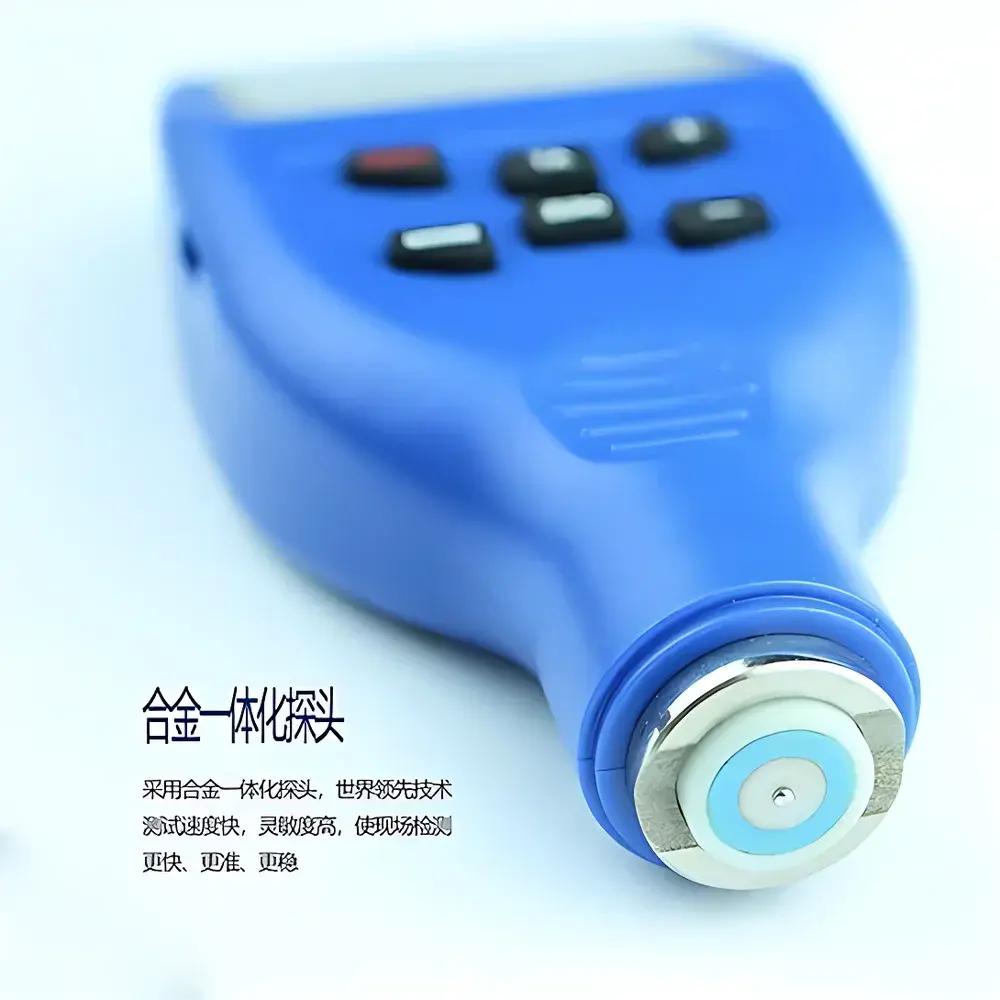
- Dual-sensor probe with automatic substrate recognition—eliminates manual mode switching errors during mixed-material inspections.
- High-resolution LCD display with real-time graphical trend visualization, enabling immediate assessment of coating uniformity across multi-point scans.
- On-device storage of up to 1,000 measurement records, each tagged with timestamp, substrate type (Fe/NFe), serial identifier, and operator code (via optional login configuration).
- USB-C interface supporting direct data export to Windows-based QA/QC software; exported files comply with CSV and Excel (.xlsx) formats for integration into LIMS and ERP systems.
- Factory-calibrated per ISO/IEC 17025-accredited procedures; includes NIST-traceable calibration certificate and optional 2-point user recalibration capability for long-term drift compensation.
- Rugged IP54-rated housing with rubberized impact guard, optimized for use in automotive assembly lines, appliance finishing plants, pipeline coating yards, and electroplating facilities.
Sample Compatibility & Compliance
The DR130 supports quantitative thickness evaluation on coated components where substrate metallurgy is known and stable. Valid measurement ranges include: electrophoretic primer layers (typically 15–35 µm on automotive body panels), porcelain enamel on steel cookware (200–400 µm), epoxy-based anti-corrosion linings in chemical storage tanks (300–3500 µm), polyester powder coatings on architectural aluminum extrusions (60–120 µm), and thin decorative chrome plating (<10 µm). All measurements conform to ASTM D7091 (Standard Practice for Nondestructive Measurement of Dry Film Thickness of Nonmagnetic Coatings on Ferrous Base Metals) and ISO 2178/ISO 2360 for magnetic and eddy current methods respectively. The device meets general requirements for GLP-compliant documentation when used with audit-trail-enabled software extensions.
Software & Data Management
Fangyuan’s proprietary DR-Link PC Suite (v3.2+) provides full traceability functionality, including electronic signature support, automated report generation (PDF/HTML), statistical process control (SPC) charting (X̄-R, Cpk), and deviation flagging against user-defined upper/lower specification limits. Raw data exports retain all metadata—measurement sequence, probe contact status, temperature-compensated signal amplitude, and calibration history. For regulated environments, optional 21 CFR Part 11 compliance modules are available upon request, delivering role-based access control, encrypted audit logs, and electronic record integrity validation.
Applications
- Automotive OEMs: In-line verification of cathodic E-coat thickness on stamped chassis and subframes.
- White Goods Manufacturers: Monitoring enamel layer consistency on washing machine drums and oven cavities.
- Oil & Gas Contractors: Field validation of fusion-bonded epoxy (FBE) and three-layer polyethylene (3LPE) pipeline coatings per API RP 5L2.
- Electroplating Shops: Routine auditing of decorative chromium and nickel-chromium duplex coatings on consumer hardware.
- Industrial Maintenance Teams: Pre- and post-recoating assessment of corrosion-resistant polymer linings in wastewater treatment infrastructure.
FAQ
Does the DR130 require zero calibration on every substrate?
No—automatic substrate detection eliminates routine zeroing; however, a reference standard (e.g., certified Fe/NFe shims) is recommended before critical batches.
Can it measure coatings on galvanized steel?
Yes, provided the zinc layer is non-magnetic (i.e., hot-dip or electrogalvanized with low iron content); accuracy is validated per ASTM B499 for galvanizing applications.
Is temperature compensation built-in?
Yes—the probe integrates a thermal sensor that adjusts signal gain in real time across –10 °C to +50 °C operating range.
What is the minimum measurable coating thickness?
0.1 µm on smooth, non-porous substrates under optimal contact pressure and surface finish (Ra < 0.8 µm).
How often should factory recalibration be performed?
Annually under normal use; more frequently if subjected to mechanical shock, extreme humidity, or continuous operation above 40 °C.



