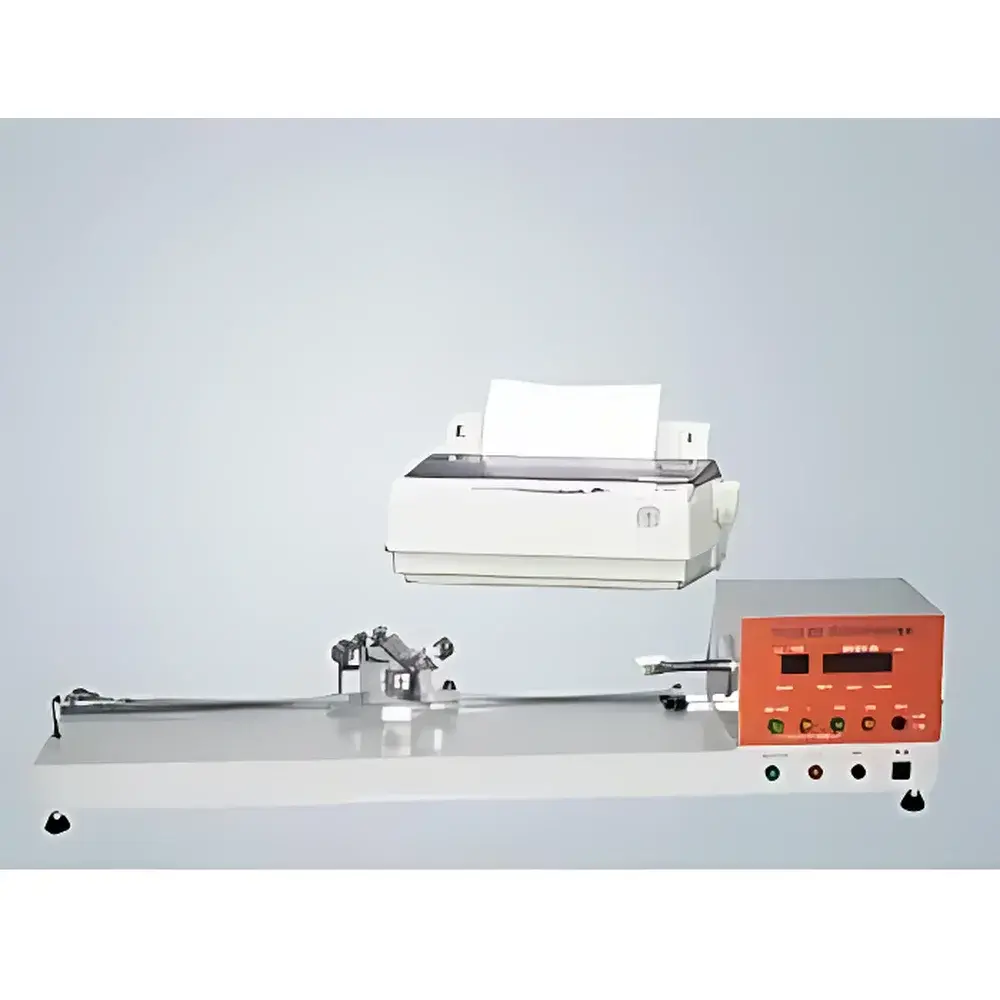
Fangyuan Y331 Series Digital Yarn Twist Tester
| Brand | Fangyuan Instruments |
|---|---|
| Origin | Zhejiang, China |
| Model | Y331 Series |
| Measurement Length | 0–500 mm (adjustable) |
| Twist Range | 1–9999.9 turns/10 cm or turns/m |
| Untwist Elongation Range | ≤60 mm (scale-indicated) |
| Max Twist Contraction | 20 mm |
| Clamp Rotational Speed | 100–2000 rpm (adjustable) |
| Pre-tension Range | 0.5–171.5 cN |
| Power Supply | AC 220 V, 50 Hz, 200 W |
| Dimensions | 900 × 250 × 300 mm |
| Weight | 30 kg |
| Compliance | GB/T 2543.1–2001, GB/T 2543.2–2001, FZ/T 10001–1992 |
| Software-Enabled Test Modes | Direct Counting Method, Untwist-Twist Method A, Untwist-Twist Method B, Triple Untwist-Twist Method |
Overview
The Fangyuan Y331 Series Digital Yarn Twist Tester is an electromechanical precision instrument engineered for the quantitative determination of twist level, twist irregularity, and twist contraction in single and plied yarns across natural and synthetic fiber systems—including cotton, wool, silk, polyester, nylon, and blended yarns. It operates on two fundamental physical principles: direct optical counting of surface helical turns under controlled tension and standardized untwist-twist equilibrium measurement based on torque and angular displacement feedback. The device conforms to internationally referenced textile metrology protocols defined in GB/T 2543.1–2001 (equivalent to ISO 2061:1997), GB/T 2543.2–2001 (aligned with ISO 2062:1993), and FZ/T 10001–1992 for air-jet spun yarns. Its dual-mode architecture enables traceable, repeatable twist characterization required for QC laboratories, spinning mill process validation, and R&D evaluation of yarn structural integrity.
Key Features
- High-resolution 7-segment LED display for real-time visualization of twist count, rotational speed, elongation, and pre-tension values
- Fully digital closed-loop motor control system ensuring speed stability within ±0.5% across the full 100–2000 rpm range
- Four standardized test modes: Direct Counting Method (for low-twist or high-contrast yarns), Untwist-Twist Method A (single-cycle equilibrium), Untwist-Twist Method B (two-cycle verification), and Triple Untwist-Twist Method (for high-stability assessment per FZ/T 10001–1992)
- Adjustable clamping length (0–500 mm) with calibrated vernier scale and fine-positioning mechanism for precise gauge length definition
- Programmable pre-tension application (0.5–171.5 cN) via electromagnetic load cell feedback, eliminating mechanical spring drift
- Integrated fail-safe torque limiter and emergency stop circuit compliant with IEC 61000-6-2 EMC immunity standards
Sample Compatibility & Compliance
The Y331 Series accommodates a broad spectrum of yarn formats—ring-spun, rotor-spun, air-jet, vortex, and compact yarns—with linear densities ranging from 5 tex to 500 tex. Its modular jaw design supports both flat and contoured yarn cross-sections without slippage. All test procedures satisfy national and international regulatory frameworks governing textile testing instrumentation: GB/T 2543.1–2001 and GB/T 2543.2–2001 define repeatability requirements (CV ≤ 2.5% for duplicate tests), while FZ/T 10001–1992 specifies calibration frequency and reference standard yarn usage. The instrument’s mechanical architecture meets ISO 17025:2017 clause 6.4.2 for equipment suitability, and its documented calibration hierarchy traces to NIM (National Institute of Metrology, China) certified reference yarns. Routine verification includes spindle runout measurement (<0.02 mm), tension sensor linearity check (R² ≥ 0.9998), and encoder resolution validation (0.1° angular step).
Software & Data Management
While the base Y331 model operates via embedded firmware with local parameter storage, the Y331B variant integrates a TM-300K thermal printer for immediate hardcopy output of raw twist counts, coefficient of variation (CV%), mean twist contraction (mm), and test metadata (date/time, operator ID, sample ID, gauge length, tension setting). All printed reports include mandatory fields aligned with GLP documentation practices: instrument serial number, calibration due date, and environmental conditions (temperature/humidity logged manually). For laboratory information management system (LIMS) integration, optional RS-232 serial output enables ASCII-formatted data export compatible with CSV parsing tools. Audit trails are maintained for all parameter modifications, satisfying internal QA requirements for ISO 9001:2015 clause 8.5.2 and supporting FDA 21 CFR Part 11 readiness when paired with validated electronic signature workflows.
Applications
- Quality assurance in spinning mills: monitoring twist consistency across bobbins, packages, and lots to prevent weaving/knitting defects such as snarling or torque imbalance
- Textile R&D: evaluating twist-dependent properties including tensile strength, elongation at break, pilling resistance, and fabric drape coefficient
- Academic research: correlating twist multiplier (TM) with fiber morphology using SEM/AFM cross-sectional analysis
- Third-party certification labs: performing accredited twist testing per GB, ISO, and AATCC methods for export compliance documentation
- Technical textile development: characterizing twist behavior in high-performance yarns (e.g., aramid, carbon, PBO) under elevated temperature or humidity conditioning
FAQ
What standards does the Y331 Series comply with?
It fully implements GB/T 2543.1–2001, GB/T 2543.2–2001, and FZ/T 10001–1992, with technical equivalence to ISO 2061, ISO 2062, and ISO 17236 for air-jet yarns.
Can the instrument measure twist in plied yarns?
Yes — the device supports both single-yarn and plied-yarn configurations using adjustable clamping force and extended elongation range up to 60 mm.
Is calibration traceable to national standards?
Calibration certificates include traceability to NIM-certified reference yarns; annual recalibration is recommended per ISO/IEC 17025 clause 6.6.
Does the Y331B model support data export to Excel?
Raw ASCII output via RS-232 allows manual import into spreadsheet applications; no native USB or Ethernet interface is provided.
What maintenance is required for long-term accuracy?
Monthly cleaning of optical sensors and jaw surfaces, biannual verification of encoder alignment, and annual load cell recalibration by authorized service centers.