
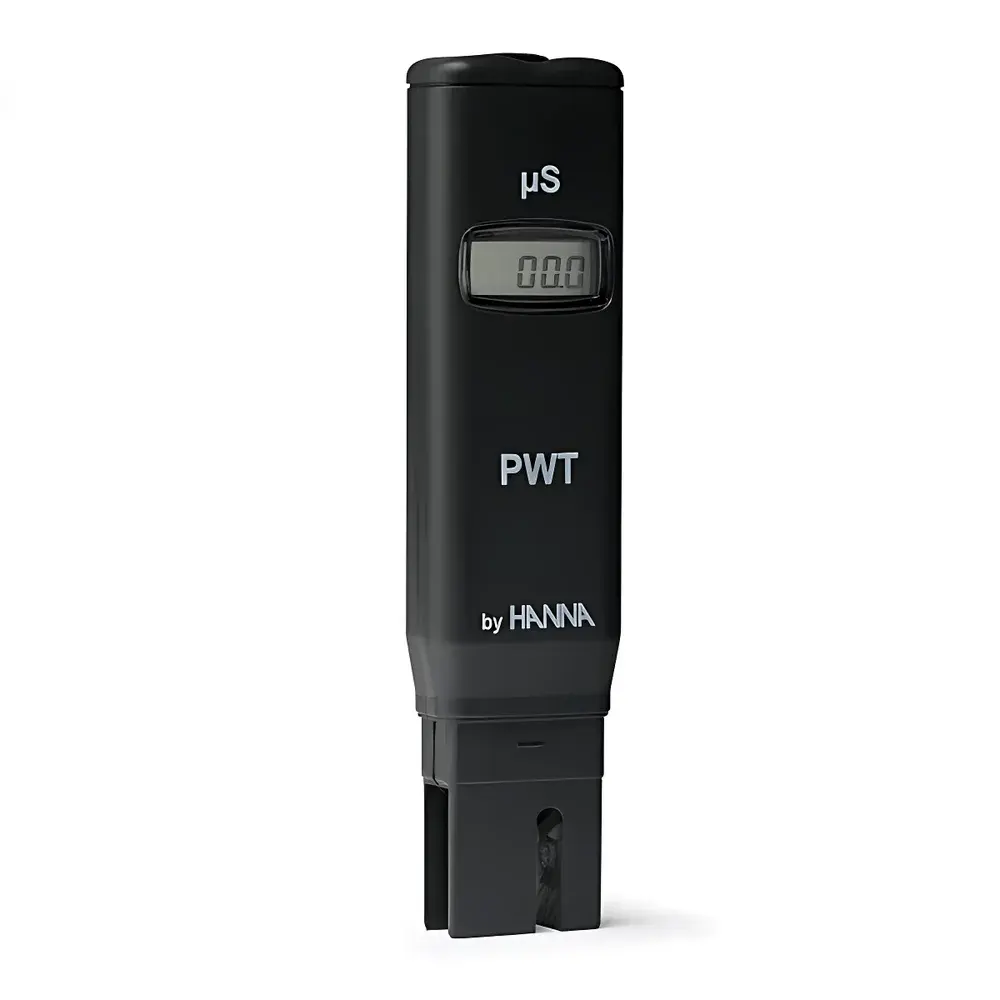
Hanna Instruments HI98308 (PWT) Portable Microprocessor-Based Conductivity (EC) Meter for Ultra-Low Range Measurements
| Brand | Hanna Instruments |
|---|---|
| Origin | Italy |
| Model | HI98308 (PWT) |
| Instrument Type | Portable |
| Parameter Type | Single-Parameter (Conductivity/EC) |
| Measurement Range | 0.0 to 99.9 µS/cm and 0.000 to 1.999 µS/cm |
| Resolution | 0.1 µS/cm (high-range), 0.001 µS/cm (low-range) |
| Accuracy | ±2% of Full Scale @ 20°C/68°F |
| Calibration | Manual single-point with built-in 84 µS/cm standard (HI7033 recommended) |
| Temperature Compensation | Automatic, 0 to 50°C, β = 2%/°C |
| Power | 4 × 1.5 V button cells (LR44) |
| Operating Environment | 0 to 50°C, ≤95% RH (non-condensing) |
| Dimensions | 175 × 41 × 23 mm |
| Weight | 95 g |
Overview
The Hanna Instruments HI98308 (PWT) is a purpose-engineered portable conductivity meter designed specifically for ultra-low-range electrical conductivity (EC) measurements in ultrapure water, pharmaceutical process water, laboratory rinse water, boiler feedwater, and low-conductivity environmental samples. Unlike general-purpose EC meters, the HI98308 employs a two-electrode graphite cell with optimized geometry and low-cell-constant design to minimize polarization effects and ensure stable, repeatable readings below 2 µS/cm—where conventional sensors often suffer from drift, noise, or insufficient sensitivity. Its measurement principle follows Ohm’s law applied to aqueous ionic solutions: conductivity (σ) is derived from the ratio of measured current to applied voltage across the electrode pair, corrected for cell geometry via the cell constant (K). The instrument operates under standardized temperature compensation (β = 2%/°C), conforming to common industrial practice for low-conductivity waters per ASTM D1125 and ISO 7888. Engineered for field and benchtop use, it delivers laboratory-grade traceability without requiring external power or complex setup.
Key Features
- Ultra-low-range dual-scale measurement: 0.000–1.999 µS/cm (resolution 0.001 µS/cm) and 0.0–99.9 µS/cm (resolution 0.1 µS/cm), enabling precise monitoring of deionized (DI), reverse osmosis (RO), and distilled water quality.
- Two-electrode graphite sensor with integrated temperature probe: chemically inert, non-polarizing, and resistant to fouling—ideal for low-ionic-strength matrices where stainless steel or platinum electrodes may introduce artifacts.
- Manual single-point calibration using built-in 84 µS/cm reference point; compatible with certified standard solution HI7033 (1413 µS/cm diluted 1:16.7) for traceable verification.
- Automatic temperature compensation (ATC) from 0 to 50°C with fixed β coefficient of 2%/°C—aligned with conductivity behavior of dilute aqueous electrolytes per IUPAC recommendations.
- Compact, rugged housing (IP67-rated when sealed): 95 g mass, 175 × 41 × 23 mm footprint—designed for glove-compatible operation in cleanrooms, wastewater sampling sites, and food production lines.
- Low-power architecture: powered by four LR44 button cells with >200 hours of continuous operation; battery replacement requires no tools and preserves calibration memory.
Sample Compatibility & Compliance
The HI98308 is validated for use with non-aggressive, low-TDS aqueous samples including purified water (PW), water for injection (WFI) pre-checks, semiconductor rinse baths, cooling tower make-up water, and hydroponic nutrient reservoirs. It is not intended for high-salinity, viscous, or suspended-solid-laden samples. While the device itself does not carry CE marking for medical devices, its measurement methodology supports compliance with pharmacopeial standards—including USP “Water for Pharmaceutical Purposes” and EP 2.2.38 “Conductivity of Water”—when used within defined procedural controls (e.g., calibrated with NIST-traceable standards, operated within specified temperature limits, and verified per internal SOPs). Data integrity is maintained through non-volatile memory retention of calibration settings and last-measured values, supporting GLP-aligned recordkeeping.
Software & Data Management
The HI98308 operates as a standalone instrument with no onboard data logging or PC connectivity. All measurement data must be recorded manually or transcribed into LIMS or ELN systems. However, its stable analog signal path and consistent calibration response support integration into automated QA workflows when paired with external digital capture tools (e.g., USB microscope cameras for screen recording or barcode-linked log sheets). Calibration history, date stamps, and operator IDs are not stored internally; therefore, users deploying this meter in regulated environments (e.g., FDA-regulated facilities) must implement external documentation protocols compliant with 21 CFR Part 11 requirements—including handwritten logs with witness signatures or validated electronic entry systems.
Applications
- Monitoring resistivity/conductivity of ultrapure water in semiconductor fabrication rinse stages.
- Verifying final rinse conductivity in pharmaceutical equipment cleaning validation (CIP) cycles.
- Field screening of groundwater recharge zones and surface water near sensitive ecological habitats.
- Quality control of bottled spring water and low-mineral beverage bases prior to carbonation or blending.
- Educational laboratories demonstrating ion mobility, dissociation constants, and water purity thresholds.
FAQ
What is the recommended calibration standard for the HI98308?
HI7033 (1413 µS/cm KCl solution) diluted 1:16.7 to yield 84 µS/cm is the manufacturer-recommended standard. Always use fresh, unexpired solution and avoid reuse after exposure to air.
Can the HI98308 measure total dissolved solids (TDS)?
No. This is a dedicated conductivity (EC) meter only. TDS estimation requires a separate algorithm and temperature-compensated resistivity input; the HI98308 does not compute or display TDS values.
Why is automatic temperature compensation set to β = 2%/°C instead of variable compensation?
For ultrapure water and low-conductivity samples (<100 µS/cm), the linear approximation with fixed β = 2%/°C provides superior reproducibility and aligns with ASTM D1125 and ISO 7888 conventions for routine QC applications.
Is the graphite electrode replaceable separately?
Yes. The sensor assembly (HI76308) is a user-replaceable module; no soldering or recalibration is required upon replacement—factory calibration remains valid.
Does the instrument meet IP rating requirements for wet environments?
The housing meets IP67 when the battery compartment seal is intact, permitting temporary submersion up to 1 m for 30 minutes—but prolonged immersion or pressure washing is not advised.



