
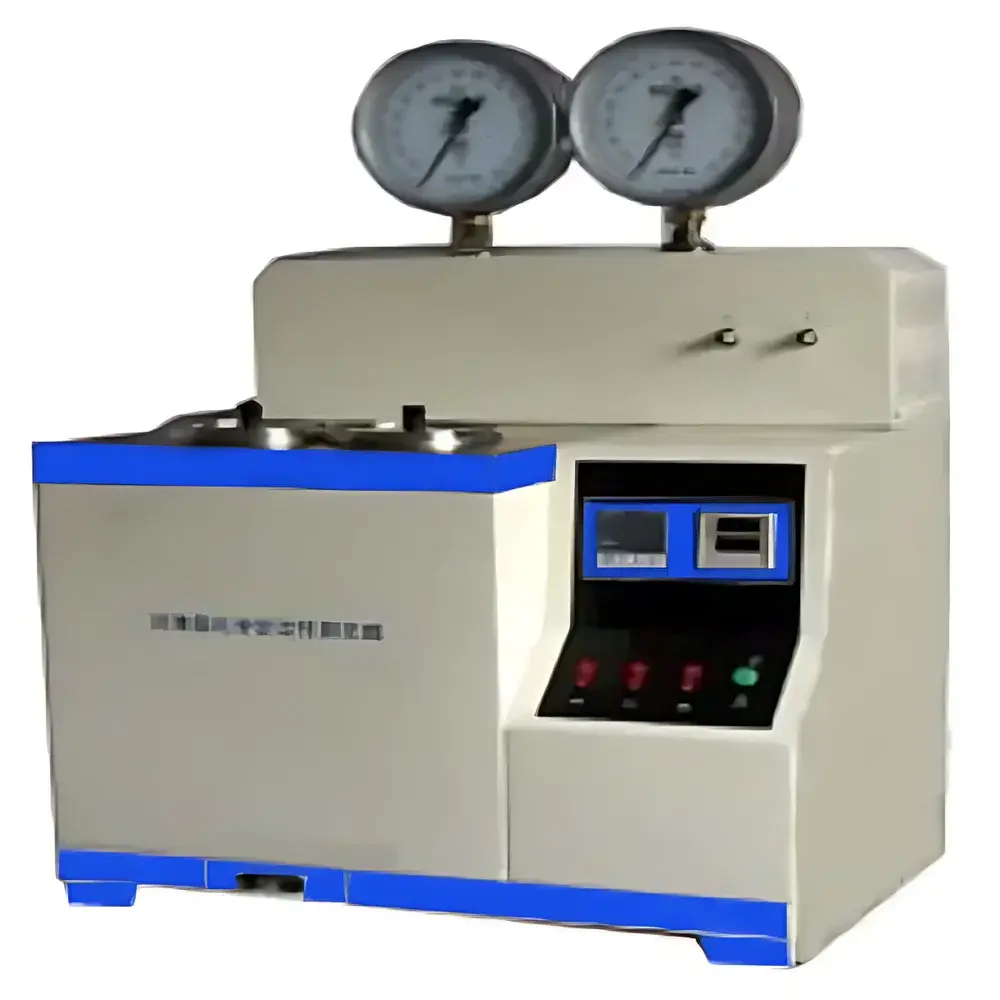
Flanland FDH-3601 Grease Chemical Stability Tester
| Brand | Flanland / csfriend |
|---|---|
| Origin | Hunan, China |
| Manufacturer Type | Authorized Distributor |
| Country of Manufacture | China |
| Model | FDH-3601 |
| Pricing | Available Upon Request |
| Working Units | Dual Stainless Steel Oxygen Bombs |
| Temperature Control | Digital PID Controller |
| Temperature Setpoint | 100 °C ± 0.1 °C |
| Timing System | Digital Timer with Audible Alarm |
| Pressure Indication | Precision Analog Pressure Gauge |
| Bath Medium | Water Bath |
| Power Supply | AC 220 V ± 10 %, 50 Hz |
Overview
The Flanland FDH-3601 Grease Chemical Stability Tester is an engineered laboratory instrument designed to evaluate the oxidative resistance of lubricating greases under accelerated, controlled high-temperature conditions. It operates on the principle of oxygen pressure decay measurement within sealed stainless steel oxygen bombs—standardized methodology aligned with ASTM D942, ISO 20875, and GB/T 3601–2022 (Chinese national standard for grease oxidation stability). In this test, a grease sample is placed inside an oxygen-filled bomb and subjected to constant temperature (typically 100 °C) for a defined duration. The rate of pressure decline over time serves as a quantitative indicator of oxidation-induced gas consumption, directly correlating to chemical degradation kinetics. The FDH-3601 provides a reproducible, benchtop platform for QC laboratories, R&D centers, and third-party testing facilities requiring compliance-grade data for formulation validation, shelf-life prediction, and raw material qualification.
Key Features
- Dual-bomb configuration enables simultaneous parallel testing—improving throughput and statistical reliability without cross-contamination or thermal interference.
- PID-based digital temperature controller ensures stable thermal regulation at 100 °C ± 0.1 °C across the water bath, minimizing drift and supporting GLP-compliant repeatability.
- Integrated digital timer with audible end-of-test alarm eliminates manual oversight errors and supports unattended operation during extended oxidation cycles.
- Stainless steel oxygen bombs conform to ASTM D942 dimensional and metallurgical specifications—ensuring mechanical integrity, corrosion resistance, and leak-tight sealing under sustained 1.0 MPa initial oxygen pressure.
- Front-panel mounted precision analog pressure gauge (0–2.0 MPa range, Class 1.0 accuracy) allows real-time visual monitoring of pressure decay trends without electronic dependency.
- Water bath design provides uniform heat transfer and thermal inertia, reducing transient overshoot and improving long-term stability compared to air-circulated ovens.
Sample Compatibility & Compliance
The FDH-3601 accommodates standard 125 mL grease samples per bomb, compatible with lithium, calcium, aluminum, polyurea, and complex-soap-based greases—as well as synthetic formulations containing ester, PAO, or PAG base stocks. Each test requires only minimal sample preparation: degassing (optional), precise mass loading, and controlled oxygen charging to 1.0 MPa at ambient temperature prior to immersion. The system meets essential requirements for ISO/IEC 17025-accredited laboratories, including documented calibration traceability for temperature and pressure instrumentation. While the instrument itself does not generate electronic audit trails, its analog-digital hybrid architecture supports manual record-keeping in accordance with FDA 21 CFR Part 11 Annex A (paper-based systems) and internal SOPs governing oxidation stability testing protocols.
Software & Data Management
The FDH-3601 is a hardware-only platform with no embedded software or data export capability—intentionally designed to align with legacy testing workflows and environments where electronic validation complexity is constrained. All operational parameters (start time, bath temperature, initial pressure, final pressure, elapsed duration) are recorded manually into standardized test logs or LIMS-integrated worksheets. Users may digitize results post-test using validated spreadsheets or laboratory information management systems compliant with GxP data integrity principles (ALCOA+). Optional accessories—including calibrated NIST-traceable thermometers and certified pressure calibrators—are available to support periodic verification per ISO/IEC 17025 Clause 6.5.
Applications
- Quality control release testing of finished grease batches against internal oxidation stability specifications.
- Comparative evaluation of antioxidant package efficacy during new grease formulation development.
- Raw material screening—assessing base oil oxidation susceptibility and thickener compatibility under thermal stress.
- Supporting regulatory submissions requiring ASTM D942 or ISO 20875 conformance data for industrial, automotive, or aerospace lubricants.
- Failure analysis investigations where premature grease hardening, acid number rise, or metal soap decomposition is suspected.
FAQ
What standards does the FDH-3601 comply with?
It is configured to meet the physical and procedural requirements of ASTM D942, ISO 20875, and GB/T 3601–2022.
Is oxygen charging performed manually or automatically?
Oxygen charging is performed externally using a certified high-pressure oxygen cylinder and regulator; the instrument includes dedicated bomb inlet valves and sealing interfaces.
Can the unit be used for testing other lubricants besides grease?
While optimized for grease, the system may accommodate certain semi-solid lubricants with sufficient structural integrity to retain shape under oxygen pressure—but it is not intended for oils or low-viscosity fluids.
What maintenance is required for long-term reliability?
Routine inspection of O-rings, cleaning of bomb threads and bath interior, annual calibration of temperature controller and pressure gauge, and verification of water level and heater element functionality.
Does the device include safety interlocks or overpressure protection?
Each oxygen bomb incorporates a certified burst disc rated for ≥1.5 MPa; the water bath enclosure has no active safety interlocks, requiring adherence to institutional oxygen-handling SOPs and ventilation protocols.





