
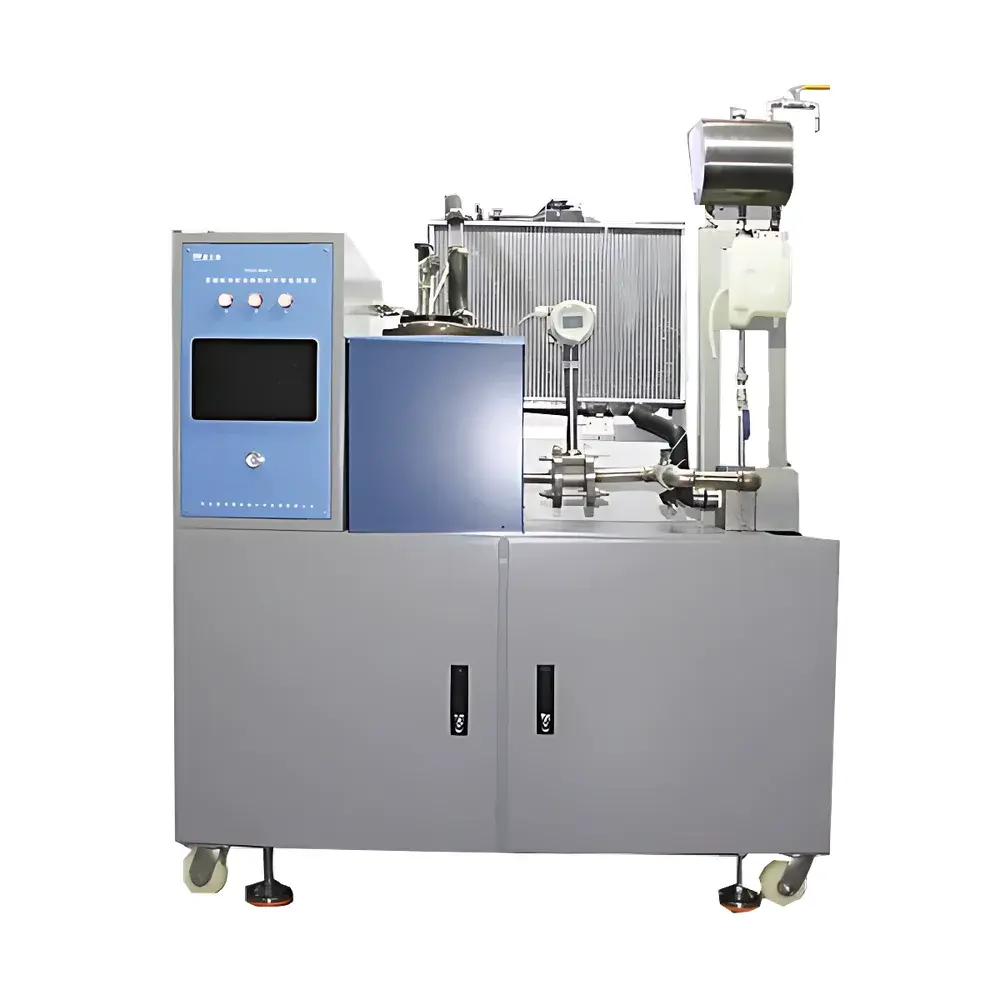
Fluoride Digital Coolant Corrosion Simulator FDY-0801
| Brand | Fluoride (csfriend) |
|---|---|
| Origin | Hunan, China |
| Model | FDY-0801 |
| Liquid Flow Rate | 1.3–1.6 L/s |
| Temperature Control | 88 °C ±3 °C |
| Test Duration | 1064 h |
| Heating Power | 2.6 kW |
| Motor Power | 2.2 kW |
| System Pressure Range | 80–103 kPa |
| Total Power Consumption | 4.8 kW |
| Supply Voltage | AC 380 V ±10%, 50 Hz |
| Net Weight | 180 kg |
Overview
The Fluoride Digital Coolant Corrosion Simulator FDY-0801 is a purpose-built benchtop test system engineered to replicate and accelerate the thermal-hydraulic aging conditions experienced by engine cooling systems under real-world operational stress. It operates on the principle of controlled recirculating flow corrosion testing—mimicking the dynamic interaction between coolant formulation, metallic heat-transfer surfaces (e.g., aluminum radiators, cast iron cylinder blocks, copper/brass heater cores), and dissolved oxygen under sustained elevated temperature and pressure. Unlike static immersion tests (e.g., ASTM D1384), the FDY-0801 introduces continuous fluid motion, precise thermal regulation, and calibrated backpressure to induce electrochemical corrosion mechanisms representative of long-term service exposure in internal combustion engines. Designed for compliance with key industry protocols—including ASTM D2570 (Standard Test Method for Simulated Service Corrosion Testing of Engine Coolants), JIS K 2234, and GB/T 25972—this instrument supports standardized evaluation of corrosion inhibitor package efficacy, material compatibility, and coolant service life prediction.
Key Features
- Explosion-proof motor assembly with dual-stage thermal cut-off protection and integrated safety relief valve on the reservoir lid—ensuring fail-safe operation during extended 1064-hour test cycles.
- Automotive-grade centrifugal pump (piston displacement: 1.6–5.0 L) coupled with an aluminum-alloy radiator core, enabling realistic flow dynamics and heat dissipation profiles consistent with OEM cooling architectures.
- Stainless steel (AISI 304) work surface and fastening hardware—resistant to coolant-induced pitting, galvanic degradation, and long-term chemical exposure; facilitates repeatable disassembly for inspection and maintenance.
- PID-controlled digital temperature regulator with high-stability Pt100 sensor feedback—maintains setpoint accuracy within ±3 °C at 88 °C across full-load thermal cycling.
- Turbine-type flow sensor with linear output signal (4–20 mA) and ±1.0% FS repeatability—provides real-time volumetric flow verification traceable to NIST-calibrated reference standards.
- Microprocessor-based digital timer with non-volatile memory—retains elapsed runtime even after power interruption, supporting GLP-compliant test documentation and audit-ready timestamping.
Sample Compatibility & Compliance
The FDY-0801 accommodates standard coolant formulations (ethylene glycol/water, propylene glycol/water, organic acid technology [OAT], hybrid OAT, and silicate-free low-phosphate types) as well as metal coupon arrays per ASTM G1—typically including ASTM B117-compatible specimens of aluminum alloy 3003, copper UNS C11000, solder (50Sn–50Pb), cast iron ASTM A48, and brass C23000. All wetted components are chemically inert to pH 7–11 coolants and compatible with common corrosion inhibitors (e.g., sodium molybdate, tolyltriazole, benzotriazole). The system meets mechanical safety requirements per IEC 61000-6-2 (EMC immunity) and electrical safety per GB 4793.1 (equivalent to IEC 61010-1), and supports validation under ISO/IEC 17025-accredited laboratory quality systems.
Software & Data Management
While the FDY-0801 operates as a standalone hardware platform, its analog sensor outputs (temperature, flow, pressure) are compatible with third-party data acquisition systems via 0–10 V or 4–20 mA interfaces. Users may integrate it into LabVIEW™, MATLAB® Data Acquisition Toolbox, or SCADA environments for automated logging, trend analysis, and alarm triggering. For regulatory traceability, manual logbooks or electronic lab notebooks (ELN) must record initial coupon mass, final mass loss, visual corrosion rating per ASTM D665/D670, and daily parameter verification. Though not natively Part 11-compliant, the instrument’s deterministic control architecture and tamper-evident mechanical timers support retrospective audit trails required under GLP and automotive OEM supplier quality manuals (e.g., AIAG CQI-9).
Applications
- Accelerated corrosion screening of new antifreeze formulations prior to field trials.
- Comparative assessment of inhibitor depletion kinetics across multiple coolant batches.
- Validation of material substitutions (e.g., aluminum vs. magnesium housings) in next-generation thermal management modules.
- Root-cause analysis of field-reported cooling system failures involving pitting, crevice corrosion, or liner cavitation erosion.
- Supporting technical dossiers for OEM coolant approval programs (e.g., GM 6277M, Ford WSS-M97B57-A2, VW TL 774).
FAQ
What coolant volume does the FDY-0801 require for a full test cycle?
The system operates with a nominal 12–15 L coolant reservoir capacity—sufficient to maintain stable thermohydraulic conditions over 1064 hours without replenishment.
Can the FDY-0801 be used for electric vehicle (EV) battery thermal fluid testing?
Yes—provided the fluid exhibits comparable thermal stability and viscosity range; however, EV-specific protocols (e.g., SAE J3060) require modified pressure and flow parameters not preconfigured in the base FDY-0801 firmware.
Is calibration certification included with shipment?
Factory calibration certificates for temperature, pressure, and flow sensors are provided; users must perform periodic verification per ISO/IEC 17025 Section 6.6 using traceable reference standards.
How is corrosion quantified post-test?
Mass loss measurement (per ASTM G1), SEM/EDS surface morphology analysis, and electrochemical impedance spectroscopy (EIS) on retrieved coupons are recommended complementary methods—not performed by the instrument itself.
Does the system support remote monitoring?
No native Ethernet/Wi-Fi interface exists; integration requires external DAQ hardware and custom scripting for secure remote access.






