
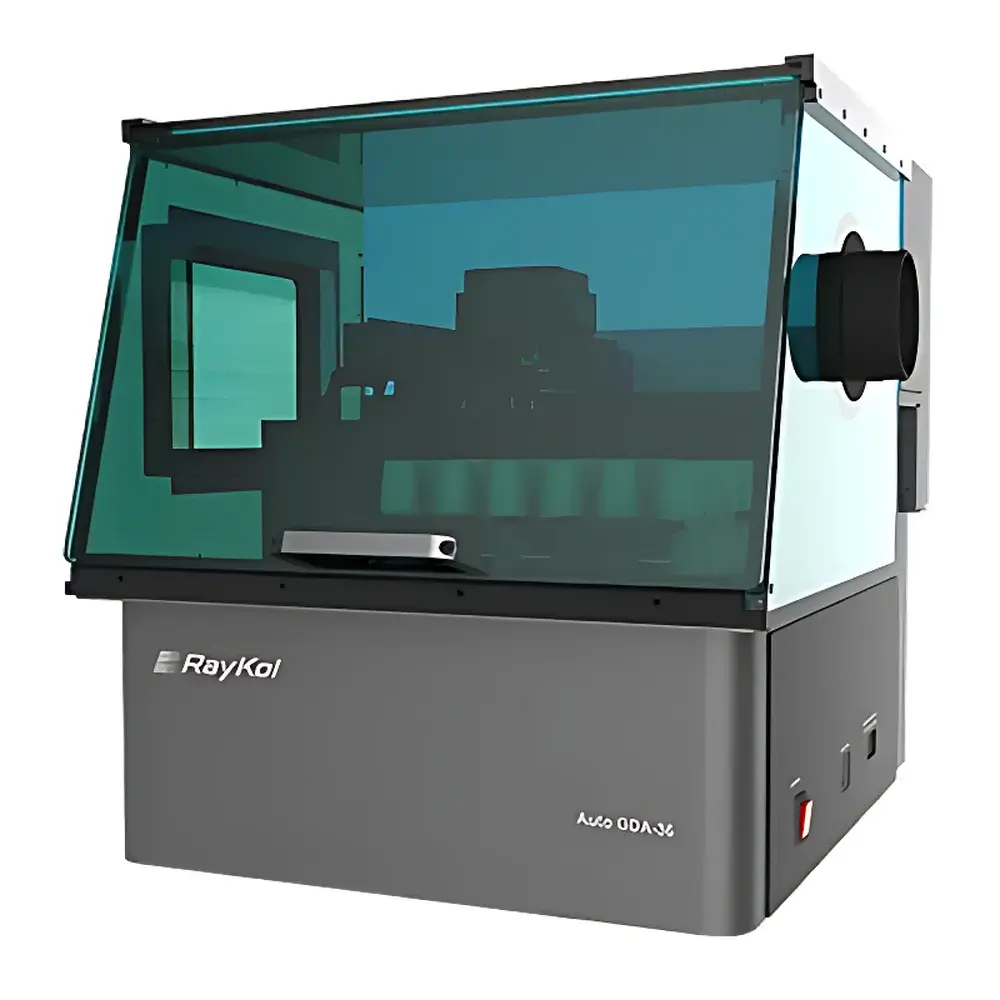
Raykol Auto GDA-36 Fully Automated Graphite Block Digestion System
| Brand | Raykol |
|---|---|
| Origin | Fujian, China |
| Manufacturer Type | Direct Manufacturer |
| Product Category | Domestic |
| Model | Auto GDA-36 |
| Instrument Type | Graphite Digestion System |
| Automation Level | Fully Automated |
| Sample Capacity | 36 positions |
| Max Heating Temperature | 230 °C |
| Temperature Control Accuracy | ±0.1 °C |
| Heating Principle | Electrically Heated Graphite Conduction |
| Reagent Channels | 12 independent channels |
Overview
The Raykol Auto GDA-36 Fully Automated Graphite Block Digestion System is an advanced wet-chemistry sample preparation platform engineered for high-throughput, reproducible, and operator-safe acid digestion of solid and semi-solid matrices. Unlike conventional hot plates or manual block digesters, the Auto GDA-36 integrates programmable graphite heating, multi-channel reagent delivery, robotic lid handling, oscillatory mixing, intelligent color-based endpoint detection, and ultrasonic volumetric finalization into a single compact architecture. It operates on the principle of controlled conductive heating via high-purity graphite blocks—ensuring uniform thermal distribution across all 36 digestion vessels—and executes standardized open-vessel acid digestion protocols (e.g., HNO₃–HCl–HF or HNO₃–H₂O₂ sequences) without human intervention after initial sample loading. Designed for laboratories facing increasing sample volumes, stringent trace-metal quantification requirements (e.g., for ICP-MS or AAS analysis), and evolving occupational safety regulations, the system delivers ISO/IEC 17025-aligned consistency while minimizing analyst exposure to corrosive fumes and thermal hazards.
Key Features
- Fully automated workflow: Unattended execution of acid addition (dual-mode: peristaltic for speed, syringe pump for precision), vortex-assisted homogenization, lid auto-placement/removal, gradient temperature ramping, reflux control, post-digestion evaporation (“ashing”), optical color recognition for reaction endpoint, and final volume adjustment using ultrasonic sensor feedback.
- 36-position parallel processing: High-density graphite block with individually calibrated temperature zones; each position maintains ±0.1 °C stability under dynamic load conditions, verified by embedded Pt100 sensors and PID feedback loops.
- 12 independent reagent channels: Chemically resistant fluid paths support sequential or simultaneous delivery of up to 12 different acids, oxidants, or internal standards—enabling method flexibility for EPA 3050B, 3060A, HJ 677, GB/T 22105 series, and GB 5009.x protocols.
- Integrated corrosion-resistant ventilation: Built-in HEPA-filtered exhaust system with acid-resistant PTFE-coated blower and ducting eliminates dependency on external fume hoods—reducing lab footprint and cross-contamination risk.
- Intuitive software interface: Web-based control via Wi-Fi-enabled tablet or PC; bilingual (English/Chinese) GUI with drag-and-drop method builder, real-time thermal/reagent status dashboard, and audit-trail-compliant logging aligned with FDA 21 CFR Part 11 principles.
- Comprehensive safety architecture: Dual-level overtemperature cutoff, ground-fault circuit interruption (GFCI), leak detection sensors, LED status lighting (non-contact operational feedback), and full-body PFA/PTFE coating on all wetted surfaces.
Sample Compatibility & Compliance
The Auto GDA-36 accommodates standard digestion vessels—including PTFE (Teflon™), quartz, and polypropylene tubes—in multiple geometries (e.g., 50 mL conical, 100 mL tall-form) to suit diverse matrix types: soils, sediments, biological tissues, foodstuffs, polymers, and electronic waste. Its validated performance meets key regulatory frameworks including EPA Methods 3050B (acid digestion of sediments and soils), 3060A (alkaline digestion for Cr(VI)), ISO 11466 (heavy metals in soils), GB/T 22105.1–3 (total Hg, As, Pb in soil by AFSS), and GB 5009.12–14, 138 (Pb, Cu, Zn, Ni in food). All digestion cycles are fully traceable with timestamped logs containing temperature profiles, reagent consumption, lid actuation events, and endpoint confirmation data—supporting GLP/GMP documentation and laboratory accreditation audits.
Software & Data Management
Control is managed through Raykol’s proprietary Digilink™ v3.2 software suite, accessible via secure HTTPS connection. The platform supports method import/export in XML format, batch scheduling with priority queuing, and automatic generation of PDF reports compliant with ISO/IEC 17025 Clause 7.8.2. Raw data—including thermal curves, reagent dispense volumes, and ultrasonic fill-level readings—are stored locally in encrypted SQLite databases with optional cloud backup. Audit trails record user logins, parameter modifications, and critical alarms with immutable timestamps—satisfying FDA 21 CFR Part 11 requirements for electronic records and signatures when configured with role-based access control and digital certificate authentication.
Applications
The Auto GDA-36 serves as a primary front-end solution for elemental analysis workflows requiring rigorous, low-blank sample dissolution prior to detection by ICP-OES, ICP-MS, GF-AAS, or HG-AFS. It is routinely deployed in environmental monitoring labs (soil, sludge, water particulates), food safety testing facilities (heavy metals in grains, dairy, infant formula), clinical and forensic toxicology (hair, tissue digests), electronics RoHS compliance screening (Pb, Cd, Cr⁶⁺, Hg, Br), and academic research involving geochemical or metallurgical samples. Its ability to replicate certified reference material (CRM) digestion protocols—such as NIST SRM 2710a or GBW07401—with sub-5% RSD across triplicate runs demonstrates analytical robustness suitable for routine QC/QA programs.
FAQ
Is the Auto GDA-36 compatible with ICP-MS sample introduction requirements?
Yes—the system achieves ultra-low procedural blanks (<0.5 pg/g for Pb, <2 pg/g for As) when operated with high-purity reagents and cleanroom-handled PTFE vessels, meeting typical ICP-MS detection limit prerequisites.
Can custom digestion methods be programmed and validated?
Absolutely. Users define heating ramps, hold times, reagent sequences, mixing intervals, and endpoint criteria via the graphical method editor; validation templates for recovery studies and spike experiments are preloaded.
What maintenance is required for long-term reliability?
Scheduled quarterly calibration of temperature sensors and reagent pumps is recommended; graphite block surface inspection and cleaning with dilute HF are advised every 200 cycles to maintain thermal uniformity.
Does the system support remote monitoring during overnight runs?
Yes—real-time status updates, alarm notifications via email/SMS, and live thermal curve streaming are enabled through optional Raykol Cloud Connect subscription.
Are consumables such as digestion tubes and reagent lines available from Raykol?
Raykol supplies OEM-certified PTFE, quartz, and PP digestion tubes, fluoropolymer reagent tubing kits, HEPA filter cartridges, and graphite block refurbishment services directly through authorized distributors.



