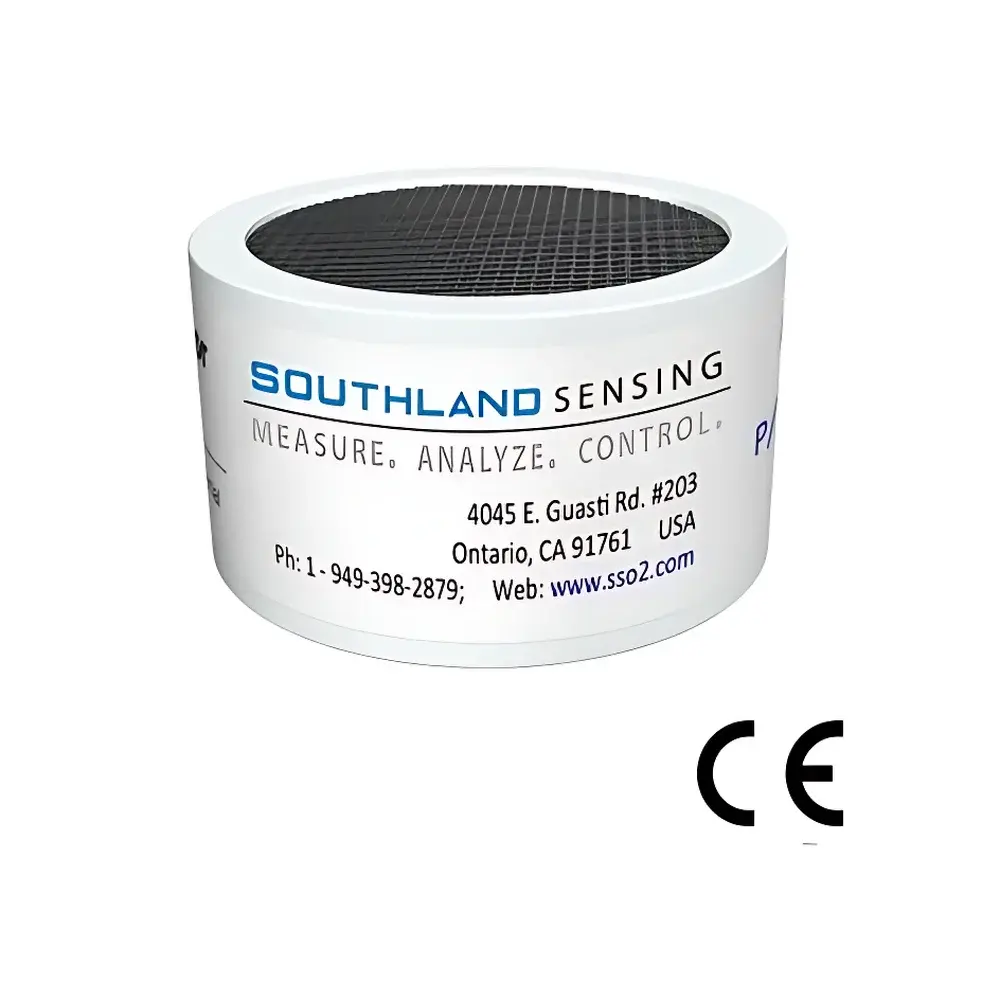
Southland Sensing PO2-24 Percent Oxygen Sensor
| Origin | USA |
|---|---|
| Manufacturer Type | Authorized Distributor |
| Origin Category | Imported |
| Model | PO2-24 |
| Price Range | USD 1–9,999 |
Overview
The Southland Sensing PO2-24 is a high-stability, electrochemical fuel cell-based percent-level oxygen sensor engineered for continuous, real-time monitoring of O₂ concentration in industrial process streams. Unlike paramagnetic or zirconia-based analyzers, the PO2-24 employs a proprietary galvanic fuel cell transducer that generates a linear current output (285–590 µA) proportional to oxygen partial pressure across its full measurement range—from trace-level (0.01 ppm) up to 100% O₂—without requiring external power for sensing operation. Its self-powered architecture eliminates drift associated with heated-element sensors and ensures intrinsic safety in explosive atmospheres. Designed for integration into OEM gas analyzers and standalone process controllers, the PO2-24 delivers robust performance in inert gas purification systems, semiconductor purge loops, hydrogen generation units, and high-purity nitrogen supply lines where long-term calibration stability and low-maintenance operation are critical operational requirements.
Key Features
- Fuel cell oxygen sensing technology with zero-power consumption at the sensing element
- Five selectable full-scale ranges: 1%, 5%, 10%, 25%, and 100% O₂—configured via external circuitry or host controller
- Fast T90 response time of ≤13 seconds across all ranges, enabling dynamic process feedback control
- Full-scale accuracy of ±1% F.S. and repeatability of ±0.5% F.S., validated per ASTM D6299 and ISO 8573-5 protocols
- Temperature coefficient of 2.54%/°C—compensated via integrated thermistor or host-side algorithm
- Operating temperature range: 0–50°C; storage temperature: 0–45°C; humidity tolerance: 0–100% RH (non-condensing)
- Optimized flow sensitivity: recommended sample flow rate of 0.5–5 SCFH for consistent diffusion-limited response
- Two programmable alarm relays (SPDT) supporting fail-safe shutdown or operator notification per IEC 61508 SIL 2 guidelines
- PCB-mountable design with center-foil cathode (negative) and outer-foil anode (positive), compatible with standard 0.1″ pitch headers
Sample Compatibility & Compliance
The PO2-24 is chemically compatible with non-corrosive, non-reactive process gases including N₂, Ar, He, H₂, CH₄, and other hydrocarbons—provided no halogenated compounds, sulfur species, or acidic vapors (e.g., Cl₂, SO₂, NOₓ) are present above detection thresholds. It is not rated for use in oxidizing acid environments or high-velocity steam lines. The sensor complies with RoHS Directive 2011/65/EU and meets CE marking requirements for electromagnetic compatibility (EN 61326-1) and low-voltage safety (EN 61010-1). For regulated industries, its analog current output supports validation under FDA 21 CFR Part 11 when integrated into compliant data acquisition systems with audit-trail functionality. Calibration traceability aligns with NIST-traceable standards for oxygen gas mixtures certified to ISO/IEC 17025.
Software & Data Management
As a hardware-level transducer, the PO2-24 does not include embedded firmware or onboard software. Its 4–20 mA or 0–5 V analog output (via optional signal conditioning module) interfaces seamlessly with PLCs, DCS platforms (e.g., Emerson DeltaV, Siemens PCS7), and SCADA systems. When paired with Southland’s optional PO2-24 Evaluation Kit, users gain access to Windows-based configuration utilities supporting zero/span calibration logging, relay setpoint assignment, and lifetime usage tracking. All calibration events—including date, operator ID, reference gas lot number, and deviation metrics—are exportable as CSV for GLP/GMP documentation. Firmware updates for companion electronics adhere to IEC 62443-3-3 security principles, ensuring integrity during remote maintenance.
Applications
- Inert gas blanketing: real-time O₂ monitoring in N₂-purged reactors, gloveboxes, and packaging lines
- Semiconductor manufacturing: verification of <1 ppm O₂ in ultra-high-purity (UHP) nitrogen used for CVD/PVD chamber purging
- Hydrogen production: safety-critical detection of air ingress in PEM electrolyzer off-gas streams
- Natural gas transmission: oxygen content verification prior to pipeline injection per API RP 1173
- Aerospace propulsion testing: ambient O₂ profiling in test cell exhaust ducts and cryogenic tank headspaces
- Heat treatment furnaces: dissolved oxygen monitoring in controlled-atmosphere annealing zones (e.g., bright annealing of stainless steel)
- Pharmaceutical lyophilization: residual O₂ quantification in vial headspace post-nitrogen backfill
FAQ
What is the expected service life of the PO2-24 sensor under continuous operation?
Typical functional lifespan is 20–25 months when operated within specified temperature, humidity, and flow parameters. Storage life is six months from date of manufacture when kept sealed in original packaging at room temperature.
Can the PO2-24 be used in hydrogen-rich environments?
Yes—the fuel cell design is inherently compatible with H₂, provided the H₂ purity exceeds 99.999% and no catalytic poisons (e.g., CO, siloxanes) are present above 0.1 ppm.
Is field calibration possible without specialized equipment?
Zero calibration can be performed using certified nitrogen (<1 ppm O₂); span calibration requires NIST-traceable O₂-in-N₂ standard gases at defined concentrations (e.g., 1.00% ±0.02%).
Does the sensor require periodic electrolyte replenishment?
No—the PO2-24 utilizes a sealed, gel-electrolyte fuel cell architecture with no user-serviceable consumables.
How is temperature compensation implemented?
Compensation is achieved either through internal thermistor feedback (when used with Southland’s signal conditioner) or via host-system lookup tables based on the published 2.54%/°C coefficient.
Related Products