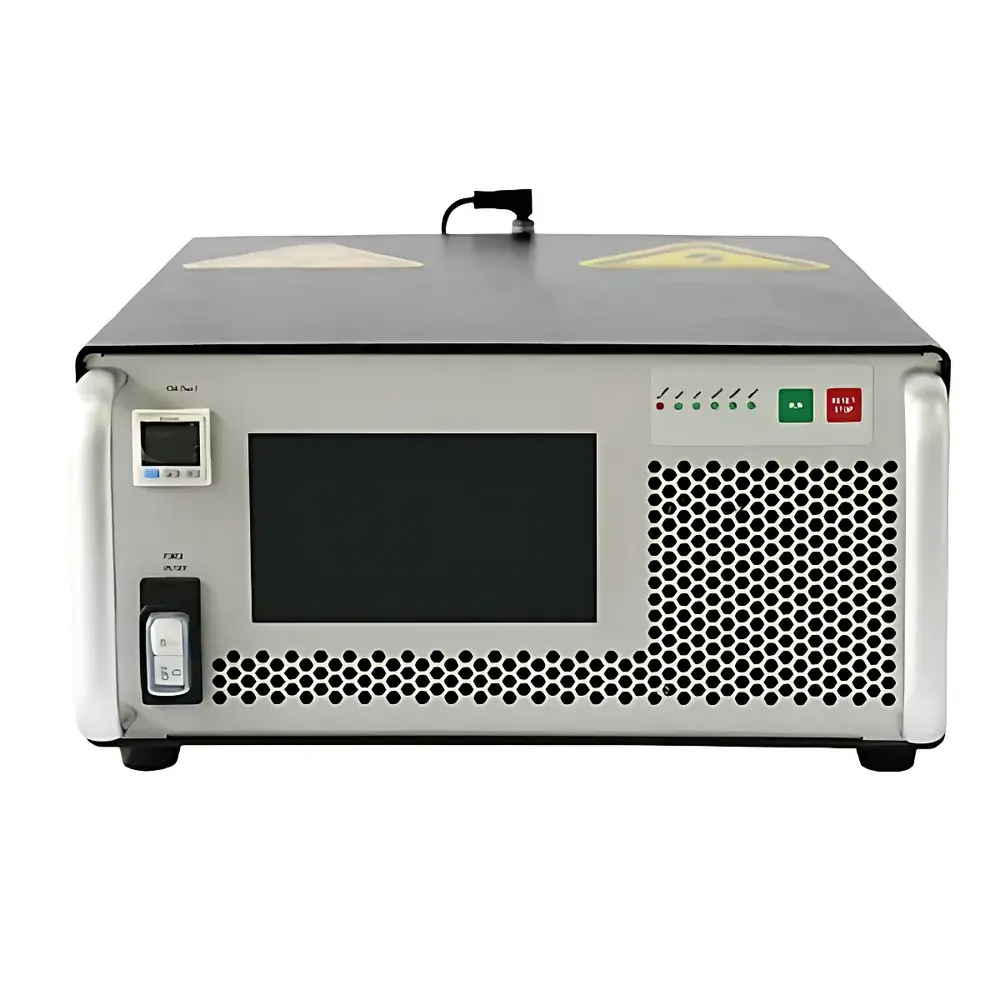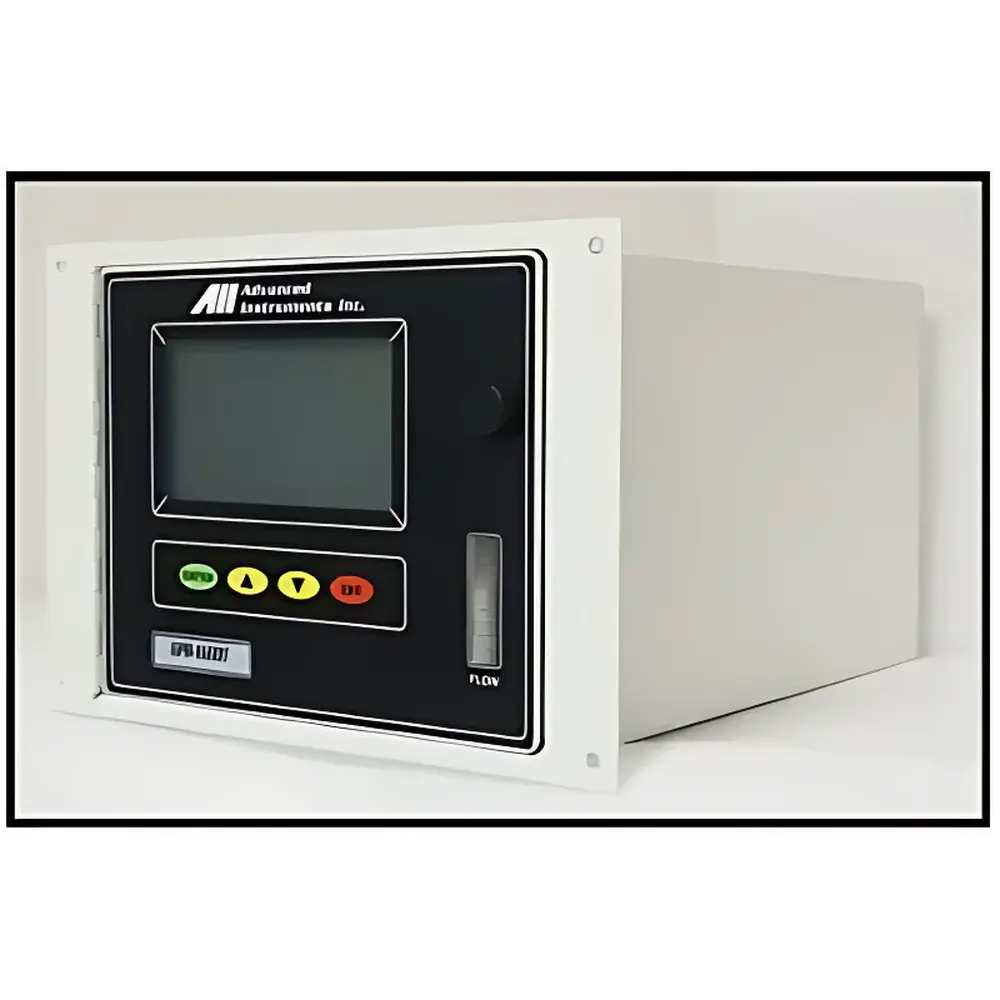
AII GPR-1600 Online Trace Oxygen Analyzer
| Brand | AII |
|---|---|
| Origin | USA |
| Model | GPR-1600 |
| Measurement Principle | Electrochemical Fuel Cell |
| Range | 0–10 / 100 / 1000 ppm, 0–1% / 25% FS |
| Accuracy | <1% FS |
| Linearity | >0.995 |
| Sensitivity | <0.5% FS |
| Response Time (T90) | 10 s |
| Recovery Time to 10 ppm | 60 s |
| Operating Temperature | 5–45 °C |
| Operating Pressure | Inlet 5–30 psig (max 100 psig), Outlet: Ambient |
| Flow Rate | 1–3 SCFH (recommended 2 SCFH) |
| Display Resolution | 0.001 ppm |
| Output Signals | 0–1 V DC and isolated 4–20 mA |
| Alarm Outputs | Two user-adjustable capacitive relay alarms |
| Calibration | Recommended with 80% FS O₂ standard gas |
| Compensation | Automatic ambient temperature and barometric pressure compensation |
| Optional Accessories | XLT-12-333 sensor (for CO₂ >0.5%), 19" rack-mount glass enclosure, NEMA 4/4X wall-mount housing, heated sampling system, flow control valve, sample/bypass selector valve, rotameter |
| Certifications | CE, ISO 9001 |
Overview
The AII GPR-1600 Online Trace Oxygen Analyzer is an industrial-grade electrochemical trace oxygen measurement system engineered for continuous, high-stability monitoring in inert, reducing, and mildly acidic process gas streams. Utilizing a solid polymer electrolyte fuel cell sensor, the GPR-1600 delivers inherently stable zero and linear response across five factory-configurable ranges—0–10 ppm, 0–100 ppm, 0–1000 ppm, 0–1% FS, and 0–25% FS—without requiring frequent recalibration or consumable components. Unlike paramagnetic or zirconia-based analyzers, the fuel cell principle provides exceptional selectivity for molecular oxygen in complex matrices including helium, hydrogen, nitrogen, argon, and CO₂-containing mixtures, with no cross-sensitivity to hydrocarbons, moisture (within specified dew point limits), or non-reactive gases. The analyzer operates on a constant-flow sampling principle (1–3 SCFH), ensuring representative gas contact with the sensing element while minimizing residence time effects and adsorption artifacts common in low-flow micro-analytical systems.
Key Features
- Factory-integrated GPR-12-333 electrochemical sensor with 24-month typical service life and zero routine maintenance requirements
- Automatic zero and span calibration routines with programmable scheduling via front-panel interface
- Five selectable full-scale ranges, switchable manually or automatically based on measured concentration thresholds
- Real-time ambient temperature and barometric pressure compensation algorithms embedded in firmware to maintain accuracy under variable site conditions
- Robust aluminum front-panel enclosure rated for panel-mount installation in general-purpose industrial environments
- Dual independent capacitive relay outputs configurable for high/low alarm thresholds, sensor health status, or system fault conditions
- Isolated 4–20 mA analog output and 0–1 V DC voltage output, both referenced to earth ground and compliant with IEC 61000-4 immunity standards
- RS-232 serial interface supporting Modbus RTU protocol for integration into DCS, SCADA, or centralized data historians
- Front-panel membrane keypad with intuitive menu navigation for range selection, calibration execution, alarm configuration, and diagnostic review
Sample Compatibility & Compliance
The GPR-1600 is validated for use with inert carrier gases (N₂, Ar, He), reducing atmospheres (H₂), and mixed process streams containing up to 25% CO₂—provided the optional XLT-12-333 sensor variant is installed. It meets CE marking requirements per Directive 2014/30/EU (EMC) and 2014/35/EU (LVD), and conforms to ISO 9001:2015 quality management system standards during manufacturing and final test. While not intrinsically safe or explosion-proof certified, its design complies with IEC 61010-1 for electrical safety in measurement and control equipment used in industrial locations. The analyzer supports compliance workflows for regulated industries: audit-trail-capable calibration logs (when paired with external data acquisition software), configurable alarm event timestamps, and deterministic response timing suitable for validation against ASTM D6349 (Standard Practice for Determining Trace Oxygen in High-Purity Gases) and ISO 8573-3 (Compressed Air – Part 3: Test Methods for Oil Content).
Software & Data Management
Though the GPR-1600 operates as a stand-alone instrument with local display and control, its RS-232 interface enables seamless integration with third-party supervisory software platforms. When connected to a PC running AII’s optional GPR Configuration Utility (v3.x), users can configure alarm setpoints, adjust damping filters, export real-time readings at user-defined intervals (e.g., 1 Hz or 10 s), and generate timestamped CSV log files compatible with Excel, LabVIEW, or PI System ingestion. All calibration events—including date/time stamp, span gas concentration entered, and pre-/post-calibration deviation—are retained in non-volatile memory for GLP/GMP-aligned record retention. No proprietary drivers are required; standard Windows COM port enumeration applies. Firmware updates are performed via ASCII command sequence over serial link, eliminating dependency on cloud services or vendor-specific gateways.
Applications
- High-purity nitrogen and argon blanketing systems in semiconductor fab tool cabinets and annealing furnaces
- Hydrogen purity verification in PEM electrolyzer and fuel cell test stands
- Leak detection and integrity verification of gloveboxes and inert-atmosphere reactors
- Process gas monitoring in PET resin drying, pharmaceutical fluidized beds, and lyophilizer purge cycles
- Quality assurance of laser cutting assist gases and electron beam welding shielding environments
- Continuous verification of oxygen scavenging efficiency in modified atmosphere packaging (MAP) lines
FAQ
What is the recommended calibration frequency?
AII recommends initial calibration upon installation, followed by quarterly verification using certified 80% FS O₂ standard gas. In critical applications, daily zero checks with high-purity inert gas (e.g., 99.999% N₂) are advised.
Can the GPR-1600 measure oxygen in 100% CO₂ streams?
No—the standard GPR-12-333 sensor exhibits accelerated degradation above 0.5% CO₂. For such applications, the XLT-12-333 low-CO₂ variant must be specified at time of order.
Is the 4–20 mA output HART-enabled?
No—the analog output is passive and non-smart. HART communication is not supported; digital communication is limited to RS-232 Modbus RTU.
Does the analyzer support automatic pressure compensation below sea level?
Yes—barometric pressure compensation operates from 60 kPa to 110 kPa absolute, covering altitudes from −500 m to +1500 m above mean sea level.
What is the minimum detectable oxygen concentration with stated resolution?
The display resolution is 0.001 ppm, but the practical lower limit of quantitation (LOQ) is governed by sensor noise floor and is typically 0.1 ppm at 25 °C under stable flow and pressure conditions.