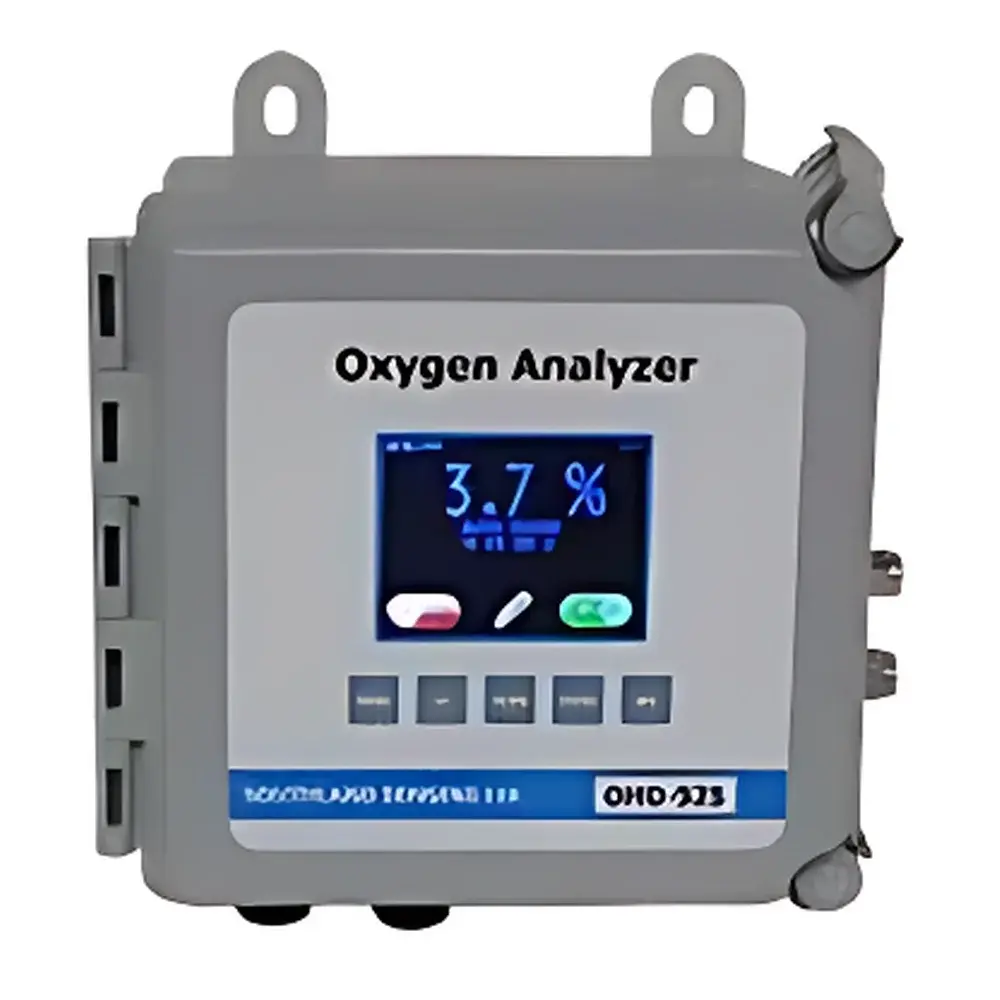
Southland Sensing OMD-425 Fuel Cell-Based Oxygen Analyzer
| Origin | USA |
|---|---|
| Manufacturer Type | Authorized Distributor |
| Origin Category | Imported |
| Model | OMD-425 |
| Price Range | USD 1,400 – 4,200 (FOB) |
| Measurement Ranges | 0–1%, 0–5%, 0–10%, 0–25%, 0–100% O₂ (selectable) |
| Accuracy | < ±1% FS |
| Sensor Type | Miniaturized Electrochemical Fuel Cell |
| Operating Temperature | –10 to +50 °C |
| Temperature Compensation | Built-in |
| Enclosure Dimensions | 241 × 165 × 96 mm |
| Power Supply | 12–24 VDC, 25 mA |
| Output Signals | 4–20 mA, 0–10 VDC, MODBUS RS485 (ASCII, bi-directional) |
| Sample Flow Rate | 230–2500 mL/min |
| Certified | CE |
| Warranty | 12 months |
| Compatible Gases | N₂, Ar, He, H₂, hydrocarbon streams, and other inert or reducing atmospheres |
| Acid-Gas Option | Available with corrosion-resistant sensor for CO₂, H₂S, or SO₂-containing streams |
Overview
The Southland Sensing OMD-425 is a compact, field-deployable electrochemical oxygen analyzer engineered for continuous, real-time monitoring of oxygen concentration in industrial process and inerted environments. It employs a miniature, solid-electrolyte fuel cell sensor—based on galvanic electrochemical principles—to generate a current proportional to the partial pressure of molecular oxygen diffusing across a selective membrane. Unlike paramagnetic or zirconia-based analyzers, the OMD-425 delivers stable, low-drift performance without requiring reference gas, purge air, or high-temperature operation. Its design prioritizes long-term baseline stability, minimal calibration drift (<0.5% FS/month), and immunity to background gas composition shifts in non-oxidizing matrices—making it especially suited for glovebox integrity verification, nitrogen/hydrogen purge validation, and controlled-atmosphere furnace monitoring.
Key Features
- Fuel cell sensor architecture ensures zero power consumption at the sensing element—no heater, no filament, no warm-up delay—enabling true plug-and-play deployment.
- Five factory-configurable measurement ranges (0–1%, 0–5%, 0–10%, 0–25%, 0–100% O₂) selected via DIP switch or software configuration; range switching does not require hardware modification.
- Integrated temperature compensation circuitry maintains accuracy across –10 to +50 °C ambient operating conditions without external thermostating.
- Robust aluminum enclosure (IP65-rated) with standardized ¼” NPT sample inlet/outlet ports; compatible with H1 flow-through cells and KF-40 flanged interfaces for vacuum-grade integration.
- Dual analog outputs (4–20 mA and 0–10 VDC) plus MODBUS RTU over RS485 enable seamless integration into PLCs, DCS systems, and SCADA networks with full bidirectional command support.
- Low sample flow requirement (230–2500 mL/min) minimizes system pressure drop and enables use with recirculating loop configurations common in glovebox and inert gas manifold applications.
Sample Compatibility & Compliance
The OMD-425 is validated for use in inert carrier gases—including nitrogen, argon, helium—and reducing atmospheres such as hydrogen and hydrocarbon streams. When configured with the optional acid-gas-resistant sensor variant, it maintains operational integrity in the presence of up to 5,000 ppm CO₂, 100 ppm H₂S, or 50 ppm SO₂—critical for natural gas line monitoring and syngas purification control. All units are CE-marked per Directive 2014/30/EU (EMC) and 2014/35/EU (LVD). While not intrinsically safe certified, the analyzer meets Class I, Division 2 (CID2) installation guidelines when used with appropriate barrier systems. Data logging and audit trail functionality comply with GLP/GMP-aligned documentation practices when integrated with Southland’s optional data acquisition firmware.
Software & Data Management
The OMD-425 supports ASCII protocol over MODBUS RS485, allowing remote readout of O₂ concentration, sensor status (e.g., voltage output, temperature reading, fault flags), and calibration history. Third-party SCADA platforms can poll device registers for real-time values and diagnostics without proprietary drivers. Optional Southland Sensing Configuration Utility (Windows-based) provides local setup of damping time, zero/span calibration points, alarm thresholds, and output scaling. All calibration events—including date, operator ID (via manual entry), and pre/post-calibration values—are timestamped and stored in non-volatile memory, supporting FDA 21 CFR Part 11–compliant record retention when paired with validated electronic log systems.
Applications
- Glovebox and dry room atmosphere monitoring for semiconductor fabrication, battery R&D, and air-sensitive chemistry.
- Verification of nitrogen or hydrogen purge efficiency in chemical reactors, distillation columns, and storage vessels.
- Oxygen leak detection in cryogenic LNG transfer lines and high-purity gas distribution manifolds.
- Process control of thermal treatment furnaces (e.g., sintering, annealing) where oxygen partial pressure directly impacts oxide layer formation.
- Quality assurance in food packaging headspace analysis and pharmaceutical inerting validation.
FAQ
Does the OMD-425 require periodic calibration? How often is recalibration recommended?
Yes—calibration is required before initial use and after sensor replacement. For critical applications, quarterly zero/span verification using certified span gas (e.g., 1% O₂ in N₂) is recommended; annual full calibration is advised under ISO/IEC 17025 traceability protocols.
Can the OMD-425 measure oxygen in humid or condensing sample streams?
No—condensate will damage the fuel cell sensor. A dedicated sample conditioning system (e.g., Nafion dryer or chilled mirror dew point controller) must be installed upstream if relative humidity exceeds 85% RH at sampling temperature.
Is the sensor affected by cross-sensitivity to carbon monoxide or hydrogen?
The standard fuel cell exhibits negligible response to CO or H₂ below 1,000 ppm. In high-H₂ environments (>10% vol), minor signal suppression may occur; this is quantified in the technical datasheet and compensatable via application-specific calibration.
What is the typical service life of the OMD-425 sensor under continuous operation?
Rated lifespan is 24 months in clean, dry, non-acidic gas streams at ambient temperature; 12–18 months in applications with intermittent exposure to trace contaminants or elevated temperatures (>40 °C).
Does Southland Sensing provide NIST-traceable calibration certificates?
Yes—upon request, factory calibration reports with NIST-traceable gas standards (certified by A2LA-accredited labs) are available at additional cost and included with IQ/OQ documentation packages.