
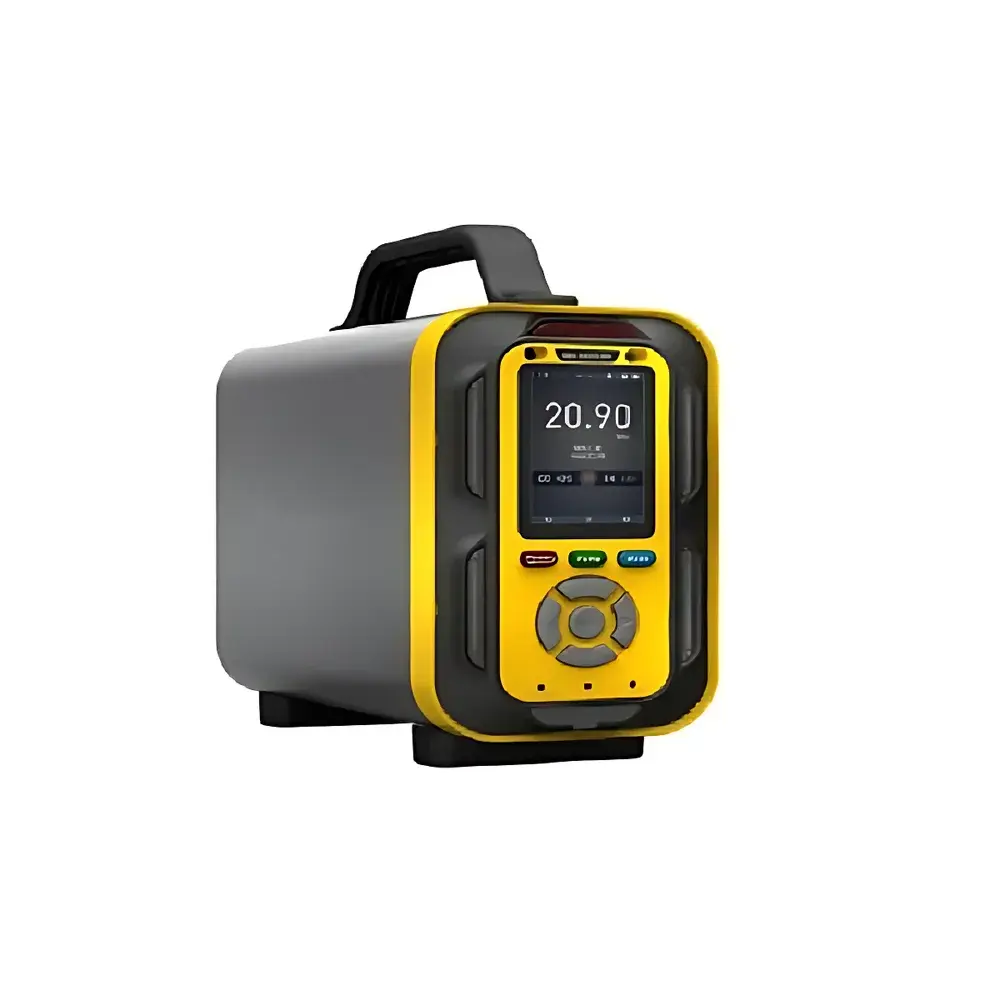
GAS600 Portable Biogas Analyzer
| Origin | Beijing |
|---|---|
| Manufacturer Type | Distributor |
| Origin Category | Domestic |
| Model | GAS600 |
| Price Range | USD 2,800–7,000 (FOB) |
| Measurement Principle | Non-Dispersive Infrared (NDIR) Absorption & Electrochemical Sensing |
| Form Factor | Portable |
| Response Time | ≤13 s (T90) |
| Repeatability | ±1.5% of reading for CH₄/CO₂ |
| Gas Components Measured | CH₄, CO₂, H₂S, O₂, CO, H₂ |
| CH₄ Range | 0–100% vol |
| CO₂ | 0–50% vol |
| H₂S | 0–9999 ppm |
| O₂ | 0–25% vol (all ranges configurable) |
| Linearity Error | CH₄/CO₂: ±2% F.S. |
| O₂/H₂S/CO/H₂ | ±3% F.S. |
| Power Supply | Removable 18650 Li-ion battery (≥8 h continuous operation), external 5 V / 2 A USB-C charger |
| Display | Color LCD (320 × 240 pixels) |
| Data Storage | Internal flash memory (≥10,000 records), timestamped |
| Communication | USB-C, Bluetooth 5.0, optional RS-485 |
| Operating Temperature | −10 °C to +50 °C |
| IP Rating | IP54 |
| Compliance | CE, RoHS, EN 61000-6-3/-6-4, IEC 61000-4-2/4/6 |
Overview
The GAS600 Portable Biogas Analyzer is an engineered field-deployable instrument designed for real-time, multi-component gas concentration measurement in biogas streams from anaerobic digesters, landfill wells, and agricultural waste treatment facilities. It employs dual-sensing architecture: non-dispersive infrared (NDIR) detection for CH4 and CO2, and high-selectivity electrochemical cells for O2, H2S, CO, and H2. This hybrid approach ensures minimal cross-sensitivity between analytes—critical for accurate biogas energy content assessment (e.g., LHV calculation) and corrosion risk evaluation (H2S monitoring). Unlike wet-chemistry or GC-based methods, the GAS600 requires no carrier gases, consumables, or routine calibration gases under stable ambient conditions, supporting unattended operation during routine site audits or commissioning verification.
Key Features
- Modular Sensor Architecture: Field-replaceable sensor cartridges with individual thermal and zero-point compensation algorithms ensure long-term baseline stability and reduce downtime during maintenance.
- Dual-Channel Signal Processing: Each NDIR channel incorporates reference and measurement detectors operating at matched wavelengths, delivering robust immunity to optical fouling and ambient temperature drift (±0.1% F.S./°C).
- Intelligent Power Management: Soft-start circuitry prevents inrush current damage; battery state-of-charge estimation enables predictive low-power alerts and graceful shutdown before critical voltage thresholds are breached.
- Real-Time Diagnostics: Continuous self-check routines monitor sensor impedance, baseline offset, and heater voltage—flagging performance degradation prior to measurement deviation exceeding ISO 14644-1 Class 5 tolerance limits.
- Configurable Range Selection: User-selectable upper limits for each gas (e.g., CH4: 0–60% or 0–100%; H2S: 0–200 ppm or 0–9999 ppm) optimize signal-to-noise ratio across diverse feedstock profiles—from food waste digesters (high CH4) to sewage sludge (elevated H2S).
Sample Compatibility & Compliance
The GAS600 interfaces directly with standard 6 mm OD PTFE sampling lines and accommodates inlet pressures from 80–120 kPa (absolute) without external regulators. Condensate separation is achieved via integrated hydrophobic membrane filters (0.2 µm pore size), compliant with EN 15267-3 requirements for particulate removal in biogas applications. All sensor modules meet IEC 60079-29-1:2016 for flammability safety in potentially explosive atmospheres (Zone 1/22 suitability when used with optional intrinsically safe barrier). Data integrity adheres to ALCOA+ principles: each stored record includes UTC timestamp, sensor serial numbers, firmware revision, and operator ID (if configured via Bluetooth pairing), satisfying GLP audit trails per FDA 21 CFR Part 11 Annex 11 expectations.
Software & Data Management
Built-in firmware supports automatic logging at user-defined intervals (1 s to 60 min), with cyclic overwrite protection for critical events (e.g., H2S > 500 ppm). Export formats include CSV (UTF-8 encoded) and PDF reports with embedded calibration certificates. The companion PC software (GASLink v3.2) enables spectral overlay analysis for NDIR channel validation, trend charting with statistical summaries (min/max/avg/std dev), and batch export to SCADA-compatible protocols (Modbus RTU over RS-485 or MQTT over TLS 1.2). All firmware updates are cryptographically signed and verified during installation to prevent unauthorized modification.
Applications
- Performance monitoring of anaerobic digestion systems—tracking CH4/CO2 ratio shifts indicative of process imbalance or acidosis
- H2S quantification for evaluating upstream desulfurization efficiency and predicting downstream equipment corrosion rates
- O2 ingress detection in sealed digesters to assess structural integrity and microbial community health
- Biogas upgrading plant feedstock qualification prior to membrane or PSA unit entry
- Regulatory reporting compliance for EPA Subpart XX and EU Directive 2009/28/EC renewable energy certificate generation
- Academic research on co-digestion substrate optimization using time-series gas composition datasets
FAQ
What is the recommended calibration frequency for field use?
For routine monitoring under stable environmental conditions, NDIR sensors require span calibration every 6 months; electrochemical cells should be zero-checked weekly and span-calibrated quarterly using certified gas standards traceable to NIST SRM 2629.
Can the GAS600 operate while charging?
Yes—the device supports hot-swap operation: internal battery continues powering sensors during external 5 V input, ensuring uninterrupted measurement during extended site surveys.
Is flow rate measurement integrated?
No—flow velocity must be acquired externally using a compatible handheld thermal mass flow meter (e.g., TSi VelociCalc®); GAS600 accepts analog 4–20 mA input for synchronized volumetric flow calculation when connected via optional analog interface module.
How is cross-interference between H2S and SO2 mitigated?
The H2S electrochemical cell incorporates a selective catalytic filter layer that oxidizes SO2 to sulfate prior to electrode contact, reducing SO2 interference to <0.5% of full scale per 100 ppm SO2 exposure.
Does the instrument support remote firmware updates over Bluetooth?
Firmware updates must be initiated from a trusted host PC via USB-C; Bluetooth is restricted to data streaming and configuration parameter transfer to prevent unauthorized code execution in regulated environments.







